
Views: 0 Author: Site Editor Publish Time: 2026-10-18 Origin: Site


Are clogged drip emitters ruining your crop yields and driving up your labor costs? When drawing water from deep boreholes, shallow wells, or turbulent rivers, it rarely comes up clean. Untreated agricultural water carries a hidden threat. Suspended sand, grit, and heavy sediment act as abrasive enemies to modern precision agriculture.
Fortunately, a highly effective primary defense exists. Centrifugal water filters solve this massive headache. They physically extract heavy sand before it ever reaches delicate downstream equipment. In this guide, we break down the exact physics of these systems. We will also provide actionable guidelines on sizing and selecting the right unit to protect your farm infrastructure.
To truly understand the necessity of primary filtration, look at the field damage caused by untreated water. Sand is relentless. Once tiny, hard particles enter an irrigation network, they trigger a catastrophic chain reaction of mechanical wear and flow restriction.
Sand is primarily composed of silica. This naturally occurring mineral boasts a hardness level significantly higher than carbon steel, brass, or cast iron. When sand-laden water blasts through a system at high velocities, it acts exactly like liquid sandpaper. This continuous scouring effect degrades pump impellers. It widens internal clearances and drastically drops overall efficiency. Over time, the abrasive action destroys mechanical seals and deeply scores expensive control valves. Operators then face premature equipment failure. Pulling a pump mid-season is a nightmare scenario that causes critical downtime right when crops need water most.
Micro-irrigation relies on incredibly precise flow paths. Drip tape and micro-sprinklers frequently feature orifices smaller than a single millimeter. Heavy grit bypassing a poorly designed setup quickly packs into these microscopic labyrinths. A single clogged emitter creates a localized drought zone. This leads to severe crop stress and highly uneven yield distribution. Identifying and unclogging individual emitters across hundreds of acres requires an agonizing amount of manual labor. Without an effective sediment filter in place, maintenance costs rapidly outweigh intended water-saving benefits.
Looking beyond individual farm operations, the broader agricultural sector is undergoing a massive transformation. As prolonged droughts stress global water reserves, the industry is shifting rapidly toward water-conscious farming. Global market data indicates a sharp decline in the use of high-water-waste media filters for primary sand removal.
Modern growers are increasingly adopting cyclonic separation technologies. This transition is driven by the urgent mandate to eliminate backwash water loss. Precision agriculture demands zero-downtime filtration. Systems that purge solid waste without interrupting main flow are now the gold standard for large-scale commercial irrigation designs.
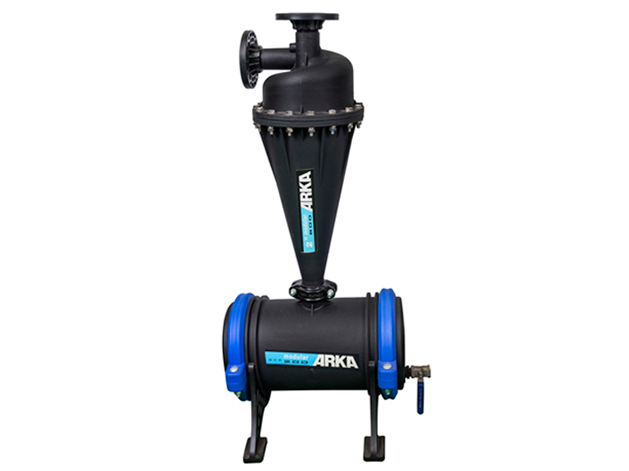
A centrifugal water filter is a specialized mechanical device engineered to separate heavy suspended solids from liquids. Unlike traditional methods that physically block particles using a porous mesh, this system utilizes rotational fluid dynamics.
The structural design is masterfully engineered for precise fluid manipulation. Four primary components work in perfect harmony:
It is crucial to recognize that a hydrocyclone filter is rarely deployed as a standalone solution. Its specific job is handling the heavy lifting. It extracts dense grit that would otherwise overwhelm downstream components. By removing bulk sand first, secondary screen filters are freed up to capture microscopic organic matter without constantly blinding over.
Specifically, the operation of these separators relies entirely on physics. They require absolutely no external power source other than kinetic energy generated by your existing irrigation pump. The separation process unfolds in three rapid phases.
Pressurized water smashes into the tangential inlet. The offset angle forces fluid to violently travel along the inner circumference. This creates a high-velocity spinning vortex. Think of it as a controlled liquid tornado inside a steel chamber. The speed of this rotation is directly proportional to the incoming flow rate. A faster flow generates a tighter, much more powerful vortex.
Immense centrifugal force pushes outward against the fluid. Specific gravity becomes the defining metric here. Specific gravity compares particle density to water density. Sand and heavy mineral scale typically boast a specific gravity of 2.6 or higher. Because these abrasive particles are significantly heavier than water, centrifugal force easily overpowers them. They strike the inner walls and instantly lose kinetic energy. Gravity pulls this heavy sediment safely into the collection chamber.
As spinning water spirals downward, physical space severely constricts. The massive fluid volume cannot exit through the tiny bottom opening. This bottleneck creates a high-pressure zone forcing water to abruptly reverse direction. An inner vortex forms, spinning tightly upward through the exact dead-center. This rising column of clean water enters the vortex finder tube and exits the system.
Furthermore, to make a truly informed purchasing decision, operators must compare cyclonic separation against other common technologies. Each method has distinct operational parameters.
| Filtration Technology | Sand Removal Efficiency | Backwash Water Waste | Maintenance Level |
|---|---|---|---|
| Centrifugal Filter | Excellent up to 98% for heavy grit | Zero. Only minor slurry purged | Very Low. No moving parts |
| Sand Media Filter | Good, but sand beds get overwhelmed | Extremely High. Hundreds of gallons | High. Requires frequent backwashing |
| Screen/Disc Filter | Poor. Screens tear under heavy sand | Moderate | High. Requires manual scrubbing |
In contrast to basic mesh filters, selecting cyclonic equipment is a strict engineering decision. Guesswork here leads to catastrophic system failures. To achieve that coveted 98% removal efficiency, buyers must follow strict sizing protocols.
The absolute most common mistake in agricultural design is selecting a sand separator based solely on existing pipe diameter. Centrifugal separation depends entirely on fluid velocity. If you install a massive 4-inch filter simply because you have a 4-inch mainline, the vortex will fail to form if your pump lacks sufficient output.
You must size the unit based on actual operational flow rate. For example, industrial-grade units like Arka's 4-Inch Hydrocyclone are specifically engineered to handle flow rates between 35 and 50 cubic meters per hour. If your primary pump delivers 40 cubic meters per hour, this 4-inch model is a perfect hydraulic match. If your flow is only 20 cubic meters per hour, you must step down to a smaller unit to maintain vortex velocity. Use standard pipe reducers if the filter inlet differs from your mainline.
A thorough empirical assessment of your water source is mandatory. Field engineers highly recommend performing a simple Imhoff Cone test. Fill a one-liter conical flask with raw irrigation water directly from the active pump. Allow it to sit undisturbed for 30 minutes. Read the exact volume of settled sediment. High sediment yields require an oversized collection chamber to prevent trapped sand from backing up into the vortex.
Even premium equipment fails if installed haphazardly. Proper integration into your existing hydraulic layout guarantees years of uninterrupted service.
Spatial positioning is non-negotiable. The unit must serve as the absolute primary stage. The correct hydraulic sequence is Water Source to Primary Pump to centrifugal filter to Fertigation System to Secondary Fine Filter to Field Distribution.
Placing the unit immediately after the pump extracts abrasive particles before they chew through delicate fertigation injectors. Always install a straight unobstructed section of pipe immediately preceding the inlet. This straight run eliminates turbulent flow caused by elbows, ensuring water enters the cyclone chamber in a smooth stream.
Maintaining a cyclonic system is remarkably straightforward. The only routine maintenance is periodic purging of the bottom chamber.
Managing sand does not have to mean replacing chewed-up impellers or wasting thousands of gallons of water on backwashing. Vortex-driven separation offers an elegant solution that protects your entire downstream infrastructure. These systems drastically reduce maintenance costs and prevent catastrophic clogging without a single moving part.
Success relies entirely on proper application. Always evaluate your true sediment load. Strictly size your equipment based on actual flow rate. Take the time to assess your hydraulic parameters. Ready to upgrade your farm's primary defense? Explore high-efficiency separation solutions at Arka Irrigation to safeguard your yields and equipment for years to come.
No, it will not. The underlying physics rely entirely on specific gravity. The centrifugal force generated by the internal vortex is only effective on particles significantly heavier than water. This includes silica sand, gravel, grit, and metal flakes. Organic matter like algae and fine inorganic particles like suspended clay have a specific gravity too close to water. These light particles simply pass completely through the unit. This scientific limitation is precisely why a cyclonic unit is classified strictly as a primary pre-filter. It must always be paired with a secondary fine mesh screen or grooved disc filter.
Generally, no. One of the most significant financial advantages of this technology is its lack of consumable or moving components. Because the separation process relies entirely on fluid dynamics, there are no internal mesh screens to tear or mechanical gears to wear out. A high-quality unit manufactured from industrial-grade carbon steel or reinforced engineered plastics operates for many years without requiring replacement parts. The only component that may eventually require attention is the bottom purge valve rubber seals after several seasons of heavy use.
The water loss is exceptionally minimal. Traditional sand media filters require massive volumes of clean water to reverse flow and agitate the media bed during a backwash. In stark contrast, a cyclonic unit requires zero backwashing. The cleaning process consists solely of opening the bottom valve to expel concentrated slurry. This purge typically lasts between 5 and 15 seconds, releasing only a few gallons of water per cycle.
Centrifugal separation is fundamentally dependent on reaching a specific minimum flow velocity. If your system suffers from low water pressure or an inadequate flow rate, water cascades lazily through the chamber without spinning fast enough. Consequently, heavy sand particles travel directly upward into your clean water line. If your current pump cannot generate the required flow, you must upgrade your pumping infrastructure or consider an alternative mechanical filtration method.
The engineering sweet spot for optimal separation is typically a pressure loss of 3 to 8 PSI. If the drop is below 3 PSI, the water is moving too sluggishly, allowing heavy grit to escape. Conversely, if the drop exceeds 8 PSI, the water is moving far too fast. This wastes valuable pump energy and accelerates abrasive wear on the inner walls of the steel cone.
The most immediate visual indicator is inspecting the purged slurry from the bottom collection chamber. If thick, concentrated sand shoots out during a purge, the vortex is successfully trapping heavy solids. Additionally, monitor your secondary fine filters. If your downstream screen filters remain relatively clean and require significantly less manual scrubbing than before, your primary cyclonic separator is performing its job perfectly.


