
Views: 0 Author: Site Editor Publish Time: 2026-10-17 Origin: Site


Imagine standing by your fields during the peak of a grueling summer heatwave. You check the pressure gauge on your main irrigation line. It has plummeted. Your pump is screaming as it struggles to push water. Halfway down the row, your drip emitters are bone dry. For agricultural operations relying on unconfined aquifers, rivers, or open canals, this nightmare scenario is incredibly common. The relentless culprit? High-sediment water.
Sandy, gritty, and heavily silted water sources wreak absolute havoc on modern farm infrastructure. They destroy expensive pump internals. They inflate maintenance budgets. Ultimately, they severely compromise crop yields through uneven watering. Fortunately, agricultural engineering provides a highly effective first line of defense. Centrifugal water filtration relies on the fundamental laws of physics to strip heavy particles from your fluid stream before they cause catastrophic damage. This method completely bypasses the limitations of easily clogged physical barriers.
In this comprehensive guide, we will explore exactly how hydrodynamic separation works. We will uncover why it drastically outperforms basic mesh screens in high-turbidity environments. Most importantly, you will learn how to select the perfect system to safeguard your crops and machinery.
Looking at the broader agricultural landscape, there is a clear pivot toward hydrodynamic separation. Why is this happening now? Severe environmental and economic pressures are forcing the industry's hand. Prolonged droughts require farmers to rely on lower-quality surface water and rapidly depleting aquifers. As water tables drop, pumps naturally pull in significantly higher volumes of sand and silt. Traditional barrier filtration methods simply cannot handle this increased load. They are proving inadequate and overly expensive to maintain.
Recent industry analyses highlight a massive push toward zero-downtime farming. Agricultural managers can no longer afford the sheer water waste associated with deep media backwashing. The labor costs of manually scrubbing screen filters are equally unsustainable. Consequently, the market is seeing a surge in the adoption of centrifugal technology. By utilizing fluid dynamics rather than consumable barriers, farms achieve superior energy efficiency. They comply with tightening local water conservation mandates while protecting their increasingly expensive micro-irrigation investments from premature failure.
For farm managers drawing from surface water or shallow wells, sediment is an unavoidable reality. Allowing raw, heavily contaminated water to flow directly into a precision irrigation network introduces severe mechanical and financial liabilities. Understanding these compounding costs is the crucial first step toward optimizing your infrastructure.
Irrigation pumps serve as the beating heart of any agricultural water distribution system. When water containing high concentrations of abrasive silica and sand is drawn through a pump, these suspended particles act like liquid sandpaper. This continuous abrasion leads to the premature wear of pump impellers, brass volutes, and delicate mechanical seals. Have you ever heard a gravel-like rattling near your pump manifold? You are likely listening to cavitation and physical scoring in real-time. Over just a few seasons, the pump loses its hydraulic efficiency. It requires significantly more electrical energy to move the exact same volume of fluid. Furthermore, internal valve components easily become scored or jammed by rogue grit. This inevitably leads to catastrophic system failures and expensive emergency replacements.
Modern precision agriculture relies heavily on micro-irrigation to maximize water use efficiency and fertilizer distribution. The inherent vulnerability of drip tape emitters and micro-sprinkler heads lies in their microscopic water passages. Even a marginal accumulation of ultra-fine sand can bridge across these narrow orifices. This causes partial or complete blockages. When emitters clog, the distribution uniformity of your entire field plummets. This results in severe localized drought stress for certain plants while simultaneously overwatering others. Such an imbalance directly translates to inconsistent crop quality and depressed harvest yields.
Relying exclusively on traditional barrier filtration creates an entirely unsustainable maintenance burden. Heavy sand loads will rapidly blind a standard nylon or stainless steel mesh. This triggers a severe pressure drop across the filter housing, forcing the system into continuous, disruptive backwashing cycles. Worse yet, it might require a farmhand to manually disassemble and scrub the unit multiple times a day. The associated labor costs represent a massive drain on farm profitability.
To combat heavy sediment loads without incurring massive maintenance penalties, agricultural engineers turn to hydrodynamic separation. Rather than forcing water through a restrictive physical barrier, this elegant method relies on fluid dynamics to clean the water stream.
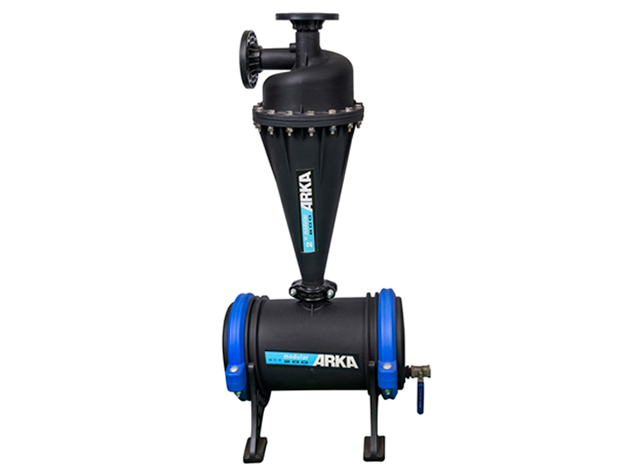
The core mechanism is remarkably straightforward yet highly effective. Raw, dirty water is pumped into the top of the cylindrical device through a tangential inlet. This specific angled entry forces the incoming fluid to spin rapidly along the curved interior walls of the chamber. It generates a high-velocity vortex, essentially acting as a controlled liquid cyclone. As the fluid accelerates, immense rotational force is exerted on everything suspended within the water column. Because there are no physical screens to block the flow, the water maintains a high kinetic energy throughout the entire separation process.
As the vortex spins with increasing intensity, the principles of inertia take over. Particles denser than water are subjected to powerful outward forces. This pushes them aggressively against the outer walls of the separator. Gravity then pulls these heavy particles downward in a spiral motion. They exit the active vortex and settle safely into a quiet collection chamber located at the base of the unit. Meanwhile, the clean, lighter water migrates toward the low-pressure center of the cyclone. It is forced upward and exits through the top outlet to continue safely into the irrigation mainline.
Let us look at a practical field application. When utilizing a robust hydrocyclone filter, such as a standard 4-inch nylon model, the system can efficiently handle flow rates typically ranging from 130 to 220 Gallons Per Minute. Engineered from durable reinforced nylon, these specific units resist corrosion while maintaining the structural integrity required to sustain the high-velocity internal vortex. The inlet and outlet configurations are specifically designed to optimize this flow range, ensuring the centrifugal force is strong enough to separate particles down to 75 microns.
It is vital to understand that the efficiency of this technology is entirely dependent on specific gravity. Pure water has a specific gravity of 1.0. Silica sand typically sits around 2.65, making it significantly heavier than water and highly responsive to cyclonic separation. Conversely, lightweight organic matter has a specific gravity very close to 1.0. Because organics are not heavier than the fluid carrying them, they will not be separated by the vortex. They simply pass right through. Therefore, this technology is strictly designed for heavy, inorganic solids.
Integrating cyclonic technology at the very head of an irrigation system provides measurable, empirical advantages over standalone barrier filtration.
Traditional screen filters are strictly limited by their physical surface area. Once the mesh is covered in dirt, filtration stops completely. In stark contrast, centrifugal systems have no physical barrier to clog. They continuously process water with exceptionally high concentrations of sand. They often handle up to 20 percent solids by volume without interrupting the flow or requiring a system shutdown. This makes them absolutely indispensable during periods of high turbidity, such as immediately after heavy seasonal rainfall or when drawing from a newly drilled well.
From a mechanical engineering perspective, simplicity usually equals reliability. These separators are typically constructed from heavy-duty carbon steel, stainless steel, or reinforced engineered plastics. Because the system relies solely on the physics of moving water, there are absolutely no moving parts. There are no electric motors, no rotating internal screens, and no expensive cartridges to replace. This static, rugged design minimizes mechanical wear and tear. It offers an operational lifespan that frequently outlasts the irrigation pumps themselves.
Multi-stage filtration is the recognized gold standard in modern precision agriculture. By deploying this technology as a robust irrigation pre-filter, you intercept the vast bulk of the abrasive sand before it ever reaches your delicate secondary filters. Removing up to 98 percent of the heavy solids means your downstream disc or screen units only have to manage lightweight organics and ultra-fine silt. This drastically reduces the backwashing frequency of the secondary filters, saving tremendous wear and tear on the internal filter elements.
Hydraulic efficiency is critical for managing soaring farm energy costs. When a traditional mesh filter accumulates dirt, the pressure differential between the inlet and outlet spikes dramatically. This forces the pump to work much harder to push the same amount of water. A cyclonic system operates entirely differently. Because it does not trap debris in the direct flow path, the pressure loss remains remarkably constant. It typically hovers between 3 to 12 PSI, depending on the specific model and flow rate. This stable hydraulic profile allows for precise pump sizing and significantly reduces overall electrical consumption.
Traditional media filters require hundreds of gallons of perfectly clean water to perform a single backwash cycle. Centrifugal systems, however, are highly water-efficient. The separated sand simply falls into a lower holding tank. This chamber can be purged in seconds while the system remains fully pressurized and operational. Purging only releases the tiny volume of water contained within the lower collection chamber, making it an environmentally responsible choice for farming regions facing strict water conservation regulations.
Farm managers frequently face decision fatigue when selecting filtration equipment. A common, costly misconception is that all filters perform the exact same function. In reality, different technologies are engineered to target highly specific types of particulate matter. Understanding these operational differences ensures that your capital is deployed effectively.
| Filter Type | Primary Target Contaminants | Vulnerabilities | Maintenance Requirement | Best Use Case |
|---|---|---|---|---|
| Centrifugal | Heavy inorganic solids, sand, grit, well scale. | Cannot remove lightweight organics like algae or leaves. | Very low. Requires quick purging of the sediment tank. | Primary pre-filtration for high-sand water sources. |
| Screen Filter | Algae, leaves, large floating debris. | Quickly blinded and clogged by heavy sand loads. | High in sandy water. Requires frequent backwashing. | Secondary filtration for surface water organics. |
| Media Filter | Fine organics, sticky clay, silt. | Large footprint, high capital cost, high water waste during backwash. | Moderate. Automated backwashing uses significant clean water. | Deep filtration for highly contaminated surface water. |
| Disc Filter | Fine particulates, precise micron-level organics. | Grooves can be physically gouged or permanently jammed by sharp grit. | Moderate. Requires automated backwashing. | Final polishing stage directly before drip tape. |
Specifically, when comparing a centrifugal filter to a screen filter, the empirical consensus is that these two technologies are highly complementary. The cyclone removes the heavy, abrasive grit. The screen filter catches the floating organics.
If your primary contamination issue is coarse, heavy sand rather than algae, installing a media filter is an expensive overreaction. A cyclonic unit provides a much leaner solution. It requires a fraction of the space, costs significantly less upfront, and wastes almost zero water during its rapid purging process.
Investing in this technology is not a one-size-fits-all endeavor. Unlike barrier filters, which can often be oversized without negative consequences, cyclonic separation relies entirely on precise fluid dynamics. If the system is not perfectly matched to your specific operational parameters, it will fail to separate the sediment.
The single most critical factor in selecting a unit is matching it to your irrigation system's exact flow rate. Centrifugal force is directly generated by the velocity of the water entering the tangential inlet. If you purchase a unit that is too large for your flow rate, the water will enter too slowly. The resulting vortex will be incredibly weak. The sand will simply pass right through the center of the unit and into your fields. Alternatively, undersizing the unit forces water through too quickly. While this creates a violent vortex, it also causes a severe pressure restriction.
You must select a sand separator where your nominal operating flow rate falls dead center within the manufacturer's specified optimal flow range. For example, if your system runs consistently at 180 Gallons Per Minute, selecting a 4-inch model rated for 130 to 220 Gallons Per Minute is the optimal engineering choice. This precise matching guarantees maximum centrifugal force without overworking the pump.
Before purchasing any equipment, objective empirical water testing is necessary. A standard bucket test or a laboratory particle size distribution analysis will reveal the volume and physical size of your sediment. To perform a bucket test, simply fill a transparent five-gallon container directly from your source. Time how long it takes for the solids to settle at the bottom. Rapidly settling solids indicate an ideal use case for cyclonic separation. These systems are highly effective at removing particles that are 74 microns and larger, provided the specific gravity is adequate.
Because this technology operates by converting pressure energy into kinetic energy, your existing irrigation pump must be capable of overcoming the inherent head loss introduced by the device. Typically, a properly sized unit will create a consistent pressure drop of between 3 to 12 PSI. You must carefully review your pump's performance curve. Verify that it can deliver the required flow rate while overcoming both the pressure drop of the separator and the total dynamic head required by your downstream irrigation network.
Even the most advanced agricultural equipment will severely underperform if installed incorrectly or neglected. Fortunately, installation is straightforward, and long-term maintenance is highly manageable.
Hydraulic positioning is paramount. The unit must be installed as the absolute first piece of equipment following the main pump discharge. It acts as the primary shield for the rest of your infrastructure. It should be placed immediately before any fertigation injection systems, chemical holding tanks, or secondary sediment filter units.
Furthermore, ensure that the piping leading into the tangential inlet is perfectly straight for a distance of at least five pipe diameters. Bends, elbows, or butterfly valves placed too close to the inlet cause severe fluid turbulence. This disrupts the smooth formation of the internal vortex and drastically reduces separation efficiency. Additionally, the unit must be installed perfectly vertical. Any tilt will disrupt the gravitational settling of the sand.
As the vortex forces heavy particles to the outer walls, they slide down into a lower collection chamber. Managing this chamber is your only routine operational requirement. It is absolutely critical that the collection tank is never allowed to overfill. If the sand builds up past the capacity of the holding chamber, it will be re-entrained into the spinning vortex. It will be pushed directly into your irrigation lines, entirely defeating the purpose of the device.
For high-sediment environments, upgrading to an automated purge valve is highly recommended. These powered valves operate on a simple programmable timer. They open for just a few seconds at predetermined intervals, rendering the system virtually hands-off.
While there are no moving parts to break down, spinning abrasive sand at high velocities means the interior walls are continually subjected to friction. At the end of each growing season, agricultural managers should perform a thorough visual inspection. Check the interior cone for signs of excessive wear, grooving, or stripped protective coatings. Verify that the pressure gauges installed before and after the unit are reading accurately. A sudden drop in pressure differential could indicate a worn inlet nozzle or a change in upstream pump performance.
High-sediment water will systematically destroy an irrigation system if proper preliminary protection is not established. Relying exclusively on standard mesh or disc filters to handle heavy sand loads is a guaranteed recipe for constant maintenance, wasted labor, and premature equipment failure.
Centrifugal water filtration offers a remarkably reliable, physics-based solution. By seamlessly removing heavy solids without the need for physical barriers, it protects your expensive pumps and extends the life of your secondary filters. Most importantly, it ensures your drip lines deliver precise, uniform hydration to your crops.
Do not let abrasive sand compromise your agricultural yield and inflate your operating costs. Upgrade your infrastructure today with a precision-engineered solution tailored to your exact flow requirements. Explore the high-performance filtration systems at ARKA to find the perfect match for your farm. Secure your investment, reduce your energy overhead, and keep your water flowing clearly season after season.
No. This technology relies entirely on the principle of specific gravity. Because algae, leaves, and organic matter are lighter than or equal to the weight of water, they will not be pushed to the outer walls by the vortex. Instead, they will remain suspended and exit through the top with the clean water. To remove organic matter, you must install a secondary screen or media filter downstream.
Yes, but the restriction is minimal and constant. Generating the high-speed vortex requires kinetic energy, which results in a pressure drop. This usually sits between 3 to 12 PSI depending on the specific model and the flow rate. However, unlike a traditional barrier filter where the pressure drop constantly increases as dirt accumulates, the pressure drop across a cyclonic unit remains steady. This makes it much easier to manage your pump's electrical efficiency.
The flushing frequency depends entirely on the sediment load of your specific water source and the physical size of the lower collection chamber. In severe, highly turbid conditions, it may require purging multiple times a day. In cleaner well water, once a week may suffice. The critical rule is to never let the collection tank fill completely. Many modern agricultural setups utilize an automated purge valve that flushes the chamber on a set timer, making the system virtually maintenance-free.
Yes, in almost all agricultural scenarios. The cyclonic unit is designed to act as a primary pre-filter. Its specific job is to remove the heavy, coarse solids that would otherwise destroy finer filters. A secondary screen or disc filter is still highly recommended to catch the remaining fine particles, silt, and lightweight organics before the water reaches and clogs your sensitive micro-sprinklers or drip emitters.
It depends on the state of the iron. If the iron has oxidized and formed heavy, solid particulate flakes, a cyclonic unit can effectively separate these heavier solids. However, if the iron is dissolved in the water, it cannot be removed by centrifugal force. Dissolved iron requires chemical oxidation or specialized filtration media to remove.
No, this is highly discouraged. These units are specifically engineered to operate under positive pressure on the discharge side of the pump. Installing one on the suction side creates a severe pressure drop that will almost certainly starve the pump of water, leading to immediate cavitation and catastrophic mechanical failure.


