
 |


F110LX
ARKA
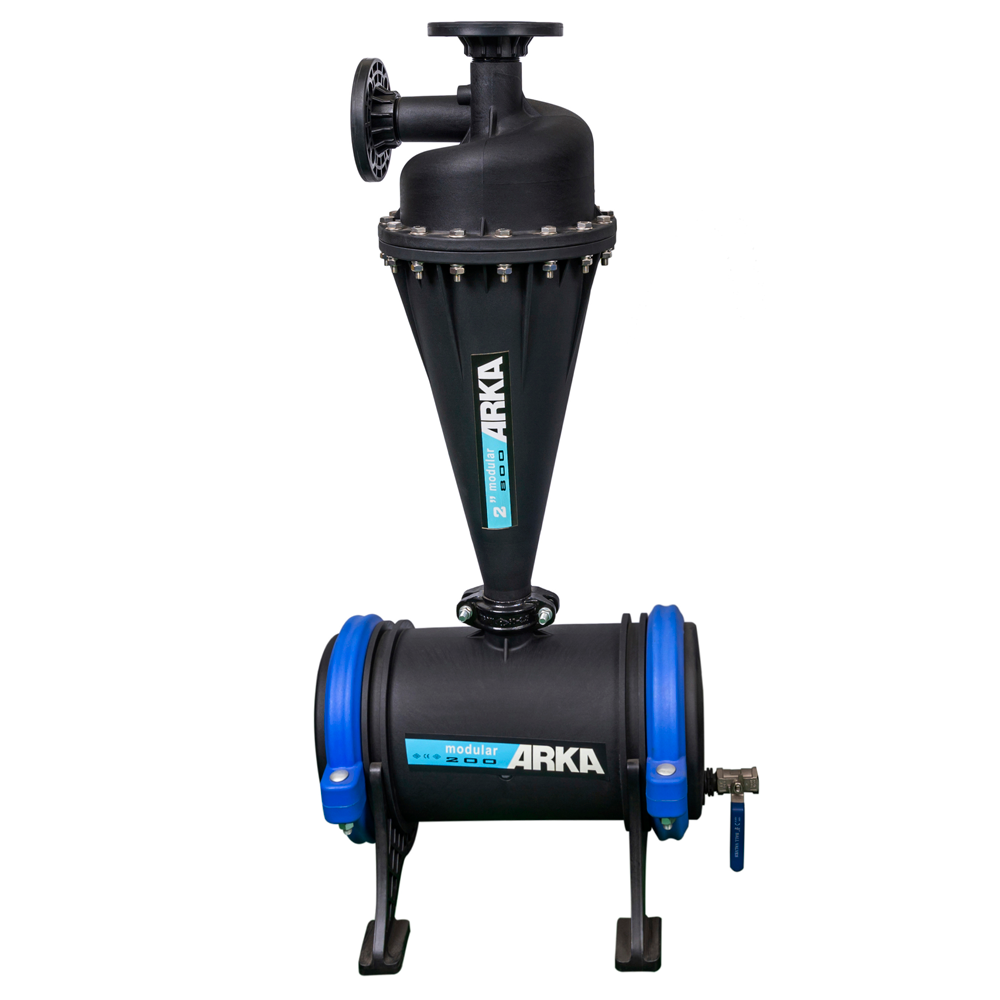
The F110LX is a 4-inch nylon hydrocyclone centrifugal filter engineered for removing sediment and large particles from water used in agricultural irrigation and industrial applications. Operating without moving parts or filter media that require replacement, this unit provides primary filtration for water sources containing sand, silt, and other dense particulate matter.
The hydrocyclone filter uses centrifugal force to separate particles from water based on density differences. As water enters the cylindrical chamber tangentially, it creates a swirling vortex that pushes heavier particles outward and downward toward the collection chamber at the bottom. Cleaner water moves toward the center and exits through the top outlet. This separation process occurs continuously without interrupting water flow, making the unit suitable for applications where consistent water supply is required.
MODEL | CONNECTION | TANK CAPACITY(L) | MAX FLOW(mm) | WORKING PRESSURE(bar) | WEIGHTS(kg) |
|---|---|---|---|---|---|
F90LX | 4 inch | 16 | 100 | 8 | 17.5 |
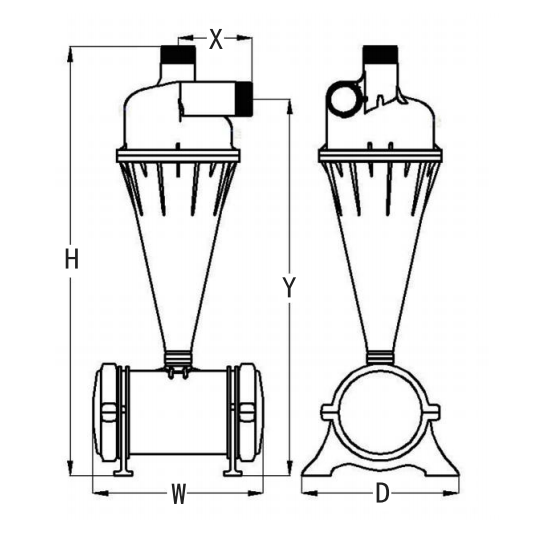
MODEL | H(mm) | W(mm) | D(mm) | X(mm) | Y(mm) |
|---|---|---|---|---|---|
F110LX | 1220 | 490 | 430 | 205 | 1070 |
Water enters the hydrocyclone through a tangential inlet that directs the flow into a circular path along the inner wall of the conical chamber. The conical shape narrows the flow path, increasing the rotational velocity as water moves downward. This acceleration amplifies the centrifugal force acting on suspended particles, driving denser materials against the chamber wall where they lose velocity and settle downward.
Separated sediment accumulates in the collection chamber located at the base of the hydrocyclone unit. This chamber stores collected material between cleaning cycles and can be drained through a valve when the sediment level reaches capacity. The collection chamber design allows maintenance personnel to remove accumulated sediment without shutting down the entire filtration system, supporting continuous operation in commercial and industrial settings.
When water is pumped from wells, it often carries sand and grit particles that can damage downstream irrigation equipment such as drip emitters, sprinkler nozzles, and valves. The hydrocyclone filter removes these large, dense particles as a first-stage filtration step, protecting downstream components and reducing maintenance frequency. This application is particularly relevant for agricultural operations relying on groundwater sources.
Water sourced from rivers, lakes, and reservoirs typically contains sediment, organic debris, and varying levels of turbidity. The hydrocyclone filter serves as primary filtration in these systems, removing heavier inorganic particles before the water passes through secondary filtration stages such as disc or screen filters. This staged approach extends the service life of downstream filter elements and reduces overall maintenance workload.
In industrial applications where water is recycled or reused, the hydrocyclone filter operates as a primary treatment step to remove suspended solids from process water. It works in conjunction with secondary filtration equipment to achieve the required water quality for specific industrial processes. The unit nylon construction withstands exposure to various water chemistries found in industrial recycling systems.
Proper installation of the F110LX hydrocyclone filter requires vertical positioning to ensure the centrifugal separation process functions as designed. The unit should be installed with sufficient clearance below the collection chamber for periodic draining and maintenance. Inlet and outlet piping should be sized to match the 4-inch connection and aligned to minimize turbulence that could affect separation efficiency.
Maintenance for the hydrocyclone filter primarily involves periodic draining of the sediment collection chamber. The frequency of cleaning depends on the sediment load in the source water and the volume of water processed. Operators should monitor pressure differential across the unit and inspect the collection chamber regularly to determine appropriate cleaning intervals. The nylon construction requires no lubrication and resists corrosion, reducing the scope of routine maintenance.
The F110LX hydrocyclone filter removes dense particles such as sand and grit based on their specific gravity relative to water. Larger and denser particles are separated more efficiently. The unit is designed for primary filtration of heavy sediment and should be followed by secondary filtration for finer particle removal. Specific removal efficiency varies with particle density, size, and operating flow rate.
Cleaning frequency depends on the sediment concentration in the source water and the system flow rate. Operations using water with high sediment content may require daily or weekly draining, while cleaner sources may need only monthly maintenance. Operators should establish a baseline by inspecting the collection chamber regularly during the initial weeks of operation, then adjust the schedule based on observed accumulation rates.
The hydrocyclone filter functions as primary or pre-filtration equipment and is typically used in combination with secondary filtration methods such as disc filters or screen filters for complete water treatment. It efficiently removes large, dense particles but does not provide fine filtration on its own. Systems requiring specific water clarity levels should incorporate additional filtration stages downstream of the hydrocyclone.
The F110LX hydrocyclone filter has a working pressure rating of 8 bar, as specified in the technical parameters. This pressure capacity covers most agricultural irrigation and industrial water treatment applications. Systems operating at higher pressures require pressure regulation or alternative filter models with higher pressure ratings to ensure safe and reliable operation.


