
Views: 0 Author: Site Editor Publish Time: 2026-10-18 Origin: Site


You pull a clogged filter cartridge after just three days. It is packed with heavy sand and grit. This rapid failure disrupts your water supply. It also bleeds your maintenance budget dry. Standard filtration media simply cannot survive heavy abrasive loads.
A centrifugal sand filter solves this problem efficiently. It intercepts heavy debris before that grit ever touches your delicate downstream equipment. In this comprehensive guide, you will learn exactly when and why to install one. We will show you how to sequence your equipment so your entire water treatment system operates flawlessly.
A centrifugal sand filter is a specialized mechanical device engineered to separate heavy inorganic particulates from a fluid stream. Conventional setups rely on a physical mesh or porous media to block particles. In contrast, a sand separator utilizes fluid dynamics to achieve purification. It lacks a physical barrier that can tear or blind over. Therefore, it is the ideal solution for extreme sediment loads.
The core operational principle relies on what engineers call the hydrocyclone effect. Raw water enters the filter housing through a tangential inlet at a specific angle. This precise entry geometry combines with the pressure from the well pump. It forces the water into a high-speed rotational spin. This action creates a powerful vortex inside the cylindrical chamber.
As the water spins rapidly, centrifugal force pushes the denser particles outward toward the inner walls of the housing. Materials like quartz sand, rust flakes, and metal shavings have a higher specific gravity than water. They are easily separated by this rotational force. Once pushed to the outer wall, gravity takes over. The heavy grit spirals downward into a designated collection chamber at the base of the unit. Simultaneously, the lighter clean water migrates toward the center of the vortex. It rises and exits through the top outlet to continue down the plumbing line.
The primary advantage of this mechanism is the complete absence of consumable parts. Standard barrier filters require constant replacement of paper or carbon cartridges. This mechanical separator only requires periodic flushing. Users simply open a purge valve located at the bottom of the collection chamber to discharge the accumulated sludge. This action takes mere seconds and incurs zero replacement costs.
Determining the exact sequence of your water treatment system is critical for operational efficiency. Standard fine filters are simply not engineered to handle heavy abrasive loads. Here are the objective scenarios where installing this equipment at the very beginning of your system is technically required.
Recent industry trends reveal a steep decline in global groundwater levels. As agricultural and industrial well pumps draw from lower depths, they inevitably pull up higher concentrations of abrasive bedrock and frac sand. Relying solely on traditional barrier filters is no longer a sustainable practice. Facilities must adapt. Implementing primary mechanical separation is now viewed by engineers as a mandatory baseline rather than an optional upgrade.
Private wells are highly dynamic geological environments. Newly drilled wells often pump excessive loose bedrock particles during their initial break-in period. Furthermore, aging wells may experience degrading well screens or shifting aquifers. This leads to a sudden influx of heavy debris. If your well is actively pumping visible grit, it will destroy a standard barrier filter almost instantly. The separator must intercept this heavy load immediately after the water leaves the wellhead.
A clear empirical indicator that your system requires a pre-filtration upgrade is your current replacement frequency. A facility manager should not have to change a 50-micron cartridge every few days. If this occurs, the particulate load has vastly exceeded the capacity of barrier filtration. Installing a centrifugal unit upstream removes up to 98 percent of the heavy mass. This allows the downstream cartridge to return to a normal multi-month replacement cycle.
Sand is highly abrasive. It acts like liquid sandpaper inside your plumbing. If heavy grit enters a water softener, it will foul the resin bed and destroy the delicate internal seals of the control valve. In Reverse Osmosis systems, sand causes micro-abrasions that permanently ruin the expensive membrane. The separator takes the brunt of the heavy lifting. It acts as a physical shield for these sensitive downstream components.
Surface water sources such as lakes, rivers, and ponds naturally carry high concentrations of suspended solids. This includes heavy silt and grit stirred up by weather events. Pumping raw surface water directly into fine mesh screens will cause immediate blinding of the filter matrix. A centrifugal unit effectively drops the heavy inorganic materials out of the water column before the fluid proceeds to the finer purification stages.
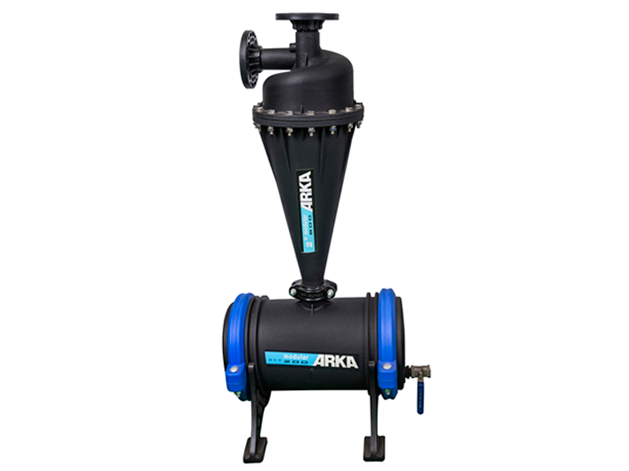
Agricultural operations face unique fluid management challenges. Water sources for irrigation are notoriously laden with sand. As the agricultural sector increasingly adopts precision farming to combat global water scarcity, protecting delicate infrastructure has become paramount.
Modern precision agriculture relies heavily on micro-irrigation systems. These delivery methods utilize tiny emitters designed to release water at a precise slow rate. Due to their microscopic orifices, these emitters are highly susceptible to clogging from even trace amounts of sand. Once an emitter clogs, the plant suffers immediate water stress. Utilizing a high-efficiency irrigation pre-filter at the main pump station reliably extracts this heavy grit. It ensures uninterrupted flow to the furthest reaches of the field.
In commercial farming, massive screen filters or sand media tanks serve as the primary filtration method. However, raw heavy sand loads will trigger their automatic backwashing cycles continuously. Frequent backwashing wastes massive volumes of water and consumes excess electrical energy. Installing a separator before the mainline filters removes the bulk of the heavy mass passively. Consequently, this drastically reduces the backwash frequency of the primary media filters.
A common misconception among property owners is that they must choose between a centrifugal unit and a traditional cartridge. In reality, these two technologies are complementary. A well-designed water treatment topology pairs them together to achieve comprehensive particulate removal.
This device operates strictly on specific gravity. It is engineered to remove heavy and dense particles measuring 50 microns and larger. Examples include quartz sand, pipe scale, and heavy rust flakes. Think of it as the heavy lifter of the system. It handles immense volumes of dense material without experiencing a drop in water pressure.
In contrast, a standard sediment filter operates on physical size exclusion. It catches the lighter particles that do not possess enough mass to be spun out by centrifugal force. This includes lightweight organic matter, fine silt, and suspended clay.
When sequenced correctly, these two devices create a highly efficient filtration synergy. The separator is installed first to strip out the heavy mass. The exiting water is free of abrasive grit but may still contain fine lightweight silt. This water then enters the barrier filter. Because the cartridge is no longer bombarded by heavy sand, it focuses entirely on capturing the fine silt. This allows it to operate efficiently for months.
Determining the precise location for your pre-filtration equipment is critical for system longevity. The unit relies on specific pressure and flow dynamics to generate its internal vortex. Placing it in the wrong sequence can disrupt this vortex. This allows abrasive particulate matter to bypass the unit entirely.
To achieve optimal performance, water treatment professionals recommend a strict sequence. The following topology ensures that heavy abrasive materials are removed before they inflict mechanical wear.
| Sequence Stage | Equipment Type | Primary Function & Pain Point Solved |
|---|---|---|
| Stage 1 | Well Pump / Raw Source | Draws raw water. Contains maximum abrasive sediment that destroys plumbing. |
| Stage 2 | Centrifugal Sand Filter | Installed immediately after the pump. Captures 90 percent of heavy mass, preventing downstream abrasion. |
| Stage 3 | Pressure Tank | Stores pressurized water. Pre-filtration prevents sediment buildup that causes internal bladder failure. |
| Stage 4 | Standard Sediment Filter | Captures lightweight particulates. Operates without premature clogging thanks to upstream separation. |
| Stage 5 | Advanced Treatment | Reverse Osmosis or UV purifiers. Safely processes clean water without risk of membrane tearing. |
Beyond the sequence, the physical geometry of the plumbing dictates success. A centrifugal filter requires smooth laminar water flow entering its chamber to create a perfect high-speed vortex.
If the water enters in a turbulent state, the vortex will become unstable. Installing elbows or valves too close to the inlet causes this turbulence. An unstable vortex fails to push heavy particles to the outer walls. Sand will travel up through the center and exit the system. To prevent this, engineers recommend maintaining a straight pipe run leading into the inlet. This straight run must be equivalent to at least five times the pipe diameter.
Selecting the correct unit is not a matter of matching pipe sizes. It is a matter of matching fluid dynamics. Purchasing a unit based solely on the diameter of your existing plumbing is the most frequent cause of system failure. You must evaluate flow rate and particle weight to make an informed decision.
The operational efficiency of a hydrocyclone filter depends entirely on the system Flow Rate. Physics dictate that water must enter the chamber at a specific velocity to generate centrifugal force.
If the filter is oversized, the water enters too slowly. The vortex remains weak. Conversely, if the filter is undersized, the water enters too rapidly and creates extreme friction. This results in a massive pressure drop across the system.
Specifically, industrial-grade units are built to precise flow windows. For example, a commercial 4-Inch Nylon Hydrocyclone Filter from Arka Irrigation is engineered from durable reinforced polyamide. It is designed to process optimal flow rates between 130 and 220 Gallons Per Minute. It withstands a maximum operating pressure of 145 PSI. If your well pump delivers 150 Gallons Per Minute, this exact specification will generate the perfect separation velocity.
These devices separate materials based on weight rather than physical size. Silica sand, gravel, and metal shavings have a high specific gravity. They are easily separated. However, lightweight materials like organic algae and fine clay have a specific gravity very close to water. The centrifugal force cannot pull them out of the water stream. You will always need a barrier filter downstream for those specific elements.
You will face a decision regarding the purge mechanism. Manual purge valves require a user to physically open a ball valve to flush out the collected sand. This is cost-effective but demands strict adherence to a maintenance schedule. For a higher initial investment, you can install an automatic valve. This device programs itself to open for a few seconds at specific intervals. It is highly recommended for remote agricultural sites.
Even with top-tier equipment, installation errors can negate the benefits of pre-filtration. Avoiding these common engineering missteps ensures your system operates at peak efficiency.
Matching the filter inlet size directly to your plumbing size is a fundamental error. A facility may have 2-inch plumbing but only a flow rate of 15 Gallons Per Minute. If they purchase a 2-inch separator designed for 50 Gallons Per Minute, the unit will fail to separate any sand. Always adapt your plumbing with reducers or expanders to fit the correctly sized filter.
Many users install a separator expecting crystal-clear water. They are disappointed to find their water is still cloudy. Centrifugal devices are not designed to remove turbidity caused by lightweight clay or colloidal particles. Their primary purpose is removing heavy abrasive mass. It is a pre-treatment tool rather than a final polishing tool.
The most common operational failure occurs when the collection chamber is ignored. When the bottom reservoir fills to maximum capacity, the newly separated sand has nowhere to go. The high-speed vortex will pick the sand back up and carry it out the top of the filter. This sends grit directly into your delicate downstream equipment. Monitoring the accumulation rate during the first few weeks is vital.
A centrifugal sand filter is an indispensable asset for protecting your water infrastructure. It removes heavy particles before they cause expensive mechanical damage. This extends the life of downstream filters, softeners, and irrigation emitters. Remember that proper sizing based on your specific flow rate is absolutely critical to success. Incorrect sizing inevitably leads to poor filtration and unwanted pressure loss.
By installing this technology as your first line of defense, you save significant money on replacement parts and drastically reduce maintenance downtime. If you are ready to upgrade your system and eliminate abrasive sand for good, explore the professional-grade hydrocyclone solutions at Arka Irrigation to find the exact model matched to your pump capacity.
If the unit is sized correctly according to your system Gallons Per Minute, the pressure drop is minimal and highly manageable. Standard operational pressure loss typically ranges between 2 to 5 PSI. However, if you install a unit that is too small for your pump flow rate, it will create excessive friction. This results in a significant and problematic reduction in water pressure.
No, it does not. Centrifugal separation relies entirely on the specific gravity of the particles. Clay, mud, and organic algae are too light. They lack the mass required for centrifugal force to push them out of the water stream. To remove these lightweight contaminants, a standard sediment filter is required downstream.
Centrifugal filters are highly effective at removing particles that are 50 microns and larger, provided the particles have a heavier specific gravity than water. They excel at capturing heavy grit ranging from 50 to over 200 microns. For particles smaller than 50 microns, separation efficiency drops, which is why pairing it with a downstream fine mesh filter is recommended.
Absolutely. They are incredibly popular for residential well systems that suffer from heavy sand pumping. Homeowners benefit greatly because the device prevents sand from destroying pressure tank bladders and indoor water softeners. You simply need to measure your residential well pump flow rate accurately to select a properly scaled unit.
The required flushing frequency is entirely dependent on the volume of particulate matter your water source produces. A degrading well could require daily flushing. A stable surface water source might only require monthly attention. Upgrading the system with an automatic timer purge valve eliminates this manual chore entirely.
While spin-down filters are effective for moderate sediment loads, they rely on a physical mesh screen to catch particles. Under heavy sand loads, the abrasive nature of the grit can tear the mesh screen. This leads to bypass and failure. A true centrifugal device has no moving parts and no internal screens to tear. It uses pure physics to separate the sand, making it the superior choice for extreme sediment problems.


