
Views: 0 Author: Site Editor Publish Time: 2026-10-17 Origin: Site


Tired of constantly replacing clogged water filters? Heavy sand ruins plumbing and drops water pressure fast. The familiar, frustrating sputtering of a clogged faucet aerator or a sudden loss of shower pressure are clear signs. Abrasive particulates have breached your system.
In this comprehensive engineering guide, you will learn exactly how these kinetic devices extract heavy sediment before it wreaks havoc on your property. Acting as the ultimate first line of defense, this technology preserves your plumbing. Furthermore, it dramatically extends the life of finer, more sensitive filtration equipment.
At its core, this is a specialized mechanical device engineered to isolate solid particles from liquids using rotational fluid dynamics. Rather than forcing the water supply through a porous membrane or tight mesh screen that physically traps debris, the system exploits the density difference between the fluid and the suspended solids.
Depending on the specific industry and application, this separation technology goes by several different names. The underlying physics, however, remains identical. In commercial agriculture and industrial manufacturing, engineers frequently refer to it as a hydrocyclone filter. Meanwhile, in residential plumbing, it is most commonly recognized as a sand separator. Regardless of the label, the primary objective is to purge dense, heavy sediment from the raw water supply before it inflicts downstream damage.
Recent industry analyses highlight a significant shift in overall water treatment strategies. With growing global concerns over water scarcity and sustainable facility operations, managers and agricultural operators are actively moving away from disposable media. The current trend heavily favors zero-waste, kinetic separation technologies. These systems minimize pressure loss and completely eliminate the environmental impact of discarded cartridges. Because they operate without flow restriction, they are rapidly becoming the standard for modern facility upgrades.
The operational brilliance of this system lies in its elegant application of basic physics. Because there are no moving mechanical parts inside the primary chamber, the device relies entirely on the kinetic energy of the incoming water. Here is exactly how the dynamic separation process unfolds in the field.
The sequence initiates when raw, untreated water is pumped into the housing. Unlike standard barrier filters where fluid flows directly into a wall of media, water enters this device tangentially. It is injected through an inlet positioned on the side of the cylindrical chamber. This specific entry angle forces the incoming stream to hug the curved inner wall. As velocity is maintained, it instantly generates a rapid, circular motion, forming a powerful liquid cyclone inside the housing.
As the vortex spins, it subjects every suspended element to intense centrifugal force. According to the laws of fluid dynamics, objects possessing a higher specific gravity or density than the surrounding liquid will be thrust outward, away from the center of rotation. Because sand, metal flakes, and dense grit are significantly heavier than water, they simply cannot maintain the tight turning radius of the inner vortex. Consequently, these abrasive particles are forcefully flung outward, colliding with the exterior walls of the chamber.
Once the heavy debris strikes the outer wall, friction causes it to lose kinetic energy and rotational speed. No longer suspended by the violent speed of the cyclone, gravity takes command. The grit spirals downward along the smooth walls, eventually dropping completely out of the active flow path. It settles into a designated holding basin located at the very bottom of the unit, safely isolated from the clean water above.
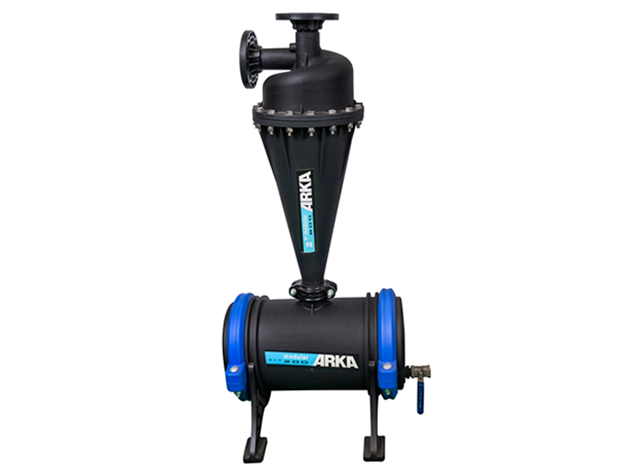
While the abrasive mass is pushed to the perimeter and falls away, the cleaner, lighter fluid remains concentrated near the center of the vortex. As this water approaches the tapered lower section of the main chamber, the internal geometry forces the flow to reverse direction. An inner, upward-spinning vortex forms, drawing the treated water up through the center of the cyclone. This clean fluid is then expelled through the top outlet, heading straight toward a traditional sediment filter for the next stage of purification.
Investing in a staged architecture is not merely about achieving pristine water quality. It is fundamentally about asset protection. Fine purification media are highly effective at capturing microscopic threats, but they are exceptionally vulnerable to physical abrasion.
Properties operating on private wells frequently endure sudden, unpredictable surges of sand and silt. This is especially true following heavy rainfall, seismic shifts, or when a submersible pump is positioned too close to the aquifer floor. If a dense wave of sand hits a standard 5-micron cartridge directly, it will instantly blind the media. Blinding occurs when large particles completely pack the microscopic pores, instantly choking off the water supply. This creates a massive pressure drop, forcing the well pump to run continuously and risking catastrophic motor burnout.
Water softeners and Reverse Osmosis systems represent substantial financial investments. If grit enters a water softener, it buries itself deep within the delicate resin bed. This restricts flow, drastically reduces ion-exchange efficiency, and renders regeneration cycles useless. Similarly, Reverse Osmosis membranes are fragile, semi-permeable barriers. Abrasive sand physically tears these membranes or causes severe scaling. In professional plumbing circles, the consensus is absolute. Heavy mechanical separation must be installed prior to any softening or purification equipment to guarantee system integrity.
To make an informed upgrade to your plumbing, it is vital to understand the operational distinctions between kinetic systems and standard barrier cartridges. The table below outlines the critical differences.
| Feature | Kinetic Separator | Traditional Cartridge Filter |
|---|---|---|
| Mechanism | Rotational fluid dynamics and gravity | Physical porous barrier |
| Pressure Loss | Consistent flow with near-zero pressure drop | Increasing pressure drop as media clogs |
| Maintenance | Simple valve purge, no parts to replace | Frequent physical replacement of cartridges |
| Ideal Use Case | Heavy sand, gravel, and large abrasive grit | Fine silt, microscopic particles, and final polishing |
Because they operate without flow restriction, these systems are deployed across a wide variety of demanding environments.
For rural homeowners, sand intrusion is a relentless nuisance. It leads to the classic sand in the bathtub scenario, destroys washing machine inlet valves, and accumulates in hot water heaters. This severely reduces thermal efficiency. Installing a separator immediately after the pressure tank is the most definitive way to shield domestic plumbing infrastructure.
In commercial farming, water is often drawn from surface reservoirs or high-yield agricultural wells. This brings substantial amounts of inorganic debris. Farmers rely heavily on these devices as an irrigation pre-filter. Modern drip tapes and micro-sprinkler heads feature incredibly narrow emission orifices that clog easily. By installing a unit at the main pump station, operators prevent widespread crop hydration failure without needing to manually unclog hundreds of individual emitters.
Industrial processes require massive flow rates that would instantly overwhelm traditional cartridges. These separators are heavily utilized in commercial cooling towers, large-scale car washes, and manufacturing facilities. They continuously extract scale, airborne dust, and rust flakes from cooling basins, protecting expensive heat exchangers from catastrophic abrasive wear.
Proper installation geometry and sequencing are paramount. If a kinetic device is placed in the wrong sequence, or if the piping configuration disrupts the fluid dynamics, the vortex will fail to form properly.
For a comprehensive residential or light-commercial setup, components must be installed in descending order based on the size of the contaminants they target. The empirically recommended plumbing layout is as follows:
Well Pump ➔ Pressure Tank ➔ Separator Unit ➔ Spin-Down Mesh Filter ➔ Fine Cartridge Filter ➔ Water Softener ➔ House Plumbing.
By placing the kinetic unit immediately after the pressure tank, it intercepts the heaviest load before any sensitive media or fine mesh is exposed to the raw water supply.
The most frequent and costly mistake buyers make is sizing the unit based solely on their existing pipe diameter. These devices must be sized strictly based on Flow Rate in Gallons Per Minute. If the flow rate is too low, the water will simply trickle through the chamber. A vortex will not form, and the sand will pass right through to the house. Conversely, if the flow rate is too high, the internal velocity becomes excessively violent. This creates unwanted friction and causes a massive pressure drop. Always measure your pump's actual output and match it to the manufacturer's specified flow range.
Selecting the correct unit ensures optimal particulate removal and prevents costly plumbing modifications down the line. A properly specified centrifugal filter will yield decades of reliable service.
When evaluating options, material and structural integrity are paramount. For instance, high-performance units like a 4-Inch Nylon model offer a perfect balance of cost-efficiency and durability. Engineered plastics like reinforced nylon or polycarbonate are completely immune to rust. They handle standard operating pressures flawlessly and often feature clear housings, allowing users to visually monitor the vortex and sediment buildup.
For heavy-duty industrial settings handling extreme pressures, 304 or 316-grade stainless steel is the absolute standard. Stainless steel withstands significantly higher operating pressures, extreme temperature fluctuations, and physical impacts where plastic housings would risk structural failure.
While famously low-maintenance, these systems are not entirely hands-off. The collected debris must be evacuated from the lower holding basin regularly to prevent it from backing up into the active vortex.
The debris basin is equipped with a dedicated purge port. Most standard units ship with a manual ball valve. Routine care requires a user to physically open this valve for 15 to 30 seconds while the plumbing remains under pressure. The internal water pressure forcefully ejects the accumulated grit out of the bottom into a bucket or floor drain.
For a completely passive approach, users can upgrade to an automatic purge valve. This motorized solenoid connects to a digital timer. The user programs the interval, such as opening for 15 seconds every 24 hours. The system evacuates the basin automatically, ensuring it never overflows.
It is important to clarify maintenance terminology. A kinetic unit does not require backwashing. Backwashing is a complex, water-intensive process used in media tanks like carbon or sand filters where the flow direction is completely reversed to fluff the bed and expel trapped dirt. A kinetic separator simply requires purging. The main flow to the property is never interrupted, flow direction is not reversed, and only a negligible amount of water is expelled.
A kinetic filtration system is an incredibly efficient, cost-saving tool that leverages the physics of rotational fluid dynamics to extract heavy sand and grit from your water supply. While it does not replace the need for fine, microscopic purification, it serves as an impenetrable shield for your downstream plumbing.
By evaluating your system's flow rate and installing the appropriately sized unit, you can permanently eliminate the frustration of clogged aerators. You protect your expensive water softeners and ensure your entire plumbing network operates at peak performance for years to come. Ready to safeguard your water infrastructure? Explore the professional-grade sand separator solutions at Arka Irrigation to find the exact specifications matched to your flow rate and industrial requirements.
These units are highly effective at removing heavy, dense particles down to approximately 50 to 75 microns, which is roughly the consistency of very fine beach sand. However, separation efficiency is based on the specific gravity of the particle rather than just its physical size. Heavy inorganic materials are easily removed, while lightweight organic matter of the same micron size may pass through.
No, they operate on completely different mechanical principles. A spin-down filter forces water into a circular motion but relies on a physical mesh screen, typically made of stainless steel or polyester, to physically block and catch debris. A true kinetic separator contains no internal screens or moving parts. It relies entirely on fluid dynamics to push dense particles outward and downward.
No. Kinetic separation only removes suspended solids that possess a higher specific gravity than water. It cannot alter water chemistry. It will not remove dissolved minerals like calcium or magnesium, dissolved iron, hydrogen sulfide gas which causes a sulfur smell, or chemical contaminants. Those issues require dedicated water softeners or chemical oxidation systems.
It is highly discouraged to use this as a standalone solution for indoor residential drinking water. While it excels as a pre-filter to remove abrasive grit, it will not capture microscopic silt, clay, lightweight organic matter, or bacteria. It should always be utilized as the first stage in a comprehensive sequence, followed by finer mechanical and carbon filters to ensure complete water safety.
Very little water is consumed during routine maintenance. A standard purge cycle only requires opening the bottom valve for 15 to 30 seconds. Depending on your system's operating pressure, this typically expels only a few gallons of water, making it vastly more water-efficient than traditional backwashing filters.
No. These devices must be installed in a strict vertical orientation. The internal separation process relies on gravity to pull the decelerated particles downward into the collection chamber. Installing the unit horizontally disrupts this gravitational settling, causing the abrasive grit to remain in the flow path and completely negating the filter's effectiveness.


