
Views: 0 Author: Site Editor Publish Time: 2026-10-20 Origin: Site


Continuous irrigation networks die without proper maintenance. Delaying a flush cycle kills system pressure. It starves crops of precise hydration. Conversely, flushing too frequently wastes critical water and energy resources. How do operators find the exact sweet spot? We rely on hard mechanical data rather than human guesswork.
Picture a blistering July afternoon. You are standing next to the main pump manifold. Do you guess if the tanks need cleaning? No. You check the differential pressure. Water enters the filtration vessel at a specific pressure and exits slightly lower. Clean silica sand typically shows a minor 2 to 4 psi drop. As algae, moss, and river silt pack into the media bed, physical resistance spikes. The golden rule for operators is simple and absolute. Trigger a backwash exactly when the pressure differential drops by 7 to 10 psi. Letting this resistance climb any higher forces dirt violently deep into the media. In extreme cases, the sheer weight of the compacted dirt can crush the internal underdrains.
Timers are simple but blind. Setting a flush cycle every 12 hours completely ignores sudden water quality shifts. An unexpected algae bloom can choke your manifold in hours, leaving emitters severely clogged. A smart differential pressure switch offers true professional reliability. The controller monitors the exact resistance across the bed in real-time. The moment resistance hits that critical 7 psi threshold, the system reverses the hydraulic flow. For unpredictable surface water, integrating an automatic sand filter guarantees you only consume flush water exactly when the dirt load demands it.
A short flush leaves residual mud behind. A long flush wastes valuable water. Industrial heavy-duty tanks typically require 1.5 to 3 minutes per vessel. To find your exact timing, look at the clear acrylic sight glass installed on the discharge manifold. Watch the wastewater closely. The cycle is complete only when that water runs crystal clear. Add roughly 15 seconds to that visual clearing point. This ensures the upper manifold is completely purged of suspended solids.
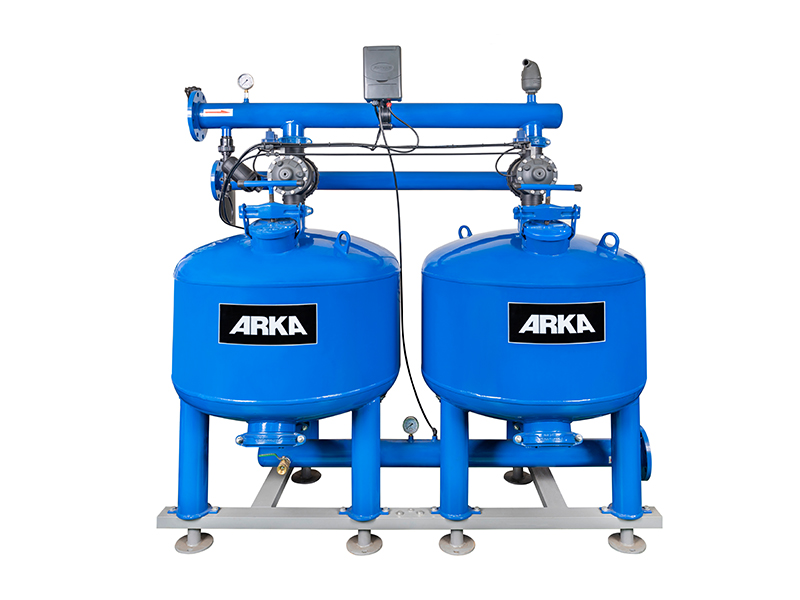
Even the heaviest steel tanks face occasional mechanical hiccups. Diagnosing these anomalies fast saves your drip lines and prevents cascading network failures.
Is your system flushing every twenty minutes? The raw water source might be temporarily ruined by heavy runoff from a summer storm. The equipment is simply doing its job trapping the massive surge of mud. However, if the river looks clear, check your media. Pouring sand that is too fine causes instant surface blinding. Alternatively, the differential sensor tubes might be plugged with micro-debris. Flush the sensor lines regularly. This basic maintenance step keeps your water treatment filter reading accurate data and prevents panic signals to the controller.
Channeling is a catastrophic structural failure. High-velocity water cuts direct tunnels straight through the silica bed. Biological slime and agricultural oils chemically glue the sand grains together into concrete-like boulders. The reverse hydraulic flow cannot lift these heavy clumps. Consequently, unfiltered water bypasses the media entirely. Depressurize the vessel immediately and open the top hatch. If the sand feels like solid rock, you must evacuate it entirely and pour fresh media.
Finding sharp grit inside your micro-sprinklers means severe internal damage. The crushed silica sits securely on top of delicate plastic laterals at the bottom of the tank. These underdrains feature microscopic slits designed to hold the sand back. If sand escapes, a lateral has cracked or shattered. This is usually caused by violent water hammer or ignoring extreme pressure differentials. Isolate the affected tank. Vacuum out the bed. Replace the broken laterals before restarting your main pump.
Making smart procurement decisions requires looking objectively at both strengths and physical limitations.
Recent agricultural engineering data highlights a massive industry shift. Global climate changes are causing prolonged seasonal droughts. Consequently, surface water reservoirs are shrinking rapidly. This drastically increases the concentration of algae, suspended solids, and organic slime in the remaining water. Farm operators are aggressively migrating away from traditional single-plane screens. The modern agricultural sector demands high-capacity depth filtration to handle these massive organic loads without bankrupting the farm on manual labor costs.
Depth filtration traps dirt throughout the entire vertical volume of the bed. It does not suffocate on a flat surface. A properly manifolded multi-tank setup isolates one vessel for cleaning while the others continue to feed the fields. This continuous flow prevents dangerous pressure drops at the emitter level.
| Filtration Technology | Dirt Holding Capacity | Best Water Source | Maintenance Need |
|---|---|---|---|
| Sand Media Filter | Extremely High via True Depth | Rivers, Canals, Open Reservoirs | Automated, Very Low |
| Screen Filter | Low via Surface Mesh | Clean Wells, Municipal Water | Frequent Manual Scrubbing |
The main drawback is the flush water volume. Lifting heavy wet sand requires serious flow. Smart operators build a dedicated settling pit next to the pump station. The dirty discharge settles in the pit over time. The clarified water is then safely recycled back into the primary reservoir. Additionally, an irrigation sand filter requires a reinforced concrete pad due to its massive operational weight. Proper site planning is non-negotiable.
Guessing your tank size leads to chronic pressure loss. You must calculate the exact flux rate. This metric measures how much water passes through one square foot of sand per minute.
For dirty canal water, you must deliberately slow the water down. This gives the sharp edges of the sand time to grab the organic slime. For example, deploying an F40 series automatic self-cleaning system utilizing a 1000mm diameter tank provides massive internal surface area. This specific engineering allows operators to process high flow rates while maintaining a low, highly efficient flux rate. Sizing up the tank diameter prevents the entire system from being overwhelmed by sudden seasonal algae blooms.
Never use smooth construction sand. It causes instant channeling. You need precisely crushed silica with jagged edges. The global industry standard is number 16 crushed silica. It effectively traps particles down to 15 microns. This perfectly protects standard drip tape. If your fields use highly sensitive ultra-low-flow emitters, upgrading to number 20 silica provides even tighter filtration. Always match the media grade directly to your specific sand media filter hardware specifications.
Unplanned pump downtime directly translates to drought stress and lost revenue. Upgrading your infrastructure to handle brutal surface water realities is a necessary yield-protection strategy. Fully automated daily cleaning keeps the network pressurized even during severe summer algae blooms.
Ready to completely eliminate manual scrubbing and protect your expensive drip lines? Evaluate your total flow requirements and your primary water source. Then, deploy a heavy-duty backwash sand filter engineered for continuous agricultural demands. Visit Arka Irrigation to find the exact industrial configuration that fits your farm's unique hydraulic profile.
Replace the media entirely every 3 to 5 years. High calcium hardness or heavy agricultural oils cause faster calcification. In harsh environments, inspect the bed annually to prevent channeling and maintain proper flow rates.
It requires high flow to lift the bed, but this water is easily recovered. Routing the discharge pipe to a settling pond allows the heavy solids to drop out. The clean water is then recycled. The massive labor savings far outweigh this managed water use.
Yes, by utilizing a multi-tank manifold. The smart controller isolates one vessel at a time. The active tanks maintain field pressure and supply the clean reverse flow needed to purge the isolated unit.
Generating enough hydraulic lift to suspend heavy wet silica requires a minimum sustained pressure of 30 to 40 psi at the discharge manifold. Dropping below this threshold leaves mud trapped deep in the media bed, leading to rapid clogging.
Rapid pressure loss across the manifold indicates the media is blinding over. This happens when the raw water suffers a sudden spike in suspended solids, or if the selected silica grade is far too fine for your specific water profile.


