
Views: 0 Author: Site Editor Publish Time: 2026-10-19 Origin: Site


Are clogged filters halting your water system? Heavy sand acts like liquid sandpaper on delicate internal components. Pump impellers degrade rapidly. Precision valves stick. Consequently, operations suffer from costly downtime, frequent repairs, and entirely avoidable resource waste. Centrifugal filtration offers a scientifically sound, low-maintenance fix to this pervasive engineering issue.
In this comprehensive guide, we explore the exact fluid dynamics that make phase separation so effective. We will cover practical field applications and provide a strict, engineering-based approach to choosing the right equipment for your specific fluid management needs.
Let us look directly at the underlying mechanics of phase separation. A centrifugal filter is a specialized mechanical device that harnesses rotational force to separate suspended solid particles from a liquid stream. In stark contrast to conventional methods that force water through a porous mesh to trap contaminants, this technology relies entirely on fluid dynamics.
Fundamentally, it is strictly a physical separation process. The system leverages the variance in density between the water and the suspended solids. Dense particles enter this spinning environment. Their mass causes them to react violently to the rotational forces, pushing them away from the clean water core. Understanding this concept is critical for facility operators, as it highlights exactly why these devices remain immune to the frustrating blinding issues that plague standard screens.
In the expansive fields of agricultural engineering and industrial water treatment, terminology frequently shifts based on the application at hand. Therefore, these devices are routinely referred to as hydrocyclones or sand extractors.
While the nomenclature fluctuates, the structural geometry and separation principles remain identical. The term hydrocyclone is heavily utilized in chemical engineering contexts, emphasizing the cyclonic action of the fluid itself. Conversely, agricultural sectors prefer terms referencing the device's primary field duty of extracting heavy grit from well water. Recognizing these alternative names is essential when reviewing technical specifications.
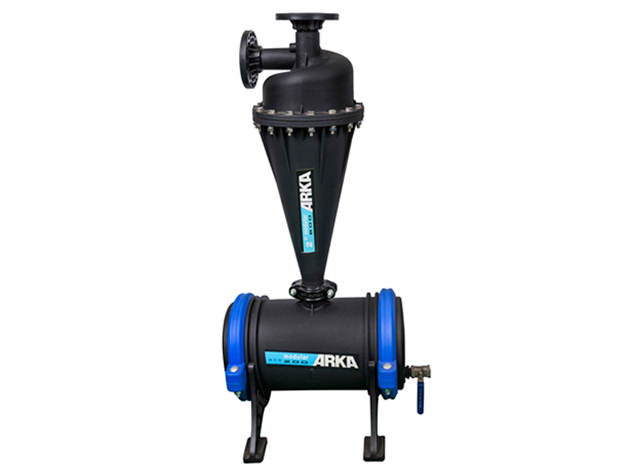
The operational efficiency of this equipment is dictated by the unforgiving laws of fluid mechanics. The core mechanism begins with a unique geometric architecture. This typically features a cylindrical upper section that smoothly tapers down into a conical lower chamber.
Crucially, water does not flow straight through this housing. Instead, it is pumped into the chamber tangentially. It enters at an angle along the inner wall rather than directly at the center. This tangential entry forces the incoming pressurized water to travel in a sweeping, circular path. As the fluid velocity increases within the confined space, it generates a powerful, high-speed vortex. Think of it as a controlled high-speed cyclone trapped inside a steel or polyamide housing. The rotational speed generates outward forces many times greater than standard gravity.
The physical extraction of contaminants unfolds through a highly predictable hydrodynamic sequence.
Raw water sources such as deep aquifers and open reservoirs carry immense loads of inorganic particulate matter. Pumping untreated, grit-filled water directly into a fine mesh or disc filter guarantees catastrophic failure.
For this exact reason, integrating a robust irrigation pre-filter is an engineering necessity. Fine filters are meticulously designed to capture microscopic organic matter and silt. They are simply not built to handle continuous volumes of abrasive sand. Under heavy sediment loads, a primary mesh filter will blind within minutes. This triggers severe pressure drops and forces the system into continuous backwash cycles. Installing a cyclonic unit upstream proactively intercepts up to 98 percent of the heavy particulate mass before the water ever reaches the delicate primary barrier.
Modern precision delivery networks rely on extremely tight tolerances. Drip emitters and micro-sprinkler nozzles feature exceptionally small orifices, often measuring between a microscopic 0.5mm and 2.0mm in diameter.
Furthermore, when abrasive grit bypasses the pump station, it scours the internal impellers of expensive water pumps. This drastically reduces their hydraulic efficiency and overall lifespan. As sand travels down lateral lines, it accumulates at the ends and violently lodges into the intricate labyrinth pathways of drip emitters. This causes irreversible blockages, localized drought stress on valuable crops, and the costly necessity of replacing miles of tubing. Pre-treatment eliminates this abrasive threat precisely at the source.
One of the most significant engineering advantages here is structural simplicity. Unlike automated screen systems that rely on internal motors, gears, and fragile meshes, a cyclonic unit has absolutely no moving parts.
This distinct absence of mechanical complexity translates directly into extreme durability and an exceptionally high Mean Time Between Failures. There are no screens to tear and no bearings to lubricate. The equipment operates flawlessly in harsh environments for years with virtually zero degradation in performance. The only required maintenance involves the periodic evacuation of collected debris from the bottom bowl. This simple purge process can easily be fully automated with a timer-based valve, rendering the system practically maintenance-free.
Traditional barrier filters inherently restrict flow as they capture debris. As the filter cake builds up, the entire plumbing network experiences a severe pressure drop. Eventually, the pump must shut down or divert flow to initiate a rigorous backwash cycle.
A centrifugal sediment filter circumvents this operational bottleneck entirely. Separation occurs dynamically within the fluid vortex. Debris is continuously pushed out of the flow path into an isolated collection zone. Because there is no physical barrier to clog, the device guarantees continuous, uninterrupted water flow. Operators no longer have to halt critical schedules to clean a blinded screen.
Every single time a traditional barrier begins to clog, the main water pump must work exponentially harder to push fluid through the restriction. This spikes the dynamic head pressure, causing a massive surge in electrical energy consumption.
By maintaining a consistent, low-pressure drop across the entire system, cyclonic separation ensures pumps operate exactly at their peak efficiency curve. This drastic reduction in hydraulic resistance translates to noticeably lower monthly electricity bills. More importantly, preventing abrasive wear saves thousands of dollars in replacement parts and emergency maintenance labor.
As global water scarcity intensifies and environmental regulations tighten, the broader water treatment industry is witnessing a massive paradigm shift. Recent market analyses and engineering trends indicate a rapid departure from high-waste, backwash-heavy methods. Instead, industrial and agricultural sectors are aggressively adopting passive, continuous-flow separation technologies.
The driving force behind this trend is the urgent mandate to minimize water loss while maximizing energy efficiency. Flushing traditional media tanks wastes thousands of gallons of process water. In contrast, cyclonic separation requires zero backwash water. It loses only a tiny fraction of fluid during the brief sediment purge. Because it drastically reduces liquid waste and lowers dynamic head pressure on pumping stations, this technology aligns perfectly with modern Environmental, Social, and Governance mandates. It is rapidly becoming the standard in forward-thinking, zero-liquid-discharge facility designs.
Specifically, when evaluating water treatment architecture, engineers must understand that centrifugation and traditional barriers serve entirely different physical purposes. They operate on completely different scientific principles.
| Feature | Cyclonic Separation | Traditional Screen Mesh |
|---|---|---|
| Separation Principle | Density and Specific Gravity | Physical Size and Micron Rating |
| Target Contaminants | Heavy inorganic solids like sand and scale | Light organics, algae, and fine silt |
| Clogging Potential | Virtually zero | High and requires frequent cleaning |
| Pressure Drop | Constant and predictable | Increases rapidly as debris builds up |
| Water Waste | Minimal purge loss | High backwash volume required |
Screen filters excel at enforcing a strict micron cutoff. However, they fail rapidly under heavy sediment loads. Centrifugal units handle massive volumes of heavy debris effortlessly but will allow lightweight organic matter like algae to pass straight through. This happens simply because organic density is too close to that of water.
From a comprehensive design perspective, it is never a rigid choice between the two. The most resilient water treatment systems utilize a multi-stage, hybrid approach.
The scientifically optimal configuration places a separator at the immediate point of intake. This acts as the heavy-duty vanguard, violently stripping 90 to 98 percent of the abrasive mass from the stream. Once this brutal load is removed, pre-treated water flows smoothly into a secondary screen or media tank. Because the secondary stage is now only tasked with capturing lightweight organics, its operational lifespan extends exponentially.
While heavily associated with large-scale farming, this technology is a foundational cornerstone of modern industrial fluid management. Cooling towers act as massive, unintended air scrubbers. They constantly pull airborne dust, dirt, and industrial particulate matter from the surrounding environment.
If left unchecked, this abrasive debris settles in tower basins, creating a hazardous breeding ground for biological growth and causing severe scaling inside heat exchangers. Industrial operators deploy these systems to continuously filter recirculating cooling water. Extracting rust flakes and airborne particulates maintains critical thermal efficiency and drastically reduces reliance on harsh chemical treatments.
Deep underground aquifers shift dynamically, causing municipal wells to suddenly pump significant quantities of fine sand. If this abrasive grit reaches the main treatment facility, it can completely destroy expensive reverse osmosis membranes or permanently foul resin beds in industrial softeners. Installing large-scale desanders directly at the wellhead effectively strips sand from raw water before it enters the municipal grid.
Selecting the appropriate equipment is a critical engineering decision. Unlike traditional methods that block particles based on physical dimensions, this system relies entirely on fluid velocity. Consequently, the selection process requires a strict evaluation of operational parameters rather than merely matching pipe diameters.
The most detrimental mistake in designing a separation system is sizing the equipment based on existing pipeline diameter. The fundamental operation depends entirely on creating a high-velocity vortex.
If the selected unit is too large for your flow rate, water enters the chamber far too slowly. A slow entry velocity fails to generate the necessary centrifugal force. Heavy particles will not be pushed against the outer walls and will simply bypass the process. Conversely, if the unit is too small, excessive velocity creates a severe pressure drop, forcing pumps to work harder and potentially causing destructive cavitation.
You must precisely measure your system flow rate in Gallons Per Minute or Liters Per Hour under normal operating conditions. The goal is to select a unit where your normal flow falls squarely in the middle of the manufacturer recommended range.
For instance, modern agricultural setups often utilize a hydrocyclone filter manufactured from lightweight engineered polyamide. A 3-inch nylon model is specifically designed for sediment extraction in irrigation, handling flows effectively while completely resisting fertilizer corrosion. For heavier industrial or municipal loads, robust carbon steel cyclone desanders coated with anti-corrosive epoxy remain the industry standard.
Understanding the specific gravity of the exact contaminants in your water source is paramount. Specific gravity is the ratio of the density of a substance to the density of water.
Because a sand separator utilizes rotational mass, it is only effective against particles significantly heavier than the carrier fluid. As a standard engineering rule, this method is highly effective for inorganic particulates with a specific gravity of 1.5 or greater. Common silica sand typically has a specific gravity around 2.65. This high density makes extraction exceptionally efficient, often achieving removal rates above 95 percent.
However, organic materials such as leaves and algae possess a specific gravity very close to 1.0. Because they weigh roughly the same as water, rotational force cannot push them out of the fluid stream. They will remain suspended and carry over into the clean water outlet.
This technology represents a highly efficient, physics-driven solution for managing heavy particulate loads in complex fluid systems. By intelligently harnessing the raw power of fluid dynamics, these devices achieve exceptional separation rates without the inherent flaws of physical barrier filters.
Stop letting abrasive grit destroy your infrastructure. Evaluate your flow rates, determine your specific gravity, and upgrade your pre-treatment architecture today. For precision-engineered solutions, explore the full range of high-performance separation equipment at Arka Irrigation to find the exact match for your specific fluid management needs. Upgrading to professional-grade cyclonic filtration will drastically lower maintenance labor, reduce energy consumption, and significantly extend the operational lifespan of every delicate component downstream.
The primary purpose is to efficiently and continuously remove heavy, suspended solids from a liquid stream using applied rotational physics. By forcing incoming water into a high-speed vortex, the device utilizes outward force to push dense particles against the chamber walls, where gravity pulls them down into an isolated collection basin. It serves as a critical first line of defense to protect expensive downstream equipment like pump impellers and fine drip emitters.
No, it cannot remove dissolved solids, salts, minerals, or chemicals from water. The technology relies entirely on the variance in mass and density between suspended particles and the carrier fluid. Dissolved solids have dissolved at a molecular level and do not possess independent physical mass for a vortex to act upon. Processes like reverse osmosis or activated carbon are required for chemical purification.
The required cleaning frequency is entirely dependent on the specific sediment load of your water source and the total volume being processed. Because these devices do not utilize traditional screens, they never require full system shutdowns for backwashing. However, separated debris accumulates in a bottom chamber that must be emptied regularly. In environments with heavy particulate loads, manual purging may be required daily. To completely eliminate this labor, most modern units can be outfitted with an automated flush valve based on a set timer.
In the vast majority of professional applications, it is not recommended as a standalone solution. While incredibly efficient at removing large, abrasive inorganic materials, its strict reliance on specific gravity means lighter organic materials like algae and microscopic silt will easily pass right through the vortex. Engineering best practices dictate utilizing it specifically as a primary separation stage paired with a secondary fine mesh or disc filter.
Performance depends heavily on the specific gravity of the particle, but a properly sized unit will typically remove 95 to 98 percent of heavy sand and grit down to 70 or 75 microns. Particles smaller than this, or particles with a density very close to water, will largely remain suspended in the fluid stream and require a secondary barrier filter for complete removal.
No. When sized correctly according to your actual volumetric flow rate, a cyclonic separator will maintain a steady, predictable pressure drop, typically between 3 and 8 PSI. Unlike traditional mesh screens that choke the water flow and exponentially increase pressure resistance as they clog with debris, a centrifugal unit maintains continuous flow without restrictive pressure spikes.


