
Views: 0 Author: Site Editor Publish Time: 2026-10-19 Origin: Site


If you spend enough summers walking crop rows, you know the frustration. You check the field only to find wilting plants because the drip tapes are choked with fine grit. Clogged emitters, jammed sprinkler heads, and the endless chore of scrubbing mesh screens are universal headaches for farm operators. Well water, turbulent rivers, and open agricultural reservoirs frequently pull heavy sand, abrasive silt, and microscopic gravel. Without protection, this debris will devastate a delicate plumbing setup in days.
Mechanical separation steps in as your ultimate first line of defense. By installing a robust centrifugal filter at the head of your water source, you intercept destructive grit before it ever reaches the field. Recent agricultural water management data points to a stark reality. Global aquifers are steadily declining. Farmers are increasingly forced to pump from shallower, sediment-dense zones. This shift in raw water quality makes upfront separation no longer just an optional upgrade, but a strict operational necessity. In this guide, we will break down exactly how this equipment operates, why it slashes maintenance costs, and how to select the precise unit to maximize your crop yields.
In modern agricultural and commercial landscape design, this equipment is a specialized, cone-shaped vessel built to extract heavy suspended solids from pressurized water. Traditional barrier filters physically trap debris against a microscopic mesh. In contrast, this unit utilizes rotational fluid mechanics to separate materials based strictly on their specific gravity.
Industry terminology often overlaps in the field. You will regularly hear professionals refer to this device as a hydrocyclone filter or a sand separator. From an engineering and system design perspective, these terms describe the exact same hardware. They can be used interchangeably without altering the system's intent.
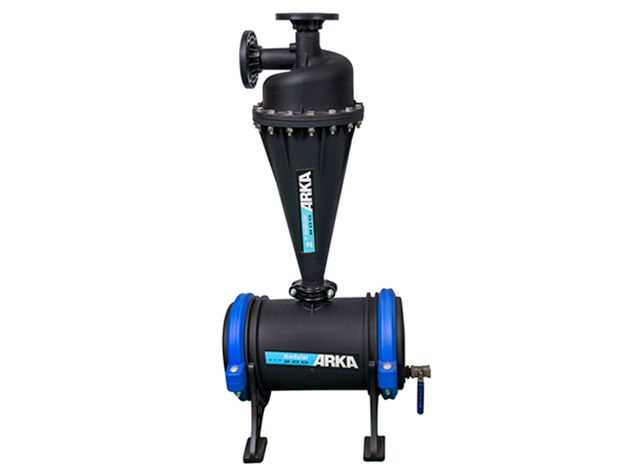
To grasp the separation process, you need to visualize the physical construction. A standard unit consists of four primary components engineered with precise internal geometry.
The Tangential Inlet: This is the entry point for pumped water. The inlet pipe is welded at an offset, tangential angle to the main cylindrical body rather than pointing directly into the center.
The Conical Body: The main chamber starts with a wide cylindrical top. It gradually tapers down into a steep, narrow cone, forcing the water into an increasingly tighter space.
The Vortex Finder: Positioned at the top center, this specialized draft tube extends slightly downward into the chamber. It acts as the exclusive exit route for clean water.
The Collection Chamber: Attached to the bottom apex of the cone, this sediment tank safely captures and stores the separated grit until an operator flushes the system.
Strategic positioning is critical. In a professionally designed layout, you install this equipment immediately after the main water pump and strictly before any fine filtration. It is not a standalone purifier for sensitive micro-irrigation. Instead, it serves as a dedicated irrigation pre-filter. Shouldering the heavy lifting right at the source prevents delicate downstream screens from blinding over within minutes of pump startup.
The purification process relies solely on the kinetic energy already generated by your main water pump. Let us break down how contaminated well water transforms into a usable resource.
The cycle initiates the moment pressurized water escapes the pump and enters the unit. The inlet pipe is positioned tangentially to the outer wall. This forces incoming liquid to flow aggressively along the curved interior surface. This specific entry angle prevents water from shooting straight across the chamber and immediately triggers a dynamic spinning motion.
Continuous water volume accelerates the rotational motion, generating a powerful vortex. Picture a controlled tornado inside the steel or nylon tank. As water pushes downward, it enters the conical section.
Fluid mechanics dictate that as the cone narrows, rotational velocity must increase dramatically to maintain the flow rate. This tight spinning generates immense centrifugal force. It pushes everything suspended within the water outward against the interior walls.
Filtration occurs right here, driven entirely by material density. Heavy silt and sand have a significantly higher specific gravity than water. Subjected to intense centrifugal force, these dense particles are forcefully flung outward. They break through the water's natural resistance and strike the inner walls.
Friction causes their rotational velocity to plummet upon impact. Gravity seamlessly takes over. It pulls the heavy sediment down the steep angle of the cone and deposits it safely into the collection chamber below.
While heavy debris pushes to the outside perimeter, the water must find an exit. As the primary downward vortex reaches the bottom boundary, continuous hydraulic pressure forces the liquid to reverse its vertical direction.
This abrupt reversal creates a tight, rapidly spinning inner column of clean water. It travels straight upward through the hollow center of the primary vortex. Since dense sediment was already ejected outward, this inner column is practically devoid of heavy grit. It travels up into the vortex finder and exits toward the secondary filters.
Building a resilient irrigation network requires understanding that different filtration technologies serve distinct mechanical purposes. Assuming one filter type handles all water quality issues is a costly field mistake.
| Feature | Centrifugal Separators | Screen & Disc Filters |
|---|---|---|
| Primary Target | Heavy inorganic matter like sand, silt, and gravel. | Light organic matter like algae, moss, and fine clay. |
| Filtration Method | Specific gravity and centrifugal force. | Physical barrier with microscopic pores. |
| Clogging Risk | Extremely low. No physical mesh to blind over. | High risk if exposed to heavy sand loads. |
| Maintenance | Minimal. Just purge the bottom collection tank. | Requires regular manual scrubbing or automated backwashing. |
For operations utilizing precision drip tape, these two technologies partner with one another. Pumping gritty water directly into a fine screen blinds the mesh in minutes. Deploying a centrifugal unit first extracts the bulk of the abrasive debris. This allows the downstream screen filter to focus exclusively on organics, drastically reducing maintenance intervals.
Modern micro-irrigation relies on emitters with incredibly narrow flow paths. A minimal accumulation of fine sand permanently blocks these channels. The result is uneven water distribution and devastating yield reductions. Removing up to 90% of suspended grit at the source ensures the physical integrity of your distribution lines.
From an operational expenditure standpoint, these devices are highly efficient. There are no internal impellers, delicate gears, or electrical sensors required for the basic separation process. The risk of mechanical failure is practically non-existent. Premium models, such as a high-grade nylon lightweight 3-inch hydrocyclone, offer exceptional durability against UV degradation and chemical corrosion in harsh field conditions.
Irrigation maintenance labor heavily impacts a farm's bottom line. Relying solely on a fine mesh filter in sandy conditions forces crews to constantly shut down and scrub screens. Integrating a sand separator dramatically reduces this burden. Routine maintenance involves briefly opening a bottom valve to purge dirt. It takes seconds and easily automates.
Suspended sand acts exactly like liquid sandpaper. It aggressively erodes PVC pipes, brass control valves, pressure regulators, and expensive pump impellers. Extracting this abrasive material early significantly extends the operational lifespan of all subsequent plumbing infrastructure.
Selecting equipment is a matter of fluid dynamics, not guesswork. A frequent mistake is purchasing a unit based solely on existing PVC pipe diameter. This approach guarantees poor performance.
The single most critical specification is matching the unit to the exact volumetric flow rate of your water pump. The underlying physics rely entirely on water velocity. For example, a standard 3-inch nylon hydrocyclone is typically engineered to process flow rates between 30 to 50 cubic meters per hour.
If you select a filter too large for your pump, water enters sluggishly. The vortex remains weak, centrifugal force drops, and sand floats right into your fields. Conversely, an undersized filter forces water through at extreme speeds. This causes an unacceptable pressure drop that starves downstream emitters. Always consult the manufacturer's performance curves.
Evaluate your contamination type before investing. Perform a simple bucket test. Fill a transparent 5-gallon bucket directly from your pump discharge and let it sit undisturbed. If a layer of sand or heavy flakes settles rapidly, a sediment filter based on centrifugal action will be highly effective. If the water remains cloudy with suspended fine clay, or if green biological matter floats, you need advanced media or disc filtration.
Generating a high-speed vortex requires kinetic energy. A pressure drop across the unit is a strict mechanical requirement, not a defect. Most high-quality units require a deliberate pressure drop of 3 to 8 PSI to achieve optimal separation. Verify your main pump has enough head pressure to accommodate this minor loss while still delivering required operating pressure to the field.
Even perfectly sized equipment fails if installed incorrectly. Simplicity demands strict adherence to basic engineering principles during setup.
Physical orientation is non-negotiable. The unit must be installed perfectly plumb. Separation relies on centrifugal force, but it relies entirely on gravity to pull sand down into the tank. If the cone tilts even slightly, heavy particles hit the side and sweep right back up into the clean water vortex.
Furthermore, provide a straight run of pipe immediately preceding the inlet. Typically, a straight run of five to ten times the pipe's diameter stabilizes water turbulence before it enters the tangential inlet. Avoid installing 90-degree elbows directly against the filter.
The bottom collection chamber must be emptied regularly. If the tank fills completely, accumulated sand sucks directly back into the clean water line. For manual purging, simply open the bottom ball valve while the system is fully pressurized. Let dirty water run until the discharge turns clear. For commercial operations, upgrade to a battery-powered automated flush valve to make the system completely hands-off.
Effective water purification boils down to practical physics. Utilizing centrifugal force and specific gravity allows you to separate destructive sediment from clean water effortlessly. By forcing incoming water into a high-speed spin, these rugged devices remove abrasive debris without relying on delicate meshes or vulnerable electrical components.
For professionals drawing irrigation water from sandy wells or turbulent reservoirs, mechanical separation is a mandatory baseline defense. It protects expensive downstream equipment, slashes manual labor, and ensures micro-irrigation systems deliver uninterrupted hydration. Evaluate your current water source today. If sand is eating your profits, upgrade your primary filtration with reliable, precision-engineered solutions from ARKA Irrigation to secure your agricultural infrastructure.
No. The physics rely entirely on particle density. Algae, moss, and leaves have a specific gravity very similar to water. Because they are light, centrifugal force will not push them to the outer walls. They remain suspended and exit through the top. You must utilize a secondary screen or disc filter to capture biological organics.
No. The device requires absolutely no external power source. It operates purely on the kinetic energy and hydraulic pressure generated by your existing water pump. Electricity is only introduced if you install an automated, timer-based flushing valve on the bottom tank.
These devices do not use a physical mesh, so they are not strictly rated by microns. Instead, performance is based on specific gravity. A properly sized unit will typically remove 90% of sand and inorganic particles larger than 75 microns. Anything finer or lighter requires a downstream barrier filter.
Water loss is exceptionally minimal. Unlike massive sand media tanks that require hundreds of gallons to backwash, purging a hydrocyclone only releases the small volume of water and trapped dirt inside the bottom collection chamber. A typical flush takes less than ten seconds.
Generally, no. It serves as a standalone filter only in large-nozzle applications like heavy flood irrigation where fine particle clogging is irrelevant. For any modern setup utilizing precision drip tape or micro-emitters, it must be deployed strictly as a pre-filter alongside a fine mesh or disc filter.


