
Views: 0 Author: Site Editor Publish Time: 2026-10-19 Origin: Site


Clogged drip emitters are a nightmare for any farm operation. Algae, silt, and organic matter ruin harvests and destroy expensive irrigation networks. Modern precision agriculture demands pristine water to deliver nutrients accurately. Global water scarcity pushes more farms to rely on lower-quality surface water like canals and retention ponds. This shift brings a massive increase in organic loading. Relying on basic mesh screens for surface water is a guaranteed path to system failure. Robust deep bed filtration is non-negotiable. An irrigation sand filter solves this problem by catching the soft, sticky debris that ruins agricultural equipment.
How does the water actually get clean? It is not just a simple sieve. The tank acts as a three-dimensional maze. Dirty water enters the top of the vessel under pressure. It hits a diffuser plate. The diffuser spreads the flow evenly across the entire surface of the media bed. This prevents the water from drilling a hole straight through the middle.
The water travels slowly downward. Suspended solids get trapped in the microscopic spaces between the sharp crushed rock grains. We call this depth filtration. The top layer catches the large debris. The deeper layers trap microscopic silt and organic matter. This mechanism captures sticky algae that easily slips through standard mesh screens. Clean water then passes through specialized underdrain nozzles at the bottom and heads out to the fields.
Over time, the media bed captures a massive amount of dirt. The pressure drop across the tank increases significantly. If you ignore this pressure drop, flow decreases and the irrigation pump burns out. The engineering solution is flow reversal.
Clean water is forced upward from the bottom of the tank. This upward force expands the media bed. The trapped dirt breaks loose from the rock grains and flushes out through a designated waste valve. An automatic sand filter handles this seamlessly. It uses pressure differential switches to trigger the cleaning cycle. You do not need a technician standing in the mud turning heavy valves every few hours.
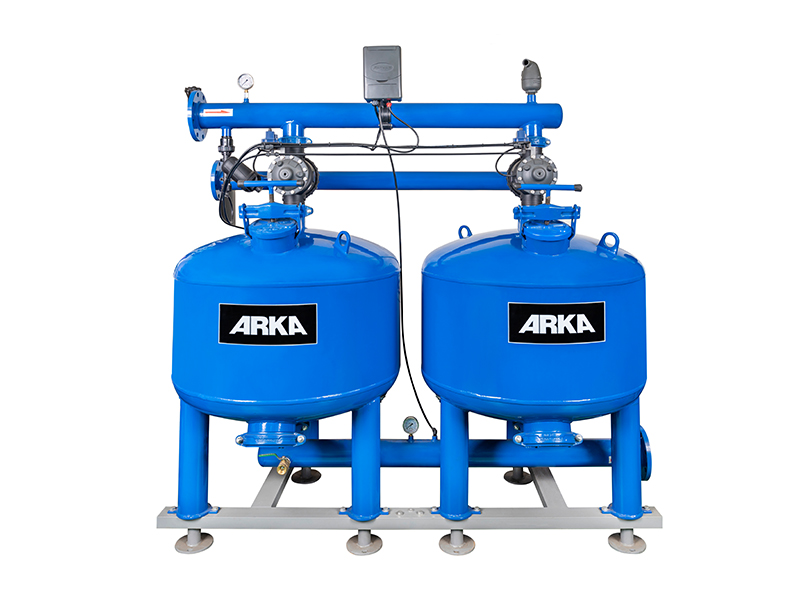
Generic advice falls apart when you are designing a 50-hectare drip system. I always point clients to equipment built for heavy duty cycles. Take the ARKA F40-2-1000mm system as a prime example of field-tested engineering.
This unit features a 40-inch tank diameter. That provides a massive surface area for high-flow scenarios. The system easily handles flow rates up to 100 cubic meters per hour. It operates safely up to 8 bar of pressure. The tanks are constructed from high-grade carbon steel coated with anti-corrosion epoxy. This ensures longevity even in harsh, humid agricultural environments. When dealing with heavy algae loads, a robust sand media filter prevents catastrophic emitter clogging and keeps the farm running.


