
Views: 0 Author: Site Editor Publish Time: 2026-10-17 Origin: Site


You invested heavy capital into a commercial irrigation layout. You meticulously piped in a primary filter. Yet, you still walk the field to find bone-dry root zones and stubbornly blocked emitters. As an irrigation engineer, I see this frustrating scenario daily across both backyard setups and massive agricultural grids. Growers often assume a filter guarantees a pristine water line. That is a dangerous misconception. Standard screens only act as a physical sieve. They block large rocks but remain completely blind to microscopic threats. Let's break down the exact physical, biological, and chemical reasons behind these failures. I will also share field-tested troubleshooting steps to fix your system permanently.
Right now, the agricultural sector is facing a massive shift. Global water scarcity is forcing farm managers to abandon pristine municipal sources. Instead, operations increasingly rely on marginal water like reclaimed wastewater, agricultural runoff, and algae-heavy retention ponds. This transition introduces unprecedented loads of suspended solids and biological contaminants into irrigation manifolds. Consequently, the demand for advanced depth filtration has skyrocketed. Legacy screen filters simply cannot handle modern water quality challenges.
Believing that a basic filter offers foolproof protection is a fast track to crop failure. A standard drip line filter functions much like a kitchen colander. It relies on a woven mesh screen to block physical debris. However, this defense mechanism has rigid physical boundaries.
Filters are categorized by mesh or micron ratings. A higher mesh number denotes smaller and more restrictive holes per square inch. If a suspended particle is even slightly smaller than the mesh opening, it slips right through. Consequently, fine silt, clay particles, and microscopic organisms easily bypass standard screens. Once inside the lateral lines, these tiny invaders travel to the end of the tubing. The water velocity drops significantly at the end of the line. This allows debris to settle, clump together, and block the delicate labyrinth of the emitter. While a primary filter is an essential first line of defense, it is far from a magical cure-all.
| Filter Type | Mesh Size | Micron Rating | What It Catches | What Bypasses It |
|---|---|---|---|---|
| Coarse Screen | 40 Mesh | 400 Microns | Large sand, pebbles | Fine sand, silt, algae |
| Standard Screen | 120 Mesh | 125 Microns | Fine sand, organic matter | Clay, bacteria, dissolved minerals |
| Fine Disc | 150 Mesh | 100 Microns | Very fine sand, algae clumps | Dissolved iron, calcium, bacteria |
Inorganic particles remain the most obvious cause of flow restriction. Even with hardware in place, physical debris can still ruin your setup if the equipment is mismatched or poorly maintained.
Using the wrong filter size guarantees systemic failure. For instance, many agricultural well-water setups default to a coarse 40-mesh filter to prevent rapid clogging at the intake pump. But the vast majority of modern drip emitters require a much finer 120-mesh or 150-mesh rating. If your primary screen is too coarse, large grains of sand will continuously enter the lines. They will wedge themselves tightly into the tiny emitter pathways and stop the flow completely.
Filtration hardware requires regular inspection and gentle handling. When farmhands neglect maintenance, debris builds up heavily on the screen. This creates a massive pressure differential. Eventually, the sheer force of the water will tear the delicate stainless steel or plastic mesh. Even a pinhole tear compromises the entire zone. Raw unfiltered water will rush through and choke your downstream emitters.
Certain soil types present unique engineering challenges. Extremely fine silt and clay particles are often too small for standard commercial screens to catch. They travel freely through the mainlines until they reach the end of the drip tape. As the water flow slows down, these fine particles settle. They act like microscopic cement that gradually builds up inside the emitter labyrinth until flow ceases entirely.
Irrigation water from surface sources is teeming with microscopic life. These living organisms ignore physical barriers entirely, passing right through standard screens to wreak havoc downstream.
Microbes are present in almost all untreated water sources. Once they pass through the filter, they find themselves inside the drip tubing. This is a warm and dark environment often enriched with liquid fertilizers. It creates a perfect incubator. The bacteria multiply rapidly and secrete a sticky gelatinous slime known as biofilm. In well-water systems, iron bacteria are particularly notorious. They feed on dissolved iron and produce a thick rusty sludge. This biological buildup leads to severe emitter clogging, completely sealing off the tiny plastic orifices.
Surface water sources like ponds and retention basins introduce unique biological hurdles. Algae spores are microscopic and easily bypass mesh screens. If your drip tubing is laid on the surface and exposed to direct sunlight, translucent sections of the pipe act like a greenhouse. The spores bloom into massive green clumps. Furthermore, these clumps eventually break loose and travel down the line to plug multiple emitters simultaneously.
Chemicals dissolved in your water supply are entirely invisible to the naked eye. They are impossible to catch with a physical screen. They only reveal themselves when environmental conditions change.
Hard water is a silent killer for micro-irrigation. It carries high concentrations of dissolved calcium and magnesium. The problem manifests at the exact point of delivery at the emitter tip. As water drips out and meets the dry air, a fraction of it evaporates. This leaves the heavy minerals behind. Over a single season, this precipitates into a hard chalky white scale that crusts over the opening.
Similar to calcium, well water frequently contains heavy loads of dissolved iron. In its dissolved state, it flows effortlessly through the system. However, iron reacts aggressively when exposed to oxygen. The moment the water exits the emitter, the iron oxidizes. It instantly transforms into solid rust-colored flakes. Manganese behaves in much the same way, though it leaves behind a stubborn dark black residue.
Injecting liquid nutrients directly into the water stream is highly efficient but carries hidden chemical risks. Mixing incompatible fertilizers can trigger rapid chemical reactions. Specifically, combining calcium-based and phosphorus-based liquids will instantly form solid calcium phosphate. This compound precipitates directly inside the tubing and acts like synthetic sand. To avoid this disaster, always perform a small-scale jar test before mixing chemicals in your main tank.
Sometimes the threat does not come from the water source at all. Subsurface drip irrigation systems are buried underground. This protects them from UV damage and heavy machinery but exposes them to severe environmental intrusion.
When an irrigation cycle finishes and the pump shuts off, the water remaining in the pipes drains down to the lowest elevation of the field. This rapid draining creates a powerful negative pressure at the higher points of the system. This vacuum acts exactly like a syringe. It forcefully sucks surrounding mud and dirty water backward into the emitter. Over time, the internal labyrinth becomes packed solid with exterior soil.
Plants are remarkably aggressive when seeking hydration. During periods of drought, microscopic root hairs sense the localized moisture surrounding a buried emitter. They grow directly toward the source and eventually penetrate the tiny plastic openings. Once inside, the roots expand and create an impenetrable biological plug.
When facing persistent blockages, guessing the cause will only lead to wasted time and resources. A systematic engineering approach is required to identify whether the failure point is physical, biological, or chemical. By isolating the specific issue, you can apply targeted treatments rather than overhauling the entire system prematurely.
The first logical step is evaluating your primary defense. Check the pressure gauges across the filter housing. A pressure drop of more than 5 PSI across a clean filter usually indicates that the unit is severely undersized for your flow rate. Conversely, if there is zero pressure drop but emitters are still failing, the mesh is likely compromised. Open the housing and conduct a visual inspection under bright light. Look for microscopic tears in the screen, a coating of slimy biological growth, or chalky white calcification. What you find here dictates what is happening at the emitter level.
If the hardware appears intact, flushing the lateral lines provides direct visual evidence of what is bypassing your filtration. Open the end caps of several drip lines while the system is pressurized and catch the initial flush water in a clear container.
Red or brown sludge indicates oxidized iron or iron bacteria. Green stringy material confirms algae blooms or bacterial biofilm. Fine sand shows that physical debris is bypassing the screen. Milky water or white flakes point directly to calcium carbonate scale or incompatible fertilizer fallout.
To protect delicate irrigation investments, facility managers must transition away from outdated technology. Modern agriculture demands robust defense mechanisms at the pump station.
Screen filters are inexpensive and common, but they only provide surface filtration. They rely on a single two-dimensional layer of mesh. Under high water pressure, soft organic matter like algae and bacterial slime simply deforms and extrudes right through the holes.
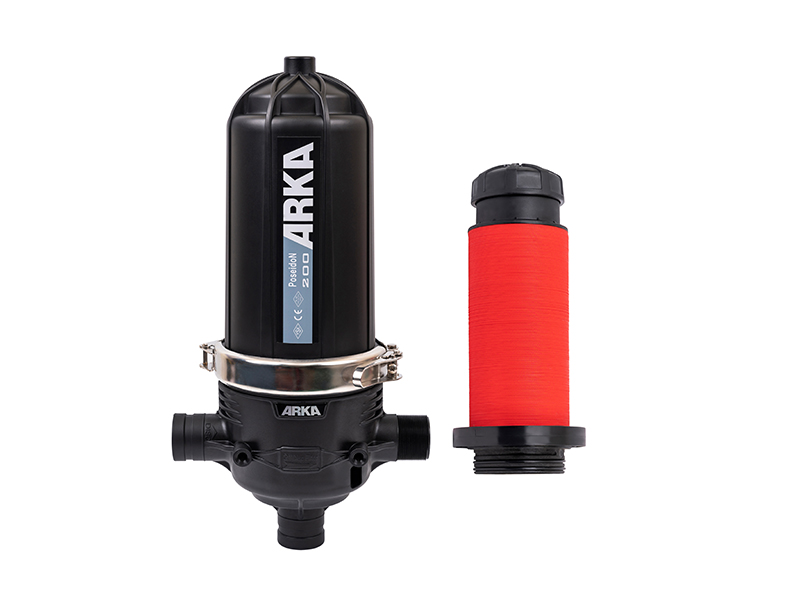
In contrast, disc filters offer a massive technological leap through depth filtration. They consist of hundreds of tightly stacked color-coded plastic discs with microscopic grooves etched into their surfaces. When compressed, these grooves intersect to create a complex three-dimensional maze. This design traps organic matter, fine silt, and algae deep within the filter matrix. It offers a significantly higher dirt-holding capacity and prevents soft debris from squeezing through.
Manual filter scrubbing is a tedious chore that farmhands often neglect. The most robust solution to eliminate blockages is transitioning to an automated system. By integrating advanced drip irrigation filtration technology, you remove human error entirely from the equation.
For example, upgrading to a commercial-grade 2-Inch Self-Cleaning Disc Filter fundamentally changes system reliability. These modern units feature a precise 120 mesh or 130 micron rating and can handle flow rates up to 25 cubic meters per hour. They utilize smart differential pressure sensors. When debris accumulates and pressure drops, the system automatically triggers a backflush cycle. The flow of water reverses, the discs decompress, and they spin rapidly. Centrifugal force ejects all trapped sand and biofilm out of a flush valve in mere seconds. This continuous automated cleaning ensures that the water entering your delicate emitters is consistently purified.
Even with the best hardware installed, water chemistry and biological factors can still develop downstream. Therefore, physical upgrades must be paired with a rigorous maintenance schedule.
Flushing physically expels the fine silt and biological slough that inevitably pass through over time. Mainlines and lateral lines should be flushed every two to four weeks during the growing season. To be effective, ensure the water velocity inside the tubing reaches at least 1.5 feet per second. This turbulence is absolutely necessary to scour the inner walls of the pipe and lift settled debris out of the end caps.
If your diagnostics revealed white scale or rust sludge, routine flushing will not suffice. You must dissolve the minerals chemically. Injecting mild agricultural acids lowers the water pH to around 2.0. Allowing this acidic solution to sit in the pressurized lines for an hour will dissolve hardened crusts inside the emitter labyrinths. Always follow up with a thorough clean-water flush.
To combat bacterial slime and algae, chlorination is the industry standard. Chlorine acts as a powerful oxidizing agent that destroys the cellular structure of contaminants before they aggregate. A shock treatment of 10 to 20 ppm injected for 30 minutes at the end of an irrigation cycle is highly effective. Never mix chlorine and acid in the same injection tank because this creates a highly toxic gas.
Dealing with blocked emitters despite having a filter installed is a complex engineering problem. It is rarely just one issue. Rather, it is a combination of physical bypasses, dissolved chemical precipitation, biological growth, and environmental factors like soil ingestion.
By understanding these hidden threats, you can move away from guesswork and implement targeted solutions. Upgrading to a high-capacity depth-filtering disc system provides the robust defense your setup desperately needs. If you are tired of manual scrubbing and crop loss, it is time to evaluate your pump station hardware. Choosing a reliable drip irrigation filtration unit from Arka will eliminate chronic clogs and keep your irrigation system running flawlessly season after season.
No, increasing pressure is not a solution and can actually cause massive damage. Drip emitters are pressure-compensating or rated for specific low-pressure ranges, typically between 15 and 30 PSI. Forcing high-pressure water through clogged lines will not blow out the debris. Instead, it will blow off pipe fittings, rupture the drip tape, or extrude soft organic matter completely through your filter screens.
The clearest indicator of an undersized filter is a rapid pressure drop shortly after cleaning. If you clean the unit and the pressure differential exceeds 5 PSI within just a few days of normal operation, the filter lacks the surface area to handle your flow rate or water dirt load. You need to upgrade to a higher-capacity housing or switch to a multi-unit disc filter manifold.
The cleaning frequency depends entirely on your water source and filter type. As a general rule, manual screen filters should be visually inspected and cleaned weekly during peak irrigation season. However, the most accurate metric is pressure. You should clean the filter whenever you observe a pressure drop of 3 to 5 PSI across the unit. To eliminate this manual labor entirely, upgrading to an automated self-cleaning model is highly recommended.
Yes, white vinegar is essentially acetic acid and can effectively dissolve minor calcium carbonate scale buildup. If you have removable emitters, soaking them in a half-and-half solution of vinegar and water for a few hours will break down the crust. However, for large-scale systems or inline drip tape where emitters cannot be removed, injecting stronger agricultural acids directly into the mainline is required to clear whole-system chemical clogs.
Green slime is a clear indicator of algae blooms. These are incredibly common when pulling irrigation water from surface sources like ponds, lakes, or open reservoirs. Sunlight exposure on translucent pipes accelerates this growth. Screen filters are poorly equipped to handle algae because the soft slime pushes through the mesh under pressure. To resolve this, switch to a disc filter for depth filtration and implement routine chlorine injection.
There is no single best size. It must match your specific emitter requirements. Most standard drip emitters require filtration between 120 and 150 mesh, which translates to roughly 130 to 100 microns. Using a filter with a lower mesh number such as 40 mesh allows damaging particles to pass through. Always consult the technical specifications provided by your emitter manufacturer to ensure your filtration matches their exact labyrinth tolerance.


