
Views: 0 Author: Site Editor Publish Time: 2026-10-16 Origin: Site


Every seasoned irrigation engineer knows a hard truth. Pumps push water, but filters protect the entire investment. You can install the most advanced drip lines and high-efficiency pumps available today. However, if your filtration setup is inadequate, your emitters will clog. Your crop yields will drop. Your maintenance costs will skyrocket.
Global agricultural trends currently show a massive shift toward climate-resilient farming. Extreme weather and severe water scarcity force growers to rethink their water management. Industry data indicates a rapid move away from labor-intensive manual setups. Modern farms now demand smart, automated solutions that can handle poor water quality without constant human intervention. Choosing the right equipment is no longer just about catching dirt. It is about maximizing water productivity and lowering long-term operational costs.
When evaluating options for your farm, looking at a basic spec sheet is never enough. You must analyze how the equipment behaves under real-world field conditions. Here are the core specifications you must compare before making a purchase.
Many buyers make a critical mistake right at the beginning. They match the filter's maximum flow rate exactly to their pump's maximum output. In practice, this leaves zero margin for error. As debris builds up on the filtering element, the effective flow rate drops rapidly.
You need to calculate your peak irrigation demand and then add a safety margin of at least twenty to thirty percent. If your field requires a steady flow of 100 cubic meters per hour, do not buy a unit rated for exactly 100. Look for a system that handles 120 or more. This ensures your drip lines remain fully pressurized even when the water source gets exceptionally muddy after heavy rainfall.
Furthermore, capturing debris efficiently requires understanding particle sizes. Filtration degree is usually measured in mesh or microns. The specific emitter type you use dictates the required micron rating. Micro-sprinklers might tolerate 200 microns. Precision drip tape with complex labyrinths absolutely requires 120 to 130 microns.
Choosing a reliable agriculture water filter means matching this rating perfectly. If the filtration is too coarse, sand and algae will bypass the barrier and plug your emitters permanently. If it is too fine, the system will blind over too quickly, triggering constant cleaning cycles and wasting valuable water.
Catching dirt is only half the battle. Pushing water through that dirt requires pressure. Every piece of equipment creates resistance, known as head loss. As the element gets dirty, this resistance increases.
You must check the clean pressure drop specification. A high-quality unit should have a minimal pressure drop when clean, typically under 0.2 bar. High head loss forces your irrigation pump to work harder. This consumes significantly more electricity or diesel over a growing season. Always ask the manufacturer for the pressure loss curve, not just a single static number.
Specifically, how does the equipment handle a sudden spike in dirt load? Manual screens require a worker to physically open the housing and scrub the element. In modern commercial farming, this labor cost is completely unsustainable.
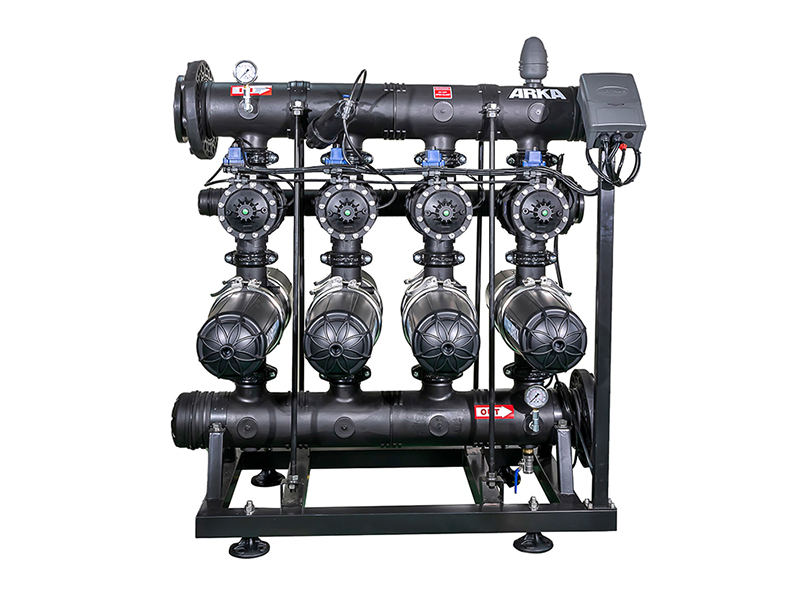
This is where engineering advancements change the game. Consider a multi-unit automatic self-cleaning disc configuration. For example, a 4-unit automatic self-cleaning disc setup utilizes differential pressure sensors. When the pressure drops across the discs, the system automatically reverses the flow. It spins the discs apart, blasts them clean with high-pressure water, and returns to normal operation in seconds.
Investing in this type of advanced agriculture water filter system guarantees uninterrupted flow. It eliminates the need for manual scrubbing and protects your crops during critical watering windows.
Irrigation water is rarely pure. It often contains harsh minerals, agricultural chemicals, and liquid fertilizers. Traditional metal housings rust. Even galvanized steel eventually succumbs to aggressive fertigation mixes.
Look for construction materials engineered for harsh environments. High-grade reinforced polyamide or industrial-strength polypropylene are the modern standards. These synthetic materials resist UV degradation, withstand high pressure, and remain completely immune to fertilizer corrosion. A rugged housing ensures your investment survives a decade in the sun rather than cracking after two seasons.
In addition, space inside a pump house is always at a premium. Bulky, outdated equipment makes maintenance a nightmare. Modern engineering favors modularity.
A manifold-based design allows you to fit high-capacity filtration into a tight footprint. If you expand your field next year, a modular setup lets you simply add another unit to the existing manifold. You do not need to tear out the entire plumbing system. Check the inlet and outlet orientations before buying to ensure they align naturally with your mainlines.
Finally, do not fall into the trap of only looking at the initial purchase price. A cheap manual unit carries hidden costs. You will pay for the labor to clean it. You will pay for crop losses when someone forgets to clean it and the emitters clog.
Calculate the total cost of ownership over a five-year period. An automated system requires a higher upfront investment. However, the savings in maintenance labor, reduced pump energy consumption, and extended drip line lifespan usually pay for the upgrade within the first two growing seasons.
To make the selection process easier, here is a direct engineering comparison of common technologies used in the field today.
| Feature | Manual Screen | Manual Disc | Automatic Self-Cleaning Disc |
|---|---|---|---|
| Debris Handling | Low to Medium | Medium to High | Extremely High |
| Labor Requirement | Very High | High | Minimal |
| Water Efficiency | Fair | Good | Excellent |
| Ideal Application | Small plots, clean well water | Medium farms, moderate organics | Commercial scale, surface water, fertigation |
| Lifecycle Cost | High hidden labor costs | Moderate | Lowest long-term cost |
The most reliable indicator is a pressure differential. Install two pressure gauges, one before the unit and one after. If the downstream pressure drops significantly compared to the upstream pressure, the element is blinding over. A difference of 0.5 bar or more usually means immediate cleaning is required. Automated systems monitor this differential electronically and trigger self-cleaning cycles without human intervention.
Screens use a single layer of mesh to block particles. They work well for hard, inorganic debris like sand. Discs consist of stacked, grooved rings that create a three-dimensional filtration matrix. This depth filtration is vastly superior for capturing organic matter like algae and slime. Organic debris easily squishes through a flat screen but gets trapped deep within the grooves of a disc stack.
Securing your water supply requires commercial-grade engineering. Do not let poor water quality dictate your crop yield. Evaluate your flow rates, assess your dirt load, and factor in the rising cost of farm labor. Moving to an automated setup is the most effective way to future-proof your farm.
If you are managing complex drip lines or pulling water from challenging sources like canals or reservoirs, you need equipment designed for heavy-duty continuous operation. Explore professional-grade solutions and upgrade your infrastructure with an Automatic Self-Cleaning Disc Filter System for Drip Irrigation from ARKA. Protect your emitters, save labor, and ensure every drop of water counts toward your harvest.


