
Views: 0 Author: Site Editor Publish Time: 2026-10-16 Origin: Site


Are clogged emitters ruining your harvest? You might be seeing dry spots and mounting maintenance bills. Poor water quality is often the leading culprit behind irrigation failure. Yet, many growers and landscapers still rely on a one-size-fits-all approach to cleaning their water. The reality is harsh. A single filter type will fail if mismatched with its environment. To guarantee a flawless and low-maintenance setup, you must align your equipment directly with your specific water source.
In this guide, we break down the exact technologies. We will look at everything from basic screens to advanced disc and sand configurations. We will pair them with their ideal applications to ensure you make the smartest purchasing decision for your fields.
When designing an agricultural or commercial watering setup, the purification unit is frequently treated as an afterthought. It is just a box to check off the equipment list. However, field experience shows that particulate accumulation is the primary driver of system degradation. Selecting the correct irrigation filter is not merely about keeping water visually clear. It is a fundamental engineering requirement for operational longevity.
Microscopic debris systematically suffocates your harvest by blocking flow at the exact point of emission. Picture a high-density tomato field in mid-July. When a single emitter clogs, that specific plant experiences immediate drought stress. In large-scale operations, even a minor five percent clogging rate can lead to devastating yield reductions. Proper equipment intercepts these particulates before they ever reach the narrow labyrinths of drip tapes or the delicate nozzles of sprinkler heads.
Beyond plant health, your filtration acts as the frontline defense for your entire hydraulic infrastructure. Sand, silt, and calcified scale are incredibly abrasive. When these hard materials pass through unregulated, they act like liquid sandpaper. They accelerate the wear and tear on expensive components. Unfiltered water will erode the internal rubber seals of solenoid valves and chew through the impellers of booster pumps. It completely compromises the accuracy of pressure regulators. By trapping these abrasives early, you extend the operational lifespan of your hardware and slash annual maintenance budgets.
Clean lines are absolutely essential for maintaining optimal hydraulic dynamics. When debris builds up inside lateral pipes or emitters, it creates artificial friction. This leads to severe pressure drops. Consequently, plants near the pump receive a deluge of water, while those at the end of the line are left starving. Furthermore, forcing water through these partially clogged lines makes your pumps work overtime, directly inflating your electrical or fuel consumption.
Before looking at a product catalog, conduct a thorough assessment of your water source. The efficiency of any cleaning mechanism is entirely dictated by the physical and biological characteristics of the fluid it processes.
Surface water presents a notoriously complex challenge. They have constant exposure to sunlight, shifting weather patterns, and agricultural runoff. This water is typically characterized by massive biological and organic loads. It frequently contains blooming algae, bacteria, moss, decaying leaves, and microscopic aquatic organisms.
Heavy spring rainfall can instantly introduce high levels of suspended solids like mud and clay. The core challenge here is that organic matter is soft and malleable. When pushed against a flat surface under high pressure, algae will easily smear, extrude, and slip right through basic flat screens. Therefore, surface water strictly requires three-dimensional depth filtration to trap debris across a thick matrix.
Well water is shielded deep underground away from sunlight. It rarely suffers from algae or heavy biological blooms. However, the geological formations it rests in present a drastically different set of hurdles.
Well water is predominantly burdened with hard, inorganic materials. Depending on the specific aquifer, it may pump fine sand, abrasive silt, small rocks, and dissolved minerals. In certain regions, iron bacteria is also a prevalent nightmare, manifesting as a sticky, rust-colored slime. Heavy sand loads can quickly overwhelm and tear delicate mesh if the velocity is too high. If a well is known to pump heavy sand, the bulk of the mass must be spun out before it reaches the primary unit.
Many urban farming operations, commercial greenhouses, and municipal landscapes rely on city water or treated reclaimed wastewater.
While municipal water is treated at a facility and is relatively clean, its journey to your field is perilous. As it travels through miles of aging underground infrastructure, it inevitably picks up rust flakes, pipe scale, or chemical precipitates. Reclaimed water often carries higher dissolved solids than standard city water. The primary goal here is catching occasional, hard physical debris rather than battling continuous, heavy organic loads.
Specifically, understanding the mechanical principles behind the different technologies is crucial. The market primarily offers four distinct designs engineered to combat specific contaminant profiles.
These are the most common and straightforward devices used in basic agricultural and landscape setups. Water is forced through a woven mesh cylinder containing precisely sized holes. Any particle larger than the hole is trapped on the inside surface.
They are highly cost-effective, simple to install, and incredibly easy to wash out manually. They excel at stopping hard, inorganic particles like sand and gravel. However, because they rely on a single, two-dimensional surface area, they are easily blinded. Algae will quickly smear across the mesh, sealing the holes and causing rapid system failure.
This technology bridges the gap between simple screens and massive media tanks. It offers a highly efficient and compact solution. Instead of a flat mesh, this setup uses hundreds of tightly stacked, grooved plastic rings compressed together inside a heavy-duty housing. The intersecting grooves create a complex, tortuous network of microscopic pathways.
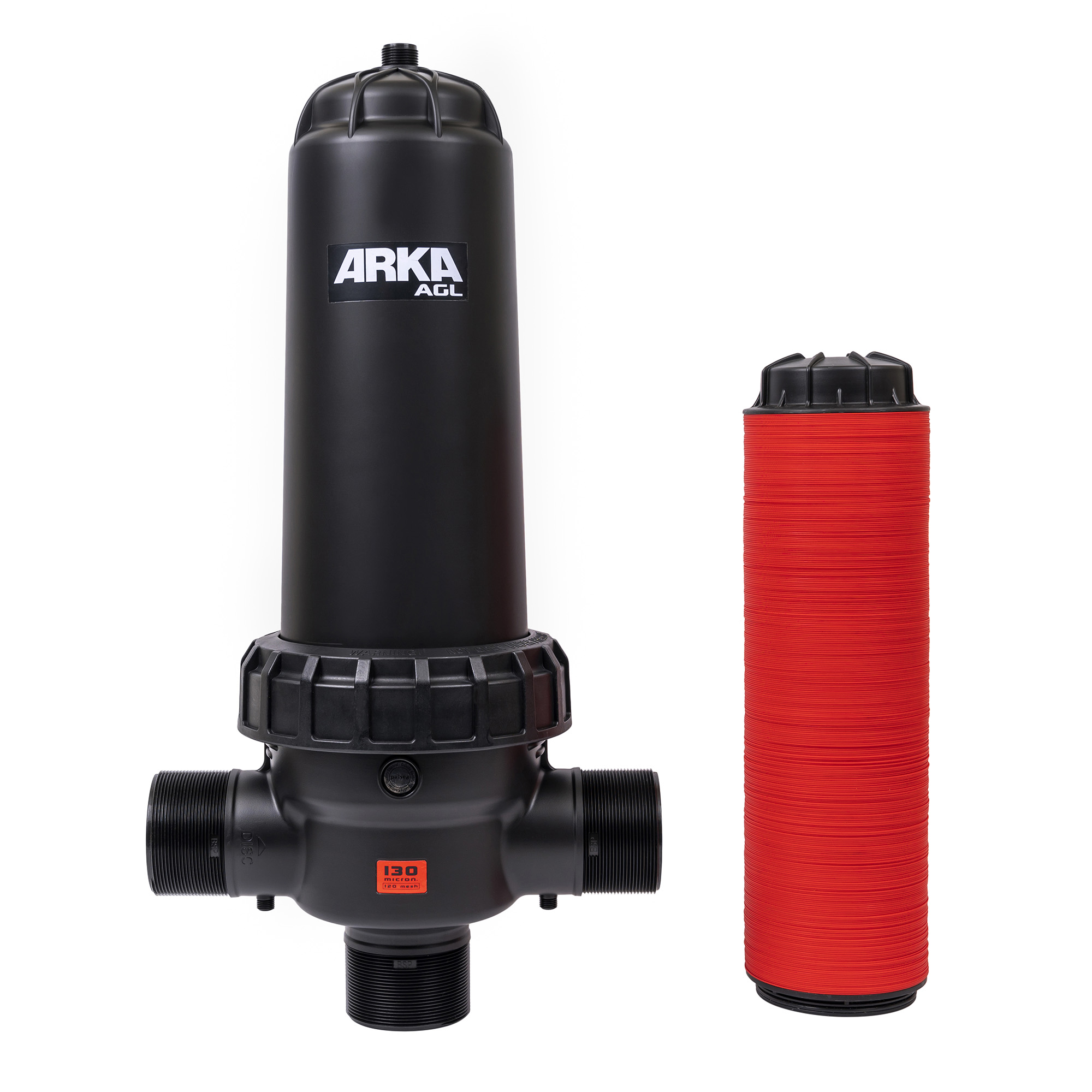
As water flows from the outside of the stack to the inside, debris is trapped deep within the intersecting grooves across the entire depth of the stack. Utilizing a high-quality disc filter ensures that soft, organic debris is trapped effectively without extruding through into your lateral lines. For instance, advanced models like the 3-Inch AGL Disc Filter feature robust nylon housings and precisely engineered 120-mesh discs. This delivers maximum protection with minimal pressure loss. They are highly durable and resistant to chemical degradation, making them an exceptional choice for mixed water sources.
For large-scale agricultural operations drawing water from highly contaminated rivers or ponds, these massive tanks are the industry standard. Water enters the top of an epoxy-coated steel tank and slowly percolates down through a deep bed of crushed silica sand or glass. The sharp edges of the media trap massive amounts of algae and mud.
While this is the gold standard for surface water due to its massive holding capacity, these systems are expensive. They require a large physical footprint and rely on complex, automated backwashing manifolds to clean the sand bed.
While technically not a filter since they lack a physical barrier with holes, separators are vital for sandy wells. Water enters a cylindrical chamber at an angle, creating a high-velocity vortex. Centrifugal force pushes heavy particles to the outer walls, where they lose velocity and fall into a bottom collection chamber. They have no moving parts and require zero manual scrubbing. But they must always be followed by a secondary unit to catch the lightweight silt they miss.
As global agriculture faces unprecedented water scarcity, the industry is witnessing a massive shift toward micro-irrigation. This transition to low-volume watering has inherently driven a demand for stricter, more reliable filtration standards. Recent market analyses reveal a distinct trend moving away from labor-intensive manual systems toward fully automated, self-cleaning technologies.
Furthermore, environmental regulations regarding agricultural runoff are pushing growers to adopt systems that minimize backwash water waste. While traditional sand media tanks have long dominated the surface water sector, modern farming operations are increasingly adopting automated disc arrays. These modular disc systems offer the same high-level depth filtration but require significantly less backwash water and a fraction of the physical footprint. This pivot aligns with broader agricultural trends prioritizing water conservation, energy efficiency, and reduced reliance on manual field labor.
Selecting the optimal equipment requires aligning the operational mechanics of the device with your specific water chemistry. Here is the definitive breakdown to guide your purchasing decision.
Because surface water demands depth filtration to handle organic smearing, your top choice for large acreage should be a sand media setup. For small to medium operations, or water sources with moderate organic loads, stacked disc technology is highly recommended. Their three-dimensional grooves trap organic matter beautifully while offering a much smaller footprint. You should absolutely avoid flat screens here. Pond algae will render them useless in minutes.
Well water requires equipment capable of taking a beating from abrasive particulates. If the well produces low to moderate amounts of sand, a high-quality stainless steel screen filter is highly efficient and cost-effective. In contrast, if your well pumps heavy sand, you must install a centrifugal separator to remove the bulk mass. Follow this immediately with a secondary mesh or disc unit to catch the remaining fine silt.
Since city water is pre-treated and generally safe, your only objective is catching occasional infrastructure debris. A simple, low-cost screen is perfect for this application. It acts as an inexpensive insurance policy against rust flakes or PVC shavings from local pipe repairs.
Drip systems represent the absolute pinnacle of water efficiency, delivering precise hydration directly to the root zone. However, this efficiency introduces a significant vulnerability: the microscopic pathways inside the emitters. If you are utilizing drip tapes or micro-sprinklers, your approach to drip irrigation filtration must be uncompromising.
Drip emitters release water at incredibly slow rates, such as 0.5 to 2.0 gallons per hour. To achieve this pressure reduction, the water must navigate tiny, tortuous labyrinths. These pathways are easily blocked by fine sand, biological slime, or chemical precipitates. Once a drip tape is clogged beneath plastic mulch or underground, it is nearly impossible to salvage and must be replaced.
Because these orifices are so minute, standard agricultural sprinklers running on 80-mesh are inadequate. Industry standards dictate that the filtration degree should be at least one-tenth the size of the emitter's smallest passageway. Consequently, most manufacturers strictly mandate the use of a 120-mesh to 155-mesh barrier to validate their product warranties. For example, utilizing a 130-micron disc module ensures strict compliance with these stringent requirements.
When selecting equipment for these sensitive applications, relying solely on surface screens is risky. This is especially true if biological material is present. Stringy organic debris can easily elongate under pressure and squeeze through two-dimensional holes. This is exactly why depth technologies are widely considered the preferred choice for drip setups, guaranteeing that flexible particles cannot deform and slip through to the sensitive micro-emitters.
Purchasing the correct type of technology is only half the battle. Sizing it accurately is equally critical for hydraulic stability. An undersized unit will cause severe pressure drops, while an oversized automatic unit may not generate enough internal velocity to backwash correctly.
The industry uses two primary metrics to describe the size of the openings: mesh and microns. Grasping the inverse relationship between these two terms will save you from costly purchasing errors. Mesh refers to the number of holes per linear inch of the screen. A higher mesh number means smaller holes and finer purification. Micron is a physical unit of measurement. A higher micron number means larger holes and coarser purification.
| Mesh Size | Micron Equivalent | Typical Irrigation Application |
|---|---|---|
| 40 Mesh | 400 Microns | Large volume impact sprinklers, heavy sand pre-filtration |
| 80 Mesh | 200 Microns | Standard landscape rotors, micro-sprinklers, spray heads |
| 120 Mesh | 130 Microns | Standard drip tubing, drip tape, micro-irrigation |
| 155 Mesh | 100 Microns | High-density drip tape, heavily contaminated surface water |
| 200 Mesh | 75 Microns | Foggers, misting systems for greenhouse propagation |
Never size your equipment based purely on the diameter of your PVC pipe. You must size it based on the system's maximum flow rate, measured in Gallons Per Minute or cubic meters per hour. To determine this, calculate the total output of all emitters running simultaneously in your largest watering zone.
As a golden rule of hydraulic engineering, you should oversize your capacity by at least 20 percent above your maximum zone flow rate. If your system requires 50 Gallons Per Minute, select a unit rated for at least 60 Gallons Per Minute. Forcing 80 Gallons Per Minute through a housing only rated for 50 creates massive friction loss. This pressure drop leaves your downstream emitters starving for water and can actually force debris straight through the element, completely defeating its purpose.
The true operational cost of an agricultural setup is heavily influenced by the labor required for maintenance. Depending on your water quality and workforce availability, you must choose between manual, semi-automatic, and fully automatic cleaning mechanisms.
Manual models are the most cost-effective upfront but demand the most labor. When clogged, the operator must shut off the water, depressurize the lines, unscrew the housing, extract the element, and scrub it with a hose. This is ideal for small residential landscapes or incredibly clean municipal water. However, a forgotten cleaning cycle can lead to catastrophic crop stress.
Semi-automatic models offer a great middle ground. They feature an external manual crank or lever. When the pressure gauge indicates a clog, the operator simply turns the crank while the system remains pressurized. Internal brushes or vacuum scanners sweep the debris away and flush it out a waste valve. This saves immense time without a massive price tag.
Fully automatic systems are an absolute necessity for large-scale farming, remote sites, or setups utilizing highly contaminated pond water. These rely on a Pressure Differential switch that constantly measures inlet versus outlet pressure. Once debris buildup causes a 5 to 7 PSI pressure drop, the controller automatically triggers a backwash cycle. Valves reverse the flow of clean water, dislodging trapped debris and expelling it in seconds, all without interrupting the watering cycle.
Ultimately, the effectiveness and longevity of your entire agricultural or landscape setup rely entirely on proper water purification. You cannot fight the innate characteristics of your water source. Instead, you must adapt your engineering to it.
Remember the golden rules. Surface water demands depth filtration to combat organic smearing, while well water requires robust surface filtration to handle abrasive sand and silt. Take the time to evaluate your specific contaminants, calculate your exact flow rates, and invest in high-quality equipment. By matching the right technology to your unique environment, you protect your infrastructure, conserve energy, and guarantee that every drop of water translates directly into healthy, uniform crop yields.
Ready to upgrade your irrigation infrastructure with industrial-grade protection? Stop letting poor water quality dictate your harvest yields. Explore the full range of high-performance filtration solutions at ARKA Irrigation to find the exact match for your specific water source and flow requirements today.
The primary difference lies in how they trap debris. A screen utilizes a two-dimensional woven mesh, functioning purely through surface filtration. It is highly effective for hard, inorganic particles like sand but clogs rapidly when exposed to algae. Conversely, a disc system uses stacks of grooved plastic rings pressed together, forcing water through a complex, three-dimensional maze. This depth filtration is exceptionally effective at trapping soft, stringy organic debris without clogging immediately.
For standard micro-irrigation systems, industry guidelines strongly recommend using an element between 120-mesh or 130 microns and 155-mesh or 100 microns. Drip emitters feature microscopic, turbulent-flow labyrinths designed to regulate pressure. If particles larger than 130 microns enter these pathways, they lodge permanently. Always consult your specific drip tape manufacturer's specifications, as using a coarser mesh will typically void the product warranty.
Using a standard flat mesh for pond, lake, or river water is highly discouraged by professionals. Surface water is rich in organic matter, including algae and bacterial slime. When this soft material hits a flat screen under high pressure, it smears across the holes, creating an impermeable seal. This blinding effect can choke a system in minutes. For ponds, always utilize depth filtration.
Cleaning frequency depends entirely on your water quality and system flow rate. Rather than relying on a set calendar schedule, you should monitor the pressure gauges installed before and after the unit. A pressure drop of 5 to 10 PSI across the housing generally indicates that the element is restricted by debris and requires immediate cleaning. During peak summer algae blooms, manual models on ponds may require daily washing.
Yes, purification is still required even when utilizing treated municipal water. While city water is generally free of organic matter, aging underground municipal infrastructure often sheds rust, mineral scale, and sediment into the lines. Additionally, routine plumbing repairs introduce PVC shavings. Installing a basic 80-mesh to 120-mesh unit is a low-cost insurance policy to protect your sensitive valves and sprinkler heads.
These large tanks clean themselves through an automated hydraulic process known as backwashing. During normal operation, water flows downward through a bed of crushed silica sand. When the system detects a pressure drop indicating a clogged bed, a controller alters the valve positions. Clean water is then forced upward through the bottom of the tank, lifting and expanding the sand bed. This releases the trapped organic matter, which is then flushed out through a dedicated waste valve before normal watering resumes.
If your unit is undersized for your system's flow rate, water is forced through the element at an excessively high velocity. This creates a severe pressure drop, starving your downstream sprinklers or drip lines of the water they need to operate correctly. Furthermore, high velocity can physically force soft debris or fine sand straight through the mesh or discs, completely bypassing your protection and clogging your emitters.
The most accurate way to identify a clog is by checking the pressure gauges installed on the inlet and outlet sides of the housing. If you notice a pressure differential of 5 to 10 PSI between the two gauges, the element is severely restricted. Visually, you might also notice a significant reduction in water throw distance from your sprinklers, or dry spots in your fields indicating that your drip emitters are not receiving adequate flow.


