
Views: 0 Author: Site Editor Publish Time: 2026-10-15 Origin: Site


Are clogged emitters ruining your crops? Picture this. You are in the middle of a critical fertigation cycle. Suddenly, system pressure plummets. Why? An unexpected algae bloom has completely blinded your mainline. Dirty water destroys infrastructure fast. Using the wrong equipment guarantees costly, frustrating downtime. You absolutely must match your hardware to your exact water source.
In this comprehensive guide, we break down how to evaluate flow rates and particulate loads. You will walk away with the technical knowledge needed to make an informed, bulletproof purchasing decision.
In the field, we never treat filtration as an optional upgrade. It is the hydraulic backbone of your entire setup. Without a reliable physical barrier, raw water contaminants will systematically tear apart your infrastructure.
Looking at broader global agricultural trends, severe water scarcity and unpredictable climate patterns are forcing growers to rely on lower-quality water sources. Farms increasingly draw from reclaimed wastewater or algae-heavy runoff ponds. Consequently, the industry is seeing a massive shift toward precision agriculture. Because modern high-efficiency setups are incredibly sensitive to particulate matter, robust filtration is no longer just a maintenance afterthought. It is your frontline defense for preserving crop yields and maximizing water use efficiency.
Think of unfiltered well water as liquid sandpaper. It carries abrasive silica sand, silt, and limestone fragments. When these inorganic materials travel through a pressurized network at high velocities, they aggressively wear down internal components. Solenoid valves, pump impellers, pressure regulators, and sprinkler nozzles all suffer. Over time, this wear alters the emission rates of your hardware. A properly specified irrigation filter intercepts these particulates before they enter the mainline, preserving the dimensional integrity of your expensive equipment.
Drip systems are inherently sensitive to water quality. The emitters used in these applications feature microscopic flow paths. These orifices often measure between 0.5mm and 2.0mm in diameter. Because of these incredibly tight tolerances, strict filtration is an absolute necessity.
Emitters generally succumb to three main types of clogging:
If organic matter passes through, it combines with fine silt to create a sticky matrix. This matrix permanently blinds the emitter labyrinth. Once an emitter is plugged, you cannot easily clean it. You usually have to cut it out and replace it entirely.
While industrial-grade equipment requires an upfront capital expenditure, the return on investment is realized rapidly. The correct setup eliminates the recurring labor costs associated with manually flushing lateral lines and replacing dead emitters. Furthermore, maintaining a high Distribution Uniformity ensures that every single plant receives the precise amount of water required. A drop in uniformity directly correlates to reduced crop yields. Therefore, proper filtration directly protects your revenue stream.
The physical and chemical makeup of your water is the primary variable in your selection process. You simply cannot choose a technology without first understanding the specific particulate load it must manage.
Groundwater pumped from deep wells is generally free of organic matter and biological growth due to the lack of sunlight. However, it frequently contains inorganic contaminants. Fine sand, silt, scale, and dissolved minerals like iron are common. Because inorganic particles are rigid and do not deform under pressure, they are relatively straightforward to capture. In these scenarios, the primary goal is preventing hard particulates from shredding valves and plugging nozzles.
Surface water is notoriously the most challenging source to manage. It is constantly exposed to sunlight and environmental runoff. This leads to a heavy presence of organic matter, including cyanobacteria, moss, leaves, and seasonal debris.
Unlike rigid sand grains, organic matter is soft and malleable. If subjected to high pressure against a standard two-dimensional mesh, algae and slime will extrude right through the pores. Therefore, surface water demands three-dimensional depth filtration. This traps organics within a complex matrix rather than just smearing them on a flat surface layer.
Municipal supplies are pre-treated and typically very clean. Nevertheless, the water travels through miles of aging infrastructure before reaching your site. It can easily pick up pipe rust, calcium scale flakes, or residual construction debris along the way. While heavy-duty processing is rarely needed here, a basic backup unit is highly recommended to catch occasional rogue debris.
Before purchasing anything, you need empirical data. Conduct a water quality analysis to determine the Total Suspended Solids measured in parts per million. Specifically, request a Particle Size Distribution test. Knowing whether your water contains predominantly 50-micron silt or 500-micron sand dictates the exact micron rating you must select.
Once you identify your water source and contaminant profile, you must match it to the appropriate engineering technology. The agricultural industry relies heavily on three primary architectures. Below is a quick diagnostic table to help you compare them.
| Filter Category | Primary Contaminant Target | Filtration Mechanism | Ideal Application Scenario |
|---|---|---|---|
| Screen | Rigid sand, scale, pipe rust | 2D Surface Filtration | Clean well water, municipal backup systems |
| Disc | Algae, silt, mixed organic/inorganic | 3D Depth Filtration | Drip irrigation, ponds, variable water sources |
| Sand Media | Heavy biological slime, moss, mud | Deep Bed Media Filtration | Large-scale agricultural canals, highly contaminated lakes |
This operates by forcing water through a cylindrical mesh made of stainless steel, woven wire, or molded plastic. It provides two-dimensional surface filtration, meaning particles are stopped strictly at the surface of the screen.
They are highly cost-effective, compact, and very easy to clean. A screen filter is the ideal choice for well water containing light to moderate amounts of rigid sand. Conversely, they are easily blinded by organic matter. Algae will quickly smear across the mesh, forming an impermeable layer that causes extreme pressure drops and requires constant manual scrubbing.
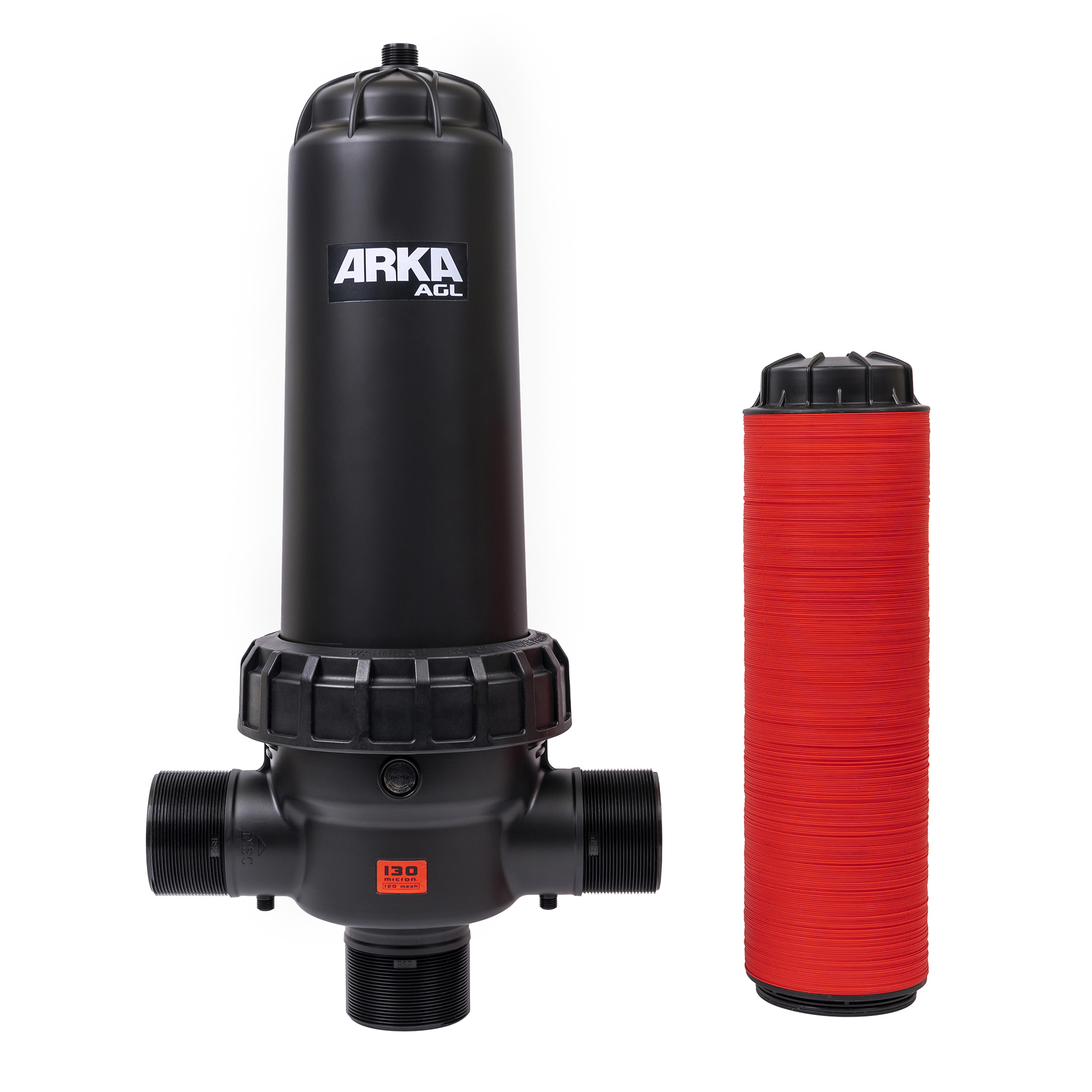
This technology utilizes hundreds of grooved, synthetic rings stacked tightly together on a central spine. When compressed, the intersecting grooves create a complex, three-dimensional network of microscopic flow paths. As water passes from the outside of the stack to the inside, debris is trapped deep within the labyrinth of the grooves.
They are exceptionally durable and highly effective at capturing both rigid inorganic sand and soft organic algae. For example, a standard 3-inch agricultural disc filter provides a massive filtration surface area. It can comfortably handle flow rates up to 50 cubic meters per hour while maintaining a precise 120-mesh rating. Because of this massive depth-holding capacity, it is widely considered the superior choice for operations where absolute water clarity is demanded.
These consist of large carbon steel or stainless steel tanks filled with a crushed filtration media, typically sharp-edged silica sand or crushed basalt. Water enters the top of the tank and slowly percolates down through the deep bed of media.
This is the gold standard for heavily contaminated surface water. The massive volume of the media bed allows a sand media filter to hold immense amounts of organic slime and algae before a backwash cycle is triggered. However, they have a large physical footprint, represent a significant capital investment, and require a high flow rate to properly lift and backwash the heavy media bed.
Selecting the correct technology is only half the battle. Sizing it correctly is equally critical. Sizing is governed entirely by your system's hydraulic parameters.
Your equipment must be sized to handle the maximum flow rate of your system at any given time. To calculate this, determine the total water demand of your largest irrigation zone. Count the number of sprinklers or emitters running simultaneously and multiply by their individual output rates.
For instance, a zone with one thousand emitters, each outputting one Gallon Per Hour, requires one thousand Gallons Per Hour. This converts to approximately 16.6 Gallons Per Minute. The unit you purchase must be rated to comfortably process this specific flow.
Filtration sizing requires a delicate balance. If a unit is too small for the flow rate, the water velocity through the element will be too high. High velocity can physically force soft debris through the mesh, completely defeating the purpose of the installation. It also causes rapid clogging.
In contrast, while slight oversizing is generally safe and increases the time between cleaning cycles, extreme oversizing in automatic systems can be detrimental. Automatic models rely on a minimum flow rate and pressure to initiate a successful self-cleaning backwash. If massively oversized, the system may lack the hydraulic energy required to flush the debris out.
Every component inserted into a mainline creates friction, resulting in a loss of pressure. This is commonly referred to as Delta P. When reviewing a manufacturer specification sheet, always locate the pressure loss chart. A properly sized, clean unit should exhibit a pressure drop of no more than 2 to 5 PSI at your target flow rate. As debris collects, this pressure drop will gradually increase.
To ensure you are removing the correct size of particulates, you must understand how elements are graded. The industry uses two distinct measurements: Mesh and Micron.
Mesh refers to the number of openings per linear inch of a screen. Therefore, a higher mesh number means more wires per inch, resulting in smaller holes and finer filtration. Micron is a metric unit of length equal to one-millionth of a meter. It measures the exact physical size of the pore opening. A higher micron number means a larger hole and coarser filtration.
The general engineering rule is that the pore size should be one-seventh to one-tenth the size of the smallest emitter orifice in your layout.
For large agricultural rotors, 40 to 80 mesh is usually sufficient. Micro-sprinklers require tighter tolerances, typically around 80 to 120 mesh. Specifically, drip irrigation filtration strictly requires fine grading between 120 and 150 mesh to ensure the microscopic labyrinths within the piping remain completely unobstructed.
Selecting the appropriate operational mechanism is just as critical as choosing the media itself. The decision between manual, semi-automatic, and fully automatic systems directly impacts your ongoing labor costs, system downtime, and overall maintenance schedule.
Manual configurations represent the most basic and affordable tier. In these systems, the element must be physically removed from its housing and cleaned by hand. For a screen, this involves scrubbing the mesh with a brush. For a manual disc model, the central spine is loosened, allowing the grooved rings to decompress so trapped debris can be washed away.
These are highly recommended for smaller agricultural plots or residential landscapes. However, if your water source carries a heavy debris load, a manual unit may blind rapidly, necessitating daily cleaning during peak seasons. This quickly translates into unsustainable labor costs.
Semi-automatic models bridge the gap between manual labor and full automation. These units still require human intervention to initiate the cleaning cycle, but they eliminate the need to depressurize the system and dismantle the housing.
Typically, an operator simply turns a crank or opens a flush valve on the exterior of the housing. This action engages an internal cleaning mechanism that sweeps the interior while the flush valve discharges the accumulated debris. They are ideal for medium-sized operations where budget constraints prohibit fully automatic systems.
For large-scale agricultural setups, remote fields, or systems drawing from highly contaminated surface water, fully automatic self-cleaning units are the industry standard. These operate independently, utilizing a pressure differential switch to monitor the accumulation of debris.
As debris builds up, it restricts water flow, causing the outlet pressure to drop. Once the switch detects a predetermined pressure difference, it sends a signal to an electronic controller. The controller then automatically opens a flush valve and initiates a backwash cycle. While the initial investment is higher, the drastic reduction in labor costs yields a rapid return on investment.
To synthesize the decision-making process, buyers should utilize a structured approach. Bypassing any of these steps can lead to severe hydraulic friction loss or catastrophic clogging. Follow this comprehensive checklist to specify the exact equipment required for your operation:
Matching your equipment to your specific water quality and flow rate is the foundational secret to maintaining a long-lasting, clog-free watering system. Ignoring empirical water data will inevitably lead to compromised hardware, labor-intensive repairs, and reduced crop yields.
When in doubt regarding fluctuating water conditions or unpredictable organic loads, opting for three-dimensional depth filtration is generally the most secure engineering choice to safeguard sensitive setups. Ensure you calculate your flow rates accurately, respect the micron requirements of your emitters, and invest in the level of automation that suits your operational scale. Ready to upgrade your system's frontline defense? Evaluate your water source today and explore professional-grade solutions at ARKA Irrigation to find the exact hardware match for your agricultural needs.
It is highly discouraged by agricultural engineering standards. Pond water is rich in organic matter, algae, and biological slimes. A standard screen relies on two-dimensional surface filtration. When soft, organic materials hit a mesh under pressure, they do not bounce off. Instead, they extrude and smear across the surface. This creates a highly impermeable biological layer that blinds the mesh almost instantly. For any surface water application, depth filtration is strictly required to trap organics within a three-dimensional matrix.
Installing an undersized unit creates a severe hydraulic bottleneck. As water is forced through a filtration area that is too small for the volume, the velocity of the water increases, resulting in a massive friction loss. Consequently, the sprinkler heads at the end of your lines will not receive sufficient operating pressure, leading to uneven water distribution. Furthermore, the high velocity can physically force sharp debris through the mesh, bypassing the barrier entirely.
There is no universal time-based schedule for cleaning a manual unit. It must be dictated entirely by water quality and system pressure. During peak agricultural seasons or periods of heavy rainfall, it might require daily cleaning. The only objective way to determine cleaning frequency is by monitoring the pressure differential. You should manually clean the element whenever the pressure difference between the inlet and outlet gauges reaches 5 to 7 PSI.
Yes, in the vast majority of agricultural scenarios. Drip emitters feature microscopic, labyrinth-like flow paths that are incredibly susceptible to blockages. While screens are excellent at stopping hard, inorganic particles like sand, they struggle with flexible debris. A disc model utilizes depth filtration, forcing water to change direction multiple times as it passes through. This makes it vastly superior at capturing soft organics, stringy debris, and fine silt, offering unparalleled protection.
A centrifugal sand separator is not a true filter, as it contains no physical barrier or moving parts. Instead, it uses centrifugal force to spin heavy particulate matter out of the water column. You need one if you are pumping well water that brings up large concentrations of heavy sand. It acts as a highly efficient pre-filter, removing up to 90% of heavy sand before the water ever reaches your primary equipment, thereby extending the lifespan of your entire system.
As a rule of thumb, always check your emitter manufacturer specifications. The industry standard dictates that your filter pore size should be one-seventh to one-tenth the size of the smallest orifice in your irrigation network. For example, most standard drip tapes require at least a 120-mesh rating to prevent clogging effectively.
A sudden spike in pressure differential usually indicates severe blinding of the filter element. This frequently happens when surface water experiences an unexpected algae bloom, or when a well pump pulls up a heavy slug of sand. If your gauges show a pressure drop exceeding 7 PSI, you must initiate a backwash or manual cleaning cycle immediately to restore hydraulic balance.


