
Views: 0 Author: Site Editor Publish Time: 2026-10-18 Origin: Site


Picture this scenario: a high-capacity pump pulls raw water from a muddy river or a deep, sandy borehole. Without robust protection, that abrasive slurry will quickly shred expensive pump impellers and plug delicate micro-sprinklers. Clogged emitters cost valuable time and money during peak growing seasons. The solution to this widespread agricultural headache lies in understanding a specific piece of engineering. By harnessing the laws of physics, a centrifugal filter removes heavy, abrasive sand before it ever has the chance to damage your downstream infrastructure. In this comprehensive guide, we will explore exactly how this vortex-based technology operates, why it outshines traditional physical barriers, and how it ultimately boosts your overall system performance and crop yield.
Recent shifts in global agricultural practices highlight a growing reliance on marginal water sources. Prolonged droughts continue to deplete primary aquifers. Consequently, farm operators are increasingly forced to draw from deeper, sand-heavy boreholes or highly turbid surface canals. Industry data indicates that this steady degradation in raw water quality has transformed pre-filtration from an optional system upgrade into a mandatory baseline requirement for modern micro-irrigation setups. Equipment capable of handling high-volume sediment loads without constant manual intervention is now at the forefront of agricultural water management. This reality is driving the widespread adoption of vortex-based separation technologies across commercial farming operations.
Understanding the mechanics behind advanced agricultural filtration requires looking beyond simple physical screens. The technology operates on fundamental laws of physics. It specifically utilizes rotational kinetic energy to isolate contaminants. Rather than trapping dirt within a mesh, it forces dirt completely out of the water path. Let us break down the objective engineering mechanics that make this highly efficient separation possible.
The process begins the moment raw water hits the fluid inlet. Traditional barrier methods force water directly into microscopic pores. In stark contrast, water enters a centrifugal separator tangentially. The inlet is positioned at an offset angle relative to the cylindrical body of the device. When pressurized water is forced through this entry point, it cannot travel in a straight line. It immediately slams into the curved interior wall of the upper chamber.
This rapid directional change converts the linear velocity of the water into angular velocity. A high-speed spinning vortex is generated instantly. This cyclone effect acts as the core engine of the device. The kinetic energy generated by your main irrigation pump is harnessed to create a continuous, powerful spiral that travels downward through the progressively narrowing conical body of the filter housing.
Once the vortex is fully established, centrifugal acceleration takes over. Fluid dynamics dictate that this force pushes objects moving in a circular path outward, away from the center of rotation. This outward push does not affect all materials equally. It is highly dependent on specific gravity, which is the density of a particle compared to the density of water.
Heavy inorganic particles like silica sand, silt, and fine gravel possess a specific gravity significantly higher than 1.0. As the fluid spins, these heavier particles are subjected to intense G-forces. They are violently thrown outward, piercing through the boundary layer of the fluid and striking the interior walls of the conical chamber. Upon hitting the rigid wall, the particles experience friction and lose their angular velocity. Gravity then takes the reins. It pulls the decelerated sludge downward along the steep walls of the cone, depositing it safely into a designated collection tank at the bottom of the unit.
While heavy particulates are forced to the outer perimeter, fluid dynamics in the center of the device behave entirely differently. As the downward-spinning outer vortex reaches the narrowest part of the lower cone, it encounters a physical restriction. Because the heavy solids have been expelled to the perimeter, the water near the central axis remains largely free of heavy debris.
A distinct low-pressure zone forms in this central core. Seeking an escape route, the clean water reverses its vertical direction and forms a secondary inner vortex that spirals upward. This inner column of processed water travels straight up through the center of the original cyclone. It finally exits the device through the top outlet, continuing its journey into the main irrigation mainline safely.
In the agricultural engineering sector, buyers frequently encounter multiple terms describing what appears to be the exact same equipment. This overlap causes unnecessary confusion during the system design phase. The terms centrifugal filter, hydrocyclone filter, and sand separator are generally used interchangeably. They simply describe the equipment from slightly different linguistic angles.
The term "sand separator" accurately describes the functional outcome for farmers dealing with sandy well water. "Hydrocyclone" describes the actual fluid behavior. "Centrifugal" highlights the specific physical force used to achieve particle separation. Regardless of the nomenclature printed on a manufacturer specification sheet, all three refer to the same vital piece of pre-filtration equipment relying on identical vortex-based physics.
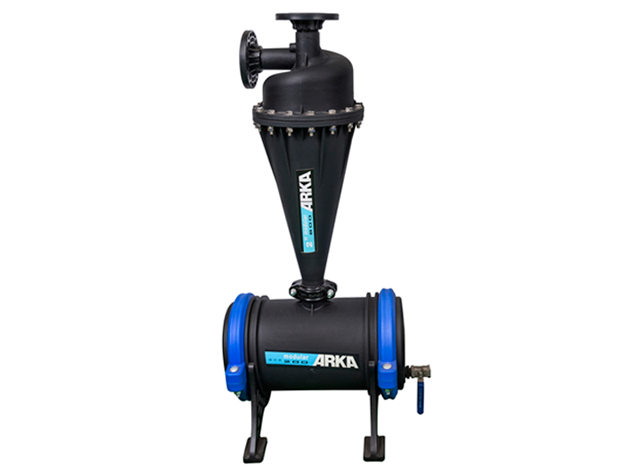
When designing a robust agricultural water system, engineers rarely rely on a single stage of filtration. Attempting to force raw, untreated water directly through fine micro-filtration is a common yet catastrophic design flaw.
Centrifugal separators are not designed to be standalone filtration units for precision micro-irrigation systems. Their specific engineering purpose is to act as a heavy-duty irrigation pre-filter. Field data consistently demonstrates that a properly sized cyclone can remove between 70% and 90% of heavy inorganic solids before the water ever reaches the secondary filtration stage.
By extracting the bulk of the abrasive silt upfront, secondary filters are only required to process lighter organic matter and microscopic particulates. This strategic two-stage approach prevents fine mesh screens or tightly stacked grooved discs from being rapidly overwhelmed and crushed by sudden sediment spikes.
A fundamental operational advantage of this working principle is the complete absence of physical filtration media. Traditional filters rely on a physical barrier with specific micron ratings. When water containing a high volume of sand hits a mesh screen, jagged sand particles wedge tightly into the pores. This causes a frustrating phenomenon known as "blinding." The screen becomes instantly blocked, causing a massive pressure drop and starving the entire irrigation system.
Because hydrocyclones utilize fluid dynamics rather than a physical mesh, there is no screen to blind. They can continuously process thousands of gallons of water with exceptionally high sediment loads without suffering sudden, catastrophic pressure drops.
| Feature | Centrifugal Separator | Standard Screen Filter |
|---|---|---|
| Filtration Method | Fluid dynamics & specific gravity | Physical porous barrier |
| Clogging Risk | Zero internal clogging | High risk of screen blinding |
| Maintenance Frequency | Minimal via quick purge valve | High requires manual scrubbing |
| Target Debris | Heavy sand, silt, scale | Organic matter, algae, fine dirt |
| System Role | Primary Pre-Filtration | Secondary Fine Filtration |
Understanding theoretical physics is only valuable if it translates into measurable field performance. Implementing this technology yields direct operational and financial benefits for agricultural enterprises.
Modern precision irrigation relies on drip tape engineered with extremely tight tolerances. The flow paths inside a pressure-compensating drip emitter are microscopic. Even a minor accumulation of fine sand can permanently plug these labyrinth flow paths.
Once emitters clog, water distribution uniformity drops drastically. Crops in clogged zones suffer from drought stress, while crops in clear zones may be overwatered. Installing a sand separator ensures that abrasive particles are removed right at the pump station. This guarantees uniform water and fertigation application across the entire field.
Sand is essentially nature's sandpaper. When suspended in high-velocity water, it becomes highly abrasive. If allowed to pass through the main infrastructure, it aggressively wears down internal components. Bronze and cast-iron pump impellers can lose their precise tolerances within a single growing season if subjected to high sand loads. This leads to a severe loss of pump efficiency and skyrocketing electrical costs.
Grit also scores the mechanical seals inside solenoid valves and pressure regulators, causing them to leak. Removing these abrasives immediately after the water source protects the structural integrity of the entire downstream network. This saves farm operations thousands of dollars in premature replacement parts.
To fully leverage this technology, agricultural professionals must understand the physical limitations of fluid dynamics. A common misconception is that a single filtration unit can magically eliminate all waterborne contaminants. Centrifugal separation is a highly specialized process governed strictly by specific gravity.
The primary function of this equipment is to extract inorganic, heavy particulate matter. The physics of the vortex dictate that particles significantly denser than water will be thrown outward. Water has a specific gravity of 1.0. For the centrifugal force to effectively isolate debris, target particles generally need a specific gravity of 1.5 or higher.
Highly effective removal targets include silica sand, heavy oxidized metals, dense silt, and inorganic scale flaking off aging well casings. If the particle is heavy enough to sink rapidly in a still glass of water, it will be efficiently separated by the intense centrifugal forces inside the cyclone.
The unit is not designed to process biological or lightweight debris. Organic matter such as algae, moss, leaves, and aquatic microorganisms typically have a specific gravity very close to that of water. Because these organic particles are neutrally buoyant, they lack the necessary mass to be thrown outward.
Instead, they remain suspended in the clean water stream, moving toward the center of the cyclone and exiting straight through the top discharge port. This strict physical limitation reinforces exactly why the unit must be paired with a secondary physical barrier designed specifically to capture light organic debris.
Selecting the correct unit is the most critical decision an agricultural engineer will make regarding water quality infrastructure. Unlike physical barrier filters sized simply by mainline pipe diameter, a centrifugal separator must be sized strictly according to operational flow dynamics.
The entire working principle requires a sustained velocity to generate the internal cyclone. If water enters the tangential inlet too slowly, the vortex will lack the kinetic energy necessary to push sand against the outer walls. The sand will simply meander lazily through the chamber and exit into your irrigation lines.
Conversely, excessive flow creates chaotic turbulence. This turbulence disrupts the smooth downward spiral of heavier particles, causing them to be caught in the upward draft of the clean water exit stream. For instance, a standard Nylon Lightweight 3-inch Hydrocyclone from Arka Irrigation is precision-engineered to handle flow rates strictly between 30 and 50 cubic meters per hour. Pushing 80 cubic meters through that same unit will completely nullify its sediment filter efficiency. Always match your system baseline operating flow to the manufacturer specified range.
Creating a high-speed vortex requires energy. In an agricultural pipeline, energy translates directly to water pressure. As water is forced through the tangential inlet and spins violently down the conical body, a natural pressure drop occurs. Engineers must account for this pressure loss, typically ranging from 3 to 8 PSI depending on flow dynamics, when calculating the total dynamic head of the irrigation pump.
If a pump is already operating at maximum capacity, adding a separator without adjusting the pump impeller could result in insufficient pressure reaching the furthest sprinkler heads. Utilizing precision-engineered options, such as the Cyclone Desander Filter series, ensures optimized conical geometries that maintain high-velocity separation while minimizing unnecessary friction loss.
Even the most precisely machined equipment will fail to protect crops if installed incorrectly. Adhering to strict mechanical installation guidelines ensures fluid dynamics operate exactly as intended.
Gravity plays an indispensable role in the final stage of the separation process. While centrifugal force pushes sand outward, gravity drags those heavy particles downward into the lower collection chamber. Therefore, the separator must be installed perfectly plumb.
If the unit is tilted even slightly off vertical, the internal vortex becomes asymmetrical. Sand particles will lose their downward momentum and accumulate heavily on one side of the cone. Over time, this asymmetrical wear causes severe abrasion to internal anti-corrosion coatings. Using a heavy-duty steel mounting stand and a reliable bubble level during installation is a non-negotiable requirement.
The defining advantage of this technology is the elimination of manual screen scrubbing. However, separated sand must still be evacuated from the bottom collection chamber. If the collection tank overfills, accumulated sand will be pulled back up into the center vortex and flushed directly into the mainline.
Maintenance personnel must routinely open the ball valve at the bottom of the collection tank while the system is under full pressure. The internal pressure forcefully ejects the accumulated sand slurry in mere seconds. For large-scale commercial operations, replacing the manual valve with an automated, timer-controlled purge valve ensures the chamber is evacuated consistently. This provides a truly hands-free approach to maintaining optimal water quality.
No. It relies entirely on the fluid dynamics and water pressure generated by your existing irrigation pump to create the centrifugal force. As long as your pump provides the necessary flow rate and pressure to push water through the tangential inlet, the physical vortex will form naturally without any supplementary electrical motors or moving parts.
A properly sized unit will typically create a pressure drop of between 3 to 8 PSI. This pressure loss is the natural energy cost required to generate the high-speed internal vortex. You must factor this drop into your pump's total dynamic head calculations during the system design phase.
Yes, but with a major caveat. It will successfully remove heavy silt, sand, and grit pulled from the pond bottom. However, it will not remove algae, moss, or lightweight aquatic organics suspended in the surface water. You must install a secondary screen or media filter downstream to handle the biological load.
A standard sediment filter uses a physical barrier, like a woven mesh screen or paper cartridge, to trap dirt. These physical barriers capture debris but clog rapidly in dirty water, causing severe pressure drops. A centrifugal unit uses spinning water to separate heavy particles outwardly without a physical barrier, making it ideal for continuous operation in high-sediment load environments without instantaneous clogging.
No. It is specifically designed to act as an initial pre-filtration stage. It effectively removes heavy inorganic debris. Lightweight organic materials will pass right through it. You must pair it with a fine disc or screen filter, which will then efficiently remove the lighter organic matter without getting overwhelmed by heavy sand.
Sizing is based strictly on your system operational flow rate measured in Gallons Per Minute or Cubic Meters Per Hour, not the diameter of your mainline pipe. You must match your actual water flow to the specified flow range. If the flow is too low, the required vortex will not form. If it is too high, you will experience excessive pressure loss and internal abrasion.
Ready to protect your irrigation infrastructure from abrasive wear and tear? Stop letting sandy boreholes destroy your expensive pumps and precision emitters. Explore the full range of high-performance, precision-engineered filtration solutions tailored for your specific flow rates at Arka Irrigation today.


