
Views: 0 Author: Site Editor Publish Time: 2026-10-18 Origin: Site


Facility managers and agricultural operators face a relentless daily challenge. Fine screens clog. System downtime spikes. Maintenance budgets swell under the weight of heavy sediment loads. Relying solely on fine barrier meshes to treat highly turbid water drains finances and wastes valuable man-hours. The centrifugal separator water filter serves as the ultimate first line of defense. This engineering guide breaks down the fluid mechanics behind the technology. We will explore exactly why it outperforms traditional mechanical pretreatment and how it transforms overall system reliability.
To fully grasp the value of this equipment, you must look at the fluid dynamics at play. When raw water enters the cylindrical chamber, it is forced through a tangential inlet. This specific geometry creates powerful rotational acceleration. It essentially generates a localized, high-velocity vortex inside the housing. As the water spins, heavier inorganic particles like silica sand, pipe scale, and metal flakes are violently thrown against the outer walls. Gravity then takes over. It pulls this separated grit downward into a designated collection basin. Meanwhile, the clean, lighter water is drawn up through the center of the vortex and exits the system.
The difference between these two technologies comes down to fundamental mechanics. A traditional screen or spun cartridge acts as a literal wall. It traps particles on its surface until the pores become completely blocked. Once blinded over, the system suffocates. In contrast, a hydrocyclone filter utilizes specific gravity to separate debris. Because there is no physical mesh to plug up, the unit never clogs in the traditional sense. It delivers uninterrupted flow regardless of the incoming particulate load.
Raw water is rarely pristine. Whether sourced from a deep aquifer or a rushing canal, it carries abrasive elements that destroy delicate infrastructure. Reverse osmosis membranes, micro-irrigation emitters, and fine mesh filters feature microscopic tolerances. When heavy sediment bypasses proper pretreatment, these precision components suffer irreversible damage. This leads to catastrophic system failures and compromised water quality.
Skipping robust primary separation carries severe financial penalties. Facilities operating without adequate pretreatment face exorbitant hidden costs. Pumps forced to push water through partially clogged screens draw significantly more amperage. This drives up electrical bills month after month. Maintenance crews are constantly dispatched for manual cleaning or emergency backwashing. These labor costs, combined with the premature replacement of expensive fine filters, can cripple an operational budget within a single season.
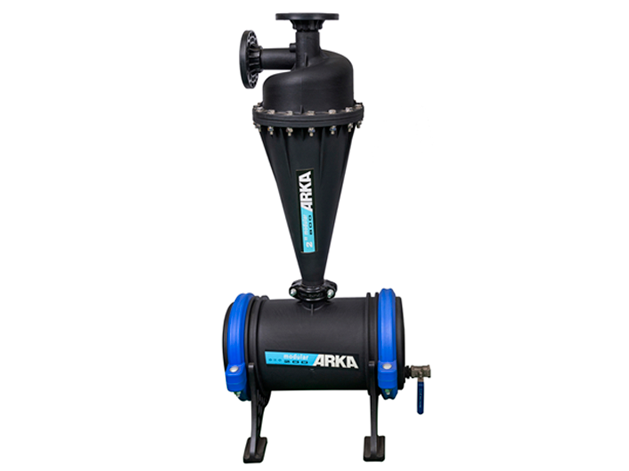
Recent market analyses highlight a massive pivot in global water management strategies. As water scarcity worsens and energy prices climb, agricultural and industrial sectors are abandoning high-waste backwash systems. Engineers now prioritize continuous, physics-based pretreatment. Regulatory pressures demand lower carbon footprints for pumping stations. By adopting centrifugal separation, facilities achieve fully automated, low-waste filtration even in the harshest environments.
Hydraulic stability is the most profound advantage of centrifugal technology. Because the separation process relies on a vortex rather than a physical screen, the pressure drop across the unit remains constant from the moment of installation. Pumps do not have to work harder over time to overcome the resistance of a slowly clogging filter. This translates directly to sustained energy efficiency and highly predictable performance.
Think of the separator as the heavy lifter of your filtration train. It strips out up to 98 percent of dense, abrasive solids before the water ever touches a secondary media bed. The burden on those downstream components virtually disappears. Fine filters that previously required weekly replacements might now last for months.
Backwashing a massive media tank consumes thousands of gallons of treated water. By intercepting the bulk of the sediment upfront, the primary filter takes significantly longer to reach its pressure-differential threshold. This dramatically extends the intervals between backwash cycles. You conserve massive volumes of water and keep the system online longer.
Mechanical simplicity defines reliability. Self-cleaning screen filters rely on electric motors, internal brushes, or complex gear assemblies. A centrifugal unit has absolutely no moving parts. There is nothing to lubricate, no gears to strip, and no fragile sensors to fail. Modern units engineered with heavy-duty Nylon or reinforced polyamides withstand extreme pressures—often up to 10 bar or 150 psi—without degrading.
Savvy engineers rarely rely on a single technology. The most resilient water treatment architectures employ a hybrid strategy. You install a separator as the primary stage to knock out the heavy grit. You follow it immediately with a fine mechanical screen to catch lightweight organics. This achieves comprehensive purification while minimizing maintenance.
| Feature | Centrifugal Separator | Traditional Mesh Sediment Filter |
|---|---|---|
| Target Contaminants | Heavy inorganics, silica sand, metal flakes | Lightweight organics, algae, moss, fine silt |
| Pressure Drop | Constant and stable 3 to 12 psi | Increases steadily as the screen clogs |
| Maintenance | Extremely low, automated purging available | High labor, requires manual scrubbing or backwashing |
| Water Waste | Near zero during operation | High volume lost during backwash cycles |
Understanding the underlying physics is only part of the evaluation process. Facility managers must determine how this equipment integrates into specific industry applications. Because these systems rely on specific gravity, they excel in environments dealing with heavy inorganic particulate loads.
Commercial agriculture frequently draws from surface water sources like rivers and canals. This water carries a high concentration of silica sand and silt. When turbid water reaches delicate micro-sprinklers, the narrow orifices clog rapidly. Deploying a centrifugal system as an irrigation pre-filter fundamentally alters the maintenance trajectory of the entire network. Separating heavy sand before the water reaches the primary screen prevents the rapid blinding of fine mesh. This ensures continuous water delivery without pressure fluctuations.
Municipal water treatment facilities and residential well owners face a shared challenge with abrasive wear on pumping infrastructure. When submersible pumps draw water heavily laden with sand, the impellers and volutes suffer from severe abrasion. Over time, this degradation reduces pump efficiency and leads to premature failure. Installing a sand separator on the discharge side of the well pump acts as a critical protective measure. It stops abrasive particulates from traveling further into the distribution network.
Cooling towers act as massive air scrubbers. They pull in airborne dust, pollen, and industrial exhaust. As the water evaporates, the concentration of suspended solids spikes. Left untreated, this grit settles in the tower basin and heat exchanger tubes. It creates scale deposits that ruin thermal transfer efficiency. A centrifugal unit continuously sweeps the cooling tower basin. It removes heavy particulates without interrupting the flow of the cooling system.
High-volume industrial environments like mining operations and commercial car washes generate wastewater heavily contaminated with metal chips, glass shards, and heavy soils. A heavy-duty centrifugal filter is uniquely suited for these harsh conditions. It contains no moving parts to jam. It easily processes thousands of gallons per minute, making the water viable for immediate reuse in preliminary wash cycles.
A common engineering error is selecting a unit based solely on the diameter of the existing pipeline. A centrifugal system relies entirely on fluid dynamics and velocity to function. You must follow strict sizing protocols.
The golden rule of hydrocyclone sizing is matching the unit to the system’s actual flow rate. Measure this in Gallons Per Minute or Liters Per Hour. If the flow rate exceeds the design capacity, the water velocity becomes too aggressive, causing severe pressure drops. If the flow rate is too low, the water will not generate sufficient centrifugal acceleration. Heavy particles will simply bypass the collection chamber. For commercial setups, standard 4-inch units are often calibrated for specific high-flow ranges.
Efficiency is dictated by Stokes' Law. The separation capability depends on the density of the target particle relative to the fluid. The technology is highly effective at removing particles significantly heavier than water. If your primary contaminant consists of floating organics, you must pair the unit with a secondary barrier filter.
Industrial applications require robust materials. Equipment engineered from high-grade Nylon or reinforced polymers provides exceptional resistance to chemical corrosion and UV degradation. Ensure the pressure rating of the selected housing matches your main supply pump's maximum output, typically looking for a 10 bar rating for reliable commercial use.
Manual purging utilizes a simple ball valve. It suits systems with low, predictable sediment loads. Automatic purging utilizes an electronic timer-based valve. This is mandatory for high-turbidity applications like agricultural irrigation. It eliminates the risk of the collection chamber overfilling and pulling trapped sediment back into the clean water stream.
Mechanical simplicity translates to straightforward installation. Adhering to strict engineering best practices ensures optimal longevity.
Install the separator as early in the water process as mathematically possible. The optimal placement is on the discharge side of the main supply pump, strictly before any pressure tanks or chemical injection manifolds. Turbulence entering the separator disrupts the internal vortex. Always provide a straight run of pipe equal to at least five times the pipe diameter immediately upstream of the inlet to ensure laminar flow.
Maintenance is exceptionally low. Routine checks involve verifying the automatic purge valve actuates according to its programmed schedule. Ensure the discharge line remains clear of blockages. Install pressure gauges at both the inlet and outlet. A sudden change in the pressure differential usually indicates a blockage in the purge chamber or a drop in the upstream pump flow rate.
Upgrading your pretreatment architecture with a centrifugal separator is a transformative step in safeguarding delicate downstream equipment. Leveraging fluid dynamics rather than physical barriers dramatically lowers maintenance costs. It eliminates unpredictable pressure drops and extends the operational lifespan of fine filters and pumps. Whether you pull abrasive water from a deep municipal well or seek to protect the intricate nozzles of a massive agricultural network, physics-based filtration provides a highly reliable solution. Evaluate your system's flow rate and sediment load today. For industry-leading, durable Nylon hydrocyclones and comprehensive water treatment solutions, explore the advanced filtration lineup at ARKA Irrigation to optimize your operational efficiency.
Centrifugal separators do not have a strict micron rating because they rely on specific gravity rather than a physical mesh. Empirical data shows that a properly sized, high-efficiency hydrocyclone removes up to 98 percent of particles that are 74 microns and larger, provided the particles are significantly heavier than water.
No. Centrifugal technology only removes suspended, heavy physical solids. It does not alter the water's chemistry. It cannot remove dissolved minerals, salts, chemical contaminants, or lightweight organic materials like algae and leaves.
Yes, but it is minimal and constant. Creating the internal vortex requires energy, translating to a steady pressure drop typically between 3 and 12 psi. Unlike physical barrier filters, this pressure drop never increases over time because the system does not clog.
The purging frequency depends entirely on the volume of sediment in your source water and your system's flow rate. Clean municipal applications may require purging once a week. Highly turbid agricultural applications may require purging multiple times an hour. Automated purge valves are strongly recommended for heavy loads.
Most centrifugal separators must be installed vertically. The separation process relies on gravity to pull the heavy, spinning particulates downward into the collection basin. Installing the unit horizontally disrupts this gravitational pull, rendering the separation process highly ineffective.
While models vary, a hydrocyclone typically requires a minimum inlet pressure of 15 to 20 psi to generate a vortex strong enough for effective separation. Always consult the manufacturer's flow and pressure curves to ensure your supply pump can meet these hydraulic demands.


