
Views: 0 Author: Site Editor Publish Time: 2026-11-04 Origin: Site


Seeing dry soil beneath your emitters or discovering blown sprinkler heads mid-season is a massive headache for any farm manager. As field engineers, we see this constantly. More often than not, this frustrating issue stems from poor water filtration. Installing a reliable barrier against dirt, sand, and algae is non-negotiable. However, simply buying off-the-shelf hardware falls short. Sizing your equipment accurately by flow rate is the absolute crucial step to ensure optimal performance and prevent catastrophic pressure loss.
In this guide, we break down the fluid dynamics behind these systems. You will learn how to calculate exact volumetric requirements and select the perfect hardware dimensions for your commercial watering infrastructure.
When designing an agricultural watering infrastructure, buyers often fixate on physical dimensions or micron ratings. Fluid dynamics actually dictate that flow rate is the foundational metric. Understanding how water moves prevents costly equipment failures and ensures uniform distribution across all agricultural zones.
Pressure drop occurs when water encounters resistance inside a confined space. Inside any screen filter system, the internal mesh acts as a physical barrier. Water molecules squeeze through microscopic pores. This inherently slows their momentum and converts kinetic energy into friction.
Forcing massive water volumes through a tiny housing multiplies this resistance exponentially. A severe pressure drop between the inlet and outlet is the immediate result. If water enters at 50 PSI but exits at 30 PSI due to an undersized housing, the remaining pressure cannot operate pressure-compensating drip tape. Correctly sizing the unit based on maximum gallons per minute ensures friction loss remains within an acceptable 1 to 3 PSI range.
Filtration efficiency depends heavily on maintaining a controlled water velocity. Exceeding the specified hydraulic capacity makes water speed dangerously high.
Excessive velocity creates severe mechanical problems. High-speed water physically forces pliable organic debris straight through the mesh pores. The unit becomes entirely ineffective. Furthermore, the sheer kinetic force of water carrying abrasive silica sand acts like a waterjet. This tears the stainless steel element apart over time.
Before purchasing equipment, you must establish the exact volume of water moving through your infrastructure. Guessing these metrics invariably leads to undersized units that clog rapidly or oversized units that waste capital.
The most reliable starting point is your water pump. This determines the absolute maximum volume pushed into the mainline. Check the manufacturer specification plate attached to the pump motor.
Look for metrics listed in Gallons Per Minute. If your pump outputs 120 GPM at operating pressure, your filtration unit must handle at least this amount. Use the operating flow rate rather than the absolute maximum theoretical output. Real-world friction loss in the suction pipe slightly reduces the final volume.
If you connect to a municipal water source without a dedicated pump, calculate the total output of your emitters. Multiply the total number of emitters by the flow rate per emitter.
Suppose you operate a greenhouse with 2500 drip emitters outputting 0.5 gallons per hour each. Your total output is 1250 gallons per hour. Divide that number by 60 minutes to get 20.8 gallons per minute. Your absolute minimum capacity requirement is roughly 21 GPM.
Large agricultural operations rarely run all emitters simultaneously. The infrastructure is divided into independent zones controlled by solenoid valves. Calculate the requirements for each individual zone. Identify the single zone with the highest water volume requirement. Size your equipment to accommodate that specific peak zone plus an appropriate safety margin.
Translating theoretical math into real-world reliability requires strict adherence to industry sizing rules.
Agricultural engineers universally advise against purchasing a unit where your calculated requirement matches the exact maximum capacity of the hardware. Buying a unit rated for exactly 100 GPM leaves zero margin for error.
As the mesh traps dirt, available surface area decreases. This artificially restricts flow and increases pressure drop. Always apply a 20 percent safety margin. Multiply your maximum requirement by 1.2. If your peak zone requires 100 GPM, purchase a unit rated for at least 120 GPM.
To make field applications easier, we rely on standard correlations between pipe connection size and flow capacities.
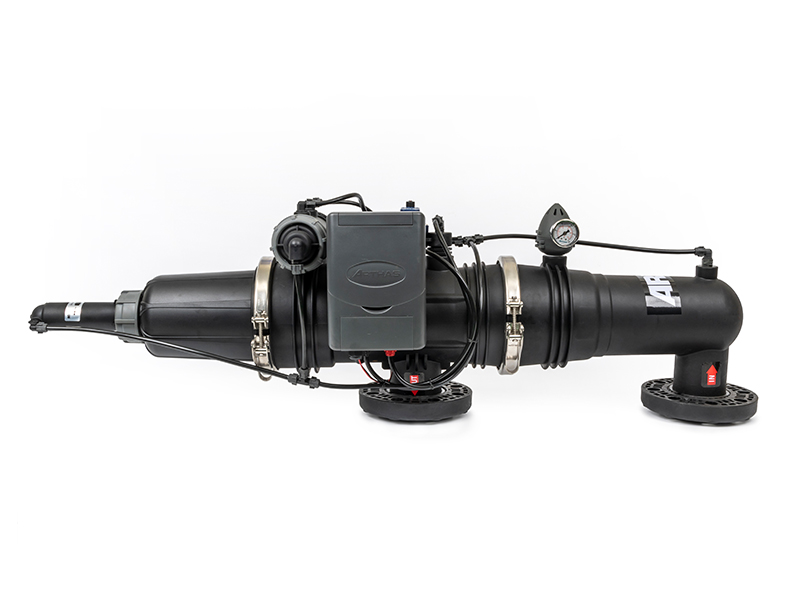
Consider an industrial-grade unit like the ARKA F110ASC 4-inch automatic backflush system. Engineered for high-demand environments, a unit of this caliber specifically accommodates flow rates up to 80 cubic meters per hour. It features a robust 316L stainless steel wire mesh screen. Matching this specific flow capacity with your mainline ensures steady pressure across hundreds of acres without bottlenecking the pump.
Water rights are becoming increasingly restricted globally. Consequently, agricultural engineering is experiencing a massive shift toward hyper-precision in water management. Recent industry data indicates commercial growers are abandoning generalized sizing charts. Instead, they favor site-specific hydraulic modeling.
Climate volatility introduces unpredictable spikes in surface water turbidity following extreme weather events. To combat this, farm managers now deliberately oversize their filtration housings. This strategic up-sizing accommodates sudden influxes of heavy silt without causing pump strain. The modern trend is clear. Investing in larger automated filtration upfront acts as an insurance policy against unpredictable environmental shifts and rising labor costs.
Beyond connection diameters, physical geometry dictates how efficiently fluid moves through the unit.
The Y-type screen filter remains highly prevalent in standard infrastructure. The mesh cylinder sits in a chamber intersecting the main water line at a diagonal angle.
This internal geometry allows water to flow in a relatively straight path. It minimizes turbulence and keeps friction loss to an absolute minimum. Because it preserves pressure so effectively, this design is perfect for gravity-fed drip systems.
T-type or in-line designs feature a chamber sitting perpendicular to the main line. While the 90-degree turn creates slightly more internal turbulence, these units feature much longer and wider mesh cylinders.
This increased surface area makes them exceptionally well-suited for moderate to high debris loads. The massive surface area offsets the slight aerodynamic disadvantage by drastically extending cleaning intervals.
As flow rates increase, suspended solids entering the system increase proportionally.
Manual units require a human operator to physically scrub the cylinder. For low flow rates drawing clean well water, manual units are highly cost-effective.
However, pumping 200 GPM of pond water forces pounds of algae against the mesh every hour. A manual unit might require flushing four times a day. If labor is unavailable, crops suffer severe water stress.
For commercial farms operating at high volumes, upgrading to an automatic screen filter is a highly logical investment. These advanced units utilize pressure differential switches.
The mechanism constantly monitors water pressure at both the inlet and outlet. When the switch detects a specific pressure difference, it triggers a self-cleaning cycle. A motorized suction scanner cleans the mesh in seconds. Crucially, this cleaning process occurs without interrupting the main irrigation flow.
Let us look at a direct breakdown of how these systems compare in field conditions.
| System Feature | Manual Filtration | Automated Filtration |
|---|---|---|
| Best Flow Rate Application | Under 100 GPM | 150+ GPM |
| Maintenance Labor | High daily monitoring required | Zero manual intervention |
| Pressure Stability | Fluctuates as debris builds | Consistently stable via auto-flush |
| Water Source Suitability | Clean municipal or deep well water | Rivers, ponds, and high-turbidity sources |
Purchasing a housing with the correct physical dimensions is only half the equation. Selecting the appropriate mesh density is equally critical.
Filtration precision relies on Mesh and Micron ratings. Mesh refers to the number of holes per linear inch. A higher mesh number means smaller holes. Micron measures the actual physical size of the hole itself.
Match the mesh to the emitter manufacturer recommendations. For example, 80 Mesh is great for heavy sand removal. Meanwhile, 120 Mesh is the absolute standard for agricultural drip tape.
Finer mesh heavily restricts flow capacity. A 200-mesh screen has significantly smaller pores than a 120-mesh screen. The open area where water passes through is reduced.
If you replace a 120-mesh element with a 200-mesh screen on a 100 GPM unit, it can no longer process the water efficiently. You must compensate for this increased resistance by purchasing a physically larger housing.
Environmental variables sometimes lead to sizing mismatches. Recognizing the engineering symptoms allows you to troubleshoot before permanent damage occurs.
The most immediate symptom of an undersized unit is a total lack of operating pressure at the end of the line. If your pump outputs 50 PSI but your drip tape is flat, you have a severe friction loss issue. Install pressure gauges directly before and after the housing. A massive drop across a clean mesh means the physical volume of water is bottlenecking.
Stainless steel elements withstand significant static pressure but remain vulnerable to high-velocity kinetic impacts. Warping or tearing indicates the water velocity is too high for the surface area. Abrasive particles are being forced through with structural-destroying force.
If pressure drops to unacceptable levels within 30 minutes of startup, the surface area is too small for the dirt load. The mesh lacks the physical real estate to hold the suspended debris. You must upgrade to a larger housing or install a pre-filtration centrifugal sand separator.
Choosing the correct hardware is a strict balancing act between your pump output, emitter requirements, and water quality. Always calculate your maximum volumetric output and apply a 20 percent safety margin. Accurately matching your flow rate to the right housing size protects your delicate drip lines from catastrophic clogs. Proper sizing is the ultimate key to ensuring long-term efficiency for your agricultural operations.
If you are tired of dealing with blown lines and constant manual flushing, it is time to upgrade your infrastructure. Explore high-performance solutions at ARKA Irrigation to find the exact automated or manual system engineered for your specific flow rate requirements.
Yes, oversizing is generally safe and highly recommended by field engineers. A larger internal cavity provides more screen surface area. This significantly reduces friction loss and pressure drops while increasing dirt-holding capacity.
A standard 4-inch connection typically handles volumetric flow rates between 200 and 350 GPM. Always consult the specific engineering spec sheet to confirm the maximum hydraulic capacity for your chosen mesh size.
A properly sized clean system should exhibit a minimal pressure drop of approximately 1 to 3 PSI. When the pressure differential reaches 5 to 7 PSI between the inlet and outlet gauges, it is time to trigger a cleaning cycle.
Screen configurations are highly efficient for removing inorganic debris like sand and scale with minimal pressure resistance. However, if your water source contains high levels of biological slime, disc filters offer three-dimensional depth filtration that prevents soft organics from extruding through the pores.
The most reliable indicator of a clogged mesh is a significant pressure differential. If the gauge before the unit reads 40 PSI, but the gauge after reads 30 PSI or lower, debris has blinded the pores. You will also notice reduced water output at your furthest sprinkler heads.
Having a flow rate lower than the maximum capacity of the housing is rarely a problem. In fact, it results in exceptionally low friction loss and extended cleaning intervals. The only drawback is that you may have spent slightly more upfront capital on a larger unit than strictly necessary.


