
Views: 0 Author: Site Editor Publish Time: 2026-11-02 Origin: Site


Agricultural irrigation systems operate in harsh, demanding environments. Farm managers frequently encounter clogged drip emitters, uneven crop watering, and sudden drops in system pressure. Imagine walking your fields at dawn. You suddenly spot localized drought stress. A single blocked emitter has starved an entire row of plants. These seemingly small issues compound rapidly. They lead to reduced crop yields and highly costly operational downtime.
The core of any reliable irrigation setup is a high-quality filtration barrier. However, simply purchasing a unit off the shelf is not sufficient for optimal performance. Choosing the correct micron rating is the exact metric that prevents premature system failure and excessive maintenance. Selecting the wrong specification can either choke your water supply or allow damaging micro-abrasives to bypass the filtration stage entirely.
This comprehensive guide breaks down the technical specifications of micron and mesh sizes required for various agricultural applications. By comparing different filtration technologies, this article provides the empirical data necessary to help agricultural professionals make the most effective purchasing decisions for their specific operational needs.
Navigating filtration terminology can be complex for buyers. For agricultural professionals, purchasing irrigation equipment requires a precise understanding of technical specifications. Grasping the exact metrics you are reviewing is the foundational step toward building a resilient irrigation infrastructure.
When evaluating filtration systems, buyers will encounter two primary units of measurement that dictate the capability of the equipment. These are microns and mesh.
Micron or Micrometer: A micron is a metric unit of length equal to one-millionth of a meter. In the context of water purification, the micron rating defines the physical size of the largest particle that can reliably pass through the openings. For instance, a 100-micron element successfully blocks any grain of sand larger than 100 microns.
Mesh: Mesh is an imperial measurement indicating the number of woven crossover points per linear inch of the screen. If a filter is rated at 120 mesh, there are exactly 120 individual gaps across a one-inch span of the stainless steel weave.
It is critical to remember the inverse relationship between these two metrics. As the mesh number increases, the threads become packed closer together. This means the physical holes become smaller. Consequently, a 200-mesh screen provides a much finer barrier than a 50-mesh screen.
To assist in system design and procurement, agricultural engineers rely on standardized conversion charts. Below is a reference table detailing the relationship between mesh counts and micron sizes, alongside their typical agricultural applications.
| U.S. Mesh Size | Approximate Micron Size | Typical Agricultural Application |
|---|---|---|
| 40 Mesh | 400 Microns | Pre-filtration, heavy sand removal, large sprinklers |
| 80 Mesh | 177 Microns | Standard impact sprinklers, moderate well water |
| 120 Mesh | 125 Microns | Standard drip irrigation, micro-sprinklers |
| 150 Mesh | 100 Microns | Fine drip tape, surface water with suspended algae |
| 200 Mesh | 74 Microns | Fertigation systems, municipal water setups, greenhouse foggers |
Selecting a filtration rating is not a matter of simply buying the finest screen available. Instead, it is about selecting the exact correct screen for your specific hydraulic parameters. The consequences of choosing the wrong specification directly impact the bottom line through equipment failure, crop stress, or inflated operational costs.
The primary function of any agricultural filter is to protect downstream emitters from clogging. Drip tape and micro-sprinklers feature microscopic flow paths. These tiny channels are easily obstructed by sand, algae, or mineral scale.
Industry standards dictate the use of the one-tenth rule, or at the absolute minimum, the one-sixth rule. This engineering guideline states that the micron rating of your filtration element should ideally be one-tenth the size of the smallest emitter orifice in your entire irrigation system. If an emitter has an opening of 1000 microns or 1 millimeter, the filter should be rated at 100 microns. This strict ratio prevents irregular particles from bridging together. If multiple jagged sand grains that are one-third the size of the emitter arrive simultaneously, they can easily lock together and form a permanent blockage.
Filtration requires a delicate balance between water purity and hydraulic efficiency. A common mistake made by facility managers is over-filtering. Choosing a micron rating that is excessively fine for your water source will lead to rapid screen blinding. This creates massive pressure drops across the pipeline. It starves the downstream irrigation zones of water and forces the centrifugal pump to work harder, which consumes more electricity and risks cavitation.
Conversely, under-filtering allows abrasive debris to pass through. Over a single growing season, oversized particulates will accumulate at the ends of drip lines. This permanently ruins expensive irrigation infrastructure and requires complete system replacement.
Recent agricultural water management reports highlight a massive migration toward precision ultra-low-flow drip technologies. Driven by tightening groundwater regulations and unpredictable climate patterns globally, farms are adopting high-efficiency emitters with microscopic flow paths. This shift drops the tolerance for suspended solids to near zero. We are seeing facility managers abandon basic sand separators. Instead, they are heavily investing in precision-engineered mesh screens capable of trapping micro-abrasives and early-stage biofilm. These modern barriers are non-negotiable for protecting next-generation irrigation networks from catastrophic failure.
A filter specification cannot be chosen in a vacuum. The specific biological and geological characteristics of your water source dictate the necessary filtration strategy.
Groundwater drawn from deep agricultural wells typically contains inorganic, hard particles such as sand, silt, and calcium scale. Because these particles are rigid and non-compressible, they are relatively easy to trap without smearing across the mesh.
For well water, a standard rating of 80 to 120 mesh is usually recommended. The exact specification depends heavily on the pump flow capacity and the specific aquifer sand concentration. Inorganic particles are efficiently captured by standard woven screens. Furthermore, they are relatively easy to flush during routine maintenance cycles.
Surface water presents a much more complex filtration challenge. Ponds, rivers, and agricultural canals are heavily loaded with organic matter. This includes algae, decomposing leaves, moss, and aquatic microorganisms.
Unlike hard sand, organic matter is soft and malleable. Under high water pressure, algae can be extruded directly through the holes of a coarse filter. Alternatively, it can smear across the surface, rapidly blinding the unit. Therefore, surface water generally requires a finer rating of 120 to 150 mesh. Because organic matter clogs screens rapidly, engineers strongly recommend utilizing a filter housing with a significantly larger screen surface area. This design choice maintains acceptable flow rates between cleaning cycles.
Farms utilizing treated municipal water face a different set of challenges. The same applies to operations injecting liquid fertilizers into their irrigation lines, known as fertigation. While the water may appear crystal clear, dissolved fertilizers can sometimes precipitate out of the solution. Minor rust from aging municipal piping can also enter the system.
In these specific scenarios, a very fine rating of 150 to 200 mesh is advised. This ensures that any un-dissolved nutrient salts or micro-rust particles are captured before they reach sensitive greenhouse foggers or precision micro-emitters.
Once the appropriate micron rating is established, buyers must select the structural design of the filter housing. The agricultural market offers several distinct configurations. Each is engineered for specific operational scales, pressure ratings, and labor availabilities.
The most fundamental design is the manual inline filter. These highly cost-effective units utilize a cylindrical stainless steel or heavy-duty plastic wire mesh filter housed within a polymer or metal body. Manual filters require a farm worker to physically open the housing, remove the element, and wash it with a hose when the pressure drop becomes too high. They are best suited for smaller agricultural plots, highly clean water sources, or farms with ample manual labor.
For heavy-duty agricultural environments that require high durability and minimal pressure loss, engineers often specify specialized structural designs. One of the most robust options in the modern market is the TX-type screen filter.
This configuration is characterized by its unique flow dynamics. It often incorporates Y-type or T-type structural elements. The distinct design benefit of this architecture is its structural integrity under hydraulic water hammer events. Additionally, farm technicians can quickly open the housing to extract the internal screen for cleaning. They can do this without requiring specialized tools or completely shutting down the main pipeline manifold. This makes it a highly reliable choice for commercial piping networks.
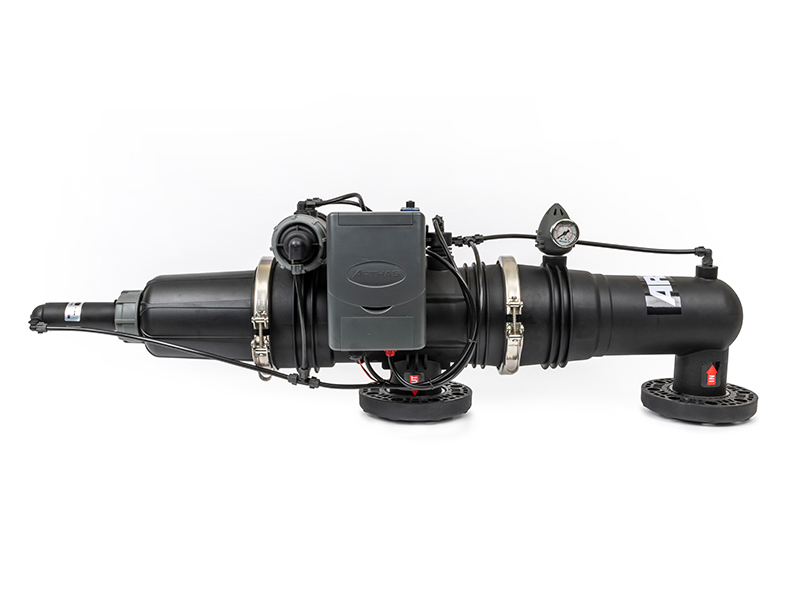
For large-scale commercial farms, manual cleaning is simply not viable. The same applies to operations drawing from highly contaminated surface water. In these instances, investing in an automatic screen filter is the most logical financial decision.
These advanced systems operate using a pressure-differential switch that continuously monitors water pressure at the inlet and outlet. As debris builds up, the outlet pressure drops. Once the pressure difference reaches a pre-set threshold, the system controller automatically triggers a self-cleaning backflush cycle. A specialized internal suction scanner rotates across the mesh. It vacuums the debris and expels it through a flush valve. All of this happens without interrupting the downstream flow of water to the crops.
Purchasing the correct screen filter system requires a systematic calculation based on flow rate, water quality, and emitter specifications. Buying a unit based solely on the pipe diameter is a critical error. It inevitably leads to hydraulic bottlenecks.
Consult the manufacturer specifications for your specific drip tape, micro-sprinklers, or foggers. Locate the flow path diameter, usually listed in millimeters or microns. Apply the one-tenth rule to determine your target micron rating.
Filters are rated by their maximum volumetric flow capacity. You must calculate the total gallons per minute or cubic meters per hour that your irrigation pump will push through the largest zone. If you push 300 gallons per minute through a housing rated for only 150 gallons per minute, the velocity spikes. The sheer water speed will force debris straight through the mesh, or the pressure will physically rupture the screen. Always select a maximum flow rating that exceeds your pump output by at least 20 percent.
Evaluate the turbidity and dirt load of the water. Highly contaminated water requires a housing with a significantly larger internal screen surface area. Two filters might both have a 120-mesh rating and a 2-inch inlet. However, one might have a screen area of 300 square centimeters while another has 600 square centimeters. A larger surface area distributes the debris load. This extends the time required between cleaning cycles.
Proper post-purchase maintenance is the only way to ensure the projected lifespan of your irrigation equipment. It directly protects your initial investment.
Manual screens must be handled with care. Technicians should use soft-bristled brushes and a moderate-pressure hose to remove debris. Never use high-pressure power washers directly on fine weaves like 150 or 200 mesh. The intense force can warp the stainless steel threads. This alters the micron rating and allows debris to pass through. For calcium scale buildup, soaking the element in a mild acidic solution is standard industry practice.
The most accurate way to monitor filter health is through empirical instrumentation. Install pressure gauges on both the inlet and outlet ports of the housing. A clean unit will typically show a negligible 1 to 2 psi differential. When that differential expands to 5 to 7 psi, it is the definitive indicator that the element has reached its debris capacity. It requires immediate cleaning.
As agricultural operations scale, the hidden costs of manual filtration become glaringly apparent. Upgrading to automated systems shifts from a capital expense to a measurable return on investment.
Evaluate the labor hours dedicated to daily maintenance. Farmhands might spend two hours every morning manually isolating valves, dismantling housings, and flushing screens. These labor costs compound rapidly over a season. Field data indicates that for medium-to-large operations, the capital expenditure of an automated setup often pays for itself within a single growing season simply through drastically reduced labor overhead.
Beyond labor savings, automation provides crucial risk mitigation. Automated systems protect sensitive crops during night watering cycles or when the farm manager is off-site. If a sudden surge of algae enters the intake pipe from a pond, an automated controller will continuously backflush to protect the drip lines. In contrast, a manual system would quickly clog. This shuts down water flow and potentially causes irreversible drought stress to the crop yield before anyone notices the problem.
Choosing the correct micron rating is the definitive factor in preventing catastrophic system failure. Most standard drip setups require 120 to 150 mesh. However, you must thoroughly evaluate your specific water source and emitter size before making a purchase. Upgrading to a robust TX-type architecture or a fully automated system can drastically reduce daily maintenance burdens.
Ultimately, taking the time to calculate the exact filtration specifications for your farm saves money, conserves water, and guarantees higher crop yields. Do not leave your harvest to chance. Evaluate your flow rates, check your emitter specifications, and browse the professional-grade solutions at Arka Irrigation to secure the exact filtration system tailored for your agricultural infrastructure today.
Generally, 120 to 150 mesh is the industry standard. This range provides excellent protection for agricultural drip tape. It prevents clogging without causing excessive pressure drops across the pipeline.
No, the terminology can be counterintuitive. A higher micron number means larger physical holes, resulting in less filtration. Conversely, a higher mesh number means smaller holes, resulting in finer filtration. You require the exact correct size for your specific emitters, not necessarily the finest screen available. This prevents rapid and unnecessary clogging.
Yes, but heavy algae will quickly blind a standard manual screen because the organic matter smears across the surface. For water sources with high algae content, utilizing an automated self-cleaning system or a sand media filter combined with a screen backup is highly recommended.
It is a heavy-duty agricultural filter featuring a robust Y-type or T-type structural design. It is engineered specifically for high durability, high-pressure tolerance, and ease of dismantling for maintenance in commercial piping systems.
Cleaning frequency depends entirely on your water quality and the current dirt load. Rather than using a set schedule, you should clean the unit when the pressure differential between the inlet and outlet pressure gauges reaches 5 to 7 psi.
The most reliable indicator is a sudden pressure drop across your system. By installing pressure gauges on both the inlet and outlet ports, you can monitor the flow in real-time. A differential of 5 to 7 psi means the screen has reached its maximum debris capacity and requires immediate flushing.
Yes, but it depends on the sheer volume of the particulates. For moderate sand levels, an 80 to 120 mesh screen works perfectly. However, if your well produces excessive heavy sand, you should install a centrifugal sand separator before the screen filter. This two-stage setup prevents the mesh from blinding too rapidly.


