
Views: 0 Author: Site Editor Publish Time: 2026-11-06 Origin: Site


Imagine walking your crop rows in mid-July. You expect lush green foliage, but instead, you discover a patch of withered, dying plants. The culprit is rarely a massive system failure. Almost always, it is a microscopic blockage in a single emitter. Drip irrigation is widely celebrated for its exceptional water efficiency because it delivers precise moisture directly to the root zone. However, this efficiency relies entirely on tiny flow passages. These pathways often measure less than a millimeter in diameter. Because they are so exceptionally narrow, they easily trap dirt, algae, and mineral scale.
In this comprehensive engineering guide, you will learn exactly how a screen filter serves as the ultimate, cost-effective first line of defense. By understanding how these mechanisms work and selecting the right hydraulic configuration, you can prevent frustrating clogs. You will ensure uniform water distribution and ultimately maximize your agricultural yield.
Understanding the root causes of emitter blockages is the crucial first step in protecting your agricultural investment. The contaminants that threaten your irrigation network generally fall into three distinct categories.
Physical debris remains the most common cause of emitter failure. When drawing water from agricultural wells, fast-moving rivers, canals, or open reservoirs, the water naturally carries suspended solids. These inorganic materials include fine sand, silt, clay particles, and small gravel. Even treated municipal water can carry rust flakes or pipe scale from aging infrastructure. As these rigid particles travel down the lateral lines, they lodge tightly at the emitter orifices. Over time, this buildup acts exactly like a miniature dam. It completely shuts off the vital water flow to the plant.
Water sources exposed to direct sunlight and fluctuating temperatures quickly become breeding grounds for organic matter. Algae, bacteria, and microscopic plant life thrive inside the warm, nutrient-rich environment of irrigation tubes. As these biological organisms multiply, they bind together to form a thick, sticky green or brown biofilm, commonly referred to as slime. This organic matrix not only blocks the emitters on its own but also acts as a biological glue. It traps fine physical silt that might otherwise pass harmlessly through the system.
Chemical clogging occurs when dissolved minerals in the water precipitate out of the solution and solidify into a crusty white scale. Hard water containing high levels of calcium and magnesium is a primary culprit here. In addition, certain injected fertilizers can react negatively with your specific water chemistry to form solid precipitates right at the drip tape.
While chemical treatments and periodic acid washes are absolutely required to manage dissolved minerals, installing a robust drip filter is a mandatory prerequisite. It serves as the physical gatekeeper, stopping suspended solids and organic debris before they ever have the chance to reach the sensitive drip tape.
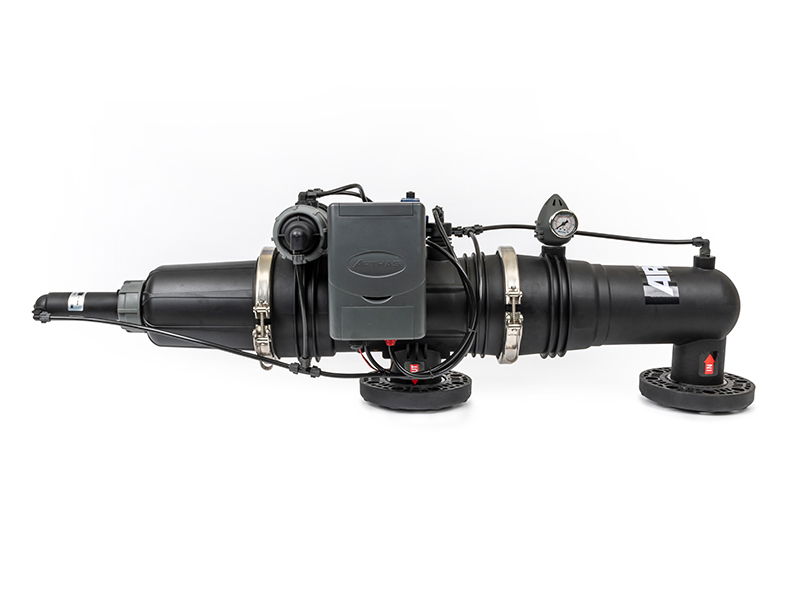
The operation of these filtration units relies on a straightforward but highly effective mechanical principle. They act as the primary security checkpoint for your irrigation network.
The core component of the unit is a cylindrical cartridge tightly wrapped in a woven mesh screen. As raw water enters the main housing, hydraulic pressure forces it to flow from the inside of the cylinder to the outside, or vice versa depending on the specific manufacturer design. Clean water successfully navigates the microscopic pores of the mesh and continues down the mainline. Meanwhile, any debris larger than the pore size is physically intercepted. It remains safely isolated from the vulnerable emitters downstream.
To choose the right equipment, you must understand how filtration levels are quantified. The industry relies on two primary metrics: Mesh and Microns. Mesh refers to the number of holes per linear inch of the screen. Therefore, a higher mesh number means more holes, but those holes are significantly smaller. Microns measure the actual physical size of the particles that can pass through.
For standard agricultural applications, a 120-mesh screen, which equals 130 microns, to a 150-mesh screen, equaling 100 microns, is the established industry standard. This specific sizing effectively captures particles large enough to lodge in standard emitters without unnecessarily restricting the overall water flow.
A properly functioning unit protects the system without starving the emitters of necessary operating pressure. As water pushes through the screen, a slight loss of pressure naturally occurs. Engineers refer to this as pressure drop or friction loss. As dirt accumulates on the mesh, this pressure drop steadily increases. If a unit is undersized for the system flow rate, it will clog rapidly. This causes a severe pressure drop that renders the emitters useless. Sizing the equipment correctly ensures a perfect harmony between thorough filtration and hydraulic integrity.
Recent agricultural irrigation trends highlight a massive shift toward automated filtration systems. Escalating labor costs and increasingly strict water conservation regulations are driving this change globally. Modern growers are rapidly abandoning manual setups because sending crews to scrub filters daily is no longer economically viable. Industry analysts note that integrating smart, self-flushing mechanisms is no longer just a luxury for massive corporate farms. It has become a baseline requirement for mid-sized operations. This technology allows farm managers to maintain precise fertigation schedules without daily human intervention, ensuring consistent crop yields even during severe labor shortages.
Not all filtration units are built with the same geometry. The design and materials of the housing dictate exactly where and how the equipment should be deployed in the field.
Named for its distinctive angled body, the Y-type screen filter features a filter element that sits in a diagonal branch off the main water line. This configuration offers immense practical benefits for everyday maintenance. It is incredibly easy to open and clean. The operator simply unscrews the cap at the bottom of the Y shape to extract and rinse the mesh without dismantling the entire pipe network. Thanks to its compact footprint and user-friendly nature, the Y-type is the preferred choice for residential gardens, commercial greenhouses, and small-to-medium agricultural setups.
In contrast, T-type configurations feature a perpendicular housing, while inline filters utilize a straight-through design. These structural variations are often utilized in complex plumbing manifolds or scenarios requiring much higher flow capacities. T-type housings generally offer a larger surface area for the mesh compared to standard Y-types. This allows them to hold a significantly larger volume of debris before requiring a manual flush.
The material of the mesh directly impacts both durability and upfront cost. Nylon or plastic meshes are highly cost-effective and resistant to corrosion from harsh agricultural chemicals. They are ideal for standard applications dealing with soft organics or fine silt. On the other hand, heavy-duty stainless steel is engineered for brutal environments. If your water source contains sharp, abrasive inorganic debris like coarse sand or fine gravel, a stainless steel mesh is a necessary investment. It prevents the screen from tearing under intense hydrostatic pressure.
For large-scale commercial growers, dispatching a crew to manually open and scrub housings every single day is an inefficient use of labor. The modern solution to this operational bottleneck is smart automation.
A self cleaning screen filter is an advanced hydraulic device that actively monitors its own performance. Premium models, such as 3-inch auto backflush units equipped with robust wire mesh filter screens, handle high flow rates seamlessly. These units are equipped with differential pressure sensors located at both the inlet and the outlet. As debris builds up on the mesh, the pressure at the outlet inevitably drops.
Once the pressure difference reaches a pre-set threshold, typically around 7 PSI, the system electronic controller automatically triggers a flush cycle. A motorized or hydraulically driven suction scanner rotates inside the cylinder. It vacuums the trapped debris and expels it through a dedicated flush valve. The massive benefit here is continuous water flow to the crops, even during the flushing cycle. The suction mechanism utilizes only a minimal volume of water to expel the concentrated waste, making it highly water-efficient.
When designing an efficient irrigation infrastructure, farm managers frequently compare screen technologies to disc technologies. Both are highly effective at clogging prevention, but they operate on fundamentally different principles. Use the table below to determine which technology fits your field conditions.
| Feature | Screen Filter | Disc Filter |
|---|---|---|
| Filtration Principle | Surface filtration. Debris is stopped at a single mesh layer. | Depth filtration. Water navigates a 3D maze of stacked grooves. |
| Best Suited For | Hard, inorganic debris like sand, silt, and fine gravel. | Soft, biological contaminants like algae and organic slime. |
| Maintenance Difficulty | Very easy. Manual units just require a quick hose rinse. | Moderate. Discs must be loosened and washed thoroughly. |
| Initial Cost | Generally more cost-effective. | Slightly higher due to complex disc stack manufacturing. |
Ultimately, for the vast majority of standard well-water and municipal drip systems, surface filtration remains the most practical, reliable, and economically viable choice for emitter protection.
Selecting the correct unit requires matching the hardware to the specific hydraulic conditions of your farm. Use these critical engineering parameters to guide your purchasing decision.
Assess whether you are pumping from a clean, deep well or a muddy surface reservoir. If your well produces a heavy load of fine sand, a standard manual unit may become overwhelmed quickly. In high-sediment scenarios, investing in a primary centrifugal sand separator followed by secondary screen filtration is a standard agronomic best practice.
The unit must be rated to handle the absolute maximum output of your irrigation pump, measured in gallons per minute or liters per hour. Sizing it too small will result in excessive friction loss. This means the emitters at the far end of your crop rows will receive insufficient water. Always select a capacity that exceeds your system peak demand by at least 20 percent.
Ensure the inlet and outlet ports match the diameter of your main irrigation line. For example, if your mainline is 3 inches, select a 3-inch filter housing. Utilizing excessive reducing bushings or adapters to force a fit introduces weak points in the plumbing and causes unwanted fluid turbulence.
Always consult the technical specifications provided by your drip tape manufacturer. They will explicitly state the required filtration level to validate their warranty. As a universal engineering rule, the filter aperture size should be at least one-seventh the size of the emitter pathway.
Even the highest quality equipment will fail if it is installed incorrectly or neglected. Implementing strict protocols is the only way to guarantee long-term success in the field.
Proper placement within the manifold is critical. The standardized installation sequence should begin with the water source and pump, followed immediately by a backflow preventer. The primary filtration unit must be installed strictly before any pressure regulators. Filters require higher upstream pressure to push water through the mesh effectively. If you are fertigating, the fertilizer injector follows the filter, capped off by the pressure regulator.
Routine manual cleaning is a non-negotiable aspect of operating a non-automated setup. Follow these empirical steps to ensure thorough cleaning without damaging the delicate mesh:
A common misconception is that high-quality filtration eliminates the need for field maintenance. While a 130-micron mesh removes large particles, microscopic silt and dissolved minerals will still pass through. Over a growing season, these micro-particles accumulate at the dead ends of the lateral lines. To achieve total clogging prevention, farmers must practice routine line flushing. Once every four to six weeks, open the end caps of all drip lines while the system is fully pressurized. Allow the water to run freely until the discharge turns completely clear. This mechanical flush purges the accumulated micro-sediment.
Emitter clogging is the silent enemy of efficient irrigation. It ruins crops, wastes valuable water resources, and destroys profitability. A properly sized filtration unit stops this problem at the source, blocking harmful dirt and safeguarding your delicate drip lines. Whether you manage a backyard garden or a sprawling commercial farm, upgrading your irrigation setup with reliable filtration is a remarkably smart choice. To protect your farm yield, reduce maintenance headaches, and ensure your system runs flawlessly every single season, we highly recommend exploring a professional-grade screen filter system tailored to your specific flow requirements.
For standard agricultural and residential drip irrigation systems, a 120-mesh to 150-mesh rating is universally recommended by agronomists. This specific density provides the optimal balance. It is fine enough to block suspended sand and debris that cause clogs, yet porous enough to allow sufficient water flow without causing rapid pressure drops. Always consult the specification sheet provided by your drip tape manufacturer.
Maintenance frequency is entirely dependent on the biological and particulate load of your specific water source. If you are utilizing clean, treated municipal water, a visual inspection and light rinsing once a month is generally sufficient. However, if you are drawing from an agricultural well with high sand content, you must check it daily or weekly during the initial setup. If the mesh is more than 30 percent covered in debris upon inspection, increase your cleaning frequency.
No, mechanical filtration is designed exclusively to remove suspended physical debris. Hard water clogging is a chemical precipitation issue caused by dissolved minerals, primarily calcium carbonate and magnesium. These dissolved ions are infinitely smaller than any mesh aperture. To prevent chemical clogging, you must manage your water pH through acid injection or utilize specialized chemical line cleaners periodically.
Subsurface Drip Irrigation systems are buried underground, making emitter maintenance exceptionally difficult. Therefore, they require rigorous, multi-tiered protection strategies. Implementing an automated flushing system is highly recommended to ensure continuous filtration without human error. Additionally, frequent lateral line flushing is mandatory, and growers must utilize specialized drip tape embedded with root-growth inhibitors to prevent plant roots from intruding into the emitters.
When a filter is brand new or freshly cleaned, the initial pressure drop should be minimal, typically ranging between 2 to 5 PSI depending on the flow rate and housing design. If you observe a pressure drop higher than 5 PSI on a clean filter, the unit is likely undersized for your pump output, and you need to upgrade to a larger housing to prevent flow restriction.
While a screen filter will catch large clumps of algae, it is not recommended as the primary filtration method for water sources with severe biological loads, such as open ponds. Algae is soft and sticky; under high pressure, it can deform and squeeze through the mesh pores, or rapidly blind the screen entirely. For heavy algae, engineers recommend using a media filter or a disc filter as the primary stage, followed by a screen filter as a secondary backup.


