
Views: 0 Author: Site Editor Publish Time: 2026-10-22 Origin: Site


Are clogged emitters constantly sabotaging your crop yields? Walking down a row to find bone-dry soil and struggling plants is a common nightmare for field growers. Inconsistent water distribution wastes expensive resources and directly damages plant health.
Many assume installing any basic filtration hardware is a universal fix. However, simply slapping a generic housing onto your mainline often introduces entirely new hydraulic headaches. The wrong size or incorrect type of purification equipment creates massive pressure loss. Worse, it might completely fail to catch the microscopic debris threatening your emitters.
A properly configured drip irrigation filtration setup serves as your ultimate defense against both organic sludge and inorganic grit. Success hinges entirely on precise mathematical configuration rather than guesswork. This comprehensive guide walks you through exactly how to calculate system flow rates, decode mesh ratings, and select the perfect hardware to guarantee long-term stability.
Before upgrading a water distribution network, you need to understand the engineering behind the equipment. Unlike basic single-layer meshes, this technology relies on a complex internal structure designed to handle highly challenging water conditions.
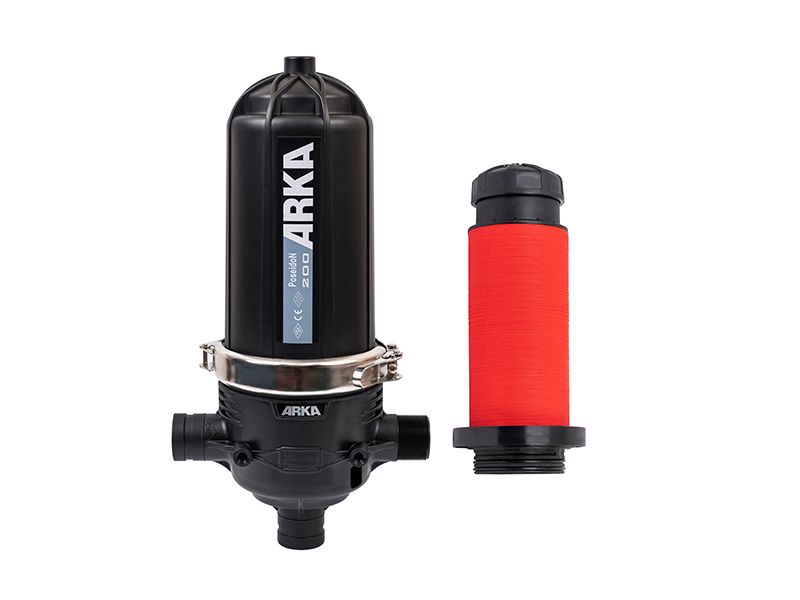
At the core of the unit sits a tightly compressed stack of color-coded, heavy-duty plastic rings. If you run a fingernail across one of these elements, you will feel hundreds of microscopic diagonal grooves. When stacked together and locked down by a central spine, these intersecting grooves create a dense, three-dimensional filtration pathway.
Pressurized water is forced from the outside of the cylinder toward the center. Consequently, debris gets trapped at multiple depths within the overlapping grooves. This massive surface area allows the unit to hold significantly more sediment than a flat surface before requiring a manual flush.
When browsing agricultural supply catalogs, you frequently encounter angled housings. Specifically, a Y-type disc filter is engineered to optimize fluid dynamics. Directing incoming water at an angle minimizes internal turbulence and reduces friction loss. Beyond hydraulic efficiency, this specific shape allows gravity to pull heavier sediment down into the cap area. This makes manual extraction and cleaning incredibly fast.
Not every irrigation project requires industrial-scale hardware. For small residential raised beds, tight greenhouse manifolds, or low-flow nursery zones, a compact disc filter is often the perfect fit. These reduced-footprint models utilize the exact same grooved-ring technology but fit seamlessly into standard valve boxes where physical space is at a premium.
A major point of confusion for buyers is choosing the correct filtration medium. Making the wrong choice here guarantees a summer filled with clogged lines and exhausting maintenance.
If you draw clean municipal water or pull from a deep well that occasionally kicks up hard grit, a screen filter for drip irrigation proves highly effective. Woven stainless steel or nylon mesh easily stops rigid inorganic debris like sand and pipe scale. However, flat screens possess a fatal flaw when deployed in the wrong environment. Under high pump pressure, soft organic matter simply squeezes and extrudes right through the mesh pores.
In contrast, stacked rings physically trap soft, malleable contaminants like algae, slime, and mud. Because of their overlapping deep grooves, soft materials cannot be pushed through the matrix. If your water source sees sunlight, stacked ring technology is non-negotiable.
| Feature | Disc Technology | Screen Technology |
|---|---|---|
| Filtration Type | 3D Depth Filtration | 2D Surface Filtration |
| Best For | Algae, organics, mud, surface water | Sand, gravel, hard grit, municipal water |
| Debris Capacity | Very High | Low to Medium |
| Maintenance | Easy to flush, rings separate for cleaning | Requires scrubbing, mesh can tear over time |
Selecting hardware based solely on the size of your PVC pipe is a remarkably common and expensive engineering mistake. Proper sizing requires strict mathematical alignment with your system's specific hydraulic demands.
Looking at current agricultural trends, the industry is rapidly shifting toward precision micro-irrigation driven by global water scarcity. Farmers are increasingly forced to utilize marginal surface water sources, such as algae-rich retention ponds and reclaimed wastewater. This shift makes relying on outdated or undersized filtration a critical failure point. Modern agronomy demands proactive hydraulic engineering rather than reactive maintenance.
Every single component you splice into a mainline creates resistance. This is known in the field as friction loss. Water pushing through microscopic grooves naturally loses kinetic energy. A properly sized unit generates a negligible pressure drop, typically registering between 2 to 5 PSI when clean.
Forcing a high volume of water through an undersized housing creates a violent bottleneck. The pressure drop can easily spike to 15 PSI or more. By the time water reaches the far end of your field, there simply isn't enough pressure left to open the emitters. The physical dimensions of the housing dictate its debris-holding capacity. Small units on heavy debris loads fill up rapidly, requiring exhausting daily manual flushing just to keep water flowing.
To guarantee peak efficiency and protect your investment, follow this objective calculation method before making a purchase. As field engineers often say, measure twice and buy once.
You must determine the absolute maximum volume of water moving through your pipes at any given time. If your farm uses automated valves to water in sections, calculate this based on your largest single watering zone.
Multiply the flow rate of a single emitter by the total number of emitters in that zone. For example, if your largest zone contains 2,000 emitters rated at 0.5 gallons per hour, your total flow is 1,000 gallons per hour. Divide that number by 60 to get 16.6 gallons per minute.
Standard hydraulic engineering principles dictate you should never run a component at full maximum rated capacity. Always apply a 20 percent safety buffer to account for gradual debris buildup and unexpected pump spikes. Taking our peak flow of 16.6 gallons per minute and multiplying by 1.2 gives 19.9. Therefore, you must select a unit explicitly rated to handle at least 20 gallons per minute.
While it is convenient to match inlet and outlet ports to your existing mainline pipe diameter, flow rate capacity always takes precedence. If your flow calculations require a 1.5-inch capacity but you only have a 1-inch mainline, purchase the larger unit and adapt the plumbing using standard reducing bushings.
Understanding filtration precision is just as vital as calculating flow capacity. Over-filtering causes just as many maintenance headaches as under-filtering.
Manufacturers use two distinct metrics to measure the size of gaps in the filtration element. Mesh refers to the number of holes per linear inch. A higher mesh number means finer filtration. Micron refers to the actual physical measurement of the hole itself. A lower micron number means finer filtration.
For the vast majority of agricultural drip tape and pressure-compensating micro-sprinklers, a 120-mesh rating, which equals roughly 130 microns, is the established gold standard. Attempting to use a 200-mesh unit on standard agricultural surface water will cause the system to blind and clog excessively fast. This provides no additional operational benefit while doubling your labor costs.
Expanding micro-irrigation footprints demand robust hardware that can process fluctuating surface water qualities without requiring constant human intervention.
The 3/4-inch to 1-inch tiers are primarily utilized for low-flow applications. They handle flow rates typically under 20 gallons per minute. This makes them highly cost-effective for raised garden beds, municipal landscape zones, and small-scale gravity-fed systems.
For sprawling orchards and high-yield row crops, a 2-inch disc filter is widely considered the workhorse of the industry. Engineered with massive internal surface areas, high-quality models manufactured from glass-reinforced polyamide can comfortably process flow rates up to 132 gallons per minute and withstand maximum operating pressures of 145 PSI. They are typically installed immediately after the primary pump station.
If commercial irrigation demands exceed single-unit capacities, upgrading to expensive metal tanks is not your only option. Engineers frequently install two or more large plastic units in parallel on a single manifold. This technique effectively doubles or triples the flow capacity while maintaining the cost-efficiency of plastic housings.
Procuring the right equipment is only half the battle. Proper installation and routine upkeep are non-negotiable for preserving optimal fluid dynamics.
These devices are strictly directional. Installing one backward forces water into the inside of the stack first. This immediately collapses the rings and destroys the internal spine. Always locate the directional flow arrow molded into the exterior plastic housing, ensuring it points away from your water source and toward your field.
Routine cleaning prevents organic fouling from permanently staining the plastic. First, turn off the water pump and open a downstream flush valve to completely depressurize the line. Never open a pressurized housing. Unscrew the main cap and pull out the internal cartridge. Loosen the tension nut at the top of the spine to let the rings separate slightly. Finally, use a high-pressure hose to spray water directly into the grooves, spinning the rings freely to dislodge trapped silt. Re-tighten the spine securely before reassembly.
Sizing your purification hardware correctly is a fundamental step in building a reliable watering system. It requires knowing your exact peak flow rate, choosing the appropriate mesh density, and understanding the specific nature of your water source.
Taking ten minutes to do the math prevents severe pressure loss and protects your plants from drought stress. Investing in durable, precision-engineered equipment upfront saves immense amounts of money on ruined lines and lost crop yields down the road. When designing your layout, source components from specialized manufacturers. Brands like Arka Irrigation provide a comprehensive selection of highly efficient models tailored to varying flow requirements, ensuring your emitters remain clear and your maintenance labor stays low. Evaluate your system's flow rate today and choose the exact Arka Irrigation filtration hardware required to optimize your agricultural output.
Yes, all physical barriers create a slight pressure drop due to friction loss. However, a properly sized unit keeps this drop minimal, usually registering between 2 to 5 PSI when clean. An undersized or heavily soiled unit causes severe pressure loss, potentially starving your zones of necessary water.
Absolutely. In the vast majority of agricultural scenarios, transitioning to a stacked-ring setup is a massive direct upgrade. This is especially true if you pump water from a pond, lake, or shallow well containing algae. You only need to ensure the inlet and outlet thread sizes match your existing plumbing manifold.
The most accurate method is to install two standard pressure gauges: one immediately before the housing inlet and one immediately after the outlet. Subtract the outlet reading from the inlet reading while the system is running at full capacity. If the difference exceeds 7 to 10 PSI, it is time to manually clean the internal cartridge.
While exact specifications vary by manufacturer, a high-quality 2-inch agricultural unit typically processes between 80 to 132 gallons per minute. Always verify the specific flow chart provided by the manufacturer, and remember to factor in a 20 percent safety buffer for optimal long-term performance.
Maintenance frequency is entirely dependent on your raw water quality. For clean municipal water supplies, inspecting and cleaning once a month may suffice. For surface water sources like ponds or rivers, you may need to flush the unit weekly or even daily during heavy summer algae blooms. Rely on pressure gauge readings rather than a set calendar schedule.
If you utilize a mesh rating that is too fine for your application, such as using a 200-mesh element to protect standard 120-mesh rated drip tape, the unit blinds and clogs incredibly fast. This results in constant pressure drops and requires exhausting daily maintenance. Always stick to the emitter manufacturer's recommended mesh rating.
Yes, provided the gravity system generates sufficient head pressure to push water through the compressed rings. Because gravity setups inherently possess very low pressure, it is highly recommended to oversize the housing. An oversized unit provides a significantly larger surface area, ensuring minimal friction loss and helping maintain optimal downstream flow.


