
Views: 0 Author: Site Editor Publish Time: 2026-10-30 Origin: Site


Are clogged emitters plaguing your different crop zones? A poorly designed water distribution network does more than merely waste water. It actively ruins harvests. It artificially inflates maintenance costs. Worse yet, it triggers catastrophic pipe blowouts right in the middle of peak growing season. When managing a diverse agricultural operation, your farm requires a highly strategic filtration infrastructure. Laying out this network involves far more than simply bolting a basic mesh barrier to a pump discharge. It demands a precise matching of technology to specific flow rates, topographical challenges, and distinct zonal requirements.
Current agricultural engineering data points to a rapid industry-wide shift toward precision irrigation, heavily driven by global water scarcity. Farm managers are increasingly forced to rely on marginal water sources. Reclaimed wastewater and nutrient-heavy retention ponds are now standard across large-scale operations. Consequently, a meticulously engineered filtration layout is no longer a luxury. It is the absolute baseline required to protect expensive variable-rate drip lines and advanced micro-sprinklers from catastrophic failure.
In this technical guide, we will walk you through expert layout strategies, equipment selection criteria, and hydraulic design principles. Our goal is to help you maximize the efficiency of your multi-zone farm and ensure you make the right infrastructure investments upfront.
Designing an irrigation infrastructure for a multi-zone farm presents complex hydraulic challenges. Single-crop plots are hydraulically simple. Multi-zone farms, however, are a completely different beast. They feature varying topography, diverse crop types, and highly staggered watering schedules.
For instance, one zone might require high-volume micro-sprinklers for a sprawling citrus orchard. Meanwhile, an adjacent zone utilizes low-flow drip tape for delicate row crops. These inherent variations create wildly fluctuating flow rates. They also introduce dynamic pressure demands across the entire pipeline network.
The filtration station serves as the protective heart of this water distribution network. Its primary function is to shield sensitive emission devices and control valves from particulate matter. When rogue debris bypasses a poorly laid-out station, the results are predictable. It inevitably leads to clogged emitters, severely uneven water distribution, and ultimately, massive crop loss.
From a commercial perspective, investing capital and engineering hours into the correct layout upfront prevents costly retrofitting later. A strategically designed layout balances water pressure across all active zones simultaneously. This ensures that the water treatment process itself does not create a hydraulic bottleneck, starving downstream crops of essential hydration when they need it most.
The foundational step in designing your layout is a brutal, honest assessment of your primary water source. The biological and mineral load of your water directly dictates the physical placement and exact type of primary intake equipment required.
Surface water sources, such as retention ponds, rivers, and agricultural canals, carry exceptionally high biological loads. They fluctuate violently with the changing seasons and often contain suspended solids that can blind a poorly specified mesh in under an hour. Conversely, groundwater sourced from deep agricultural wells or municipal supplies is generally free of biological matter. However, it frequently carries dissolved minerals, fine inorganic grit, and sharp pipe scale.
To design an effective layout, contaminants must be categorized accurately. Organic contaminants like algae, moss, leaves, and biological slime require depth filtration. This prevents the internal elements from clogging rapidly. In contrast, inorganic contaminants such as sand, silt, and rust are effectively managed by surface separation methods. In practical terms, if you are drawing from a surface source, your primary intake barrier should be placed as close to the water as possible. Utilizing a suction screen or a coarse pre-filter before the main pump prevents large debris from entering the pump volute. This reduces mechanical wear and protects the central station downstream.
Because multi-zone farms have diverse requirements, a one-size-fits-all approach rarely succeeds. Different agricultural zones often require distinctly different technologies based on the specific emitters installed in the field. Understanding the exact specifications of your hardware is critical.
A high-quality screen filter system utilizes a physical stainless steel or durable plastic mesh barrier to separate particles from the water flow. It operates on the principle of surface filtration. Debris larger than the mesh aperture is trapped directly on the flat surface.
This technology is best suited for well water, municipal water, and environments with heavy inorganic debris like sand or grit. In a multi-zone layout, these units are highly effective when deployed as secondary or zone-specific safeguards. Placing them at the head of a specific zone manifold ensures that any pipe scale that bypassed the central station is caught before entering sensitive drip lines. Look for models offering precise micron ratings tailored to your specific emitter orifice size.
Unlike flat mesh, a modern disc filter system consists of stacked, color-coded plastic rings featuring microscopic diagonal grooves. When compressed tightly together by water pressure, these grooves intersect to create a robust, three-dimensional trapping network.
These units are ideal for moderate organic material, mixed debris, and environments where water quality fluctuates unpredictably. Because they offer true depth filtration, they are perfect for mainlines feeding into highly sensitive drip irrigation zones. They excel at capturing flexible organic matter, like stringy algae. Under high operational pressure, this soft debris might otherwise extrude straight through a standard flat mesh.
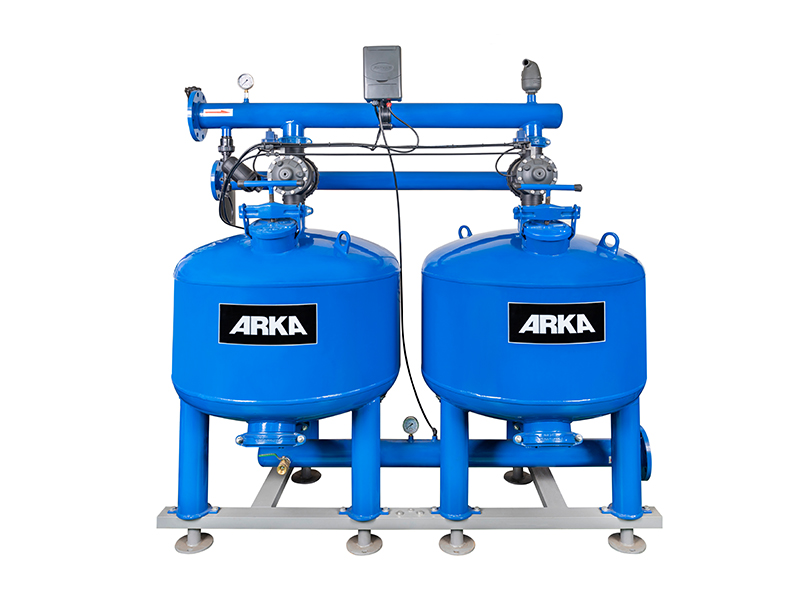
Often referred to as media tanks, these heavy-duty stations force water through a thick bed of crushed silica sand or basalt. The jagged edges of the media particles trap microscopic debris as the water percolates downward.
These are strictly meant for surface water burdened with heavy organic loads and high suspended solids. A robust sand filter system, such as the F40 series 1000mm automatic self-cleaning model, should always be placed at the central pumping station. Featuring a large 1000mm tank diameter and dual-tank configurations, these systems act as the primary, heavy-duty line of defense before the mainline splits into multiple sub-mains. Due to their massive size and vigorous backwash flow requirements, they require a dedicated concrete pad and robust drainage infrastructure.
| Technology Type | Best Water Source | Target Contaminants | Ideal Layout Placement |
|---|---|---|---|
| Screen | Well / Municipal | Sand, Silt, Pipe Scale | Secondary / Zone Valves |
| Disc | Mixed / Fluctuating | Light Algae, Mixed Grit | Primary or Mainline |
| Sand Media | Ponds / Canals / Rivers | Heavy Algae, Organic Slime | Central Pump Station |
Furthermore, determining where to physically place this equipment is a critical engineering decision. Farm managers must choose between centralized, decentralized, or hybrid layouts based on farm topology, budget, and labor availability.
A centralized layout features one large, high-capacity station located directly at the primary water source or main pump house. The distinct advantage here is streamlined maintenance. Workers only visit one location to monitor gauges and perform cleanings. It also vastly simplifies automation wiring and backwash drainage. However, pushing water through a massive central unit requires higher initial pump pressure to overcome the friction loss before the water even reaches the distant agricultural zones.
Conversely, a decentralized layout places smaller, independent units at the start of each specific zone valve. This is highly customizable. If Zone A uses micro-sprinklers requiring 80 mesh and Zone B uses drip tape requiring 120 mesh, decentralized units allow exact matching. The major drawback is the brutal labor required. Imagine trekking a quarter-mile through muddy tomato rows in the pouring rain just to check a clogged gauge.
For modern, large-scale operations, a hybrid layout is widely considered the gold standard. This involves installing a heavy-duty central media tank array at the source to handle the vast majority of the biological load. This is followed by decentralized secondary units at each zone valve. This secondary layer acts as a reliable insurance policy against mainline pipe scale, ensuring absolute protection for the emitters.
Relying on manual cleaning in a multi-zone farm introduces significant operational risks and glaring labor inefficiencies. As internal elements inevitably clog, line pressure drops rapidly. This leads to severely uneven water application across your crops, stunting growth in the furthest rows.
Manually disassembling and scrubbing housings across five or more zones is a painfully time-consuming task. During peak irrigation season, a sudden heavy algae bloom in a retention pond can blind a manual unit in mere hours. This requires constant vigilance. It diverts valuable farm labor away from critical crop management tasks like pruning, fertilizing, or harvesting.
Integrating a reliable automatic backwash filter entirely eliminates this manual labor bottleneck. These advanced systems are equipped with a differential pressure switch and a smart controller. When the controller detects a specific pressure drop across the housing, typically between 5 to 7 PSI, it automatically reverses the water flow. This reversed high-velocity flow aggressively flushes the trapped debris out through a dedicated discharge valve.
While the initial capital expenditure for automation is noticeably higher, the system pays for itself rapidly. The Return on Investment is realized through drastic reductions in labor costs, the extended lifespan of drip emitters, and most importantly, consistent crop yields achieved through uninterrupted, uniform hydration.
Proper physical installation is just as important as selecting the right technology. Following these strict engineering guidelines will ensure a resilient, long-lasting layout.
A filtration layout is effectively flying blind without pressure gauges. You must install high-quality, liquid-filled gauges immediately before and after every single unit in the network. The pressure differential between these two gauges is the only objective metric to determine when a housing is clogging and requires immediate backwashing.
Never install a housing directly inline without a bypass manifold. A proper bypass layout utilizes a series of three heavy-duty valves. This allows farm operators to route water around the equipment temporarily. If emergency maintenance or part replacement is required, the entire farm's watering schedule does not have to be shut down.
Gravity significantly impacts hydraulic pressure. If your central station is located at the bottom of a steep hill and Zone C is at the top, you must account for the elevation head loss. You lose roughly 0.433 PSI for every foot of elevation gain. Ensure your layout places equipment where incoming pressure is sufficient to overcome both the internal friction loss and the topographical incline.
A frequent layout error is pipeline bottlenecking. Ensure that the pipe diameter immediately entering and exiting the housing matches the equipment's maximum flow capacity. Forcing high-velocity water through undersized PVC pipes creates excessive friction loss, damaging turbulence, and premature wear on the internal components.
Agricultural operations naturally grow over time. When pouring the concrete pad for a central station or designing a PVC manifold, always leave physical space and capped T-fittings. This simple foresight allows you to easily install an additional unit in parallel to the existing array when you acquire more land or add new watering zones.
Accurate sizing is the most critical engineering phase when designing your layout. Guesswork in this stage inevitably leads to hardware failure, compromised emitter performance, and uneven water distribution across different plots. Proper sizing requires a strict mathematical approach to flow rates and operational capacity buffers.
The foundational metric is the maximum flow rate, typically measured in Gallons Per Minute or Liters Per Hour. In a multi-zone layout, peak demand occurs when the maximum number of overlapping zones operate simultaneously. To calculate this, determine the total flow requirement of the emitters within each active zone. If Zone A requires 50 Gallons Per Minute and Zone B requires 75 Gallons Per Minute, and they run concurrently, your baseline flow rate is 125 Gallons Per Minute. The station feeding these zones must be rated to handle this combined volume effortlessly.
Standard agricultural engineering practice dictates the twenty percent rule. You should never operate a unit at maximum flow capacity continuously. As debris accumulates between cleaning cycles, the effective surface area decreases, artificially restricting flow. Once you calculate your peak simultaneous flow rate, upsize your capacity by a minimum of 20 percent. For a peak demand of 125 Gallons Per Minute, select equipment rated for at least 150 Gallons Per Minute.
Selecting the correct micron or mesh degree is equally essential. If the mesh is too coarse, large particles will pass through and destroy your drip emitters. If it is too fine, the system will blind prematurely, causing severe pressure drops. The general rule of thumb is to select a mesh that removes particles at least one-seventh to one-tenth the size of the smallest emitter orifice in your zone.
Even with premium components, structural flaws in the layout design can severely degrade the performance of an irrigation network. Avoiding these common empirical errors will save significant time and capital investment.
A frequent error is mixing incompatible technologies in a series without accounting for cumulative pressure differentials. Every single unit introduces friction loss. If pressure regulators or sustaining valves are not installed between a primary media station and secondary zonal filters, downstream equipment may experience violent pressure spikes. When spikes exceed structural ratings, you will inevitably deal with blown seals or cracked housings.
Specifically, many designers ignore specific backwash flow requirements. Automated systems operate on strict hydraulic principles. They require a specific minimum pressure and flow rate to reverse the water and expel trapped debris effectively. If the mainline pipe is too small, or the pump cannot generate the required backwash velocity while simultaneously watering a distant zone, the debris remains trapped. Over time, this leads to permanent fouling.
Finally, ergonomics play a direct role in equipment longevity. Placing secondary units deep inside muddy crop rows, hidden under heavy foliage, or cramped inside tiny underground valve boxes practically guarantees they will be neglected. Equipment must be installed on stable, well-drained pads with adequate clearance for technicians to remove heavy covers and extract internal elements safely.
A smart layout secures your farm's future and protects your bottom line. Proper sizing prevents unexpected pressure drops, while choosing the right combination of technologies saves you countless hours of manual labor. Always match your equipment to your specific water source and zonal emitter requirements. This careful, strategic planning maximizes your crop yield and preserves your irrigation infrastructure for years to come. Take the time to evaluate your current setup before the next growing season begins. We highly recommend exploring ARKA's comprehensive range of advanced filtration solutions to upgrade your layout for maximum hydraulic efficiency and unmatched reliability.
While technically possible for exceptionally clean ponds, it is generally highly discouraged by engineers. Surface pond water contains elevated organic matter, such as algae and biological slime. This organic load will rapidly blind the flat surface of a standard mesh screen. For surface water applications, a sand media tank or a grooved disc setup is vastly superior, as they provide the depth filtration necessary to handle sticky organic loads.
The most accurate and objective method is by monitoring the pressure differential. If the liquid-filled pressure gauge installed after the housing drops by 5 to 10 PSI compared to the gauge before it, the internal element is restricted and requires immediate cleaning. Automated systems monitor this differential constantly and trigger the flushing process for you without manual intervention.
This depends entirely on your farm's specific topology and crop diversity. A centralized large station at the pump is much easier to manage, wire for power, and maintain. However, if your farm zones have vastly different water quality needs, utilize contrasting emitter types, or are spread miles apart across uneven terrain, utilizing decentralized zonal units is a much more hydraulically efficient engineering practice.
No. Modern automated systems are engineered to be highly efficient. They typically use only a fraction of a percent of your total water volume to execute a flush cycle. Furthermore, the agricultural runoff generated during backwashing can be safely redirected to non-crop areas, vegetative buffer strips, or settling ponds. This ensures minimal environmental impact and virtually zero water waste.
A screen setup uses a woven physical mesh to block particles on a single flat surface, which provides two-dimensional filtration. This makes it highly efficient for hard, inorganic debris like sand or pipe scale. Conversely, a disc setup utilizes a stack of tightly compressed, grooved plastic rings that trap debris deep within intersecting pathways, providing three-dimensional filtration. This depth makes the grooved rings vastly superior for trapping soft, flexible organic matter like algae without clogging immediately.
When internal elements are completely clean, a properly sized unit typically creates a minimal friction loss of 2 to 4 PSI. However, as debris accumulates during normal operation, this pressure drop will steadily increase. Engineers generally recommend initiating a cleaning cycle once the pressure loss reaches 5 to 7 PSI to maintain optimal hydraulic efficiency across the farm.
Secondary protection should be installed as close to the emission devices as physically possible. Best practices dictate placing these units immediately downstream of the zone control valve and pressure regulator. This ensures that any rust, PVC shavings, or scale that breaks loose from the mainline piping is caught right before it can enter and permanently blind the sensitive drip tape.


