
Views: 0 Author: Site Editor Publish Time: 2026-10-28 Origin: Site


Cooling towers act as the critical heat rejection workhorses for industrial manufacturing and large-scale commercial HVAC networks. Yet, their thermal efficiency and mechanical longevity rely entirely on one frequently ignored metric: water quality. Pumping raw, unfiltered fluid into the basin is a guaranteed recipe for disaster. It introduces abrasive suspended solids that trigger severe scaling, foul expensive heat exchangers, and inflate maintenance budgets. Here, we break down exactly how a dedicated makeup water filter eliminates these headaches, keeping your cooling infrastructure running flawlessly under heavy loads.
To truly appreciate the value of front-end filtration, facility engineers must first look at the constant fluid loss and replenishment cycle inherent to evaporative cooling.
Cooling towers reject thermal energy by evaporating a small percentage of the circulating fluid into the atmosphere. Simultaneously, exhaust fans sweep away tiny droplets as drift. To stop dissolved minerals from concentrating to dangerous levels, operators must regularly dump basin water down the drain via blowdown. Because of this continuous volume loss, fresh influent must be constantly injected to maintain safe operating levels.
Source water quality fluctuates wildly. Industrial plants might draw from municipal lines, shallow wells, nearby rivers, or treated wastewater. None of these sources are perfectly clean. Open basins act like massive air scrubbers, pulling in airborne dust, pollen, and industrial soot. Well water drags up fine silica sand. Even municipal lines can suddenly flush heavy pipe rust directly into your mechanical room.
Picture a commercial chiller running at maximum capacity during a mid-July heatwave. When suspended dirt enters the loop, it settles inside the heat exchanger. These particles become the perfect anchor points for calcium carbonate. Because mineral scale is a highly effective thermal insulator, a microscopic layer can force chiller energy consumption to spike by up to 20 percent. Furthermore, a dirty basin creates a nutrient-rich sludge where biological hazards like Legionella thrive, forcing operators to dump massive amounts of expensive biocides into the system.
Taking a step back to view the broader cooling water treatment sector reveals a massive operational shift. Driven by tightening environmental regulations and escalating global water scarcity, heavy industrial facilities are rapidly abandoning outdated, water-wasting sand media tanks. The current engineering consensus heavily favors high-efficiency, low-waste automated depth filtration.
Moreover, modern plant managers demand data. There is a clear trend toward integrating filtration skids with centralized IoT platforms. Tracking differential pressure trends and backwash frequencies in real-time allows control rooms to spot upstream municipal water quality drops before they compromise the cooling loop. This proactive, data-driven approach is becoming the absolute standard for facilities aiming to hit strict sustainability targets while curbing utility costs.
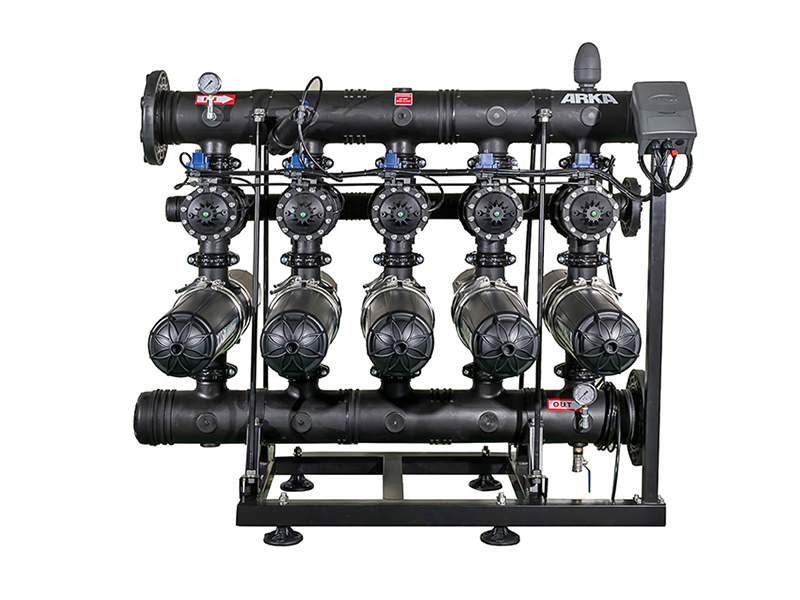
Understanding the internal hydraulics of this technology shows exactly why it dominates demanding HVAC applications. The architecture is built to handle sudden, heavy debris loads without requiring a maintenance technician to ever lift a wrench.
At the heart of the system are hundreds of highly durable, color-coded polymer rings stacked tightly around a hollow spine. These discs are completely immune to rust and chemical degradation. Each ring features microscopic, diagonally intersecting grooves. When compressed by hydraulic pressure, these overlapping grooves create a dense, three-dimensional depth matrix. This design gives the filter massive dirt-holding capacity compared to flat screens.
During normal operation, raw water enters the pressurized housing and flows from the outside of the compressed disc stack toward the hollow center. As the fluid navigates the tortuous path of the grooves, suspended solids are physically wedged in place. Large grit is stopped on the outer edge, while fine silt is trapped deep inside. Clean water flows up the center spine and out to the cooling tower basin.
The engineering brilliance of an automatic backwash filter shines when it gets dirty. Once the grooves fill with debris, the pressure differential between the inlet and outlet reaches a setpoint—typically around 0.5 to 0.7 bar. The controller instantly shifts a three-way valve. The central spine decompresses, allowing the rings to separate slightly. High-velocity jets of clean water spray outward, spinning the discs rapidly. The combination of centrifugal force and reverse flow aggressively blasts all trapped organics and silt down the drain line in under 20 seconds.
Engineers often weigh different filtration methods during the design phase. Plotting modern synthetic disc matrices against legacy systems highlights severe operational differences.
| Feature | Automatic Disc Filter | Traditional Screen Filter | Sand Media Filter |
|---|---|---|---|
| Filtration Type | 3D Depth Filtration | 2D Surface Filtration | Depth Filtration |
| Organic Matter Handling | Excellent. Traps algae without extrusion. | Poor. Algae extrudes through mesh under pressure. | Good, but organics can cause sand channeling. |
| Backwash Water Waste | Extremely Low. Less than 1% of total volume. | Moderate to Low. | Very High. Requires hundreds of gallons per flush. |
| Footprint & Weight | Compact, modular, lightweight. | Compact. | Massive floor space required, extremely heavy. |
| Media Replacement | None. Permanent polymer discs. | Occasional screen replacement due to tearing. | Requires expensive, labor-intensive sand replacement. |
Integrating a dedicated disc filter system delivers measurable returns by protecting the entire downstream cooling infrastructure.
The primary job of a cooling loop is heat rejection. Stripping out suspended solids ensures chiller tubes remain bare metal. By preventing the slow accumulation of insulating scale and mud, the system maintains maximum thermal conductivity. This stops the dreaded upward creep in chiller kilowatt-per-ton energy consumption, saving thousands in electrical costs.
Because the backwash mechanism is so fast and targeted, the volume of water sent to the sewer is negligible. More importantly, feeding ultra-clean water into the basin allows operators to safely increase the cycles of concentration. Running the fluid through the tower more times before triggering a blowdown saves massive amounts of municipal makeup water over a cooling season.
Filtration and chemical dosing work hand-in-hand. When you remove physical dirt from the water, your chemical inhibitors become drastically more effective. Biocides no longer waste their killing power trying to penetrate thick basin sludge. Scale inhibitors stay suspended in the fluid rather than binding to floating silt. This synergy allows facilities to lower their chemical pump rates significantly.
Specifying the right equipment is critical. A mismatched filter will either starve the basin or fail to protect the chiller.
The micron rating defines the gap size in the disc grooves. For industrial cooling towers, a rating between 50 and 130 microns is the sweet spot. Going too fine—such as 20 microns on a dirty river water feed—will cause the unit to backwash constantly. Going too coarse allows abrasive grit to bypass the manifold. Standard modular units easily accommodate 50, 100, or 130-micron discs depending on your source water analysis.
You must size the manifold for the absolute peak flow rate of the feed line, not the daily average. If the makeup valve opens fully during a hot summer day, the filter must handle that surge without causing a massive pressure drop. Industrial industrial disc filter skids are highly modular. You can gang together 3, 4, or 5 pods on a single manifold to comfortably process hundreds of cubic meters per hour. Additionally, ensure your feed pump can provide the minimum 2.8 bar required to fully separate the discs during the backwash cycle.
Proper mechanical installation ensures the pneumatic valves and differential pressure sensors operate flawlessly for years.
Always install the skid directly on the incoming feed line, downstream of the main supply pump but strictly before the mechanical float valve in the tower basin. This guarantees that 100 percent of the new water is scrubbed before it mixes with the circulating loop.
During a backwash, the system ejects water at high velocity. Installers must size the drain manifold correctly and route it to an atmospheric floor drain that can handle sudden surges. Never restrict the flush line, as backpressure will prevent the discs from spinning clean.
Modern controllers feature dry contacts and digital outputs. Wire the controller into the plant's Building Management System. This allows operators to monitor inlet pressure, outlet pressure, and backwash counts from the control room. A sudden spike in flush frequency triggers an alarm, warning the team of a municipal pipe break before dirt reaches the tower.
These units are built for neglect, but a basic preventative maintenance routine ensures decades of reliability.
Once a month, walk past the skid. Verify that the analog pressure gauges match the digital readout on the controller. Press the manual flush button to ensure the hydraulic valves actuate smoothly without violent water hammer in the pipes.
During the winter shutdown, isolate the manifold and depressurize the pods. Pull the disc spines out for a quick tactile inspection. In areas with extremely hard municipal water, calcium might slowly glaze the polymer rings over time. Dropping the decompressed stacks into a bucket of 10 percent citric acid for a few hours will dissolve the scale, making the discs look brand new.
Deploying an automatic disc filter on your cooling tower makeup line is a definitive engineering upgrade. By physically blocking debris before it enters the loop, you actively prevent heat exchanger fouling, slash chiller energy draw, and eliminate the miserable job of shoveling mud out of the basin. Whether you are dealing with silty well water or unpredictable municipal lines, investing in automated depth filtration ensures your cooling infrastructure runs at peak thermodynamic efficiency.
Ready to optimize your cooling tower? Evaluate your peak flow rates and water source, and select a modular filtration skid designed for heavy industrial loads. Visit ARKA Irrigation to explore high-performance auto-backwashing disc filter systems tailored to your facility's exact specifications.
For most commercial and industrial cooling loops, a rating between 50 and 130 microns is optimal. This range successfully captures damaging grit, airborne dust, and organic matter without causing the filter to short-cycle and backwash too frequently.
These systems are incredibly efficient. A single cleaning cycle takes roughly 10 to 20 seconds per pod. Over a month of operation, the backwash waste typically accounts for less than 1 percent of the total filtered water volume, making it vastly superior to sand media tanks.
Legionella bacteria thrive in the nutrient-rich sludge that accumulates in dirty cooling tower basins. By filtering out the suspended solids and organics from the makeup water, you eliminate the food source and breeding ground for the bacteria, making your chemical biocides far more lethal.
When the discs are clean, the pressure drop across the manifold is very low, typically between 0.1 and 0.2 bar. The system is programmed to initiate a self-cleaning backwash cycle once the differential pressure reaches a setpoint of approximately 0.5 to 0.7 bar, ensuring flow to the basin is never severely restricted.
No. Filtration and chemistry handle two different problems. Filters remove physical solids like dirt, sand, and algae. Chemicals prevent dissolved minerals from scaling and kill microscopic bacteria. However, removing the physical dirt first makes your chemical program highly efficient, allowing you to reduce dosing rates.


