
Views: 0 Author: Site Editor Publish Time: 2026-10-16 Origin: Site


You walk down a 300-foot row of greenhouse tomatoes, only to find the last 50 feet visibly wilted. Are clogged emitters quietly ruining your crop yields? In my years of designing agricultural water systems, I have seen unfiltered water destroy precision setups with alarming speed. It inevitably causes uneven growth, wastes expensive fertilizer, and leads to sky-high repair costs.
Modern precision farming relies heavily on delivering exact amounts of water and nutrients directly to the root zone. However, this level of precision introduces a significant vulnerability. The microscopic orifices of modern micro-sprinkler and drip setups are highly susceptible to blockages. Whether you draw water from a deep agricultural well, an open surface pond, or a municipal line, implementing the right filtration setup is absolutely non-negotiable. We will explore how robust filtration solves these pain points and outline the best options to secure your farm infrastructure.
Agricultural water sources carry varying loads of contaminants. Unfiltered water introduces two primary types of threats into an irrigation network. Organic matter, such as algae, moss, decaying leaves, and biological slime, can quickly accumulate and bind together inside lateral pipes. Meanwhile, inorganic matter acts as a relentless abrasive force. This includes fine sand, suspended silt, clay particles, and rust flakes scraping off aging well casings. When these materials breach an irrigation system, they trigger a cascade of operational failures.
The mechanics of emitter clogging are straightforward but devastating. A standard drip tape emitter often features an opening as small as 0.5 to 2.0 millimeters. When tiny particles bypass inadequate barriers, they lodge deeply into these microscopic labyrinth pathways. This blockage restricts water flow. It leads to immediate, localized drought stress for the affected plants. In a sprawling commercial operation, even a minor reduction in flow uniformity can result in substantial yield losses. A commercial-grade irrigation filter acts as a physical fortress. It captures these particles long before they reach the delicate delivery points in your fields.
Beyond protecting the emitters, this equipment plays a critical role in preserving the entire infrastructure. I frequently see sand and silt erode the impellers of expensive water pumps. Abrasive debris scores the internal mechanisms of pressure-regulating valves and accumulates in the lower elevations of PVC mainlines. By removing these abrasive materials at the source, you drastically reduce mechanical wear and extend the lifespan of your entire setup.
Selecting the correct filtration technology is critical for operational success. The agricultural industry primarily relies on three distinct configurations. Each is engineered to address specific water quality challenges.
This is the most common and straightforward device used in agriculture. It operates on the principle of simple surface straining. Water is forced through a rigid cylinder made of woven stainless steel mesh or molded synthetic polyester. The physical gaps in the mesh allow clean water to pass while trapping larger particulate matter on the inner surface.
In practical terms, a screen filter excels when dealing with relatively clean water sources containing hard, inorganic debris. They are the standard choice for deep wells pulling up fine sand or municipal lines carrying pipe scale. However, they struggle significantly with organic matter. Soft biological debris, such as algae, tends to be extruded right through the mesh under high water pressure. It smears across the surface, rapidly blinding the filter and requiring constant manual scrubbing.
This technology represents a massive leap forward by utilizing three-dimensional depth filtration. The core consists of hundreds of tightly stacked, color-coded plastic rings. Each ring features microscopic diagonal grooves radiating from the center to the outer edge. When compressed within the housing, these intersecting grooves create a complex, tortuous matrix of tiny trap points.
As water flows from the outside of the compressed stack to the hollow center, it must navigate this deep path. This three-dimensional structure traps particles throughout the entire body of the element, not just on the surface. Consequently, it can easily capture hard sand while simultaneously trapping soft, fibrous organic materials without smearing. Furthermore, releasing the compression allows the rings to separate, making them incredibly easy to flush clean instantly.
For the most challenging environments, heavy-duty percolation provides unparalleled protection. Instead of a physical barrier like a mesh or grooved plastic, this system relies on a deep bed of crushed silica sand or crushed glass housed within large carbon steel tanks.
Water is introduced at the top and percolates slowly down through the thick bed. The sharp edges of the crushed media trap massive amounts of organic matter, algae, and suspended solids. A sand media filter is the ultimate solution for open, surface-water sources such as agricultural ponds, canals, and rivers that carry heavy biological loads. Because they trap such large volumes of debris, they require a systematic automated backwashing process to lift and expel the trapped waste.
| Filter Type | Best Water Source | Target Debris | Maintenance Level |
|---|---|---|---|
| Screen | Deep Wells, Municipal | Hard sand, pipe scale | High manual cleaning if organic |
| Disc | Shallow Wells, Clean Ponds | Mixed sand and organics | Low, easy to flush |
| Sand Media | Rivers, Open Canals, Lakes | Heavy algae, biological slime | Automated backwash required |
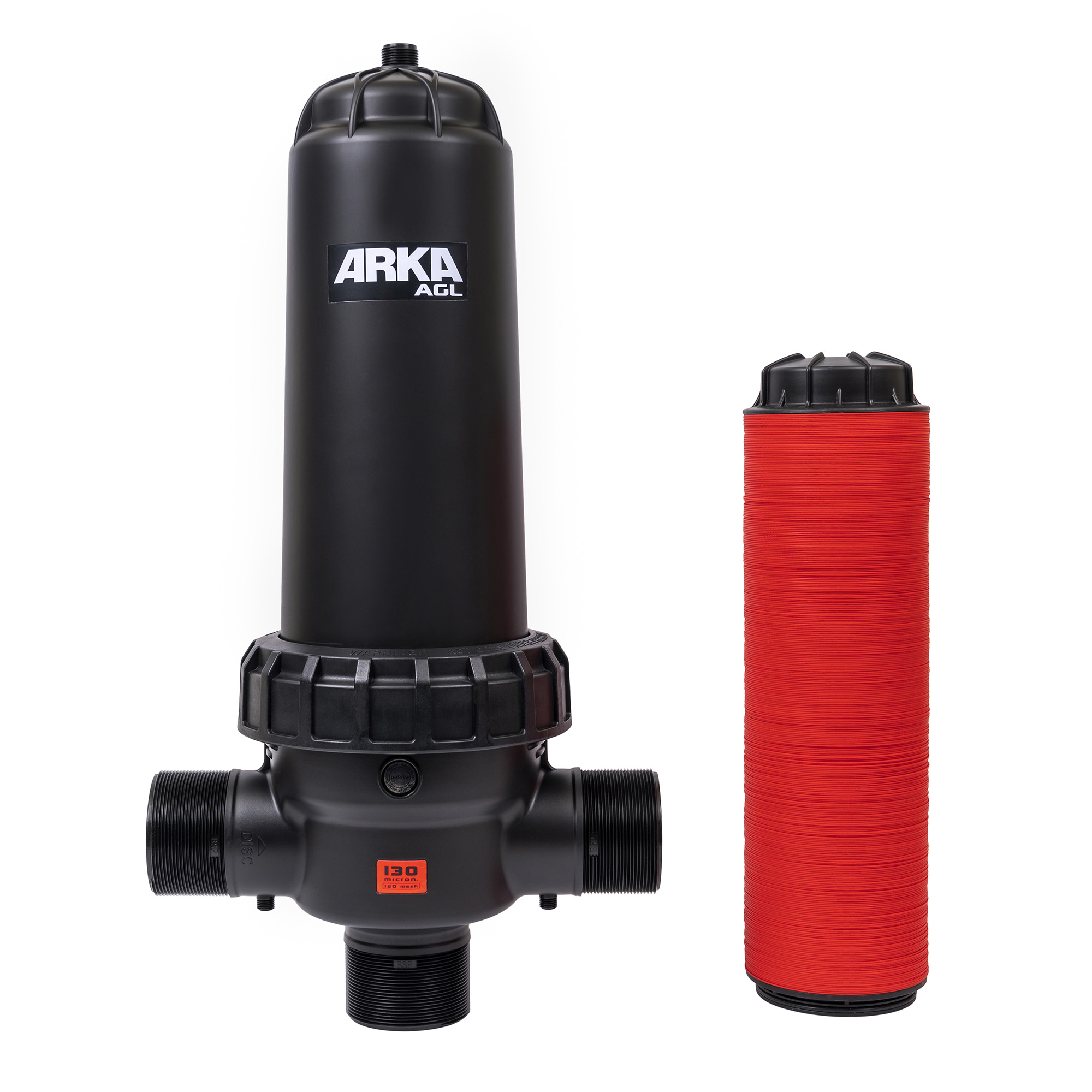
When evaluating hardware for highly controlled agricultural environments, disc technology consistently emerges as a superior choice. Greenhouses and modern precision farms leave virtually zero margin for error regarding water purity. Exact water and nutrient delivery is paramount.
Because they utilize depth filtration, disc arrays provide a much higher dirt-holding capacity than standard screens. Consider the specifications of a professional-grade disc filter, such as a 3-inch AGL model. These units are engineered to handle high flow rates while maintaining precise 120-mesh protection. The color-coded discs ensure that microscopic particles, which could easily bypass a two-dimensional screen under fluctuating pressure, are securely trapped within the grooved matrix. This level of precision protects ultra-low-volume emitters, maintaining the exact flow rates required for sensitive hydroponic crops.
Operational efficiency also demands minimizing maintenance downtime. During manual cleaning, the central spine holding the stack can be loosened, allowing the rings to decompress and spin freely. A simple rinse with a high-pressure hose immediately clears both organic and inorganic debris. Utilizing a high-performance polymer housing ensures that your system receives consistent, clean water without unexpected pressure drops, easily withstanding the rigorous chemical environments associated with modern fertigation practices.
While the fundamental physics of water purification remain the same, application strategies differ vastly between open-field farming and controlled greenhouse environments. Tailoring your approach is essential for optimal performance.
Open-field agriculture typically involves massive acreage, requiring exceptionally high flow rates measured in hundreds of gallons per minute. Field farmers often deal with variable seasonal quality. A well might pump perfectly clean water in the spring but pull heavy sand by late summer. To handle these robust demands, open-field strategies often employ a multi-stage approach. A common setup involves installing a centrifugal sand separator directly after the pump, followed by a large-capacity secondary unit. The focus here is on high-volume capacity and durability.
In contrast, greenhouse operations prioritize extreme precision over massive volume. Water sources are generally cleaner, but the delivery hardware is highly sensitive. A primary concern is fertigation, which is the process of injecting liquid fertilizers directly into the line. If the water is not perfectly clean, suspended solids can react with fertilizer salts. This causes chemical precipitation that instantly cements drip tape shut. Therefore, greenhouse strategies require exact micron sizing to ensure the nutrient solution remains perfectly soluble and uniform.
The agricultural sector is currently undergoing a massive technological shift. This evolution is driven largely by global water scarcity and the rising cost of farm labor. Recent industry analyses highlight a rapid transition away from purely manual filtration toward automated, smart systems. Modern agricultural setups are increasingly integrating Internet of Things sensors directly into the filter manifolds.
These smart sensors continuously monitor pressure differentials in real-time. They send alerts to a farmer smartphone before a critical clog occurs. Furthermore, with severe droughts impacting major agricultural hubs, there is zero tolerance for wasted water. Newer automated backwashing systems use advanced algorithms to initiate flush cycles only when absolutely necessary. They use the exact minimum volume of water required to clean the media. This trend underscores a broader industry movement. We are viewing filtration not just as a protective measure, but as a proactive tool for extreme resource optimization.
Evaluating equipment purchases requires a strict analysis of the return on investment. An advanced filter is not merely an accessory. It is a fundamental asset that directly influences resource efficiency and operational profitability.
When organic matter or mineral deposits accumulate inside narrow pathways, they cause localized pressure spikes within the lateral lines. Over time, these differentials lead to pipe bursts, blown fittings, and catastrophic water loss. Investing in proper drip irrigation filtration prevents these blowouts. Automated self-cleaning models further optimize usage by initiating backwash cycles precisely when needed, keeping the majority of your water directed toward crop development.
Clean, unobstructed emitters ensure uniform distribution across the entire field. When applied evenly, soil moisture remains consistent. This prevents localized dry spots and reduces the risk of waterlogging in adjacent areas. Consistent moisture profiles are essential for preventing nutrient runoff and topsoil erosion, ensuring fertilizers stay exactly where the roots need them.
The hidden cost of unfiltered water lies in manual labor. Replacing miles of compromised polyethylene tubing requires significant capital for new materials and draining labor hours. By integrating a reliable unit into your primary line, farmhands can focus on crop management rather than constantly walking the rows to manually unclog individual micro-sprinklers with pins.
Selecting the correct hardware requires a systematic approach based on empirical data from your specific environment. Guessing on sizing inevitably leads to inadequate protection or excessive pressure loss.
The origin of your water dictates the type and volume of particulate matter you must manage. Surface water from ponds, lakes, or rivers is exposed to sunlight, meaning it carries high biological loads like algae and fish waste. For these sources, heavy-duty media tanks or automated three-dimensional arrays are required to handle the organic slime. Conversely, groundwater from deep wells is generally free of organics but frequently contains fine sand, silt, and iron precipitates. This makes standard surface or grooved-ring units highly effective.
A unit must be properly sized to match the maximum capacity of your pump. If it is undersized, it will create excessive friction, resulting in a severe head loss across the housing. This forces the pump to work harder, consuming more electricity and potentially failing to deliver adequate operating pressure to the furthest zones. Always calculate your maximum system flow in Gallons Per Minute and select a connection size, such as a robust 3-inch manifold, that comfortably accommodates that volume. I always recommend oversizing by 15 percent to create a safety buffer.
The primary objective is to protect the smallest orifice in your layout. Therefore, the mesh size must be physically smaller than the pathways inside your emitters. As a general rule, standard agricultural drip tape requires 120 to 150 mesh, which equals roughly 125 to 100 microns. Micro-sprinklers typically require 80 to 120 mesh. Ultra-low volume setups in hydroponic greenhouses demand highly precise protection, often requiring 200 mesh to prevent microscopic silt from bridging inside the labyrinth pathways.
Even the most highly engineered systems will fail if neglected. Establishing a rigorous maintenance protocol ensures peak efficiency year-round and prevents dangerous debris from bypassing into the lateral lines.
Inspection frequency should be dictated by seasonal variations and baseline water quality. During peak summer months, surface sources experience rapid algae blooms requiring daily monitoring. The most reliable way to monitor health is by installing pressure gauges on both the inlet and outlet sides. When clean, the difference is minimal, usually around 1 to 3 PSI. As debris accumulates, inlet pressure rises while outlet pressure drops. Industry standards dictate cleaning when the differential reaches 5 to 10 PSI.
For manual screen housings, depressurize the system, remove the mesh, and wash it gently with a soft brush and clean water. Never use hard wire brushes, as they warp the woven threads and destroy the micron rating. When dealing with stacked-ring units, loosen the central spine to decompress the elements, fan them out, and flush the trapped matter from the grooves. For hard water environments, soaking the elements in a mild acidic solution, like diluted vinegar, once a season dissolves mineral scale and restores original flow dynamics.
In regions experiencing freezing temperatures, winterization is critical. Water expands when it freezes, easily cracking high-density plastic housings and shattering cast iron manifolds. At the end of the growing season, completely drain the main lines, open all housing drain valves, and remove the internal elements. Store them in a dry, climate-controlled environment. Apply a light coat of agricultural-grade silicone lubricant to the rubber O-rings to prevent the seals from cracking during storage.
Reliable farm and greenhouse watering is fundamentally impossible without highly efficient filtration. Without it, the microscopic pathways of modern precision hardware will ultimately fail, taking your crop yields down with them. Choosing the right technology protects your harvest while significantly improving daily operational efficiency.
Quality equipment prevents costly future pipe repairs, stops fertilizer waste, and conserves vital water resources. Do not wait for a catastrophic mainline blowout or widespread drought stress to evaluate your setup. Upgrade your agricultural infrastructure this growing season. Explore the high-performance filtration solutions at Arka Irrigation to find the exact specifications your system demands, and protect your bottom line with proven, commercial-grade technology.
The primary difference lies in how they capture debris. A screen utilizes two-dimensional surface filtration. Water passes through a single layer of woven mesh that catches physical particles like sand. A disc unit utilizes three-dimensional depth filtration. It consists of tightly stacked, grooved plastic rings. As water navigates the complex pathways between the compressed rings, it traps both hard inorganic debris and soft organic matter across a much larger surface area, making it highly resistant to blinding.
Technically, it is possible only if you are utilizing highly purified municipal water, but it is strongly discouraged by agronomists. Even treated municipal water can carry pipe scale, rust, or mineral precipitates from transit infrastructure. Because micro-emitters feature labyrinth pathways designed to regulate flow, even a minor accumulation of debris will cause permanent clogs. Proper purification is considered mandatory for virtually all agricultural and greenhouse setups.
The required size depends on the specific emitters installed in your field. Generally, a 120 to 150 mesh rating is recommended for standard agricultural lines and tape. However, if you are using ultra-low-flow emitters in a greenhouse hydroponic setup, you may need a finer 200 mesh barrier. Always verify the minimum requirements printed on the specification sheet provided by the emitter manufacturer.
Cleaning frequency is entirely dependent on the biological and mineral load of your source. Systems drawing from surface ponds during the summer may require daily or weekly flushing due to algae blooms. Systems utilizing clean well water may only need visual inspections once a month. The most accurate method is to monitor the pressure gauges. You should initiate a cleaning cycle whenever there is a pressure differential of 5 to 10 PSI between the inlet and outlet.
The most definitive sign of a clog is a noticeable drop in water pressure and flow rate at your emitters. If plants at the end of your irrigation lines are wilting while those near the pump are thriving, your system is likely starving for water due to a blockage. Additionally, checking the pressure gauges installed on the filter manifold will provide a clear mathematical indicator. A high pressure differential confirms a clog.
Filtration units should be installed as close to the water source as possible, typically immediately after the main water pump and backflow preventer, but before any fertilizer injection systems or pressure regulators. This primary placement ensures that all downstream components, including expensive valves, injectors, and the intricate network of drip lines, are fully protected from abrasive debris and organic matter.


