
Views: 0 Author: Site Editor Publish Time: 2026-10-21 Origin: Site


Do sudden pressure spikes constantly threaten the integrity of your pipeline infrastructure? Unstable fluid flow is more than just a minor operational inconvenience. In the field, erratic pressure serves as the primary catalyst for severe micro-leaks, premature equipment fatigue, and catastrophic pipe bursts. If you have ever dealt with a blown flange at 2 AM, you know exactly how costly these fluctuations can be.
Implementing a robust fluid management system stands as the definitive solution to these destructive forces. By autonomously modulating flow and absorbing hydraulic shocks, these engineered systems safeguard municipal grids, agricultural fields, and industrial networks. This comprehensive guide breaks down the internal mechanics of these critical components. We will detail specific configurations available for various industries and provide actionable insights to help you specify the exact equipment required for long-term pipeline stability.
At its core, a hydraulic control valve is a highly engineered mechanical device designed to regulate the flow, pressure, and level of water within a closed-loop system. Standard manual gate valves require an operator to physically turn a handwheel. In contrast, these advanced devices operate automatically. They primarily utilize the hydraulic pressure of the fluid itself as their motive force. This brilliant design effectively eliminates the strict requirement for external electrical or pneumatic power sources in basic configurations.
The term water service refers to the comprehensive integration of these regulating devices into a broader fluid management network. It is not merely a single isolated component sitting on a pipe. Rather, it represents a systematic approach to managing water supply for municipal distribution, industrial cooling, or commercial agriculture. A properly engineered water service ensures that fluid moves from the source pump to the final endpoint safely, efficiently, and at the exact required barometric pressure.
To truly grasp their function, you must look at their basic anatomy. A standard regulation unit consists of three primary elements. First is the main physical housing that contains the internal moving parts. Second is a pilot system acting as the brain to sense pressure changes. Third is a control chamber where fluid accumulates to force the valve closed or empties to allow it to open.
Operating a fluid network without precise pressure regulation introduces significant physical and financial risks. Water is an incompressible fluid. Therefore, any sudden change in its momentum or volume directly translates into severe mechanical stress on the surrounding infrastructure.
Hydraulic shock, commonly known in the industry as water hammer, occurs when a fluid in motion is forced to stop or change direction suddenly. Imagine a sudden power outage that immediately shuts down a massive municipal pump. The kinetic energy of the moving water has nowhere to go. It converts instantly into a high-pressure acoustic shockwave that travels back and forth through the piping system at incredible speeds. Over time, these violent waves cause severe fatigue in welded pipe joints and thrust blocks. This inevitably leads to catastrophic ruptures.
Consistently high pressure is equally destructive. When source pressure exceeds the design specifications of downstream infrastructure, the results are immediate and costly. Flange seals blow out. Aging pipe walls develop micro-fractures. Sensitive downstream equipment sustains permanent damage. Furthermore, over-pressurization exacerbates previously undetected background leaks. This results in thousands of gallons of wasted water and heavily inflated utility costs.
Conversely, low pressure leads to systemic underperformance. In municipal settings, inadequate pressure creates a severe risk of backflow. Contaminated groundwater can be siphoned directly into the clean drinking water supply. In agricultural contexts, under-pressurization results in uneven water distribution. Crops situated at the end of the irrigation line are left completely dehydrated.
The operational brilliance of these systems lies in their ability to maintain hydraulic equilibrium entirely automatically. This seamless regulation is achieved through a continuous mechanical feedback loop managed by the pilot circuit.
The pilot system constantly monitors either the upstream or downstream pressure, depending on the specific function required. When the pilot detects a micro-deviation from the pre-calibrated set point, it physically reacts by opening or closing a tiny internal port. This precise movement alters the flow of water directed into the main control chamber. If downstream pressure rises too high, the pilot directs high-pressure line water into the chamber. This forces the main valve to close proportionally and restrict flow. If pressure drops, the pilot vents the chamber to the atmosphere or downstream, allowing the main valve to open wider.
The vast majority of these autonomous systems utilize a diaphragm valve design. The diaphragm is a flexible, heavily reinforced elastomeric disc secured firmly between the valve body and the top cover. The surface area of the diaphragm inside the upper control chamber is larger than the surface area exposed to the water flowing through the pipe below. Consequently, equal pressure results in a net downward force, pushing the valve closed. By subtly varying the pressure in this upper chamber via the pilot, the rubber diaphragm flexes up or down. This action modulates the flow with exceptional smoothness. It effectively absorbs kinetic energy and prevents dangerous pressure spikes.
Different pipeline topographies and operational challenges require highly specialized configurations. Fortunately, the modular nature of the pilot system allows a single basic body to perform vastly different functions simply by swapping the external tubing. Here is a breakdown of the most common configurations used in modern engineering.
| Valve Type | Primary Function | Best Application | Key Engineering Feature |
|---|---|---|---|
| Pressure Reducing | Lowers high upstream pressure to a stable downstream setpoint. | Municipal grids, residential feeds. | Maintains setpoint regardless of flow rate changes. |
| Solenoid Control | On/Off automation via electrical signals. | Smart grids, automated treatment plants. | Bridges hydraulic power with SCADA/IoT systems. |
| Pressure Relief | Vents excess pressure to protect upstream pumps. | Pump stations, fire suppression lines. | Reacts instantly to prevent pump cavitation. |
| Agricultural Irrigation | Handles raw water and liquid fertilizers. | Farms, drip networks, greenhouses. | Self-cleaning strainers and chemical-resistant bodies. |
A pressure reducing valve is specifically designed to take a high, violently fluctuating upstream pressure and convert it into a stable, manageable downstream pressure. Remarkably, it maintains this lower setpoint regardless of drastic changes in flow rate or upstream supply spikes. The pilot senses downstream pressure. If it exceeds the spring setting, the pilot fills the main chamber, throttling the flow down. This configuration is absolute best practice for municipal water feeds entering residential neighborhoods.
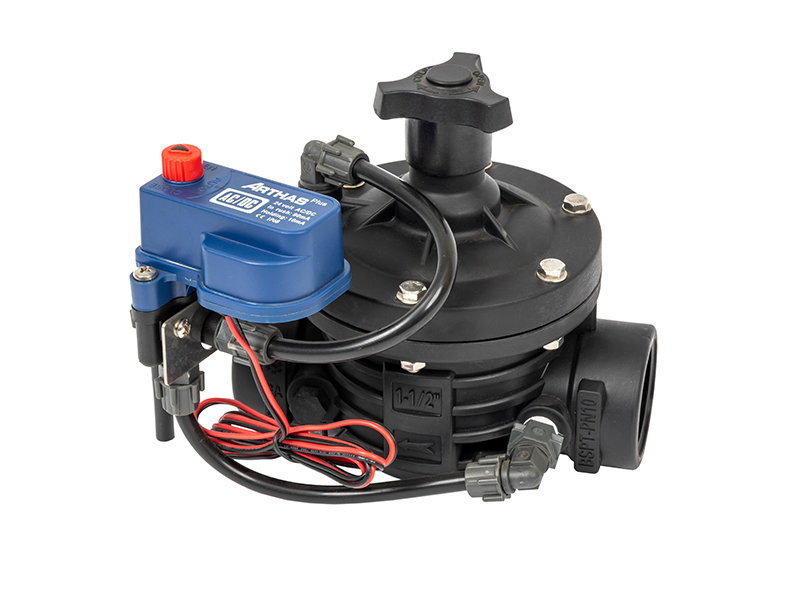
For modern automated facilities, a solenoid control valve serves as the critical bridge between mechanical hydraulic power and electronic automation. While the main body still uses line pressure to flex the diaphragm, the pilot circuit is governed by an electrical solenoid. When a low-voltage electrical signal is dispatched from a smart timer, the solenoid opens or closes the pilot port. A prime example is the AS50SC-T 2-inch T-type solenoid valve. Built from robust glass-filled nylon, these units handle high flow capacities and resist UV degradation while seamlessly integrating into digital irrigation controllers.
Agricultural fluid networks face unique environmental hostilities. An irrigation valve is engineered specifically to handle varying seasonal flow rates and raw surface water. This water often contains abrasive silt, algae, or corrosive liquid fertilizers. These specialized units frequently feature modified internal geometries and self-cleaning pilot strainers to prevent catastrophic clogging. In large-scale drip networks, they guarantee that every single crop receives the exact volumetric flow required.
The global fluid management sector is undergoing a massive technological shift. Based on recent engineering data and utility reports, extreme water conservation is no longer just an environmental goal. It is a strict financial necessity. Mitigating non-revenue water—clean water lost to underground leaks before ever reaching the consumer—has become the top priority for utility operators worldwide.
Consequently, there is a massive trend toward autonomous, localized pressure management. Facilities are rapidly moving away from static manual gate valves in favor of smart, self-regulating hydraulic systems. By maintaining perfectly stable pressure, these valves drastically reduce the volume of water forced out through microscopic pipe fractures. Furthermore, operating at the correct, optimized pressure significantly reduces the electrical load on pumping stations. This leads to massive energy savings across the grid.
In addition, the integration of IoT technology is revolutionizing field maintenance. Modern hydraulic valves are increasingly paired with digital pressure transducers. This allows facility managers to monitor pipeline health in real-time from a smartphone or control room. This set-it-and-forget-it mechanical reliability, combined with digital oversight, saves municipalities thousands of dollars annually in emergency road excavations.
The implementation of a proper fluid management system is not a universal template. It requires deep adaptation to specific environmental demands. Across various demanding sectors, the inability to maintain stable pressure results in immediate operational failure.
City water grids rely on complex topographies. Water must often be pumped from a low-elevation treatment plant to high-elevation storage tanks. In these networks, pressure must remain strictly between 40 and 80 psi at the consumer endpoint. Regulating valves are essential here. They ensure that water pumped with massive force does not blow out the plumbing of homes situated in the lower valleys, while still maintaining enough kinetic energy to reach homes on the highest hills.
In industrial manufacturing environments, fire protection systems demand instantaneous and flawless water pressure. Deluge systems and industrial sprinklers may remain dormant for years. Yet, they must operate perfectly within seconds of a fire detection signal. Hydraulic control systems in these environments are engineered to maintain a constant static pressure. This prevents pump cavitation and ensures maximum flow capacity is delivered to the suppression zones the exact moment the system triggers.
Selecting the correct component for your pipeline is a highly technical process. A mismatched valve will not only fail to protect the system but can actually introduce severe new hydraulic anomalies. Follow these critical engineering steps to ensure proper specification.
First, identify the primary system function. Does the pipeline need downstream pressure reduction to protect fragile pipes? Do you need upstream pressure relief to protect a pump? Defining this objective dictates the exact type of pilot circuitry required.
Second, size the valve correctly. This is arguably the most common engineering stumbling block in the field. A frequent fallacy is assuming that the valve size should automatically match the pipeline diameter. Bigger is rarely better in fluid regulation. An oversized valve will operate too close to its fully closed position. This leads to a destructive phenomenon known as hunting, where the valve rapidly oscillates between open and closed states. This causes severe wear on the internal elastomer and induces localized water hammer. Sizing must always be calculated based on the system's minimum, continuous, and peak flow rates using the Flow Coefficient, known as Cv.
Finally, match the physical construction material to the fluid's characteristics. Ductile iron remains the industry standard for high-pressure municipal applications due to its exceptional tensile strength. However, glass-filled nylon is frequently utilized in agricultural and landscape settings. It offers superior resistance to UV degradation and harsh liquid fertilizers, making it ideal for exposed field installations.
Even the most precisely engineered systems require systematic maintenance to prevent mechanical degradation. Establishing a proactive maintenance schedule prevents operational drift and ensures decade-long reliability.
Standard engineering practice dictates a bi-annual visual and operational inspection. The most critical component to monitor is the pilot system's Y-strainer. Because these valves operate utilizing the fluid's own pressure, any particulate matter that clogs the narrow pilot tubing will immediately compromise the valve. Technicians must flush the pilot lines and aggressively clean the strainers to ensure unobstructed hydraulic communication.
The internal elastomer diaphragm is the primary moving part and will eventually experience fatigue. Continuous flexing causes the rubber to slowly lose its elasticity. Industry data suggests proactively replacing diaphragms every five to seven years. A distinct advantage of this specific valve design is its inline serviceability. Technicians can simply unbolt the top cover and swap the rubber component without ever needing to remove the heavy body from the pipeline flange.
In exposed outdoor environments, freezing temperatures pose a severe threat. Water trapped inside the pilot tubes will freeze, expand, and crack the brass fittings or the main cover. Winterization protocols must strictly include isolating the valve, completely draining the control chamber, and blowing out the delicate pilot lines with compressed air before the first seasonal freeze.
Maintaining absolute stability in pipeline pressure is impossible without properly specified and rigorously maintained equipment. Erratic fluid dynamics inevitably lead to shattered infrastructure, wasted resources, and highly inflated operational costs. By integrating a meticulously calibrated control valve system, facility operators create an autonomous, self-sustaining barrier against both water hammer and extreme pressure fluctuations.
Whether your network requires the rugged durability of an agricultural irrigation setup or the pinpoint digital accuracy of a solenoid-actuated municipal grid, investing in high-quality fluid management technology upfront is the smartest move. It is the most effective way to prevent disastrous pipeline failures down the road. Evaluate your current pressure stability today, consult with fluid dynamics experts, and upgrade your infrastructure to protect your most valuable resources. For industry-leading reliability, explore the comprehensive range of hydraulic control solutions at ARKA Irrigation to find the exact specifications your project demands.
A standard gate valve is a manual isolation device designed exclusively to be either fully open or fully closed to start or stop flow. It cannot regulate pressure dynamically. Conversely, a hydraulic control valve automatically modulates the flow and pressure based on real-time system conditions. It continuously adjusts its internal diaphragm position to maintain a specific, calibrated setpoint without ever requiring human intervention.
Yes. The fundamental working principle of these mechanical devices relies entirely on the kinetic energy and static pressure of the pipeline fluid itself. The line pressure is routed through external tubing into a control chamber to physically force the valve open or closed. However, if a facility requires remote operation, an electronic pilot can be added to the hydraulic base, which will then require a low-voltage electrical signal to actuate.
Never size a control valve simply by matching it to the existing pipe diameter. Sizing must be based on the Flow Coefficient of the system. You need to calculate the minimum, maximum, and continuous flow rates, along with the allowable pressure drop. Choosing an oversized valve leads to mechanical hunting and premature wear, while an undersized valve creates excessive friction and restricts flow.
Yes, absolutely. Because these valves utilize a flexible rubber diaphragm and a precision pilot system, they close gradually rather than slamming shut. This slow, modulated closure absorbs the kinetic energy of the moving fluid, preventing the acoustic shockwaves that cause severe water hammer in pipelines.
The lifespan is divided into two distinct categories. The metallic or heavy-duty nylon housing can easily operate for decades if properly protected from external elements. The internal rubber diaphragm and O-ring seals typically have an operational life of five to ten years. This lifespan fluctuates heavily based on raw water quality, chemical dosing concentrations, and the daily frequency of pressure fluctuations.
Loud humming, chattering, or rapid vibration is generally a symptom of hunting. This mechanical anomaly occurs when the valve is oversized for the actual flow rate passing through it. The internal seal rapidly bounces against the valve seat as it struggles to find equilibrium. It can also indicate that there is atmospheric air trapped inside the pilot control chamber. Bleeding the air from the high-point indicator or installing a smaller bypass valve are standard engineering solutions for this issue.
Yes. Standard municipal valves are designed strictly for clean, treated, and filtered potable water. Agricultural valves are engineered with wider internal clearances and utilize robust, chemical-resistant polymers. This allows them to handle untreated well water, surface water containing heavy algae and silt, and the highly corrosive nature of liquid fertilizers injected directly into the irrigation pipeline.


