
Views: 0 Author: Site Editor Publish Time: 2026-10-11 Origin: Site


Tired of replacing clogged drip emitters? Picture a scorching mid-summer afternoon. Your crops are begging for hydration. Suddenly, a microscopic grain of sand quietly shuts off their lifeline. Tiny emitters easily block with suspended grit, algae, and mineral scale. Once obstructed, the surrounding plants suffer localized drought stress. They can die in a matter of days.
A high-quality drip irrigation water filter solves this frustrating issue at the source. In this guide, you will learn exactly how to choose the right technology and determine the perfect mesh size. You will also discover actionable maintenance strategies to protect your entire setup from premature hydraulic failure.
Before diving into technical specifications, it is crucial to understand where the agricultural sector is heading. Recent industry data highlights a massive shift toward precision water management. Driven by escalating global water scarcity and unpredictable climate patterns, growers are no longer treating filtration as a mere accessory. Modern irrigation engineering now views advanced filtration as the foundational layer of smart farming. As automated fertigation systems become more prevalent, the tolerance for particulate bypass has dropped to zero. Investing in robust filtration is universally recognized as a baseline requirement to secure crop yields and maximize water use efficiency.
To truly understand why filtration is critical, look inside a standard emitter. Whether pressure-compensating or turbulent-flow designs, these devices rely on a microscopic labyrinthine flow path. This internal channel is specifically engineered to step down the incoming water pressure, allowing fluid to exit at a slow, controlled drip.
However, the orifices and internal pathways of these components are exceptionally narrow. They often measure less than one millimeter in diameter. Because of these microscopic dimensions, any suspended solids in the water supply easily lodge within the labyrinth. A single trapped particle acts as a tiny dam. It rapidly accumulates even smaller debris until the emitter is completely blocked.
The financial and operational impact of compromised lines is severe. From an agronomic perspective, a blocked orifice means a specific crop zone is deprived of water and essential nutrients. Stunted growth, reduced yields, and potential crop failure inevitably follow.
Furthermore, diagnosing and repairing these blockages wastes valuable labor. Drip lines are frequently buried under thick mulch or integrated into dense plant canopies. Locating a single dead emitter requires meticulous physical inspection. Replacing ruined tape incurs ongoing material costs and diverts your crew from other critical farm tasks.
In fluid dynamics and irrigation engineering, the consensus is absolute: prevention is vastly cheaper than remediation. You cannot effectively clean out a microscopic labyrinth once it is packed solid with mineral scale or biological slime. Attempting to flush severely clogged lines rarely yields good results. By installing a reliable filter at the point of connection, you intercept particulate matter before it reaches the distribution network. This single point of prevention acts as an insurance policy for miles of delicate drip tape.
Equipment specification cannot be generalized. It depends entirely on the physical and biological composition of your unique water chemistry. Different supplies carry distinct types of particulate loads, requiring tailored engineering strategies.
Municipal water is treated and pressurized by local utility facilities. It is the cleanest source available for irrigation. Yet, clean for drinking does not automatically equate to safe for micro-emitters. This water travels through miles of aging underground infrastructure before reaching your property. During transit, the fluid picks up pipe rust, calcium carbonate scale, and microscopic mineral deposits. While the particulate load is relatively low, these inorganic materials still accumulate over time. A basic Y-type screen filter is typically sufficient to capture these stray particles with minimal maintenance.
Aquifers present a completely different set of engineering challenges. Depending on the depth and the integrity of the well casing, pumps frequently draw up fine sand, silt, and sediment. Additionally, well water often contains dissolved minerals like iron and manganese. When exposed to oxygen, these minerals precipitate into solid particles or foster the growth of iron bacteria. This sticky, rust-colored slime is notorious for destroying drip networks. Fine mesh filtration is mandatory here. In cases of heavy sand loads, a centrifugal sand separator must be installed upstream.
Ponds, lakes, rivers, and canals are universally recognized as the most challenging sources. Exposed to continuous sunlight and agricultural runoff, surface water carries massive biological and organic loads. You will encounter algae, moss, zooplankton, decomposed leaves, and suspended clay. Soft organic matter easily deforms and squeezes through standard flat screens under hydraulic pressure. Consequently, surface water demands advanced, three-dimensional depth filtration to trap and hold biological matter effectively.
Selecting the correct technology is the most critical decision in designing your head assembly. The market offers distinct mechanisms engineered to address specific debris profiles.
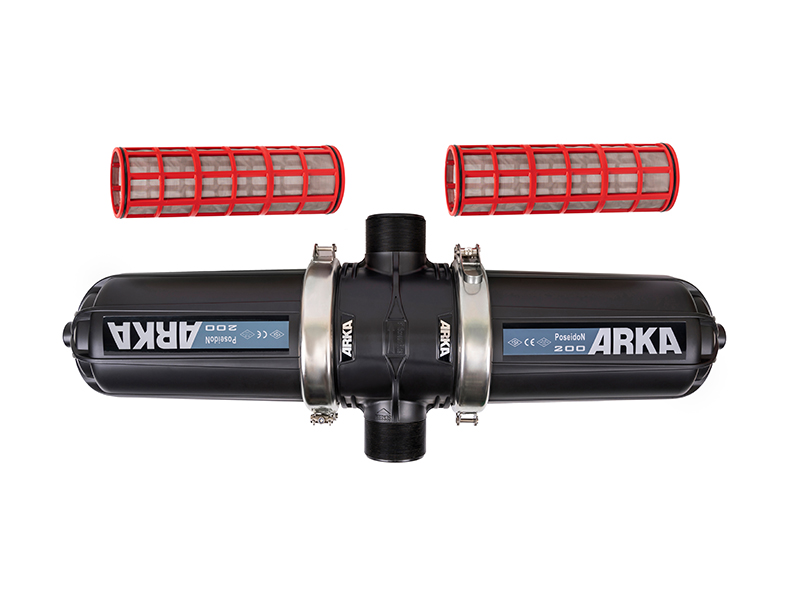
A screen filter for drip operates on the fundamental principle of surface filtration. It consists of a rigid plastic or stainless-steel mesh cylinder housed within a protective casing. As water flows through, solid particles larger than the mesh openings are physically blocked on the screen surface.
These units are highly cost-effective and straightforward to maintain. They are universally recommended for solid, inorganic debris such as sand and gravel. For instance, professional-grade models like 3-inch H-Type plastic screen units feature robust housings capable of handling flow rates up to 50 cubic meters per hour at 10 bar pressure. Equipped with 120-mesh stainless steel elements, they offer incredible durability against abrasive grit. However, they are not recommended for heavy algae, as the soft slime extrudes through the holes.
A disc filter utilizes a fundamentally different mechanism known as depth filtration. Instead of a single layer of mesh, this device contains a stack of hundreds of tightly compressed, color-coded plastic rings. Each disc is etched with microscopic diagonal grooves. When compressed tightly by a central spine, these intersecting grooves create a complex, three-dimensional matrix of filtration pathways.
As water passes through the stack, particles are trapped deep within the labyrinth of grooves. This 3D depth is vastly superior for organic matter. While a soft piece of algae might bypass a flat screen, it inevitably becomes entangled in the deep, winding grooves of a disc stack.
| Filter Type | Filtration Mechanism | Best For | Limitations |
|---|---|---|---|
| Screen | Surface physical barrier | Well water, municipal water, sand, pipe scale | Struggles with heavy organic algae slime |
| Disc | 3D Depth matrix | Surface water, ponds, moderate organic loads | Requires slightly more effort to manually clean |
| Sand Media | Deep bed percolation | Heavy commercial canal water, extreme debris | High capital expense, large physical footprint |
Choosing the physical type is only the first step. You must specify the correct filtration density and hydraulic capacity to prevent severe pressure drops.
To size equipment accurately, you must understand the two primary units of measurement in the industry. Mesh refers to the number of openings per linear inch of the screen. A 120-mesh screen features 120 microscopic holes per inch. Micron measures the actual physical size of the particle that can pass through the barrier. There is an inverse relationship here. A higher mesh number equates to a lower micron number, resulting in tighter filtration.
Industry standards and empirical field data dictate strict requirements. The vast majority of standard drip lines require a filtration level of 120 to 155 mesh, which translates to 130 to 100 microns. Because orifices are so narrow, any particle larger than 130 microns poses a severe clogging risk. Always consult the technical specification sheet provided by your tape manufacturer to maintain warranty compliance.
A catastrophic mistake made by novice growers is purchasing a unit based solely on existing pipe diameter. Buying a 1-inch housing simply because the mainline is 1 inch is a recipe for failure.
In practice, equipment must be sized according to the maximum flow rate capacity of your system, measured in Gallons Per Minute or cubic meters per hour. Every housing has a maximum hydraulic limit. Forcing excessive flow through an undersized unit creates extreme hydraulic shear stress. This starves your plants of water and can physically rupture the internal screen. Always calculate your total system flow rate and select a model that exceeds that capacity by at least 20 percent.
Once you determine the correct mesh size, you must choose between manual maintenance and automation. This choice heavily impacts ongoing labor costs and daily watering reliability.
Manual units are the standard choice for residential gardens, boutique greenhouses, and medium-scale farms. The operator must physically monitor the unit, shut off the water supply, open the housing, and rinse the internal components. While upfront capital costs are low, these setups introduce a high risk of human error. If the operator forgets to perform routine maintenance, the system eventually loses pressure.
Modern commercial operations are rapidly transitioning toward precision automation. Upgrading to a self cleaning filter is becoming a baseline standard for profitability. These automated systems operate using advanced hydraulic technology. Equipped with a Differential Pressure switch, the controller constantly monitors water pressure at both the inlet and the outlet. As debris builds up, the outlet pressure drops.
Once the pressure differential reaches a pre-set threshold, the electronic controller initiates an automatic backflush cycle. A flush valve opens to the atmosphere, reversing the flow of water and vacuuming the debris out in seconds. This happens without interrupting the downstream irrigation cycle. The return on investment is rapidly realized through drastically reduced labor costs and guaranteed continuous protection.
Even premium filtration technology fails if installed in the wrong sequence within the plumbing manifold. Incorrect assembly is a leading cause of component rupture.
To ensure maximum hydraulic efficiency, assemble the manifold in a strict, empirically validated sequence. Water flows from the pump, moving first through a backflow preventer. Next, the water travels through the master control valves before reaching the crucial filtration stage. Immediately following this barrier, the water passes through the pressure regulator before entering the distribution mainline.
Growers frequently ask why filtration must occur upstream of the pressure regulator. Regulators contain highly sensitive internal components, including small springs, rubber diaphragms, and microscopic bypass ports designed to step down high incoming pressure.
If unfiltered water enters the regulator, sand easily lodges in these internal ports. This causes the device to stick in the open position. If the regulator fails, high-pressure water surges into the delicate drip lines, blowing off fittings and rupturing the tape. Placing the physical barrier first ensures only clean water touches your sensitive control valves.
When physically installing the unit, strict attention must be paid to the directional flow arrow molded into the exterior housing. Installing the device backward forces water against the weaker structural supports of the element, leading to immediate collapse. Additionally, always leave adequate physical clearance around the housing. You must be able to comfortably unscrew the canister and extract the internal element without hitting adjacent pipes. Ensure you feel the O-ring compress smoothly to guarantee a watertight seal.
Filtration is an active collection point that requires routine monitoring. Neglecting this component turns it into a system bottleneck.
Maintenance frequency depends entirely on your water chemistry and the season. When you first install the system, inspect the internal elements every three days. This establishes an empirical baseline for debris accumulation. If the mesh remains relatively clean, extend the interval to a week. Conversely, if you draw from a pond during peak summer algae blooms, you may need to perform manual flushing daily.
Proper techniques significantly extend the lifespan of internal elements. When servicing a screen model, isolate the pressure, unscrew the housing, and carefully remove the cylinder. Gently scrub the outside with a soft-bristled nylon brush under a stream of clean water. Never use a wire brush. Wire bristles distort the micron rating and create microscopic tears.
For disc models, remove the cartridge and loosen the tension nut at the top of the central spine. This allows the individual rings to decompress and fan out loosely. Spray the fanned grooves with a high-pressure hose nozzle while spinning them. This blasts all organic slime out of the deep matrix. Always retighten the spine securely before reinstallation.
Imagine walking your crop rows and noticing a sudden drop in water output. The head assembly is always your primary diagnostic checkpoint. A massive pressure drop downstream usually indicates a heavily occluded element.
If you inspect the housing and find it perfectly clean, yet emitters are still clogging, you face one of two engineering issues. Either the mesh size is too coarse for your specific tape, or chemical precipitation is occurring downstream. In the case of calcium scaling, chemical injection of agricultural acids into the lines may be necessary to dissolve the internal buildup.
A dedicated physical barrier is the beating heart of a healthy, efficient watering network. Without it, the microscopic pathways of your emitters inevitably succumb to blockages, leading to uneven watering, stressed plants, and costly repairs. By carefully analyzing your water source, selecting the appropriate screen or depth technology, and adhering to the 120-mesh industry standard, you create an impenetrable defense against debris. Prioritizing this specific component is the single most effective way to protect your agricultural investment and ensure long-term operational success.
Ready to eliminate emitter clogging for good? Choosing the right equipment does not have to be a guessing game. From heavy-duty 3-inch H-Type plastic models designed for high flow rates to advanced automated self-cleaning solutions, implementing professional-grade technology ensures your crops get the precise hydration they need. Explore high-performance options and find the perfect match for your specific water source at ARKA Irrigation today.
Typically, a 120 to 155 mesh filtration level is required to safely protect micro-emitters. This fine density translates to 130 to 100 microns, ensuring that particles large enough to block the microscopic flow paths are intercepted. Always check your specific tape manufacturer's technical recommendations to maintain warranty compliance.
Screen units use a single layer of physical mesh and are best suited for hard, inorganic debris like sand, gravel, and pipe scale. Disc units use a stack of tightly compressed, grooved rings to create three-dimensional depth filtration. This specific design makes them vastly superior at trapping soft, malleable organic materials like algae that would otherwise squeeze through a flat screen.
Absolutely not. Operating a micro-irrigation network without proper protection inevitably leads to hydraulic failure. Even visually clean municipal water contains microscopic pipe scale, rust, and dissolved mineral deposits that accumulate over time and permanently clog sub-millimeter orifices.
Cleaning frequency depends entirely on your water source and biological load. Municipal setups may only need monthly checks, while systems pulling from agricultural ponds during summer may require daily flushing. Monitor the pressure differential gauge carefully; a pressure drop of 5 to 7 psi across the housing indicates it is time to clean the internal element.
Rapid occlusion usually indicates the unit is undersized for your system's flow rate, or the water source has a severe organic load exceeding the current technology's capacity. Upgrading to a larger housing, switching from screen to depth filtration, or installing a coarse centrifugal sand separator upstream can resolve this persistent bottleneck.


