
Views: 0 Author: Site Editor Publish Time: 2026-10-16 Origin: Site


Are clogged emitters slowly destroying your valuable crops? Uneven watering and frustrating maintenance routines drain your profitability and waste critical labor hours. Operating an irrigation network without addressing water quality is a guaranteed path to premature equipment failure. Severe plant stress inevitably follows.
Not all water behaves the same in an agricultural system. The water pulled from an open pond requires a completely different engineering approach than the water extracted from a subterranean aquifer. Consequently, surface water and well water demand highly specific filtration solutions. In this comprehensive guide, we break down how to evaluate your specific water source. You will discover how to select the exact filtration infrastructure needed to protect your agricultural and commercial landscape investments.
Before investing capital into any filtration hardware, conducting a comprehensive water quality test is the fundamental first step. The physical and chemical properties of your water source dictate the specific mechanics required to maintain system integrity. Water pulled from an open environmental source presents an entirely different set of challenges compared to water extracted deep underground.
Surface water is drawn from open environmental bodies such as agricultural reservoirs, canals, rivers, and lakes. These sources are constantly exposed to direct sunlight, fluctuating ambient temperatures, and agricultural runoff. Therefore, their filtration requirements are highly complex.
Field experience shows that you might pull from a seemingly clear pond in May, only to face a thick, green biological sludge by July. The primary contaminants here are organic loads. These include various species of algae, moss, fish waste, decaying leaves, and small aquatic organisms. Furthermore, surface water quality is highly susceptible to seasonal spikes. During the warmer summer months, increased sunlight and fertilizer runoff often trigger severe algae blooms. Because this organic matter is soft, slimy, and deformable, it requires specific mechanisms that trap debris within a physical matrix rather than just blocking it at a flat surface level.
Conversely, well water is sourced from underground aquifers via private domestic wells or high-capacity agricultural pumps. The water is naturally filtered through layers of earth and bedrock before extraction. As a result, it is generally free of biological contaminants like algae or leaves.
However, pumping from a deep aquifer introduces a different hidden threat in the form of inorganic particulate matter. The primary contaminants are hard, rigid particles such as fine silica sand, silt, clay, and gravel grit. In addition, well water frequently presents complex chemical issues. High concentrations of dissolved iron, manganese, and calcium are incredibly common. When these dissolved minerals are pumped to the surface and suddenly exposed to oxygen, they can precipitate into solid forms. This creates severe scale buildup inside pipes and valves. Understanding the specific abrasive load of your well is critical for selecting a system that can withstand constant mechanical wear.
Attempting to run a modern agricultural setup without an adequate physical barrier is a costly engineering mistake. The initial capital expenditure of installing robust hardware is vastly outweighed by the heavy financial loss associated with replacing damaged infrastructure and suffering reduced crop yields.
Modern farming and commercial landscaping heavily rely on drip systems due to their superior water efficiency and targeted delivery. However, these emitters are engineered with incredibly tiny internal orifices and tortuous flow paths designed to regulate water pressure drop by drop. These pathways are frequently less than a millimeter in diameter.
Without strict and precise drip irrigation filtration, even microscopic suspended solids will accumulate within the emitter labyrinth. When razor-sharp sand lodges in an emitter, or when sticky algae biofilm accumulates over weeks, it causes permanent occlusion. Because this happens at the micro-level, operators often do not notice the clogs until localized drought stress visibly wilts the plants. Proper physical barriers ensure uniform water distribution, effectively protecting the precise application rates that make micro-irrigation valuable.
Beyond protecting delicate emitters, a primary filter acts as the main shield for the entire mechanical infrastructure. Irrigation networks consist of expensive components, including centrifugal pumps, solenoid valves, pressure regulators, and digital flow meters.
When abrasive inorganic grit is allowed to flow freely through the system, it acts exactly like liquid sandpaper. It degrades pump impellers, scores the internal rubber diaphragms of control valves, and causes pressure regulators to stick in the open or closed position. By capturing this debris at the point of origin, you drastically extend the operational lifespan of all downstream components. This proactive approach minimizes emergency maintenance labor and replacement costs.
Looking at recent agricultural engineering trends, we see a massive pivot in how growers approach water management. Escalating global water scarcity and unpredictable climate patterns are forcing operations to abandon basic, single-layer mesh setups. The industry is rapidly adopting high-efficiency, automated depth filtration. Modern farms demand systems that handle complex biological loads while minimizing backwash water waste. Selecting the right technology is no longer just about stopping dirt. It has become a critical component of sustainable water stewardship and operational profitability.
To make an informed purchasing decision, you must understand the internal mechanics of the three primary technologies utilized in the industry today.
This unit utilizes a straightforward physical barrier to intercept debris. The element is typically constructed from woven stainless steel wire or molded plastic mesh. Water passes through the cylinder, and any particle larger than the aperture size of the mesh is physically blocked.
In practical terms, they are highly effective at capturing hard, rigid, inorganic debris like sand and pipe scale. They are generally the most affordable option and feature a compact footprint. However, they operate via two-dimensional surface filtration. This makes them highly susceptible to blinding when exposed to soft, organic matter. Algae and biological slime can easily deform and extrude through the mesh holes under hydraulic pressure. It can also smear across the surface, causing rapid and severe pressure loss.
This technology brilliantly bridges the gap between simple screens and massive sand tanks. These units contain a stack of tightly compressed, color-coded plastic rings. Each ring is engineered with microscopic diagonal grooves. When stacked and compressed, these intersecting grooves create a complex, three-dimensional matrix.
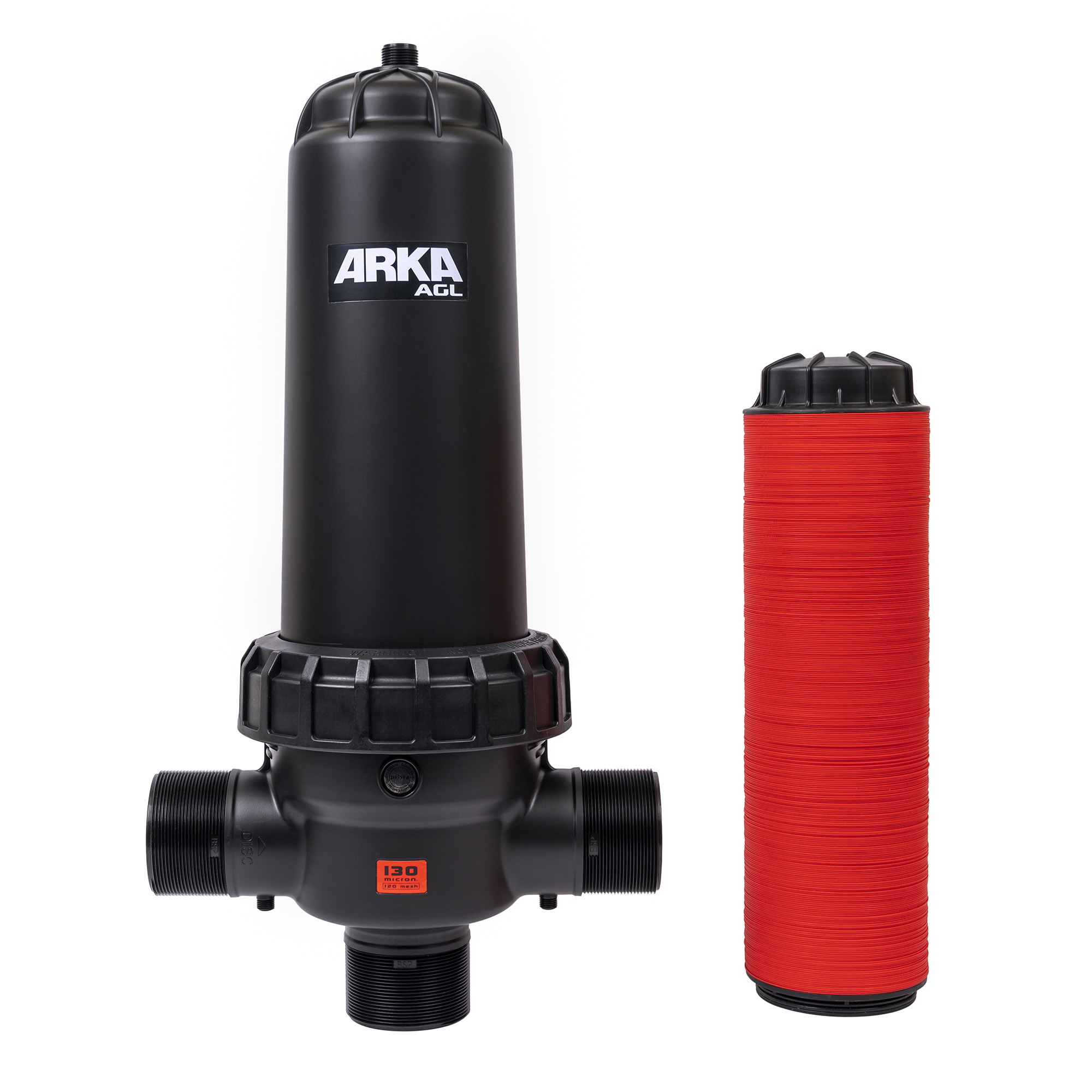
This mechanism provides true depth filtration. As water navigates the tortuous path between the rings, both hard inorganic sand and soft organic algae are trapped effectively. For instance, an industrial-grade disc filter, such as a 3-Inch AGL model, can seamlessly handle volumetric flow rates up to 50 cubic meters per hour while providing precise 120-mesh depth filtration. This specific engineering ensures resilient, long-lasting performance across variable water conditions. They are easily cleaned via manual rinsing or automated backflushing, making them incredibly versatile.
These systems consist of large, pressurized carbon steel or fiberglass tanks filled with a specific grade of crushed silica sand, basalt, or crushed recycled glass. Water enters the top of the tank and slowly percolates down through the deep bed of media.
This is the absolute gold standard for heavy organic loads. The massive depth of the sand bed traps vast quantities of algae, slime, and suspended solids before they can reach the field lines. In contrast to smaller units, these systems require a significant capital investment. They occupy a large physical footprint, require complex manifold plumbing, and necessitate automated backwashing cycles that consume a considerable amount of water.
When dealing with ponds, rivers, or canals, your strategy must prioritize the capture and retention of biological loads without suffering from immediate pressure drops.
For large-scale agricultural operations pulling from open bodies of water, a sand media filter is often the only viable choice. The three-dimensional depth of the bed is required to trap slimy, deformable algae. If algae hits a flat two-dimensional surface, it smears and completely seals the flow of water. In a deep media tank, the organic matter is caught within the microscopic voids between the grains throughout the entire depth of the tank. This allows water to continue flowing even as the unit loads with heavy debris.
For small to medium-sized operations, or situations where space and budget are constrained, grooved plastic rings offer a fantastic, cost-effective alternative. Because they simulate the depth filtration of a sand bed, they successfully capture organic matter without the massive footprint or high capital cost of steel tanks.
Standard, single-layer wire meshes are strongly discouraged for pond or lake water. The biological load will blind the mesh almost immediately. This results in a frustrating scenario where you are manually scrubbing green slime off the element multiple times a day just to maintain operational pressure.
Strategies for groundwater focus heavily on separating and removing hard, abrasive inorganic particles and managing potential mineral precipitation.
Because subterranean aquifers are typically devoid of algae and organic slime, the primary threat is rigid sand and silt. A quality screen filter is perfectly designed to stop these hard particles. Since silica does not smear or extrude, it simply bounces off the stainless steel mesh and falls to the purge basin at the bottom of the housing.
In scenarios where an agricultural well pumps a high volume of sand, often referred to as a sandy well, relying solely on a mesh element will result in rapid accumulation. In these cases, a hydrocyclone, also known as a centrifugal sand separator, should be installed before the primary unit. The separator uses centrifugal force to spin heavy sand outward and downward into a collection chamber. This removes up to ninety percent of the grit before the water even reaches the mesh.
Stacked ring technology is also exceptionally effective here. This is particularly true if the aquifer produces a combination of fine silt, clay, and sand. The three-dimensional matrix captures finer inorganic particulate that might occasionally slip through a standard woven wire.
To facilitate a clear purchasing decision, the following matrix breaks down the operational parameters and cost-effectiveness of each technology.
| Feature | Screen Filter | Disc Filter | Sand Media Filter |
|---|---|---|---|
| Filtration Mechanism | 2D Surface Filtration | 3D Depth Filtration | Deep Bed 3D Filtration |
| Best Water Source | Clean Well Water | Well & Moderate Surface Water | Heavy Surface/Pond Water |
| Target Contaminants | Hard Sand, Scale, Grit | Sand, Silt, Algae, Organics | Heavy Algae, Biological Slime |
| Maintenance Type | Manual wash or Auto-flush | Manual wash or Auto-flush | Automated Backwash required |
| Footprint / Space | Small / Compact | Small to Medium | Large / Requires concrete pad |
| Capital Cost | Low Budget | Medium Budget | High Budget |
Both mesh and grooved-ring systems are rated by micron size, such as 120 mesh or 130 micron. This allows for precise matching to emitter requirements. Deep bed tanks rely on the physical grade of the crushed media to determine its equivalent micron rating. This typically provides excellent ultra-fine particulate removal depending on the flow velocity.
Regarding upkeep, manual units require an operator to physically open the housing, pull out the element, and wash it with a hose. For larger commercial operations, automated versions use differential pressure switches to trigger a self-cleaning backflush cycle. This drastically reduces labor costs and eliminates human error. Heavy-duty media tanks almost exclusively rely on automated backflushing due to the sheer volume of sludge they collect daily.
Selecting the correct hardware is a critical engineering decision that directly impacts the efficiency and longevity of your setup. A mismatched system can lead to severe pressure drops or catastrophic emitter failure. Follow this systematic approach to identify the exact specifications required for your infrastructure.
The most common mistake when purchasing an irrigation filter is sizing it based solely on the pipe diameter rather than the actual volumetric flow rate. Flow rate is typically measured in Gallons Per Minute, known as GPM, or cubic meters per hour.
Forcing water through a unit that is too small for your flow rate will result in massive friction loss across the housing. This decreases the water pressure available to your field lines and accelerates wear on your pumping equipment. Always check your pump’s output specifications. Select a unit that can handle at least fifteen to twenty percent more flow than your system's maximum requirement to allow for a safety margin as debris accumulates.
| Pipe Size (Inches) | Typical Flow Rate Range (GPM) | Recommended Application |
|---|---|---|
| 3/4" to 1" | 10 - 25 GPM | Small landscape beds, residential gardens |
| 1.5" to 2" | 30 - 80 GPM | Light agricultural use, large estates |
| 3" to 4" | 100 - 300 GPM | Commercial farming, greenhouses |
| 6" and above | 400+ GPM | Large-scale agriculture, municipal projects |
Different distribution methods require different levels of water purity. Impact sprinklers can pass small debris without issue, but micro-systems demand highly precise purification. You must consult the manufacturer specifications of your drip tape. They will state a minimum requirement, expressed in either Mesh, which means holes per linear inch, or Microns, indicating the actual size of particles allowed to pass.
| Mesh Rating | Micron Equivalent | Typical Application |
|---|---|---|
| 40 Mesh | 400 Microns | Large impact sprinklers, flood irrigation |
| 80 Mesh | 177 Microns | Micro-sprinklers, large nursery jets |
| 120 Mesh | 125 Microns | Standard drip tape, landscape drip lines |
| 150 Mesh | 100 Microns | Pressure-compensating drip emitters |
Reiterate the fundamental rule of thumb from an engineering perspective: Do not rely on a standard two-dimensional mesh for surface water. The hydraulic pressure will force soft algae through the holes, blinding it entirely within minutes. You must select depth filtration for heavy organic loads. Conversely, if you are pumping from a clean underground well, a quality stainless steel mesh or stacked-ring system will provide ample protection against rigid grit at a much lower cost.
Matching the right physical barrier to your specific environmental water source is the foundational secret to a resilient, hassle-free agricultural setup. Ignoring this vital step leads to inevitable emitter failure, compromised crop health, and endless maintenance headaches.
If you are dealing with clean well water containing minor sand and rigid scale, a straightforward wire mesh will serve you perfectly. If your operation relies on heavily soiled pond or river water with high biological loads, investing in deep media tanks is absolutely necessary. For a versatile, space-saving all-rounder that handles both surface and well water beautifully, grooved-ring depth filtration is the ultimate choice. Do not wait for your system to fail. Test your water quality, calculate your operational flow rates, and upgrade your infrastructure today. For industry-leading solutions designed to secure the longevity of your crops, explore the high-performance filtration systems at ARKA Irrigation to find the exact match for your agricultural needs.
Yes, protection is absolutely necessary for well water systems. While groundwater pumped from an aquifer may appear crystal clear to the naked eye, it frequently carries invisible threats to your infrastructure. Submersible pumps often draw up microscopic inorganic particles, including fine silica sand, silt, and clay. Furthermore, well water is often rich in dissolved minerals such as calcium, magnesium, and iron. When these minerals are exposed to oxygen or changes in pressure, they can precipitate and form hard scale. Without a reliable barrier, this abrasive grit will erode the internal components of expensive solenoid valves and permanently block the orifices of your distribution devices.
Because micro-emitters possess microscopic internal pathways designed to restrict flow, they are incredibly susceptible to clogging. The standard requirement for these systems is highly precise purification, typically ranging from 120 mesh to 150 mesh. For these stringent requirements, stacked grooved-ring technology is widely considered the optimal choice. Unlike a single-layer mesh, the compressed rings create a three-dimensional depth matrix. This allows the unit to capture both hard inorganic particles and soft organic matter simultaneously. It provides a much larger surface area for trapping debris and extending the time between cleaning cycles.
Using a standard two-dimensional mesh element for surface water is highly discouraged by agricultural engineers. Ponds, lakes, and rivers are exposed to sunlight and environmental runoff, making them rich in biological contaminants like algae, moss, and decomposed leaves. Biological debris is inherently soft and slimy. When this organic matter hits a single-layer wire, the hydraulic pressure will quickly smear the slime across the surface, causing it to blind almost instantaneously. Under high pressure, soft algae can actually extrude through the tiny holes, entering your lines and clogging downstream emitters. You must use a system that offers depth filtration to trap soft debris effectively.
The frequency of cleaning depends entirely on the quality of your water source, the size of your unit, and the volume of water you process daily. Cleaning schedules should be dictated by pressure metrics rather than a calendar. Every setup should have two pressure gauges installed: one on the inlet side and one on the outlet side. As debris accumulates, it restricts flow, causing the outlet pressure to drop. As a strict rule of thumb, you should clean the unit manually or trigger a backwash cycle when the pressure differential reaches 5 to 7 PSI. Allowing the differential to exceed 10 PSI can cause permanent damage to the element or force debris through the pores.
The required micron size is dictated entirely by the emission devices installed in your field. You must check the manufacturer specifications for your specific drip tape, micro-sprinklers, or impact rotors. As a general engineering standard, the filter's aperture size should be at least one-tenth the size of the smallest orifice in your irrigation system. For standard drip lines, 120 mesh, which equals 125 microns, is the industry standard. For larger impact sprinklers, 40 to 80 mesh is usually sufficient to prevent nozzle clogging.
Undersizing is a critical error that forces high volumes of water through a small surface area. This creates extreme friction loss, drops your field pressure, and forces your pump to work harder, burning excess electricity and accelerating pump failure. It also means the unit will clog rapidly, requiring constant cleaning. Oversizing, on the other hand, is rarely a mechanical problem. A larger housing simply provides more surface area for debris collection, which lowers the friction loss and extends the duration between backwash cycles. When in doubt, always size up to accommodate future expansion and heavier debris loads.


