
Views: 0 Author: Site Editor Publish Time: 2026-10-22 Origin: Site


Are clogged emitters destroying your crop yields? Dirt, algae, and suspended solids easily block tiny drip lines. This turns a highly efficient watering setup into a massive liability. Imagine standing in the middle of a 50-acre tomato field during a peak summer heatwave. You suddenly discover dry patches caused by blocked micro-labyrinths. In this post, you will learn how an automated filtration approach protects your infrastructure. It saves countless labor hours and guarantees uniform fertigation across your entire operation.
For agricultural managers and irrigation engineers, technical validation is the vital first step before upgrading headworks infrastructure. An advanced disc filter system represents a significant engineering leap over traditional media and mesh screens. It utilizes a unique physical structure to trap stubborn contaminants that easily bypass older technologies.
At the core of this equipment is a tightly compressed stack of synthetic color-coded rings. Engineers typically specify highly durable polymers, such as polypropylene or glass-reinforced polyamide, to construct these components. Both sides of each individual ring feature micron-precise diagonal grooves. When compressed together along a central spine, these grooves intersect. This intersection creates a complex, tortuous path for the water to travel through.
Unlike a flat screen that only stops particles on its surface, this intricate design creates a deep three-dimensional filtration matrix. The industry refers to this as depth filtration. Consequently, debris is trapped not just on the outer edge of the stack, but throughout the entire depth of the overlapping grooves. This allows the unit to hold a massive volume of suspended solids before requiring a cleaning cycle.
The true efficiency of this technology lies in its automated cleaning cycle. It operates entirely without manual intervention. Precise fluid dynamics govern the process, eliminating operator guesswork.
Specifically, a pressure differential switch continuously monitors the pressure between the inlet and outlet. As organic slime and dirt accumulate in the grooves, the outlet pressure naturally drops. Once this differential reaches a preset threshold, typically around 0.5 bar or 7 psi, the controller automatically initiates the flush cycle. The hydraulic or pneumatic valve reverses the flow of water. This action releases the pressure that holds the stack together, allowing the discs to separate slightly.
High-pressure water is then sprayed from multi-jet nozzles located inside the central spine. This outward spray causes the loose discs to spin rapidly. The powerful combination of centrifugal force and high-velocity water jets dislodges the trapped debris. The system then flushes the waste out through a drainage manifold. After a brief 10 to 20-second cycle, the valve switches back. The rings recompress, and standard operation resumes instantly.
Drip irrigation is widely recognized as the most efficient method for delivering water and nutrients directly to the root zone. However, this precision comes with strict operational requirements. The system's greatest vulnerability lies in its microscopic pathways.
Modern emitters are engineered to deliver exact flow rates, typically ranging from 0.5 to 2.0 gallons per hour. To control this slow drip, water must navigate microscopic labyrinth channels inside the plastic dripper. Even micro-particles of sand, silt, or sticky biological matter can quickly block these narrow pathways.
When emitters clog, the Coefficient of Uniformity across the field plummets. Plants in affected zones suffer from severe nutrient lockout and drought stress. This inevitably leads to a measurable reduction in harvest quality. Protecting these delicate components is not an optional luxury. It is the fundamental requirement for a functional and profitable setup.
The agricultural sector is currently undergoing a massive transformation in water management. Driven by prolonged droughts and strict groundwater regulations, farm operations are increasingly forced to utilize marginal water supplies. These alternative sources include reclaimed municipal wastewater, open canal networks, and agricultural runoff.
Consequently, irrigation headworks face unprecedented biological loads. Market data shows a sharp pivot away from traditional sand media tanks toward modular, automated filtration. Farm managers now demand systems that require zero manual intervention while handling high levels of Total Suspended Solids. This shift underscores a broader industry move toward precision agriculture, where consistent water quality is treated as a critical production input rather than an afterthought.
Investing in advanced headworks infrastructure yields specific, measurable advantages. These benefits directly impact both the operational budget and the agronomic outcomes of a commercial farm.
The most immediate financial benefit of upgrading to an automatic disc filter is the drastic reduction in manual labor. Picture the old routine. A maintenance crew goes out at 6 AM to physically open heavy steel housings. They pull out dirty elements, scrub them clean with high-pressure hoses, and reassemble the units. This grueling process steals hours of productivity and must be repeated frequently during peak algae season.
Automated systems operate on a set-it-and-forget-it paradigm. Because the equipment cleans itself based on real-time data, it completely eliminates the labor hours previously dedicated to scrubbing and maintenance.
Organic debris presents a unique challenge. When soft algae hits a standard flat screen, the continuous pressure of the water tends to extrude or smear the material right through the mesh. This pushes the algae directly into the drip lines.
In contrast, depth filtration acts as an impenetrable maze. The soft, sticky debris is caught deep within the intersecting grooves of the compressed rings. It cannot be pushed through by hydraulic pressure. This ensures that biological contaminants remain safely isolated from the delicate micro-emitters.
Uniform fertigation relies entirely on consistent pressure. When a manual unit clogs, pressure drops gradually over time. As a result, plants at the end of the line receive significantly less water than those near the pump station.
An automated setup prevents this degradation. By initiating a brief cleaning cycle exactly when the differential reaches the optimal threshold, the irrigation lines maintain a steady, uniform flow rate. In modular setups, one pod can flush while the others continue to supply the field. This guarantees zero interruption to the watering schedule.
When designing an irrigation headworks, agricultural managers frequently face a critical decision between two dominant technologies. While both aim to automate the flushing process, their underlying mechanics differ significantly.
| Feature | Depth Filtration (Disc) | Surface Filtration (Screen) |
|---|---|---|
| Filtration Mechanism | Three-dimensional intersecting grooves | Two-dimensional flat woven mesh |
| Organic Matter Handling | Excellent; traps soft algae without smearing | Poor; algae easily extrudes through the mesh |
| Inorganic Debris (Sand) | Highly effective | Highly effective |
| Backwash Efficiency | Uses centrifugal spin and multi-jet spray | Uses suction scanners or mechanical brushes |
| Ideal Water Source | Surface water, canals, treated wastewater | Deep well water with sand content |
A self cleaning screen filter utilizes a stainless steel cylinder to block particles larger than the pore size. This works exceptionally well for hard, inorganic particles like sand and pipe scale. However, mechanical brushes can actually smear algae across the mesh, exacerbating the clogging issue.
To ensure optimal performance and avoid premature equipment failure, the chosen technology must match the specific water profile. If you are pumping deep well water with a high sand content, a screen filter is a highly efficient choice. Conversely, if you are drawing surface water containing suspended biological solids, a disc setup is strictly required to prevent emitter failure.
For buyers in the decision stage, specifying the correct equipment is vital for operational stability. Not all units are manufactured to the same rigorous standards. When evaluating options for a commercial project, several technical specifications must be carefully reviewed.
Drip tape manufacturers provide strict guidelines regarding the maximum particle size their products can handle to honor warranties. Disc modules use a universally recognized color-coding system to denote their micron rating.
For example, a red stack typically denotes a 130-micron or 120-mesh rating. This is the industry standard for most agricultural applications. Finer black discs, rated at 100 microns, are reserved for ultra-precise subsurface drip irrigation. Selecting the appropriate grade ensures you balance maximum emitter protection with a reasonable backwash frequency.
Agricultural water demand fluctuates based on crop stage, seasonal evaporation rates, and acreage expansion. A robust solution must accommodate current flow rates while offering future scalability.
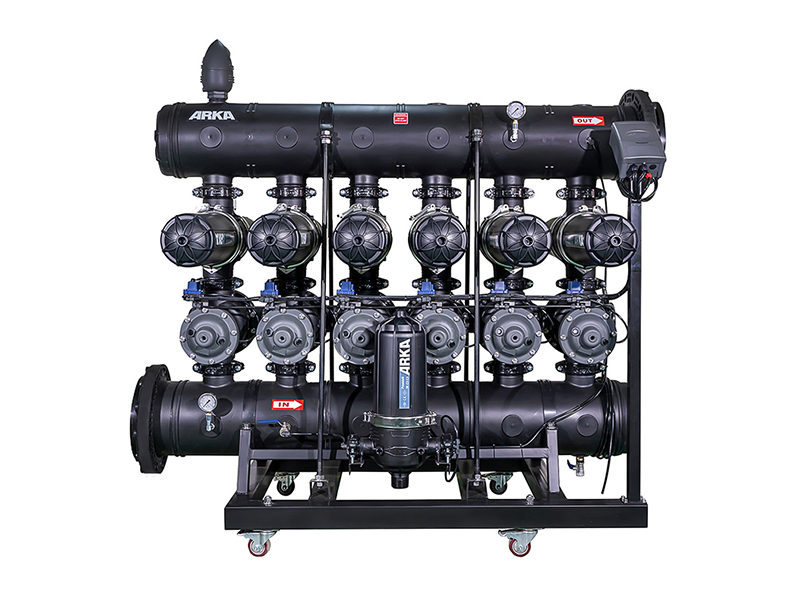
Modern engineering favors modularity. High-performance systems, such as the F406H series, utilize linked standard-sized pods. Operations can install banks of 2-inch, 3-inch, or 4-inch units together in parallel on a single high-density polyethylene manifold. If a farm expands its footprint next season, additional pods can simply be bolted onto the existing framework without overhauling the entire infrastructure.
Irrigation lines frequently act as delivery mechanisms for harsh chemicals through fertigation and chemigation. Metal housings are highly susceptible to rust and degradation under these acidic conditions.
High-quality systems are constructed from industrial-grade engineered polymers. Glass-reinforced polyamide provides complete resistance to agricultural fertilizers and harsh ultraviolet exposure. This ensures decades of reliable service out in the elements.
Upgrading from outdated manual screens to a fully automated backwash disc filter requires a higher initial capital expenditure. However, farm managers should view this not as a sunk cost, but as an asset that generates a rapid and measurable Return on Investment through operational savings.
The financial justification becomes obvious when analyzing eliminated overhead. First, consumable costs drop to near zero. Unlike cartridge setups that require continuous purchasing of disposable spun-fiber elements, synthetic discs are permanent. They only require periodic visual inspections.
Second, the thousands of dollars spent annually on wages for manual cleaning are instantly eradicated. This allows you to reallocate your workforce to revenue-generating tasks. Finally, by strictly preventing debris from entering the field, the lifespan of the lateral lines is significantly extended. This delays the massive capital cost of a full-field drip tape replacement.
Beyond direct operational expenditure savings, the greatest financial impact is realized at harvest time. Clean, properly filtered water guarantees uniform fertigation distribution. Every single plant receives the exact volume of water and nutrients prescribed by the agronomist.
This uniformity eliminates stunted growth zones and reduces crop stress. In commercial agriculture, higher uniformity directly correlates to better crop sizing, premium market grades, and maximized profitability. The resulting increase in premium yields often offsets the cost of the filtration unit within a single growing season.
An automated filtration system is not just an accessory. It is the beating heart of a reliable drip irrigation network. By effectively blocking both organic and inorganic debris, it ensures your crops receive consistent, uniform watering day after day.
Remember, protecting your delicate drip lines early is vastly cheaper and easier than replacing miles of clogged tape mid-season. If you are ready to upgrade your headworks and eliminate manual scrubbing forever, explore the high-performance solutions available at Arka Irrigation. Their modular systems are engineered to handle the toughest agricultural water challenges, slash labor costs, and secure your harvest.
The backwash frequency is not strictly time-dependent. Rather, it is dictated by the real-time quality of your source water. The system is equipped with a pressure differential switch. As debris accumulates in the stack, the water pressure on the outlet side drops. When this pressure difference reaches a predetermined threshold, the controller automatically initiates the flush cycle. Most modern controllers also feature a preset timer as a secondary failsafe, ensuring the system flushes at least once every few hours regardless of pressure buildup.
To ensure the discs separate and spin rapidly during the cleaning phase, the system requires a minimum backwash pressure. For most industrial-grade agricultural units, engineers recommend maintaining at least 2.5 to 3.0 bar of pressure at the flush valve. If the system pressure drops below this threshold, the centrifugal force will be insufficient to eject sticky biological solids from the grooves.
It is highly effective at physically removing suspended algae clumps, filaments, and sticky biological solids that cause emitter clogging. Because of the three-dimensional depth filtration, it traps these soft organic materials rather than letting them extrude through a mesh. However, it acts as a physical barrier, not a chemical treatment. Microscopic algae spores smaller than the micron rating will pass through. To completely neutralize algae growth within the water itself, the hardware should be paired with proper chemical treatments, such as chlorination or copper sulfate injections.
The color-coded polymer rings are incredibly durable. Because they are manufactured from robust materials like glass-reinforced polyamide or high-density polypropylene, they resist chemical degradation and physical wear. Under normal agricultural operating conditions, a single stack of discs can easily last 7 to 10 years. Replacement is usually only necessary if the discs are subjected to extreme abrasive sand over long periods or damaged by improper acid washing.
No, it does not interrupt field irrigation when configured correctly. These units are typically installed as multi-pod modular banks. When the controller triggers a flush, only one pod enters the cleaning mode at a time. The remaining pods continue to actively filter water and supply the main line. Once the first pod finishes its brief 15-second cleaning cycle, it returns to service, and the next pod begins its flush. This sequential process ensures zero downtime and steady pressure to the field.


