
Views: 0 Author: Site Editor Publish Time: 2026-10-14 Origin: Site


Are clogged emitters quietly eroding your crop yields? When poor water quality meets sensitive irrigation infrastructure, reliable filtration becomes an absolute necessity rather than a mere option. Manual cleaning drains valuable time and labor. Modern agriculture demands a completely autonomous approach to water management. In this comprehensive engineering guide, we dive deep into the mechanics of self-cleaning systems. We will explore exactly when integrating automated filtration makes the most operational sense for your specific field conditions.
An automatic disc filter stands as a cornerstone of advanced water treatment. Engineers designed this equipment specifically to extract suspended solids, organic matter, and debris from irrigation networks without demanding daily human intervention. Unlike conventional surface barriers, this robust system relies on a stack of tightly compressed, color-coded synthetic rings. Look closely at each individual disc. You will notice microscopic diagonal grooves radiating from the center to the outer edge.
When compressed tightly onto a central spine, these intersecting grooves form a highly complex, three-dimensional labyrinth. Raw water pushes through this matrix from the outside in. Particles become trapped at varying depths depending on their physical size. Fluid dynamic experts formally refer to this process as depth filtration.
The autonomous classification stems from the unit's built-in self-cleaning capability. Outfitted with pressure differential switches and a smart controller, the setup constantly monitors debris accumulation. The moment the head loss hits a pre-set threshold, the system independently reverses the flow. It decompresses the stack and aggressively flushes trapped particulates out through a designated drain valve. This seamless operation proves invaluable for large-scale agricultural sites. Shutting down the main centrifugal pump for manual scrubbing is simply out of the question during peak fertigation cycles.
The primary factor driving the selection of any filtration hardware is the inherent quality of the source water. Continuous agricultural setups frequently pull from highly diverse environments. These range from deep boreholes and open canals to rivers and treated wastewater. Each source carries a unique particulate profile that dictates the necessary filtration physics.
A high-quality irrigation disc filter is explicitly designed to tackle complex, heavy-load water profiles. It excels in environments teeming with biological and organic contaminants. When agronomists evaluate a site, they typically divide threats into two distinct camps: inorganic grit like sand or silt, and organic matter such as algae or biological slime.
Surface water sourced from lakes or reservoirs is notoriously dynamic. Subject to seasonal algae blooms and rainfall runoff, these sources carry a massive organic load. Traditional mesh screens often fail miserably in these conditions. System pressure simply forces soft, deformable organics right through the metal holes. The three-dimensional matrix of a grooved disc stack effectively traps these malleable particles. They cannot slip through the labyrinth.
Groundwater pulled from deep wells might lack algae but often carries fine abrasive sand or dissolved minerals. Basic screens handle coarse gravel well. However, a depth-based approach offers a vital secondary layer of security against microscopic silt. Without this protection, fine abrasive grit bypasses the manifold and slowly grinds away the internal geometry of your driplines.
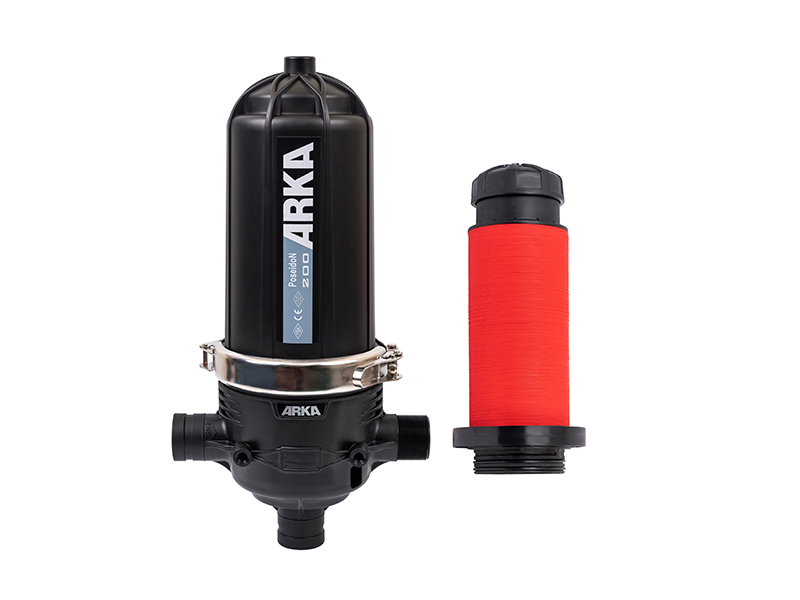
System designers inevitably face a classic debate when mapping out a new manifold block: discs versus screens. Both serve the ultimate goal of shielding downstream emitters. Yet, the physics governing their fluid dynamics differ dramatically.
Screen filters operate strictly on surface filtration principles. Picture a microscopic sieve. Utilizing a stainless steel or woven plastic mesh, they block anything larger than the specified pore size. They excel at stopping hard, inorganic debris like gravel. They fall incredibly short when confronted with organic matter. Biological slime easily extrudes through the two-dimensional mesh under standard operating pressure. The slime creeps directly into the lateral lines.
Depth filtration forces the water to navigate a tortuous, multi-directional path. The stacked grooves ensure that even soft, gelatinous organic materials snag within the matrix long before they can breach the clean side of the housing.
| Technical Parameter | Screen Filters | Automatic Disc Filters |
|---|---|---|
| Filtration Method | Surface Filtration — 2D mesh | Depth Filtration — 3D matrix |
| Organic Matter Handling | Poor — High extrusion risk | Excellent — Trapped securely in grooves |
| Inorganic Matter Handling | Excellent — Easily stops rigid particles | Excellent — High capacity for sand and silt |
| Backwash Efficiency | Moderate — Screens require manual scrubbing over time | High — Discs decompress to release debris fully |
| Physical Footprint | Generally requires more vertical space | Compact, modular, and scalable |
Operations drawing from open ponds gain a clear operational edge with depth filtration. It drastically cuts the risk of organic bypass and subsequent field-wide clogging.
The global agricultural sector is undergoing a massive transformation driven by climate-induced water scarcity and chronic labor shortages. Market data reveals that automated filtration is rapidly transitioning from a luxury upgrade to a baseline requirement for climate-resilient farming. Relying on manual labor to monitor gauge pressures and scrub filters is no longer economically viable for commercial growers.
With the rise of IoT-enabled smart agriculture, modern farms require localized infrastructure capable of self-regulation. Advanced self-cleaning manifolds integrate seamlessly with central farm management software. Farm managers can now monitor differential pressure remotely via mobile dashboards. This automation reallocates valuable farmhands from mundane filter-scrubbing to higher-value crop management tasks. At the same time, precise backwash cycles conserve thousands of gallons of water annually compared to outdated sand media tanks.
Implementing a formidable filtration strategy extends far beyond merely securing clean water. It acts as a comprehensive insurance policy for your entire irrigation infrastructure. Integrating a premium disc filter into a farming setup manifests directly in stabilized crop yields and slashed operational overhead.
The autonomous backwash capability guarantees absolutely uninterrupted fertigation. Commercial watering schedules are meticulously timed to match plant transpiration rates and minimize soil evaporation. Manual units force abrupt system shutdowns. These interruptions throw delicate nutrient delivery schedules into disarray. Self-cleaning banks utilize a multi-pod design. One pod purges itself while the remaining pods continue delivering pressurized water to the field. The crop never experiences a dry spell.
These systems provide absolute engineering precision. Manufacturers mold the synthetic grooves with exact microscopic dimensions. The resulting micron rating is highly accurate. Growers can confidently select a 130-micron or 100-micron grade that perfectly aligns with their specific emitter orifices. This entirely removes the guesswork often associated with traditional sand media beds.
The modular architecture saves incredibly valuable footprint space. A farming enterprise might start with a dual 2-inch pod system. As the farm acquires more acreage, technicians can seamlessly bolt additional pods into the existing manifold without requiring a ground-up redesign.
Drip and micro-irrigation methods are universally celebrated for unparalleled water efficiency and targeted nutrient delivery. The very micro-emitters that make these systems so effective feature incredibly narrow flow paths. These paths often measure less than a single millimeter across. This microscopic geometry makes them highly vulnerable to catastrophic blockages.
A dedicated drip irrigation filter serves as the final, critical barrier between source contaminants and total system failure. Imagine walking down a 500-foot row of high-value tomatoes. You suddenly discover the last 50 feet are severely stunted due to a microscopic algae buildup inside the emitter labyrinth. When an emitter chokes, the corresponding plant suffers immediate water stress. In high-density plantings, even a minor five percent clogging rate triggers uneven growth. This drastically complicates commercial harvesting and grading efforts.
Blocked driplines severely disrupt the hydraulic balance of the entire irrigation zone. As some emitters clog, head pressure forces the remaining open emitters to discharge far more water than intended. This creates a chaotic field mix of waterlogged roots and parched soil. Capturing the micro-grit and biological slimes notorious for fouling drip tape extends your hardware's lifespan by years. It safeguards your massive initial capital investment.
The defining hallmark of this technology is its highly engineered backwash cycle. It is a hydraulic sequence designed to restore flow capacity completely hands-free. Grasping this mechanical ballet is essential for maintenance personnel and system operators alike.
A precision differential pressure switch dictates the entire process. Raw water filters through the compressed stack. Particulates accumulate on the outer edges and deep within the grooves. This buildup creates immediate hydraulic resistance. The pressure on the clean outlet side begins to drop relative to the raw inlet side.
The switch registers this pressure gap—typically calibrated around 0.5 bar or 7 psi. It immediately signals the electronic brain of the unit. The controller activates a hydraulic or pneumatic command to shift a three-way valve. This precise action shuts off the raw water inlet to that specific pod and opens its atmospheric drain port.
Clean water from adjacent active pods is instantly forced backward into the dirty pod. The hydraulic pressure that previously clamped the central spine together releases. The discs separate slightly. High-velocity jets of clean water spray tangentially from the center spine. This causes the loose discs to spin rapidly. The dual action of centrifugal force and high-pressure spray violently dislodges the trapped sludge. It flushes the debris out the drain. Within 15 to 20 seconds, the valve shifts back. The stack compresses tightly, and normal filtration resumes seamlessly.
Nailing down the correct specifications for your manifold requires a solid grasp of fluid dynamic measurement standards. An undersized unit will backwash constantly and waste pump energy. An oversized unit ties up unnecessary capital. Filtration precision is universally expressed in either Microns or Mesh sizes.
A micron represents one-millionth of a meter. It measures the actual physical size of the particle trapped. A lower number indicates a tighter, finer filter. Mesh refers to the number of openings per linear inch of a screen. A higher mesh number denotes a finer degree of filtration.
Irrigation engineers follow a strict golden rule. The filter's pore size should be exactly one-tenth the diameter of the smallest emitter orifice in your field.
| Filter Color Code | Micron Rating | Mesh Equivalent | Ideal Agricultural Application |
|---|---|---|---|
| Blue | 400 Micron | 40 Mesh | Micro-sprinklers, large landscape jets |
| Yellow | 200 Micron | 80 Mesh | Standard sprinklers, pivot irrigation |
| Red | 130 Micron | 120 Mesh | Standard drip irrigation, heavy wall driplines |
| Black | 100 Micron | 140 Mesh | Thin-wall drip tape, precision greenhouse emitters |
| Green | 55 Micron | 200 Mesh | Foggers, misting systems, specialized hydroponics |
Selecting a 55-micron green grade for a standard impact sprinkler setup is a classic rookie mistake. The tight matrix will trigger excessive, unnecessary flushing cycles. Precision sizing is a delicate balancing act rooted strictly in objective emitter specifications.
Massive, multi-pod automated banks are the gold standard for primary pump stations. However, individual field zones often demand a more localized approach. The Y type disc filter features a distinct structural design. The housing intersects the main pipeline at an angle, perfectly resembling the letter Y.
Engineers highly favor this specific geometry for low-to-medium flow applications. It serves perfectly as a secondary polishing checkpoint positioned directly at the valve head of a specific block. The angled body boasts excellent hydraulic efficiency. Water passes through with significantly less head loss compared to bulky T-type or inline housings.
These Y-shaped units act as indispensable backup security in sprawling continuous irrigation networks. A farm might rely on a heavy-duty automated station at the main reservoir. Yet, engineers frequently install smaller 2-inch Y-type units at the entry point of each field sector. Suppose an underground PVC mainline fractures and sucks in mud downstream of the primary station. These localized checkpoints ensure the sensitive drip tape in that specific zone remains completely protected from the sudden debris spike.
Excessive backwashing typically signals that the unit is undersized for the current flow rate. It can also indicate the source water experienced a sudden spike in turbidity—such as a seasonal algae bloom or heavy storm runoff. Frequent flushing might also stem from an improperly calibrated or clogged differential pressure sensor. Operators should immediately verify source water conditions and recalibrate the DP switch to standard parameters.
Manufactured from rugged, chemical-resistant synthetic polymers, the discs are incredibly durable. Under standard agricultural conditions, they do not degrade. They will easily last for several years of continuous use. Replacement is generally only warranted if they suffer prolonged physical abrasion from sharp, heavy sand, or if exposed to highly incompatible industrial chemicals.
Agronomists strongly advise injecting fertilizers and chemicals downstream of the primary filtration station. Injecting upstream introduces a severe risk. Certain fertilizers precipitate out of solution when they react with trapped organic matter. This chemical reaction can severely cement the disc stack together. Keeping corrosive nutrients out of the housing also significantly prolongs the lifespan of internal rubber seals and hydraulic valves.
Rigorous winterization is non-negotiable for operations in frost-prone climates. Water expands as it freezes. Trapped moisture will easily shatter reinforced plastic or cast metal housings. Operators must trigger a final manual backwash to thoroughly clean the matrix. Next, open all drain valves and remove the housing covers to allow complete evaporation of residual moisture inside the manifold.
A successful self-cleaning cycle relies entirely on adequate reverse hydraulic pressure. Most industrial-grade disc units require a minimum downstream pressure of 2.5 to 3.0 bar—roughly 35 to 45 psi—during the flushing sequence. If the system pressure drops below this threshold, the discs will not separate fully, and the centrifugal spin will lack the force needed to eject sticky biological sludge.
The decision hinges entirely on your total system flow rate and the requirement for continuous operation. A standalone filter requires the water flow to stop completely during manual cleaning. If your crop demands uninterrupted fertigation and your flow rate exceeds the capacity of a single 3-inch housing, you must upgrade to a multi-pod automated bank. This ensures one pod can clean itself using the pressurized clean water generated by the adjacent active pods.
Reliable filtration forms the invisible, unyielding backbone of any successful agricultural operation. Self-cleaning disc systems effectively neutralize the constant threat of organic and inorganic debris. They ensure a steady, uninterrupted flow of vital water and nutrients directly to the root zone. Matching the correct micron rating and modular configuration to your specific water quality profile protects expensive micro-emitters. It also drastically slashes long-term maintenance overhead and labor costs. Upgrading to an automated, depth-based filtration strategy is a profound strategic investment in the longevity and profitability of your entire farm. To explore high-performance, climate-resilient filtration solutions tailored to your specific flow requirements, review the advanced technical specifications available at Arka Irrigation and safeguard your crop yields today.


