
Views: 0 Author: Site Editor Publish Time: 2026-10-22 Origin: Site


Large-scale farming faces a critical bottleneck when managing water resources. Emitters clog. Crop yields drop. Maintenance costs soar. Protecting miles of drip tape across hundreds of acres requires more than just a basic mesh screen. It demands robust and intelligent filtration. Recently, the agricultural sector has experienced a massive shift toward precision irrigation. Driven by global water scarcity and rising labor costs, modern farm managers are moving away from manual maintenance. They need reliable automation to ensure every drop of water reaches the plant roots without interruption.
Designing a filtration setup for extensive agricultural projects requires a deep understanding of hydraulics, water sources, and field conditions. A poorly specified setup leads to pressure drops and wasted energy. A well-engineered solution works silently in the background and protects your entire irrigation infrastructure.
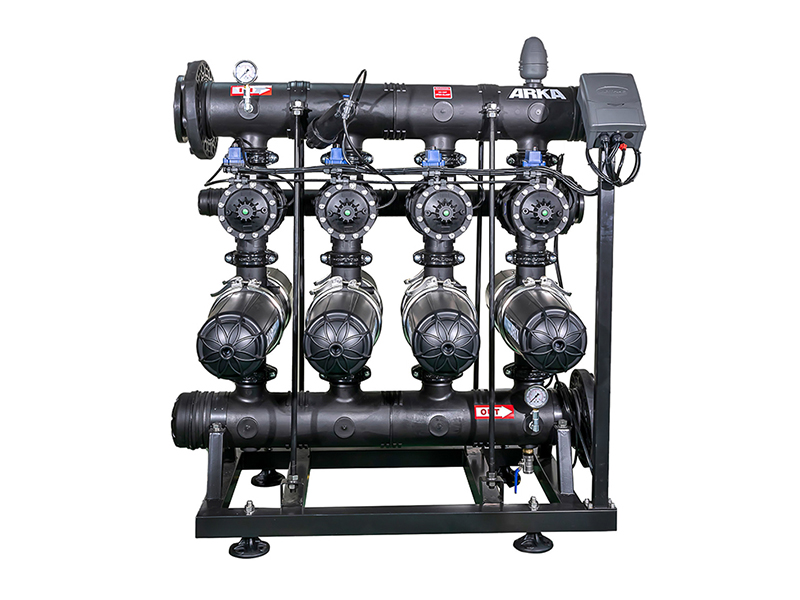
Specifically, selecting the right equipment involves analyzing several dynamic factors. Water quality is always the starting point. Surface water drawn from canals or reservoirs brings seasonal algae blooms and heavy organic loads. Borewell water often carries fine sand and silt. The filtration grade must perfectly match the emitter orifice size. For most commercial drip lines, a 130-micron rating serves as the golden standard. It blocks damaging particles while allowing dissolved nutrients to pass through freely.
System sizing is equally critical. Undersized manifolds lead to frequent cleaning cycles and severe pressure fluctuations across the field. Oversized designs inflate upfront capital expenditures unnecessarily. Engineers must calculate the peak flow demand of the largest irrigation zone and size the disc filter system to handle that exact volume with a comfortable safety margin. This approach guarantees optimal performance even when water quality temporarily degrades following heavy rainfall.
Furthermore, theoretical design must translate into absolute field reliability. Let us look at real-world specifications that make a difference on the farm. Consider a high-capacity setup like the ARKA F304H series. This configuration typically features a robust 6-inch manifold equipped with 3 or 4 filter units. It handles massive flow rates effortlessly while maintaining a highly compact footprint.
The true value lies in the automated cleaning mechanism. When organic matter builds up on the disc spines, the differential pressure across the inlet and outlet increases. Once this pressure hits a predetermined threshold, the backwash controller instantly triggers the cleaning cycle. It reverses the water flow, spins the grooved discs apart, and forcefully ejects trapped debris out of the flush valve. This happens sequentially. One unit cleans itself while the others continue supplying filtered water to the crops. I have seen farms lose significant crop yield simply because their manual filters could not handle sudden algae spikes. An automated setup completely eliminates this risk.
In contrast to traditional methods, grooved plastic disc technology offers unique operational advantages. Farm managers often debate between different filtration types. The table below highlights why disc technology is rapidly becoming the standard for modern agriculture.
| Feature | Screen Filters | Sand Media Filters | Automatic Disc Filters |
|---|---|---|---|
| Filtration Mechanism | Surface only | Depth only | Surface and Depth combined |
| Organic Matter Handling | Poor to Moderate | Excellent | Excellent |
| Physical Footprint | Small | Very Large | Highly Compact |
| Maintenance Labor | High | Medium | Extremely Low |
| Water Waste During Flush | Low | High | Very Low |
Therefore, how do you specify the exact equipment for your upcoming project? Move away from abstract estimates and use concrete operational data.
First, calculate your absolute peak flow. Do not rely on average daily water usage. Determine the maximum gallons per minute required when your largest irrigation blocks are running simultaneously. Match this figure against the manufacturer flow charts.
Second, assess your primary water source rigorously. If you are pumping from a turbulent river or an open pond, always opt for a multi-unit disc filter. Having three or four units on a single manifold ensures that your irrigation lines remain pressurized even while one unit is flushing out heavy silt.
Third, define your automation requirements. Standardize on control panels that offer dual-trigger mechanisms. The system should initiate a flush based on differential pressure, but it must also have a time-based backup. This dual-layer protection guarantees that the discs remain clean even during low-flow fertilizer injection cycles.
Water conservation is a major priority for large farms. A highly efficient self cleaning filter uses less than one percent of the total system flow for flushing. The entire cleaning sequence typically lasts only 15 to 20 seconds per unit. This rapid action minimizes wastewater and keeps the main irrigation pressure stable.
Yes, they are designed specifically for remote agricultural environments. Modern setups utilize DC latching solenoids. These components draw very little power and run flawlessly on standard alkaline batteries or small solar panels. You do not need to trench electrical cables across your entire farm to achieve full automation.
Ultimately, protecting your irrigation investment requires field-proven technology. Stop letting clogged emitters dictate your maintenance schedule and threaten your crop yields. Upgrading your agricultural infrastructure with intelligent filtration creates immediate returns through saved labor and improved harvest uniformity.
Evaluate your current flow rates and water quality challenges today. Explore the robust ARKA F304H series and other high-performance configurations at ARKA Irrigation. Find the exact engineering match for your farm and secure the future of your water management system.


