
Views: 0 Author: Site Editor Publish Time: 2026-10-14 Origin: Site


Picture this: it is the peak of a scorching dry season. You walk your fields or landscape, expecting lush growth, only to discover bone-dry soil beneath your drip lines. You rub the emitter between your fingers and feel a gritty, chalky paste. Untreated water, drawn from wells or surface ponds, hides abrasive sand, silt, and rust. Over time, these microscopic invaders act like liquid sandpaper. They choke delicate emitters and slowly destroy the internal mechanics of expensive pumps.
Implementing a dedicated sediment filter for your setup is not an optional accessory. It is the ultimate defense mechanism for agricultural and landscaping success. In this comprehensive guide, we will walk you through everything required to choose the perfect irrigation water filtration hardware for your specific water source, flow rate, and budget. Getting this right ensures your system runs flawlessly year-round.
When designing an agricultural watering network, buyers often focus heavily on high-horsepower pumps, complex piping layouts, and smart timer controllers. However, the physical quality of the water flowing through those premium components ultimately dictates their lifespan. Skipping proper filtration turns a minor upfront savings into a massive long-term liability.
Modern micro-irrigation relies on absolute precision. Drip tape, micro-sprays, and soaker hoses feature incredibly small orifices engineered to deliver exact droplets to a plant's root zone. When suspended solids like fine silt or algae enter these laterals, they accumulate at the emission points.
Consequently, this buildup leads to partial or complete blockages. A choked emitter means a crop receives zero moisture. Yields drop, and dead patches spread across the landscape. As some lines become obstructed, the hydraulic pressure inside the remaining network spikes, causing tubing blowouts. Proper filtration arrests this particulate matter before it ever reaches the delicate lateral lines.
The devastation caused by untreated sediment extends far beyond the fields. It actively degrades your most expensive hardware. When coarse sand passes through a water pump, you can sometimes hear the unmistakable whine of a struggling motor. The grit acts like a grinding wheel against spinning impellers and the internal volute casing. This continuous abrasion destroys pump efficiency, forcing it to consume more electricity while moving less water.
Automated zone control relies on solenoid valves. These valves operate via small internal rubber diaphragms and tiny pilot holes. If a single grain of quartz lodges in a diaphragm's pilot hole, the valve will fail to close entirely. This results in flooded zones, wasted resources, and potential motor burnout.
The foundational step in selecting reliable hardware is conducting a thorough evaluation of your specific water source. Different bodies of water carry entirely different biological and geological profiles.
From an engineering perspective, recent agronomic trend analysis reveals a critical shift. As regional aquifers deplete and water tables drop globally, farmers are forced to pump from deeper, sandier wells or utilize marginal reclaimed surface water. This environmental reality has driven the agricultural sector away from basic single-mesh screens toward robust, multi-stage filtration setups capable of handling highly turbid water without constant manual intervention.
Deep wells remain the backbone of commercial agriculture, but they are notorious for pumping inorganic particulate matter. Depending on the aquifer's geology and the age of the well casing, the drawn water frequently contains high concentrations of coarse sand, gravel fragments, and oxidized iron flakes.
Because these particles are heavy and sharp, standard mesh screens are almost always inadequate. A basic screen will catch the sand, but it will blind over so rapidly that a farmhand would need to scrub it multiple times a day just to maintain line pressure. Therefore, groundwater demands specialized kinetic solutions designed to process heavy sediment continuously.
In contrast, rainwater harvesting and surface water extraction present a vastly different set of hurdles. While lakes, ponds, or rivers may harbor some suspended silt, the primary contaminants are organic and biological. Roof catchment systems introduce shingle grit, decayed leaves, and bird droppings. Pond water is heavily laden with sticky algae, organic muck, and aquatic microorganisms.
These organic materials are soft and pliable. If forced into a high-pressure manifold, algae will simply smear across a traditional screen, creating a waterproof paste that instantly stops flow. For these sources, three-dimensional disc filters or coarse media tanks are generally required to trap fibrous debris without smearing.
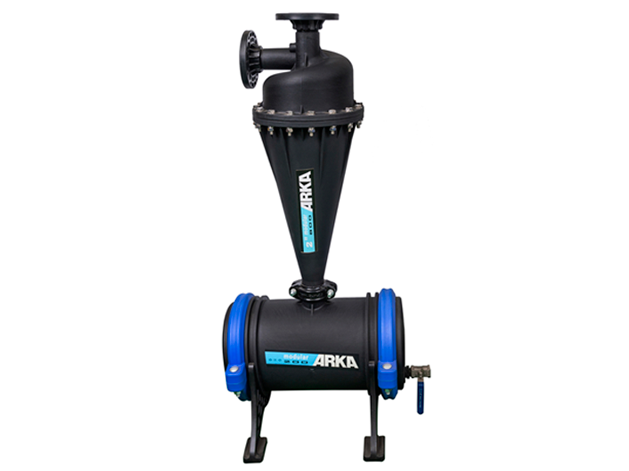
Understanding the core mechanics available on the market allows buyers to match the hardware to their specific environmental challenges. The industry is not one-size-fits-all. Selecting the wrong mechanism guarantees frustration.
Screen filters represent the most basic tier of defense. They utilize a rigid plastic or stainless-steel mesh cylinder housed inside a pressure casing. While highly effective at catching light, hard debris like occasional pipe scale, they lack the surface area to handle heavy, continuous loads.
Disc filters operate on a completely different principle. They feature a tightly compressed stack of grooved plastic rings. As water pushes through the microscopic intersections between the rings, debris is trapped within a deep, three-dimensional matrix. They excel at capturing organic matter because the depth of the grooves prevents soft algae from easily flattening and blocking the water path.
A spin-down unit is a distinct upgrade from a static screen. It utilizes a specialized diverter head that forces incoming water into a swirling motion. This kinetic action pushes larger, heavier particles outward against the clear outer housing and downward into a collection bowl. The primary benefit here is visibility and ease of maintenance. You can see the debris accumulating and simply open a bottom valve to flush it away without shutting down the main pump.
When dealing with severe sand intrusion, the centrifugal sediment filter is the undisputed champion of agricultural engineering. Unlike the options above, a true hydrocyclone contains absolutely no physical mesh, rings, or moving parts that can clog. Instead, it relies entirely on fluid dynamics. Because there is no physical barrier restricting the flow, these units process massive volumes of heavy debris with virtually zero maintenance.
For operators pulling from sandy aquifers, understanding the physics behind a water sand separator is vital. It almost always serves as the mandatory first stage in a multi-tiered protection strategy.
The mechanics of a hydrocyclone are brilliantly simple yet highly effective. Untreated water is pumped into the upper chamber at a precise tangential angle. This entry trajectory forces the fluid into a high-velocity, downward-spiraling vortex.
Specifically, because sand, silt, and rust are denser than the surrounding water, the centrifugal force generated by the vortex throws these heavy particles outward against the conical walls of the separator. Gravity then drags the grit down into a lower holding chamber. Meanwhile, the clean, lighter water hits the bottom of the cone, reverses direction, and rises through the low-pressure center of the vortex to exit the top outlet. This separation happens instantly, powered solely by the kinetic energy of your existing pump.
Historically, industrial separators were forged from heavy carbon steel or cast iron. While undeniably strong, metal units present severe long-term liabilities in modern farming. They are incredibly heavy, requiring machinery to install. More critically, carbon steel rusts internally, paradoxically adding iron flakes to your water. They also degrade rapidly when exposed to liquid fertilizers injected during fertigation cycles.
Today, advanced agronomic engineering has shifted toward high-strength, glass-reinforced polymers. Industrial-grade PA66 nylon offers exceptional durability while being completely rust-proof and immune to harsh agricultural chemicals. A 4-inch nylon unit is significantly lighter, reducing structural strain on PVC plumbing manifolds and making seasonal maintenance a one-person job rather than a heavy-lifting chore.
One of the most frequent and catastrophic mistakes buyers make is selecting the wrong micron rating. Misunderstanding this metric will either result in unprotected, clogged emitters or a completely choked water supply.
A micron, or micrometer, is a unit of measurement equaling one-millionth of a meter. To put this into a practical, visual perspective, a single grain of fine beach sand is roughly 100 to 200 microns wide. An average human hair is about 70 microns thick. Anything below 40 microns is generally invisible to the naked eye. In filtration, the micron rating dictates the exact size of the pores in the filter media.
Many consumers, familiar with their under-sink drinking water systems, assume that a smaller number is always better. They attempt to install 1-micron or 5-micron cartridges on their outdoor lines. This is a critical hydraulic error.
Filters rated at 1 to 5 microns are designed exclusively as pre-filters for indoor reverse osmosis systems, dealing with very low flow rates of maybe one or two gallons per minute. If you install a 5-micron element on an outdoor well line, the massive volume of water will pack microscopic silt and harmless organics into the pores within minutes. Your line pressure will instantly drop to zero, and your sprinklers will fail to pop up.
For reliable field performance, the industry standard sits between 100 and 130 microns, which is roughly 120 to 150 mesh. This specific threshold is small enough to perfectly protect drip tape and micro-sprays from abrasive grit, yet large enough to allow dissolved minerals and harmless microscopic organics to pass through without destroying your hydraulic momentum.
| Irrigation Type | Recommended Micron Rating | Equivalent Mesh Size | Debris Targeted |
|---|---|---|---|
| Drip Tape / Emitters | 100 - 130 Microns | 120 - 150 Mesh | Fine sand, silt, algae clumps |
| Micro-Sprinklers | 130 - 200 Microns | 75 - 120 Mesh | Medium sand, large silt |
| Impact Sprinklers | 200 - 400 Microns | 40 - 75 Mesh | Coarse sand, small pebbles, leaves |
Purchasing the correct hardware requires matching the unit to the specific hydraulic dynamics of your setup. A mismatched housing will either fail to clean the water or severely bottleneck your system's performance.
The most vital specification of any unit is its flow rate capacity, measured in gallons per minute or cubic meters per hour. You must ensure the housing comfortably accommodates the maximum output of your primary pump.
If you install a unit rated for 20 gallons per minute on a pump pushing 50, the restriction creates severe backpressure. This can blow out PVC fittings or burn out the pump motor. Conversely, centrifugal separators require a minimum flow rate to function. If the water moves too slowly, it cannot generate the vortex required to separate the sand. For commercial or large-scale plots, upgrading the manifold diameter to accommodate a 4-inch connection ensures high volumes of water pass through seamlessly, maintaining the velocity necessary for efficient multi-zone coverage.
Every single component added to a plumbing line creates friction, resulting in a loss of water pressure. When evaluating models, always check the manufacturer's pressure drop charts.
A clean, high-quality housing should not drop your system pressure by more than 2 to 5 PSI. However, as debris collects, this friction increases. If your pump produces 50 PSI, and your drip zones require 30 PSI to function, you only have a 20 PSI buffer. Choosing a properly sized unit with a massive internal surface area minimizes this initial pressure loss and extends the operational time before a cleaning is mandatory.
Trapped debris must eventually exit the system. You have two primary choices for purging:
Even the most advanced hardware will fail if installed backward or neglected. Following strict agronomic best practices guarantees longevity. When threading connections, always use ample Teflon tape and verify the directional flow arrows stamped onto the outer casing.
The sequence of your plumbing components dictates the safety of the entire network. The golden rule is to install your primary defense above ground, immediately after the pump and check valve, but before any pressure regulators, fertilizer injectors, or automated zone valves.
By placing it upstream of the zone valves, you protect the sensitive rubber diaphragms and solenoids from being scored by sharp quartz particles. If you utilize a multi-stage approach, the hydrocyclone must always be installed first to strip out 90% of the heavy mass. This leaves the secondary screen to easily manage the remaining microscopic organics.
Maintenance frequency depends entirely on your specific sediment load, but establishing a baseline routine prevents mid-season disasters.
Choosing the right hardware is an investment that directly protects your crop yields and your landscape's vitality. It prevents the maddening chore of replacing clogged emitters and saves thousands of dollars in premature pump repairs.
Take the time to evaluate your water source carefully. Match the unit's flow rate to your exact volume requirements to prevent pressure loss. If you are battling well water or heavy grit, relying on a kinetic solution rather than a static mesh screen will transform your maintenance schedule.
Proper filtration ensures your system runs smoothly, efficiently, and reliably year-round. Don't wait for a catastrophic pump failure to take action. Upgrade your setup today with a durable, rust-proof 4-Inch Nylon Hydrocyclone Filter and secure the lifespan of your entire irrigation network.
A centrifugal sand separator followed by a secondary screen filter is the premier combination for well water. The centrifugal unit uses kinetic physics to remove heavy sand and rust flakes before they can reach the finer mesh, preventing rapid clogging and maintaining consistent water volume.
Yes, slightly. All plumbing components cause a minor pressure drop due to friction. However, sizing the hardware correctly for your pump's output and keeping the collection chamber clean minimizes this effect, ensuring your sprinklers still pop up with adequate force.
In high-sediment or highly turbid situations, yes. The separator acts as the heavy-duty primary defense, removing up to 90% of the large, abrasive particles. This allows the secondary screen to easily catch the remaining microscopic organic debris without blinding over constantly, drastically reducing your manual labor.
It depends entirely on your water source and seasonal usage. During peak dry seasons with heavy pumping, spin-down and centrifugal collection basins should be flushed weekly or even daily. The most reliable indicator is pressure. If you notice a significant drop in water throw distance at your sprinkler heads, it is time to flush the system.
You must match the filter's maximum flow rate capacity to your pump's output. Check your pump's manual or data plate to find its gallons per minute rating. Select a housing that comfortably exceeds this number. For heavy agricultural use, adopting a 4-inch connection size is standard practice to prevent bottlenecking high-volume water transfer.
It can remove oxidized iron flakes, which are solid pieces of rust that have already formed in the well casing. Because these flakes are heavier than water, the vortex easily spins them out. However, it cannot remove dissolved iron, which requires chemical oxidation or specialized iron-removal media tanks to treat.


