
Views: 0 Author: Site Editor Publish Time: 2026-10-24 Origin: Site


Picture this. It is the absolute peak of the growing season. Your crops desperately need hydration, but out in the field, your expensive irrigation equipment is failing daily. Muddy boots and frustrated crews spend hours walking the rows. They inevitably discover that clogged emitters are starving your high-yield plants. Dirty water is quietly destroying your bottom line.
A robust 4 inch irrigation disc filter abruptly stops this cycle of damage. Engineered to handle heavy hydraulic flow while blocking microscopic debris, this equipment is the frontline defense for your entire agricultural water network. In this comprehensive guide, we will break down your best options. We will compare the practical, on-the-ground realities of manual and automatic systems so you can secure your harvest and maximize your return on investment.
Managing large-scale agricultural projects means delivering precise amounts of water and nutrients to crops without a single interruption. Suspended solids in water sources directly threaten this objective. Whether you are drawing from a muddy river or a sandy aquifer, you need a physical barrier.
The 4-inch designation refers directly to the diameter of the inlet and outlet ports. In fluid dynamics, pipe diameter strictly dictates volume capacity. Categorized as heavy-duty agricultural equipment, these units accommodate massive water volumes. This high flow capacity allows farm managers to irrigate vast acreage simultaneously. It significantly reduces pump run times and optimizes the entire daily watering schedule. Conversely, installing an undersized field irrigation filter creates severe pressure drops. This leads to inadequate water distribution at the far end of your field lines.
Disc filtration operates on a highly effective three-dimensional depth filtration principle. The core of the unit consists of a tightly compressed stack of synthetic, color-coded rings. Each disc features microscopic, diagonally crossing grooves on both sides. When compressed by a central spine and hydraulic pressure, these intersecting grooves create an impenetrable matrix of traps.
As water flows from the outside of the disc stack into the hollow inner core, suspended particulates are captured at multiple depths. Standard two-dimensional screen filters often fail here. Organic matter like algae can simply extrude through a wire mesh under high pump pressure. In contrast, the 3D depth of a grooved stack effectively captures and securely holds organic matter, fine sand, and silt.
The ultimate objective of this equipment is total risk mitigation. Modern drip lines and micro-sprinklers feature extremely small emitter orifices. These openings often measure less than a single millimeter in diameter. If sediment or biological matter bypasses the primary filtration stage, these precise emitters will inevitably clog. A clogged emitter means a dry, stressed plant. By intercepting these hazards right at the pump station, the equipment ensures uniform water distribution and protects expensive solenoid valves from internal abrasion.
The agricultural market offers several distinct configurations. Selecting the appropriate architecture depends entirely on the specific hydraulic demands and environmental variables of your unique farm.
The primary operational distinction between models lies in their cleaning mechanism. Manual units require physical, hands-on intervention when the core becomes saturated with debris. An operator must completely depressurize the system. They then open the heavy outer housing, loosen the compression cylinder, and manually spray the rings clean with a high-pressure hose. Manual models save you money upfront and boast high mechanical reliability. They are best suited for relatively clean groundwater where cleaning frequency remains very low.
Furthermore, upgrading to an automatic disc filter completely eliminates the need for manual washing. These intelligent systems utilize sensitive differential pressure sensors. When debris accumulates, the pressure drops on the outlet side. Once this differential reaches a pre-set threshold, the controller triggers a rapid backwash cycle. Hydraulic valves reverse the water flow. The internal stack decompresses, and high-velocity jets spin the rings. This action ejects the trapped debris through a flush valve in seconds. This technology is highly recommended for surface water sources carrying high organic loads.
Specifically, the Y-type disc filter is named for its geometric shape, closely resembling the letter Y. The main inlet and outlet form a straight, continuous line. Meanwhile, the internal filtering element is housed in an angled cylinder extending downward. This specific design offers significant hydraulic advantages. The straight-line flow path minimizes head loss, allowing your main irrigation pump to operate with far greater energy efficiency. The angled housing allows field technicians to quickly access and remove the core for inspection without ever needing to dismantle the heavy main pipeline.
While Y-type models are excellent standalone units, T-type architectures are frequently utilized when building massive modular arrays. For sprawling operations requiring flow rates exceeding 200 cubic meters per hour, a single unit is vastly insufficient. Instead, multiple 4-inch units are installed in parallel on a common steel or HDPE manifold. Industry-standard setups, like 4-unit or 8-unit automated banks, create an infinitely scalable system. If one pod enters a self-cleaning backwash cycle, the remaining pods continue to deliver purified water. This ensures absolutely uninterrupted irrigation to the fields.
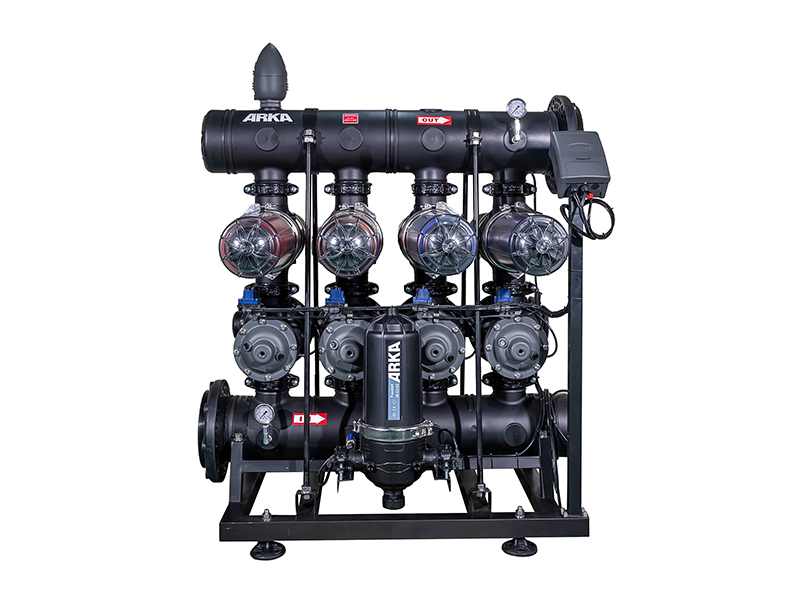
Procuring the correct hardware requires precisely matching technical specifications to environmental realities. A mismatched unit will inevitably result in either inadequate crop protection or an exhausting, excessive maintenance schedule.
Water quality dictates your filtration technology. Groundwater drawn from deep wells typically contains inorganic particulates like fine sand and abrasive silt. While traditional screen filters handle some sand, grooved rings are equally effective and offer vastly superior durability against abrasive particles.
In contrast, surface water drawn from rivers, open canals, or holding reservoirs is characterized by high biological loads. This includes algae, moss, and decaying organic matter. Here, depth filtration is the undisputed superior choice. It actively prevents soft, malleable organic materials from squeezing through the matrix under high pump pressure.
The actual filtration degree is determined by the microscopic size of the grooves, measured in microns or mesh. Manufacturers utilize a strict, industry-standard color-coding system to identify these ratings at a glance. As a general rule of thumb, your chosen micron rating should be exactly one-tenth the size of your smallest emitter orifice.
| Disc Color | Micron Rating | Mesh Equivalent | Typical Agricultural Application |
|---|---|---|---|
| Blue | 400 Micron | 40 Mesh | Micro-sprinklers, very coarse debris |
| Yellow | 200 Micron | 80 Mesh | Heavy sprayers, landscape irrigation |
| Red | 130 Micron | 120 Mesh | Standard drip tape, thin-wall drip lines |
| Black | 100 Micron | 140 Mesh | Ultra-low flow drip emitters |
Note: The Red 130 micron variant remains the most widely specified rating for standard agricultural drip irrigation worldwide.
Every piece of hardware introduces a degree of friction into the pipeline, universally known as head loss. When selecting a heavy-duty model, you must check the manufacturer's head loss curve chart. If your system pushes 80 cubic meters per hour through the manifold, the chart will indicate exactly how much pressure will be lost across the unit. Your main pump must be adequately sized to overcome this friction while still delivering the required operating pressure to the furthest, most distant drip emitters in your field.
When evaluating procurement options, savvy purchasing managers look far beyond the initial invoice. Calculating the total cost of ownership over a demanding multi-year lifespan reveals the true financial impact.
A manual model is highly cost-effective at the point of purchase, making it attractive for tight budgets. However, a fully automated bank requires a significantly higher initial capital outlay. This is due to the inclusion of hydraulic valves, electronic controllers, and pressure differential switches. The financial justification for the automated route relies entirely on massive operational savings compounding over time.
During the intense peak of the irrigation season, surface water sources frequently experience massive algae blooms. Extreme turbidity following sudden rainstorms is also common. Under these harsh conditions, a manual unit may require physical cleaning two to three times a single day. This necessitates dispatching a laborer to the pump station, completely shutting down the watering cycle, scrubbing the core, and painstakingly restarting the pumps.
An automated setup eliminates this recurring labor cost entirely. It self-cleans in mere seconds without any human intervention. By preventing the pumps from fighting against a partially clogged barrier, it actively prevents crop stress caused by delayed watering schedules.
Modern automated arrays are engineered for ruthless efficiency. A typical backwash cycle lasts between a brief 15 to 20 seconds per pod. Because the controller only initiates backwashing when the pressure differential dictates it is absolutely necessary, it conserves thousands of gallons of water annually. Maintaining a continuously clean flow path reduces the ongoing mechanical strain on the irrigation pump, leading to highly measurable savings in electricity or diesel fuel consumption.
Proper installation ensures your equipment operates at peak efficiency from day one. It prevents sudden drops in water pressure and dramatically extends the lifespan of your expensive filtration components.
First, operators must always verify the flow direction indicator. A prominent arrow is located on the outer plastic housing. You must install the unit so this arrow perfectly matches the water flow from the pump to the field. Reversing the flow will instantly damage internal components and cause the entire network to fail.
Next, set up liquid-filled pressure gauges properly on the pipeline. Place one gauge directly before the inlet valve and the second immediately after the outlet valve. This allows field workers to monitor pressure differentials at a glance. Heavy four-inch pipes full of rushing water also require solid physical support structures. Utilize concrete blocks or custom metal stanchions to prevent mechanical stress on the plastic housing. Unsupported pipes will eventually cause the casing to fracture under its own weight.
For operations relying on manual units, establishing a rigorous cleaning protocol is non-negotiable. Regular, thorough cleaning prevents severe emitter blockages downstream. Before attempting any maintenance, operators must completely shut down the main agricultural water pump and safely depressurize the entire pipeline network. Never force open a pressurized housing. The stored kinetic energy can cause severe injury.
Open the main clamp carefully and extract the inner element from the casing. Loosen the central spine holding the plastic rings together, allowing them to separate slightly. Spray the rings with clean, high-pressure water until all trapped organic matter is completely flushed out. Occasionally, hard calcium deposits will build up on the plastic. When this occurs, soak the rings in a mild, diluted acid bath for one hour, rinse them thoroughly, and reassemble the unit. Ensure the thick rubber O-ring is seated perfectly before repressurizing to prevent significant leaks.
Modern agricultural environments are unforgiving. Equipment must withstand intense chemical exposure, blistering UV radiation, and extreme weather fluctuations. Upgrading your legacy technology improves overall farm efficiency significantly. It also drastically reduces unexpected downtime during critical growing phases.
Industry analysts observing the agricultural hydraulic sector note a decisive, rapid shift toward IoT-enabled water management. Global water scarcity and unpredictable climate patterns are driving this change. Unseasonal heatwaves frequently trigger sudden, severe algae blooms in open reservoirs. As a result, farm operators are moving entirely away from reactive manual cleaning.
Instead, the trend heavily favors automated, pressure-responsive arrays built from advanced polymers. Contemporary automated setups connect directly to smart irrigation control panels via Remote Terminal Units or cloud-based platforms. Farm managers can now monitor backwash frequency, pressure differentials, and system health in real-time from a smartphone. An unexpected spike in cleaning cycles serves as an early warning alert for changing water source conditions. This visibility allows for proactive, data-driven farm management.
Selecting the correct hardware is only half the equation. Sourcing it from a reputable manufacturing partner with proven agricultural engineering expertise is absolutely crucial. A reliable partner offers consistent technical support, provides accurate head loss calculations for your specific project, and honors clear warranty terms. Buying cheap, unverified equipment often leads to catastrophic system failures right when your crops need water the most.
For robust, high-capacity solutions tailored to the rigorous demands of modern farming, explore the comprehensive disc filter system options available at ARKA Irrigation. Their engineering focuses heavily on precision filtration, utilizing highly durable anti-corrosion materials like glass-reinforced polyamide. Their reliable automatic backwash technologies, including modular 4-unit and 8-unit banks, are specifically designed to keep your fields perfectly hydrated while driving your daily maintenance costs down to zero.
Choosing the right 4 inch irrigation filter is a foundational step in agricultural planning. It comprehensively protects your entire field infrastructure from the pump to the very last plant. Whether you opt for a highly efficient standalone unit or invest in a fully automated bank, quality matters immensely. Do not wait for clogged emitters to destroy your yield. Evaluate your water source, check your flow rates, and upgrade your filtration hardware today to safeguard your harvest.
Flow capacity depends heavily on your specific raw water quality and the chosen micron rating. Typically, a single unit handles between 60 to 100 cubic meters per hour of continuous operation. Cleaner water sources allow for much higher flow rates. Heavy sediment or algae will reduce the maximum safe operating capacity. Always consult the manufacturer's performance charts to prevent dangerous pressure buildup.
Screen filters utilize a flat, two-dimensional metal or plastic mesh. They are highly effective for trapping hard, inorganic particles like sand. However, they struggle significantly with soft organic materials. Algae can easily deform and push through a standard wire screen under pressure. Disc units utilize a three-dimensional matrix of grooved plastic rings, creating a deep filtration path. This makes them vastly superior for trapping algae, leaves, and soft debris found in surface water sources.
The frequency depends entirely on the real-time pressure differential across the unit. Usually, a 0.5 bar pressure drop triggers the self-cleaning cycle. While some older systems use a basic pre-set time interval, pressure-based triggers are much more efficient. They ensure cleaning happens only when absolutely necessary, saving significant amounts of water and reducing energy costs.
Yes, they are excellent for agricultural fertigation applications. A high-quality model is manufactured from reinforced, highly durable engineering plastics that safely resist harsh agricultural chemicals and liquid fertilizers. To ensure longevity, always flush the system with clean water for several minutes after every single fertigation cycle ends. This prevents chemical residue buildup on the plastic rings.
The required micron rating is dictated entirely by your specific emitters. You must identify the smallest emitter orifice in your entire irrigation network. The filter must trap particles smaller than that opening. Generally, 120 mesh is the global industry standard for drip tape. These specific rings are universally colored red for easy identification. Micro-sprinklers or ultra-low flow tape may require different ratings.
Pressure loss, or head loss, varies based on the flow rate and how dirty the rings are. Under normal clean operating conditions at optimal flow rates, expect a very low head loss of around 0.1 to 0.2 bar. As the unit traps debris, this friction increases. This is exactly why automated systems are set to backwash once the pressure loss hits 0.5 bar, ensuring your downstream emitters still receive adequate operating pressure.
No. These are physical, mechanical filters designed strictly to capture suspended solid particulates like sand, silt, and algae. They cannot remove dissolved minerals, iron, or heavy metals from groundwater. If you are dealing with high iron content that precipitates and clogs emitters, you will need to implement chemical water treatment or aeration systems prior to the physical filtration stage.


