
Views: 0 Author: Site Editor Publish Time: 2026-10-29 Origin: Site


Invisible air acts as a silent destroyer of heavy-duty steel and PVC pipes. While agricultural engineers frequently obsess over pump horsepower and pipe diameter, sprawling irrigation networks face a hidden, vastly underestimated danger. Managing water flow across miles of undulating farmland presents a complex hydraulic challenge. Trapped air severely blocks regular water flow, and sudden vacuum conditions can trigger massive pipe collapses.
Recent shifts in global agricultural practices reveal a growing reliance on extended pipeline networks. Driven by unpredictable climate patterns and regional water scarcity, modern farms are pumping water across unprecedented distances. This industry-wide expansion brings transient pressure management to the forefront. Engineering data indicates that as pipeline length increases, the frequency of catastrophic bursts linked to trapped air multiplies exponentially. Consequently, we are witnessing a massive shift toward mandatory surge protection in commercial irrigation designs.
In this engineering breakdown, we will explore the critical fluid dynamics at play beneath your fields. You will learn how these unsung mechanical heroes protect your infrastructure, reduce energy costs, and keep your irrigation network operating smoothly season after season.
To truly master agricultural fluid dynamics, you must look beyond the basic movement of water. An air vacuum valve is a specialized mechanical device installed within a piping network to actively manage the presence of atmospheric air. Its primary function is twofold. First, it exhausts massive quantities of air from the pipeline when the system is initially filled with water. Second, it admits large volumes of outside air back into the pipeline when the system drains.
Without this dual capability, a pipeline operates under extreme mechanical stress. Picture turning on a high-capacity pump on a cold spring morning. As water rushes into the empty mainline, it pushes a solid wall of air ahead of it. The valve utilizes a precision internal float mechanism to manage this turbulence. The rushing air passes freely out of the large orifice. Once the water finally reaches the valve chamber, the liquid lifts the float, sealing the opening tight. Conversely, if the pressure drops and the water drains away, the float drops instantly. This action lets air rush back in to equalize the internal and external pressure.
A common point of confusion for system designers is distinguishing between different air management devices. While their names sound interchangeable, their functions address entirely different operational phases.
Specifically, a standard air release valve is designed to continuously vent tiny, pressurized air bubbles while the irrigation system is actively running under full pressure. Its orifice is deliberately small. In stark contrast, a vacuum break valve features a massive orifice designed exclusively to handle bulk volumes of air during the highly volatile startup and shutdown phases.
Long pipelines utilized in commercial agriculture are uniquely vulnerable compared to short residential irrigation setups. Imagine a mile-long stretch of undulating farmland. The sheer volume of water, combined with varying terrain and significant elevation changes over thousands of feet of piping, creates a highly complex hydraulic environment. In these sprawling systems, air is not just a minor inconvenience. It represents a severe structural threat.
Air inevitably enters irrigation systems through multiple entry points. Deep well pumps often draw in air at the suction intake, and empty pipes naturally contain atmospheric air before they are filled. Furthermore, as water moves forcefully through the pipeline, it drags this ambient air along.
Because air is lighter than water, it naturally migrates and accumulates at the highest elevation points of the topography. Over time, these small bubbles merge into massive air pockets. These pockets act as physical blockages, severely reducing the cross-sectional area of the pipe available for water to pass through. This phenomenon, known in fluid dynamics as air binding, literally chokes the water flow. Consequently, your pumps must work significantly harder to push water past these invisible barriers, leading to premature wear and tear on expensive mechanical components.
While trapped air restricts flow, the sudden absence of air causes catastrophic structural failure. When a pump is shut down, or when a pipeline is drained for winterization, the heavy column of water rapidly exits the lower elevations of the pipe.
As the heavy liquid departs, it leaves a dangerous void behind. If outside air cannot enter the pipe fast enough to fill this void, a severe vacuum develops. Without a properly sized intake device to admit atmospheric air, the external atmospheric pressure becomes vastly greater than the internal pipe pressure. This extreme pressure differential can easily cause thin-walled irrigation pipes, and even thick-walled PVC or steel mains, to crush inward and implode like a stepped-on soda can.
Modern water conservation mandates now heavily prioritize surge protection to prevent massive water loss from ruptured mains. Investing in proper air management components is no longer an optional upgrade. It is a fundamental requirement for the long-term viability of agricultural infrastructure.
The physical protection of agricultural infrastructure remains the primary concern for farm managers. Replacing miles of ruptured, buried pipe is exponentially more expensive and labor-intensive than installing proper valving from the beginning. A single burst main can create a logistical nightmare that ruins an entire harvest season.
Serving as a dedicated pipeline protection valve, this device manages the extreme forces of fluid dynamics. It prevents the structural deformation of pipes, protects pipe joints from separating under stress, and completely prevents the collapse of the mainline. This proactive defense extends the lifespan of the entire irrigation network by decades, ensuring that heavy capital expenditures are preserved.
Water hammer is a violent hydraulic shockwave that occurs when the flow of water is forced to stop or change direction suddenly. In long pipelines, trapped air severely exacerbates this issue. If a large pocket of air is rapidly pushed toward a closed gate valve or a sudden bend, the air compresses. When it can compress no further, the kinetic energy rebounds through the water column as a devastating shockwave.
These pressure surges can easily exceed the maximum pressure rating of the pipes, leading to immediate bursts and localized flooding. By safely and predictably exhausting the air cushion before it can be dangerously compressed, these valves act as critical shock absorbers that stabilize internal pressure.
Beyond physical protection, there is a strong, measurable return on investment associated with air management. A pipeline that is completely free of accumulated air pockets operates with significantly less internal friction.
When air pockets restrict the pipe diameter, the system experiences higher head loss. The irrigation pump is then forced to consume more electrical energy or diesel fuel to maintain the required flow rate for the sprinklers. By automatically removing this air, the system allows water to flow freely. Less friction means the pump operates closer to its ideal efficiency curve, which translates to major reductions in energy costs over the course of every season.
Understanding the specific fluid dynamics of your agricultural setup is essential before purchasing components. Not all air management devices perform the same function. Selecting the incorrect type can leave your infrastructure exposed to the very forces you are trying to mitigate.
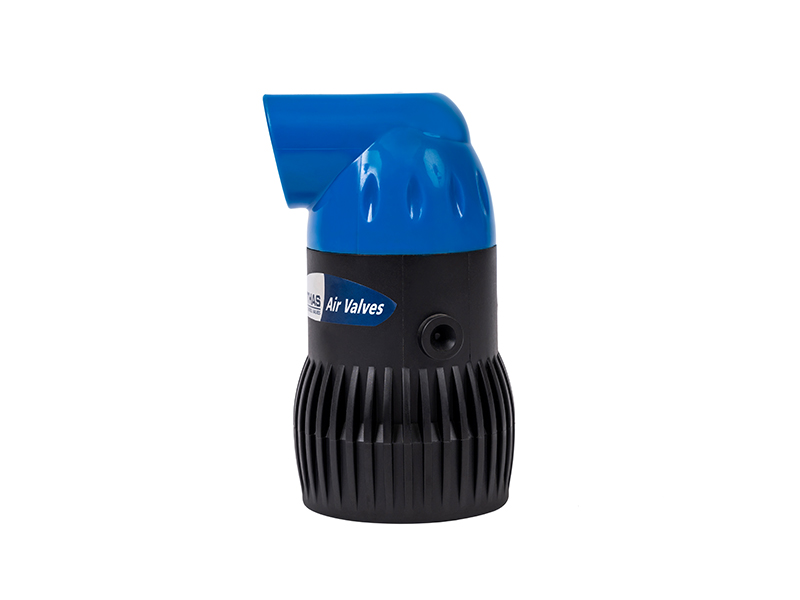
A kinetic air valve is specifically engineered to handle massive volumes of air dynamically during the initial filling and final draining phases. Take the A20 2-Inch Vacuum Break Valve as a prime example of field-ready engineering. Designed from durable, UV-resistant materials, its large aerodynamic orifice remains fully open during startup. This allows high-velocity air to escape at maximum flow rates without blowing the internal float shut prematurely.
Conversely, when the pump shuts down, this kinetic mechanism drops open immediately. This rapid opening admits large quantities of atmospheric air back into the pipe, effectively breaking the vacuum. However, once the pipe is fully pressurized and the valve closes, it will not open again to release small air bubbles that accumulate during normal operation.
While kinetic models handle the heavy lifting during startup and shutdown, an automatic release valve is designed for the continuous maintenance of a pressurized system. During standard irrigation cycles, water naturally carries dissolved air. Changes in temperature and pressure cause this dissolved air to separate and form micro-bubbles.
These bubbles eventually coalesce into larger pockets at the highest elevations. This valve utilizes a precision lever mechanism to continuously bleed off these pressurized air pockets while the system is actively running, ensuring unrestricted water flow. Importantly, it cannot admit enough air to prevent a vacuum during system drainage.
For modern, long-distance agricultural setups, the combination model is widely considered the industry standard. As the name suggests, this device integrates the large-orifice capabilities of a kinetic valve with the small-orifice continuous bleeding function of an automatic release valve within a single robust housing.
During system startup, the large orifice exhausts the bulk air. While the system operates under pressure, the small orifice takes over to vent accumulating micro-bubbles. Upon shutdown, the large orifice drops open again to admit atmospheric air. By addressing all phases of fluid movement, the combination valve serves as the ultimate protection for complex networks.
| Valve Type | Primary Function | Operational Phase | Best Application |
|---|---|---|---|
| Kinetic Air Valve | High-volume air exhaust and intake | System Startup & Shutdown | Emptying and filling large diameter pipes |
| Air Release Valve | Low-volume continuous air venting | Active Pressurized Operation | Removing micro-bubbles at high points |
| Combination Valve | Both high-volume and low-volume management | All Phases Startup, Active, Shutdown | Long irrigation pipelines requiring full protection |
Proper selection is an engineering decision based on empirical data regarding your specific irrigation layout. Installing a valve that is too small or made of the wrong material can be just as detrimental as having no valve at all.
Sizing dictates the success of your surge protection strategy. The valve must be proportioned to match both the pipe diameter and the maximum water flow rate measured in gallons or liters per minute.
As a general engineering rule of thumb, the diameter of the valve inlet should be approximately ten to fifteen percent of the main pipeline diameter. Furthermore, the exhaust capacity of the valve must exceed the filling rate of the pump. If the valve is undersized, the escaping air will reach a critical velocity. This causes the internal float to slam shut before all the air is removed, which traps the remaining air and triggers violent pressure surges.
The material of the valve housing and internal components dictates its longevity and suitability for specific agricultural environments.
High-density plastics and glass-reinforced nylon are highly resistant to corrosion. This makes them ideal for systems that utilize fertigation by injecting fertilizers and chemicals directly into the water. They are lightweight, cost-effective, and completely immune to rust. On the other hand, for systems operating under extreme pressure typically above 200 PSI or in environments prone to heavy physical impacts, cast iron or ductile iron metal valves remain the standard choice. Keep in mind that metal variants require protective epoxy coatings to prevent internal degradation.
When investing in infrastructure meant to last for decades, sourcing components from established manufacturers is paramount. Implementing rigorous quality control in your procurement process prevents catastrophic failures during peak agricultural seasons. Selecting a high-quality irrigation air valve ensures your system remains fully protected against unexpected pressure surges and devastating vacuum conditions. Reliable vendors provide detailed performance curves, allowing engineers to match the exact exhaust and intake requirements of their specific pipeline topography.
Even the most advanced, precisely engineered valve will fail to protect the system if it is installed in the wrong location. Air management relies entirely on the physics of fluid dynamics and gravity. Because air is significantly lighter than water, it predictably travels to the highest available spaces within a closed system.
The most critical installation zones are the absolute high points of the pipeline. Whenever a pipe travels up a hill or over an embankment, the peak of that elevation change becomes a natural trap for air pockets. As water flows over the peak, the trapped air restricts the cross-sectional area of the pipe. Installers must place a combination or release valve at every distinct topographical peak. In addition, if the pipeline features a gradual increase in elevation followed by a sharp downward slope, the apex of this change is highly vulnerable to column separation, making valve placement here mandatory.
A common misconception in agricultural engineering is that perfectly flat fields do not require air valves. In reality, when trenching across a seemingly flat field, laser levels often reveal subtle dips and rises. As water travels over long distances, dissolved air continuously separates from the fluid.
For long, uninterrupted horizontal runs, industry standards recommend installing an air management device every 1,500 to 2,500 feet. This regular spacing ensures that micro-bubbles are continuously vented before they can merge into dangerous, flow-restricting air pockets.
The areas immediately adjacent to mechanical interventions are zones of high turbulence and rapid pressure changes. When a deep well or surface pump activates, it pushes a massive column of air ahead of the water. A large-capacity kinetic valve must be installed immediately downstream of the pump and after the check valve to exhaust this air before it enters the main distribution network. Similarly, placing valves upstream of shut-off valves helps cushion the blow of water hammer when a gate is closed quickly, thereby protecting the mechanical seals.
Agricultural water is rarely pristine. It carries suspended solids, sand, biological growth, and chemical residues. While modern valves are designed to be relatively low-maintenance, neglecting them entirely will lead to mechanical sticking, continuous leaking, or catastrophic failure during a vacuum event.
A proactive inspection schedule should be implemented at the beginning and end of every irrigation season. During active, pressurized operation, visually observe the valve. If a kinetic or combination valve is continuously spitting water, the internal seal is likely compromised by debris. Next, listen to the valve during pump startup. You should hear a distinct, strong hiss of escaping air followed by a solid click or thud as the float seals. If the hiss is weak, the orifice may be blocked.
The most common point of failure is debris interfering with the internal float mechanism. Many modern valves feature a manual flushing port. Periodically opening this port allows high-velocity water to wash away accumulated silt and sand from the base of the valve housing.
If the valve is stuck open, isolate it from the main pressure line using a ball valve. Remove the top cover and carefully extract the float. Clean the float and the elastomeric O-ring seals with clean water and a soft brush. Specifically, ensure that the protective screen covering the exhaust orifice is intact. Spiders and mud daubers love to build nests inside open valve ports during the dry season, which can completely block the intake of air when a vacuum occurs.
Long irrigation pipelines represent a massive capital investment, and air-related damages are entirely preventable. An air and vacuum valve acts as the silent guardian that keeps your water flowing smoothly. These vital tools prevent pipe collapse during drainage and stop sudden pressure surges during startup. Proper air management saves energy, reduces pump wear, and extends the life of your entire system.
Don't wait for a ruptured main line to address your pipeline fluid dynamics. Evaluate your current setup, map out your elevation peaks, and upgrade your infrastructure today. For industry-leading solutions, explore the comprehensive range of high-performance air valves at ARKA Irrigation to find the exact components your agricultural operation demands.
No, utilizing only an air release valve leaves your system highly vulnerable. An air release valve is designed with a very small orifice to bleed off tiny, pressurized micro-bubbles while the pump is running. It physically cannot handle the massive volume of air intake required to prevent a vacuum when the pipeline drains. To protect against pipe implosion during shutdown, you must use an air and vacuum valve or a combination valve.
Trapped air exhibits several clear physical symptoms. You may notice sputtering, uneven water distribution at your sprinklers or drip emitters. In the pump house, trapped air creates artificial head pressure, meaning your energy bills will rise as the pump works harder to push water past the air blockages. Additionally, pressure gauges that fluctuate wildly, or physical shaking and loud banging sounds in the pipes, are strong indicators of poor air management.
An undersized valve creates a severe bottleneck. During startup, it will not exhaust air fast enough, causing the escaping air to reach a high velocity that prematurely slams the internal float shut. This traps the remaining air and causes extreme pressure surges. During shutdown, an undersized valve cannot admit atmospheric air quickly enough to replace the draining water, creating a vacuum that can easily crush steel or heavy-duty PVC pipes.
Yes, in the context of the agricultural and irrigation industry, a kinetic air valve is simply a specific, technical classification of an air and vacuum valve. The term kinetic refers to its aerodynamic design, which allows it to handle large volumes of air dynamically without blowing shut prematurely. Both terms refer to a device that manages massive air volumes during the filling and draining phases of a pipeline.
Elevation peaks are the most critical zones. You must install them at the highest points of your topography, immediately after the pump discharge, and along any extensive flat runs every 1,500 to 2,500 feet to guarantee complete air removal and vacuum protection.
A standard engineering rule dictates that the inlet diameter of your valve should be roughly ten to fifteen percent of your main pipe diameter. Furthermore, you must verify that the exhaust capacity matches or exceeds your pump filling rate to prevent premature closure during system startup.


