
Views: 0 Author: Site Editor Publish Time: 2026-10-13 Origin: Site


You stare at the pressure gauge on your pool equipment, wondering why the water remains persistently cloudy. One of the most common frustrations among homeowners managing domestic water systems is determining the exact amount of purifying material required. Purchasing too much sand wastes money and creates heavy storage issues. Buying too little guarantees severe mechanical failures. The core of this confusion centers around a single practical question. Is a standard 50lb bag of sand actually enough for your specific setup?
A well-maintained sand media filter plays a fundamental role in keeping residential pools and compact water features crystal clear. It operates by pushing unpurified water through a dense bed of specialized silica. This engineered process traps microscopic debris before returning pristine water to the main reservoir. However, precise calibration of this volume is an absolute necessity. If the system does not function exactly as designed, water quality deteriorates rapidly.
This comprehensive guide breaks down exact equipment dimensions and provides a definitive size-to-sand conversion chart. We will also walk you through the replacement and maintenance process from an engineer's perspective. Following these objective guidelines ensures your backyard setup operates at peak efficiency without unnecessary expenditure.
To determine if a single bag will suffice, we must first look at the physical constraints of your equipment. Filtration tanks are meticulously engineered to operate with specific volumes of material. This precise volume maintains proper internal hydraulic pressure and flow dynamics. Guesswork in this area often leads to costly repairs.
Industry specifications dictate that 12-inch to 14-inch tanks represent the operational sweet spot for a single 50lb bag. These compact dimensions are typically found in small-scale residential setups. Examples include small above-ground pools, usually under 10,000 gallons, residential koi ponds, and compact domestic setups designed for localized use. If your vessel's diameter exceeds 14 inches, pouring in just one bag will fail to provide the necessary depth for effective particle entrapment.
To verify if a 50lb-capacity unit is adequate for your home's water volume, you must calculate the turnover rate. This metric defines the amount of time it takes for the pump to cycle the entire volume of the pool or pond water once.
The standard formula is straightforward. Total Gallons divided by Desired Turnover Time, measured in hours, equals Required Flow Rate, or Gallons Per Hour. For instance, a 6,000-gallon above-ground pool requiring an 8-hour turnover needs a flow rate of 750 gallons per hour, or roughly 12.5 gallons per minute. A standard 14-inch vessel holding 50 lbs of sand is typically rated for up to 35 to 40 gallons per minute. Consequently, it is perfectly suited for this specific application. Understanding this mathematical relationship ensures you do not undersize your hardware.
A frequent barrier to proper maintenance is the lack of clear, accessible data regarding tank sizes and their corresponding material requirements. Knowing your exact diameter prevents the common operational mistake of under-buying or over-buying filtration media. Both errors can severely disrupt your summer maintenance schedule.
Below is an empirical reference table detailing standard residential diameters and their required volumes. Always measure across the widest part of the tank's equator if the manufacturing label has faded over time.
| Filter Tank Diameter, Inches | Estimated Sand Requirement, lbs | Equivalent in 50lb Bags | Typical Application |
|---|---|---|---|
| 12-inch | 35 to 40 lbs | Less than 1 Bag, leaving the remainder | Spas, tiny ponds |
| 14-inch | 50 lbs | Exactly 1 Bag | Small above-ground pools |
| 16-inch | 100 lbs | 2 Bags | Medium above-ground pools |
| 18-inch | 150 lbs | 3 Bags | Small in-ground pools |
| 24-inch | 300 lbs | 6 Bags | Standard in-ground pools |
Technical Note: Always verify the manufacturer's data plate located on the side of your unit. Specific internal geometries may alter these requirements slightly by 5 to 10 lbs.
Addressing the mechanical consequences of improper levels is crucial. Many property owners assume that adding extra material will somehow boost purifying power. Conversely, some believe that running the system slightly low is harmless. Both assumptions are mechanically incorrect and lead directly to equipment failure.
Every vessel is designed with a specific freeboard space. This is the empty area between the top of the bed and the upper internal mechanisms. This void is mandatory. When you initiate a cleaning cycle, the water flow reverses. It lifts and expands the bed to flush out trapped debris.
If the unit is overfilled, there is no freeboard space available for expansion. The immense hydraulic pressure will force the heavy, wet silica upward into the multiport valve. This action can easily break the internal standpipe or blow gritty dirt directly back into your pool through the return jets. Ultimately, overfilling fundamentally neutralizes the system's ability to clean itself.
In contrast, underfilling leads to a destructive phenomenon known in fluid dynamics as channeling. Water will always seek the path of least resistance. If the bed is too shallow, the pressurized water will carve localized tunnels straight through the material.
When channeling occurs, the water bypasses the purifying process entirely. The pump will continue to hum, consuming electricity and generating pressure, but it will simply return untreated, cloudy water back into your reservoir. A single 50lb bag must only be used in a 14-inch unit to ensure the depth remains sufficient. This forces water through the grains rather than around them.
Analyzing recent market data and search intent reveals a distinct shift in how homeowners approach residential water systems. While the traditional 50lb manual setup remains a reliable staple for entry-level pools, there is growing fatigue associated with manual maintenance. Property owners are increasingly searching for solutions that minimize human error and maximize water clarity without constant monitoring.
The industry is rapidly pivoting toward smart, self-regulating equipment. Manual push-and-turn valves require users to physically monitor pressure gauges, shut off pumps, change settings, and time cycles. This leaves ample room for mistakes, such as turning the handle while the pump is running, which instantly destroys internal spider gaskets. To combat this, modern consumers are upgrading to an automatic sand filter. These advanced systems detect pressure differentials and trigger self-cleaning cycles automatically, representing the future standard of residential water management.
Even with perfect chemical balancing and optimal flow, the internal material undergoes physical degradation. Recognizing the empirical signs of failure allows for proactive maintenance before your backyard oasis turns into a swampy hazard. If you rely on a compact water treatment filter, keep an eye out for these specific indicators.
Replacing the contents of a 14-inch tank is a manageable DIY task, provided it is executed methodically. The internal components, particularly the plastic laterals at the bottom of the standpipe, are extremely fragile. Follow this technical protocol to ensure a safe transition.
Power Down and Drain the Tank. Safety must always be the priority. Disconnect the power supply at the breaker to prevent accidental activation. Locate the drain plug at the bottom, remove it, and allow all the liquid to drain out completely. Depending on compaction, this may take several hours.
Remove the Valve and Protect the Standpipe. Carefully unbolt or unscrew the collar holding the valve to the top. Lift it straight up. Inside, you will see a central PVC pipe. It is absolutely crucial to place a plastic cup over this open pipe or seal it tightly with duct tape. If a single grain falls inside during the filling process, it will shoot directly into your pool upon startup.
Extract Old Material and Inspect Laterals. Using a small cup or a specialized shop vacuum, carefully extract the exhausted silica. Avoid using metal shovels or sharp tools, as you risk snapping the plastic laterals. Once empty, gently rinse the inside and inspect those bottom spokes for hairline cracks. If they are brittle, they must be replaced before proceeding.
Create a Water Cushion Before Pouring. Before pouring anything dry, fill the vessel halfway with water. This is a non-negotiable engineering step. The water acts as a shock absorber. Pouring 50 lbs of dry weight directly onto unprotected plastic laterals will almost certainly crush them under the impact. With the liquid cushion in place, slowly and evenly pour the single bag into the unit, ensuring the standpipe remains perfectly centered.
Reassemble, Flush, and Rinse. Remove the tape from the standpipe. Clean the O-ring, apply a silicone-based lubricant, and securely reattach the valve. Do not set it to the standard filtering mode yet. You must run a flushing cycle first to remove the fine dust present in all new silica. Afterward, run a rinse cycle to settle the bed before finally returning the system to standard operation.
Adding fresh material is only half the equation. How you maintain it dictates its lifespan. The most common error homeowners make is cleaning the system too frequently on a rigid weekly schedule.
In practical terms, a backwash filter process should only be initiated when the pressure gauge reads exactly 8 to 10 PSI above the clean starting baseline. Interestingly, these systems actually perform slightly better when they are a little dirty. The trapped debris helps catch even finer particles. Reversing the flow too often disrupts this natural efficiency.
Furthermore, always utilize the rinse setting immediately after flushing. The cleaning cycle lifts and disorganizes the bed. If you immediately switch back to normal operation, a burst of dirty liquid will shoot into the pool. Running the rinse cycle for one to two minutes forces liquid downward, compacting the bed back into its proper operational state and sending residual dirt out the waste line.
If your pool usage has increased, or if you find yourself needing to flush your 50lb setup more than once a week to maintain clarity, your environmental debris load has likely exceeded the unit's operational capacity. At this juncture, transitioning to larger, automated technology is the most logical engineering decision.
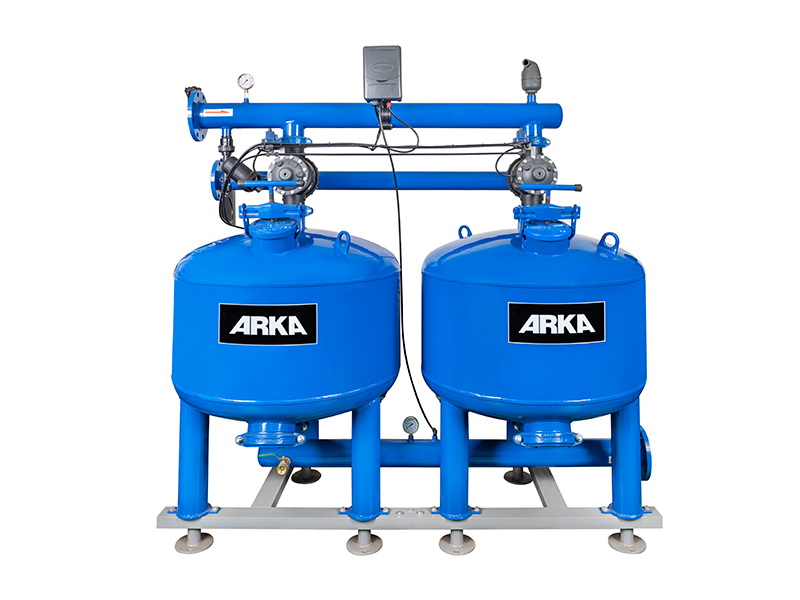
For those seeking precision and reduced labor, upgrading to industrial-grade or high-end residential equipment transforms water management. Consider the specifications of advanced units like the Arka F40-2-1000mm Automatic Self-Cleaning Sand Media Filter. Designed for demanding water treatment and irrigation, this type of hardware utilizes integrated digital pressure sensors to continuously monitor internal resistance. When the pressure reaches that critical threshold over the baseline, motorized valves automatically trigger the necessary cleaning cycles without any human intervention. This ensures the equipment operates at peak efficiency around the clock, preventing pressure build-ups that degrade silica prematurely.
Ultimately, a single 50lb bag perfectly suits 12-inch to 14-inch residential tanks, providing exactly the right volume for compact above-ground pools and domestic ponds. Accurate measurement of your equipment prevents severe damage to internal components and ensures you avoid the dreaded channeling effect.
By handling internal laterals with care, adhering strictly to the water-cushion method during refills, and always following proper rinsing protocols, you can maximize the lifespan of your setup. If your water demands have outgrown a basic manual system, it is time to explore smarter solutions. For professional-grade upgrades and automated filtration hardware tailored to your specific needs, explore the advanced product lineup at Arka Irrigation to guarantee a season of perfectly clear, low-maintenance water.
A 16-inch unit requires approximately 100 lbs of material, meaning a single 50lb bag will not be sufficient. You will need exactly two 50lb bags to ensure proper depth. Attempting to run a 16-inch vessel with only 50 lbs will result in severe channeling and persistently cloudy water.
No, absolutely not. Standard pool silica is specifically graded and refined, typically #20 silica measuring between 0.45mm and 0.55mm, to catch microscopic debris without clogging the internal mechanisms. Play sand and construction materials contain high levels of impurities, dirt, and inconsistent grain sizes. Using them will instantly ruin your equipment, cause massive pressure spikes, and blow fine mud directly into your pool.
With proper chemical balance and a routine maintenance schedule based on pressure gauge readings, your material should last between 3 to 5 years. Over time, the rough, jagged edges of the grains wear down and become smooth due to liquid friction, causing them to lose their microscopic filtering ability.
While standard #20 silica is the traditional industry baseline, crushed glass is a highly efficient, scientifically proven alternative. Glass possesses a slight negative electrical charge that helps attract finer particles. Keep in mind that glass is less dense and lighter than silica. You typically need 20 percent less glass by weight compared to traditional material for the exact same volume.
From an engineering standpoint, reusing old sand is highly discouraged. While chemical cleaners can strip away oils and scale, they cannot restore the physical shape of the grains. Once the sharp edges of the silica have worn smooth from years of water friction, the material permanently loses its mechanical ability to trap fine dirt. Replacing it is the only viable option for restoring water clarity.
If you are seeing grit in your pool immediately after a refill, one of three things has occurred. First, you may have forgotten to run the essential rinse cycle after the initial flush, allowing loose dust to enter the return lines. Second, a grain of sand may have fallen into the open standpipe during the pouring process. Finally, the heavy impact of pouring dry material without a water cushion may have cracked the plastic laterals at the bottom of the tank.


