
Views: 0 Author: Site Editor Publish Time: 2026-10-20 Origin: Site


Are your drip emitters constantly clogging? If you draw irrigation water from ponds, rivers, or open reservoirs, you already know the nightmare of slimy, algae-filled water. Standard screen and disc filters excel at catching inorganic grit. However, they quickly blind over when hit with sticky biological debris. To combat this, deploying a robust sand media filter serves as the ultimate, heavy-duty solution. By utilizing a unique depth filtration method, this architecture is specifically engineered to handle severe organic loads without the need for constant manual intervention. In this comprehensive guide, we will explore exactly why and when this technology is the superior choice, how it compares to alternative options, and the critical parameters for sizing the right setup for your irrigation infrastructure.
For agricultural managers and farm operators, water quality is a primary variable in crop yield predictability. When evaluating purification needs, it is critical to classify the water source accurately. Organic-rich water is characterized by high concentrations of biological matter. This includes algae, moss, bacterial slime, decaying leaves, and microscopic organisms. Unlike inorganic particulates such as sand or silt, organic matter is soft, malleable, and highly cohesive. This fundamental physical difference is exactly what causes standard surface filtration systems to fail prematurely in agricultural settings.
Surface water sources are the primary contributors to organic loading in irrigation networks. Open reservoirs, natural lakes, rivers, and agricultural canals are continuously exposed to direct sunlight. When this solar radiation combines with nutrient runoff from surrounding fields, specifically nitrogen and phosphorus from fertilizers, it creates an optimal breeding ground for rapid algal blooms. Furthermore, seasonal changes cause severe fluctuations in biological debris. During warmer months, biological activity peaks. This transforms relatively clear surface water into a challenging, thick fluid for any irrigation system to process.
The financial implications of inadequate filtration in organic-rich environments are severe. Modern micro-irrigation systems rely on highly precise, narrow flow paths that are often as small as 0.5mm to 1mm. When organic matter bypasses a primary filter, it enters the lateral lines. Bacterial slime acts as a binding agent, trapping smaller silt particles and forming a resilient biofilm inside the emitters. Instead of focusing on crop health, farm managers often find themselves spending hours manually scrubbing blinded screen meshes or flushing lateral lines during peak summer heat. The result? Localized drought stress directly reduces crop yields, while unplanned labor costs severely impact seasonal profitability.
Recent agricultural engineering analyses and water management trends reveal a significant shift in filtration strategies. With rising global temperatures and increased agricultural nutrient runoff, surface water sources are experiencing more frequent, aggressive, and prolonged algal blooms. Industry experts note that relying on traditional surface filtration in these changing climates is becoming economically unviable. Consequently, commercial farming operations are increasingly migrating toward deep media filtration as a necessary adaptation to reliably handle the escalating biological concentrations found in modern surface water.
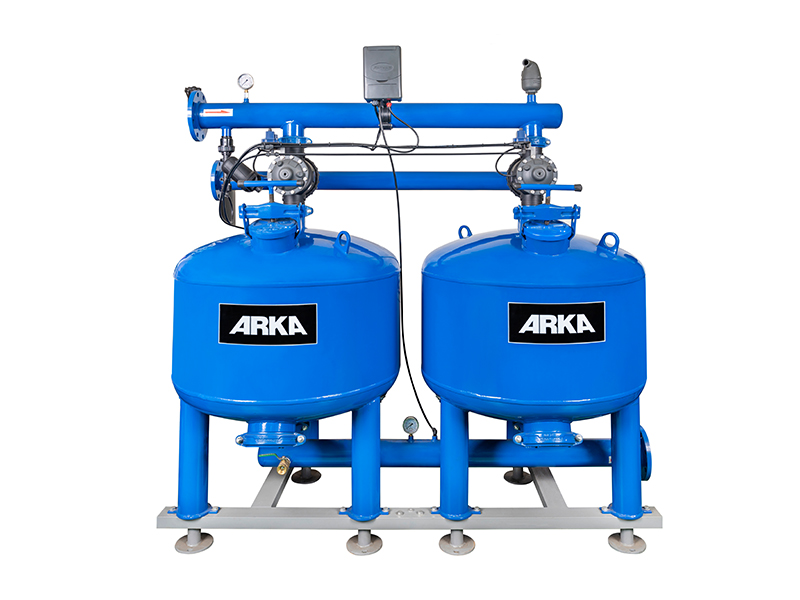
To combat heavy biological loads, the agricultural industry relies on heavy-duty filtration architecture. These purification vessels consist of large, pressurized tanks typically constructed from epoxy-coated carbon steel or marine-grade stainless steel. They are filled with a specific grade of crushed filtration media. Rather than relying on a single physical barrier, they force water through a thick, porous bed. This utilizes complex fluid dynamics to separate suspended solids from the irrigation stream.
The operational superiority of this system lies in the principle of depth filtration. In a standard screen filter, water passes through a two-dimensional plane, meaning dirt is stopped strictly on the surface of the mesh. By contrast, a media vessel introduces water at the top of the tank, where it slowly percolates downward through a 12-to-18-inch deep bed of sand. As the water navigates the microscopic, winding pathways between the particles, organic debris is trapped throughout the entire depth of the matrix. The clean water then safely exits through specialized underdrain manifolds at the bottom of the tank.
A common misconception is that these tanks are filled with standard beach or river sand. In reality, agricultural filters utilize precisely engineered, crushed silica sand. The physical shape of the media is crucial. Crushed silica features highly jagged, sharp edges. When slimy, gelatinous organic matter attempts to pass through, it snags on these sharp edges and is held firmly in place by microscopic friction. If smooth, round sand were deployed, the slippery organic matter would easily glide past the media under hydraulic pressure.
When consulting with irrigation engineers regarding surface water, the recommendation consistently points toward media filtration. This is not a matter of preference. It is a measurable result of physical engineering principles interacting with biological matter.
The primary metric for evaluating any filter is its dirt-holding capacity, which is the volume of suspended solids it can accumulate before requiring a cleaning cycle. Because a media filter utilizes a deep, three-dimensional bed, its dirt-holding capacity is massive compared to surface screens. A standard 48-inch tank contains thousands of cubic inches of filtration space. To maximize this holding capacity while minimizing human oversight, modern agricultural setups often integrate an automatic sand filter. Advanced models, such as the F40 series, are designed for water treatment and irrigation, offering automatic self-cleaning capabilities and handling filtration grades from 2 to 1000mm. This allows the system to absorb heavy influxes of algae for days without experiencing a critical drop in system pressure.
Specifically, the most significant failure point of screen filters in organic-rich water is a phenomenon known as extrusion. Algae and bacterial slime are highly compressible. When a screen filter begins to clog, the differential pressure across the screen increases rapidly. Once the pressure reaches a certain threshold, the hydraulic force physically extrudes, or squishes, the soft organic matter directly through the tiny pores of the stainless-steel mesh. A deep sand bed prevents extrusion entirely. It locks the biological debris within a thick matrix of sharp silica until the system is intentionally purged.
Decision-makers must evaluate multiple filtration technologies before allocating capital. Below is an objective comparison of the three primary irrigation filters to help determine the most appropriate choice for specific water conditions.
| Feature / Filter Type | Screen Filters | Disc Filters | Sand Media Filters |
|---|---|---|---|
| Primary Filtration Method | Surface 2D | Surface / Shallow Depth | True Depth 3D |
| Best Suited Water Source | Deep wells, municipal water | Wells, mild surface water | Rivers, lakes, open reservoirs |
| Performance with Algae | Poor Rapid blinding and extrusion | Moderate Requires frequent flushing | Excellent High holding capacity |
| Initial Capital Investment | Low to Moderate | Moderate | High |
Screen filters utilize a stainless-steel or plastic mesh to block particulates. They are best suited for well water and environments where the primary contaminants are inorganic, such as scale or fine grit. However, algae acts like a biological paste. It coats the surface of the screen and causes rapid pressure drops that shut down the irrigation system entirely.
In contrast, disc filters use stacks of grooved plastic rings tightly compressed together, offering a slight depth filtration effect. They are excellent for pump stations with severe space constraints and handle mild organics better than screens. Yet, when faced with severe biological loads from stagnant ponds, they still require highly frequent flushing cycles. This wastes water and interrupts crucial irrigation schedules.
For agricultural operations drawing from surface water plagued by heavy algae and biological slime, deep bed filtration is the undisputed heavyweight champion. The long-term reliability and protection it offers to sensitive drip infrastructure far outweigh the larger physical footprint and higher initial investment.
When managing surface water sources laden with organic matter, the primary operational bottleneck is often the manual labor required to clean blinded filter elements. Traditional screen and disc arrays demand constant monitoring in algae-rich environments. The mechanical ingenuity of a backwash sand filter transforms agricultural water management from a reactive chore into a streamlined, highly efficient process.
The operational superiority of these systems lies in their ability to purge accumulated biological debris without requiring physical disassembly. As debris accumulates, the flow of water becomes restricted, causing a pressure differential. When this differential reaches a critical threshold, the backwash cycle is initiated. The system manifold reverses the flow of water, directing clean water from the bottom of the tank upwards. This upward velocity fluidizes, or lifts, the sand bed. Because the organic matter is lighter than the silica sand, it separates from the media and is flushed out through a designated waste manifold.
For large-scale agricultural operations, relying on manual valves to initiate a backwash cycle is highly inefficient. Modern setups utilize automated configurations to completely remove human error from the equation. These systems rely on a Pressure Differential switch connected to a digital controller. When the sensors detect a pressure loss, indicating that the sand bed is loaded with organic debris, the controller automatically sends a signal to the hydraulic or pneumatic valves. In a multi-tank setup, the controller isolates one tank at a time, ensuring the irrigation process is never interrupted while the system cleans itself.
Procuring the correct equipment requires careful calculation. An improperly sized irrigation sand filter will either fail to capture organic matter effectively or result in excessive pressure loss and media blowout. Decision-makers must evaluate their system specific hydraulic parameters before finalizing a purchase.
The most critical metric in sizing is the water velocity passing through the media bed, often referred to as the flux rate. If the water moves too rapidly, the hydraulic force will physically push soft organic matter deep into and eventually through the sand bed, contaminating the lateral lines. Conversely, if the velocity is too low, the system is unnecessarily oversized, resulting in excessive capital expenditure. Industry standards dictate that the optimal filtration velocity for organic-rich surface water is typically between 15 to 20 gallons per minute per square foot of media surface area.
The physical tank is only the housing. The crushed silica sand is the actual filtration engine. It is imperative to select the correct media grade to match the specific requirements of your irrigation emitters. In agricultural applications, the two most common grades are Number 16, which is equivalent to 150 to 180 mesh, and Number 20, equivalent to 200 to 250 mesh crushed silica. Selecting the appropriate grade ensures precise protection for everything from micro-sprinklers to ultra-low-flow drip tape.
While automated systems are designed to be largely hands-off, treating them as entirely maintenance-free will inevitably lead to premature failure. Establishing a baseline maintenance protocol for your water treatment filter ensures longevity and protects your capital investment.
Preventative maintenance should be conducted on a monthly and seasonal basis. Technicians must verify the calibration of the Pressure Differential switch to ensure it is accurately triggering the backwash cycle. Additionally, inspect the hydraulic tubing for leaks, and ensure the 3-way backwash valves actuate smoothly. In regions that experience freezing temperatures, winterization is a non-negotiable procedure. Before the first freeze, all tanks must be completely drained to prevent expanding ice from rupturing the steel vessels or destroying the internal underdrain manifolds.
A common misconception is that the silica media inside the tanks lasts indefinitely. In reality, the very process that cleans the system slowly degrades the media over time. The constant fluidization and grinding of sand particles against one another gradually wear down their sharp, jagged edges. As the sand becomes smooth and rounded, it loses its grip on slippery organic matter. Empirical data suggests that for agricultural systems pulling heavily contaminated surface water, the silica media should be completely evacuated and replaced every 3 to 5 years to maintain system integrity.
Relying on surface water plagued by algae and organic debris can quickly ruin standard surface filters, turning daily irrigation into a labor-intensive nightmare. By leveraging the three-dimensional depth of a silica bed, media filtration handles this sticky, biological debris with ease. It not only saves countless hours of manual maintenance but also protects your sensitive drip lines from catastrophic clogging. Upgrading to a heavy-duty, automated filtration setup is a strategic investment that ensures consistent water distribution, promotes healthier crop yields, and guarantees a superior long-term return on your agricultural infrastructure. If you are ready to upgrade your irrigation setup and eliminate clogging issues for good, explore the professional-grade filtration solutions available at Arka Irrigation to find the exact specifications required for your farm.
No. These systems are designed strictly for physical filtration, not biological purification. While they excel at removing large biological matter such as algae, moss, and decaying plant material, microscopic pathogens and bacteria will pass through the media bed. If your agricultural application requires sterile water, additional chemical treatments, such as chlorination or UV sterilization, must be implemented downstream of the filtration unit.
When properly calibrated, an automated system is highly efficient. A typical backwash cycle lasts between 90 seconds and 3 minutes per tank. Across an entire irrigation season, the total water discharged through the waste manifold usually accounts for less than 1 to 2 percent of the total pumped water volume. Because the system utilizes differential pressure sensors, it only initiates a cleaning cycle when strictly necessary, preventing the unnecessary waste of water resources.
In terms of initial capital expenditure, yes. The heavy-duty steel tanks, automated manifolds, and volume of silica media require a higher upfront investment compared to plastic disc filter arrays. However, for organic-rich surface water, the Return on Investment is realized rapidly. The elimination of daily manual labor costs, the prevention of crop loss due to uneven water distribution, and the extended lifespan of drip lines make this technology far more cost-effective over a 5 to 10 year operational period.
For automated agricultural applications, a minimum of two tanks, known as a duplex system, is mandatory. The mechanics of the backwash process require clean, filtered water to flush the debris out of the dirty sand bed. In a multi-tank setup, the active tanks provide the pressurized clean water needed to backwash the isolated tank. If only a single tank is used, the irrigation flow to the field must be completely shut down during cleaning.
The filtration precision is dictated by the grade of crushed silica used inside the tanks. Standard agricultural systems typically utilize Number 16 or Number 20 grade silica sand. These grades provide a depth filtration equivalent of 150 mesh to 200 mesh, which is approximately 100 to 75 microns. This level of precision is optimal for protecting sensitive micro-sprinklers and thin-wall drip tapes from biological clogging.
The easiest way to determine your filtration needs is by visually inspecting your water source during the warmest months of the year. If your water comes from an open source like a pond or canal and has a green tint, visible algae, or a slimy texture, a media filter is required. Screen filters will fail quickly under these conditions. If your water is drawn from a deep well and only contains sand or scale, a screen filter is usually sufficient.
For most agricultural applications dealing with heavy organic loads, the crushed silica media will last between 3 to 5 years. Over time, the backwashing process causes the sand particles to rub together, wearing down the sharp edges needed to catch algae. Once the sand becomes smooth, you will notice a decrease in filtration efficiency, indicating it is time to replace the media.


