
Views: 0 Author: Site Editor Publish Time: 2026-10-20 Origin: Site


Agricultural and landscape irrigation networks frequently face a persistent operational hurdle: rapidly deteriorating water quality. Picture pulling up a section of drip tape in the middle of the season. You expect clear water, but instead find the emitters completely choked by green biological slime. In other cases, you might watch expensive micro-sprinklers sputter and fail due to heavy silt buildup. When drawing water from surface sources like unlined retention ponds, open rivers, or deep agricultural wells, your pumping infrastructure remains highly susceptible to these destructive elements.
Recent industry analyses highlight a significant shift in how modern farms handle this issue. With global agricultural sectors facing unprecedented water scarcity and stricter environmental regulations, the trend is moving rapidly toward high-efficiency, smart water management. Commercial growers are abandoning reactive maintenance in favor of proactive, heavy-duty mechanical solutions to protect their sensitive drip lines. However, a successful deployment does not begin with cutting PVC pipes or pouring concrete. It demands meticulous preliminary planning. This guide outlines the critical steps required before setting up your filtration infrastructure, from analyzing contaminant levels to preparing the physical site for optimal hydraulic performance.
The foundational step in any pre-installation plan is understanding the exact nature of the water passing through your pipes. Water quality directly dictates the required media type, tank size, and backwash frequency. Without this baseline data, engineers are essentially flying blind.
Irrigation water typically carries two primary categories of debris. Organic matter includes algae, moss, and biological slimes frequently found in open surface water like ponds and reservoirs. These materials are soft and gelatinous. Under high pressure, they easily extrude through standard flat screen meshes, rendering basic filters useless. Inorganic matter consists of coarse sand, silt, and mineral particulates typically drawn from underground wells.
This dynamic is precisely where a sand media filter proves its engineering superiority. Unlike single-layer screens, this equipment utilizes a three-dimensional bed of crushed media. This depth filtration method allows the system to trap sharp-edged inorganic particles and sticky organic matter throughout the entire depth of the sand bed. It effectively prevents the rapid surface-level clogging that plagues lesser systems.
Before finalizing your equipment specifications, you need objective data. Relying on a quick visual inspection falls short for commercial applications. Field experience dictates conducting a professional laboratory water test to determine the exact Parts Per Million of Total Suspended Solids. If a lab test is not immediately feasible, a standardized bucket test offers a practical baseline. Draw a five-gallon sample of source water and let it settle for 24 hours. Visually inspecting the sediment volume at the bottom helps gauge your particulate load. Higher contamination levels naturally necessitate larger tanks to accommodate the debris volume without requiring constant, disruptive cleaning cycles.
Proper sizing represents the most unforgiving technical requirement of your project. Installing an undersized unit results in excessive pressure drops, ultimately starving your furthest crops of water. Conversely, an oversized unit may fail to achieve the reverse flow velocity needed to clean itself properly.
The first metric to establish is the peak flow rate of your entire irrigation setup. You must calculate this in cubic meters per hour or Gallons Per Minute. Sum up the flow requirements of all emitters, micro-sprinklers, or drip tapes operating simultaneously in your largest watering zone. Once you have that baseline, industry engineering standards dictate that your irrigation sand filter capacity must exceed the absolute maximum flow rate by at least 15 to 20 percent. This built-in buffer accommodates the gradual pressure increases that naturally occur as the media bed collects debris between cleaning cycles.
Beyond basic flow rates, pressure dynamics play an equally crucial role. Every filtration system introduces a natural friction loss into the pipeline. Furthermore, you must plan for the specific pressure threshold required to trigger and execute a successful backwash cycle. For instance, looking at industrial-grade specifications, a 40-inch dual-tank setup like the F40-2-1000mm model handles flow rates up to 100 cubic meters per hour. To function correctly, it requires a minimum operating pressure of 0.2 MPa to lift and separate the heavy sand bed during cleaning. If the system pressure drops below this manufacturer threshold, trapped debris remains locked inside. This creates channeling within the sand and leads to eventual systemic failure.
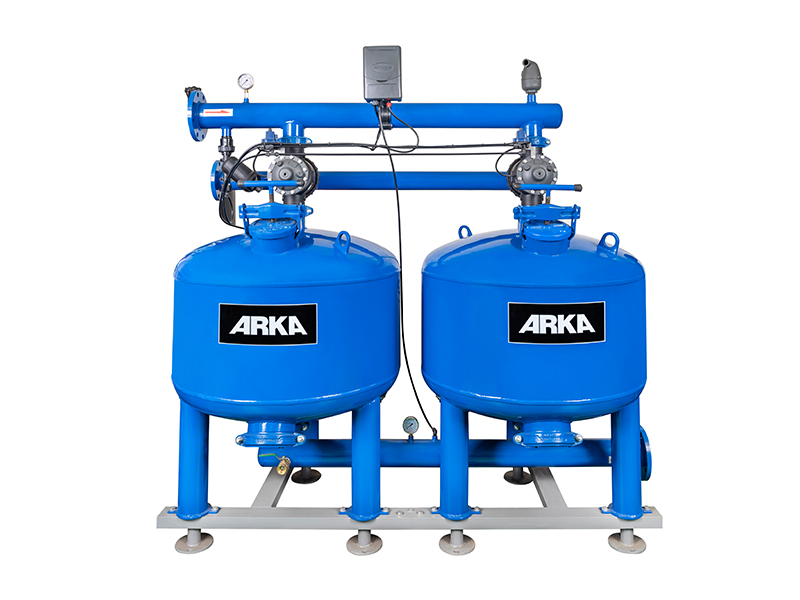
The decision regarding system control mechanisms drives both your initial budget and your long-term daily maintenance schedule. While both configurations utilize the same core physical filtration principles, their management differs vastly. Driven by chronic farm labor shortages, modern operations increasingly demand systems that self-regulate.
To clarify the commercial value and operational differences, review the core comparison below:
| Feature / Metric | Manual Valve System | Automated Control System |
|---|---|---|
| Initial Investment | Lower upfront capital expenditure. | Higher initial cost due to sensors and solenoids. |
| Labor Requirements | High. Requires a technician to physically monitor gauges and turn valves daily. | Minimal. Operates autonomously based on pressure differentials or timers. |
| Risk of Human Error | High. Forgetting to backwash leads to severe flow restriction and crop stress. | Low. The system cleans itself exactly when needed, protecting downstream emitters. |
| Best Application Scenario | Small plots, highly predictable clean water, or operations with abundant cheap labor. | Large commercial farms, variable surface water sources, and smart-farm integrations. |
Aligning with current agricultural tech trends, an automatic sand filter provides a highly measurable return on investment. These systems utilize pressure differential switches. When the controller detects that the pressure difference between the inlet and outlet exceeds a pre-set threshold, it triggers solenoid valves to reverse the water flow instantly. This drastically reduces labor hours and ensures consistent crop watering during critical growth stages.
Treating heavy-duty agricultural equipment like standard, lightweight PVC components is a frequent and costly error. Filtration tanks possess immense physical density once filled with water and crushed silica media. A standard dual-tank commercial setup easily weighs several thousand pounds during operation.
Imagine placing this massive weight directly on bare, rain-soaked soil. The tanks will inevitably settle unevenly. This shifting places catastrophic shear stress on the connecting PVC manifolds, leading to cracked pipes and flooded pump houses. To prevent this, pouring a reinforced concrete pad is standard engineering practice. The concrete should reach a minimum thickness of four to six inches, utilizing rebar or wire mesh for structural integrity. Additionally, your layout must account for maintenance clearance. Technicians need adequate overhead and lateral space to safely open access ports, inspect internal diffusers, and shovel out heavy wet sand during media replacements.
By design, a backwash sand filter expels a highly concentrated volume of dirty wastewater during its self-cleaning cycle. Depending on the scale of your setup, a single event discharges hundreds of gallons of water in mere minutes. Pre-planning the drainage route is a non-negotiable step. Installers must map out discharge pipes that route this wastewater safely away from the concrete foundation, electrical panels, and sensitive crop root zones to prevent soil erosion. Operators must also review local environmental regulations, as discharging agricultural runoff directly into public waterways may be strictly prohibited.
To ensure a seamless assembly process without frustrating mid-project delays, contractors must compile a comprehensive bill of materials. Standardizing your plumbing materials ensures system integrity under high-pressure spikes and water hammer effects. Standard thin-wall pipe will not suffice. Your checklist should include Schedule 80 PVC or galvanized steel for the main manifolds. Crucially, the layout should incorporate a bypass valve loop. This specific design element allows operators to divert water completely around the filter during emergency maintenance.
A new filtration unit does not operate in a vacuum. It must integrate harmoniously with your existing pump infrastructure and downstream equipment. Before finalizing any purchase, carefully analyze the performance curve of your existing well or surface pump. The pump must possess sufficient horsepower to push water through the dense media bed, overcome the friction loss of the complex plumbing manifold, and still deliver the required pressure to the very last drip emitter in your field.
In professional agricultural setups, filtration is rarely a single-step process. You must determine exactly where the new tanks will sit within the broader water treatment filter sequence. Standard engineering practice dictates placing the media tanks first in line, immediately after the pump. As the primary defense mechanism, they strip out the heaviest biological and inorganic loads. Finally, a secondary screen or disc filter is installed downstream. This crucial backup unit ensures that if an internal lateral fails and stray sand escapes the main tank, it is caught before it can travel into the field and permanently plug miles of drip tape.
Establishing a realistic financial framework prevents project abandonment and ensures all necessary components are procured at required commercial quality levels. The initial capital expenditure varies drastically based on your required flow rate and the chosen level of automation.
When building your budget, allocate funds across several distinct categories. The tank and manifold assembly represents the bulk of the cost. However, specialized crushed silica is purchased by weight, meaning shipping costs for the heavy media must be factored in. If opting for a self-cleaning system, you must also budget for solenoids, pressure differential switches, digital control panels, and raw materials for site preparation.
Prudent buyers evaluate the total cost of ownership. While these systems are incredibly durable, they require ongoing financial inputs. The sharp edges of silica sand eventually erode and become smooth from the constant friction of backwashing, losing their filtration efficiency. Budget for complete media replacement every three to five years. Furthermore, calculate the seasonal labor costs associated with fully draining and winterizing the system in freezing climates to prevent cracked manifolds.
Proper planning serves as the bedrock of a successful filtration upgrade. By taking the time to scientifically evaluate your water source, accurately calculate your system hydraulics, and meticulously prepare your physical site for heavy tanks and rapid drainage, you protect your entire irrigation investment. Executing a well-thought-out plan prevents thousands of dollars in ruined emitters, strained pumps, and ultimately, lost crop yields.
Ready to upgrade your agricultural water management? Visit Arka Irrigation at https://www.arka-irrigation.com to explore our full range of commercial-grade filtration solutions. From robust dual-tank systems to fully automated smart controllers, our engineering team can help you select the exact specifications required to keep your fields thriving.
For small-scale residential or light commercial systems, individuals with advanced plumbing experience can often complete the installation themselves. However, for large agricultural setups utilizing automated systems, professional installation is highly recommended. Commercial installations require complex hydraulic manifold assembly, electrical wiring for sensors, and precise flow rate calculations to ensure cleaning cycles function correctly without dead-heading the pump.
The spatial footprint varies significantly based on the required flow rate and tank diameter. Generally, a standard dual-tank commercial setup requires a minimum four-by-four foot reinforced concrete pad. Additionally, you must account for at least three feet of vertical and lateral clearance around the tanks to allow technicians to remove the heavy steel lids and maneuver shovels when replacing the media.
Cleaning frequency is entirely dependent on the contamination level of your specific water source and seasonal variations like summer algae blooms. Instead of relying on a rigid time schedule, operators should strictly monitor the pressure gauges. The system should be backwashed whenever the pressure differential between the inlet and outlet manifolds reaches 5 to 10 PSI. Automated setups use sensors to detect this exact pressure drop and initiate the cleaning cycle independently.
While depth filtration is highly effective for removing three-dimensional organic matter and heavy particulates, it is not recommended as a standalone solution for drip irrigation. Industry best practices strongly advise installing a secondary screen or disc filter downstream. This secondary unit acts as a critical fail-safe to capture any stray silica particles that might accidentally escape the main tank, thereby protecting delicate micro-emitters from permanent damage.
A common, yet disastrous mistake is dumping standard playground sand or masonry sand into these tanks. Using incorrect, smooth-edged sand destroys system efficiency. Agricultural filtration requires strictly graded, crushed silica or crushed glass media. These materials feature sharp, angular edges designed to interlock and trap microscopic debris. You must consult manufacturer specifications to purchase the correct micron rating to precisely match the emitter sizes in your field.
Right after a fresh backwash cycle or when the media is brand new, a clean system typically exhibits a natural pressure drop of 2 to 4 PSI simply due to water passing through the dense sand bed and internal diffusers. As the system operates and traps debris, this differential will gradually increase. Once the pressure drop reaches 7 to 10 PSI above the clean baseline, a backwash cycle must be initiated to restore optimal flow.


