
Views: 0 Author: Site Editor Publish Time: 2026-10-13 Origin: Site


Are you tired of constantly battling cloudy pool water? Imagine hosting a weekend barbecue only to realize your backyard oasis looks murky and uninviting. The real secret to crystal-clear water is not about dumping more chemicals into the skimmer. It hides deep inside your filter tank.
Proper HTH pool care pool filter sand solves this frustrating issue. It acts as an impenetrable physical barrier. This media traps microscopic contaminants, body oils, and environmental debris. The result is a safe and transparent swimming environment.
In this guide, we break down exactly how this mechanical filtration method works. We will explore the fluid dynamics behind its efficiency and share practical maintenance steps straight from the pump room. Choosing the right aggregate is critical for water sanitation, whether you operate a standard residential setup or a massive commercial system.
The main objective of adding high-grade sand to your circulation system is creating a robust mechanical sieve. Chemical sanitizers like liquid chlorine neutralize bacteria biologically. Sand, however, operates as the heavy-duty workforce of your plumbing. It works continuously during every pump cycle. Its primary job is extracting solid particulate matter from the water column to prevent organic waste buildup.
Circulating pool water carries a vast array of unwanted materials that bypass initial skimmer baskets. HTH pool care pool filter sand is formulated to capture two distinct waste categories. Visible debris includes decaying leaves, small insects, and pet hair. Yet, the true value of this aggregate lies in capturing invisible microscopic contaminants.
As water permeates the dense sand bed, silica grains catch resilient algae spores and suspended atmospheric dust. They also trap sticky sunscreen residue and coagulated body oils. Physically trapping these elements within the tank prevents them from returning to the pool basin. This eliminates the very food sources that encourage rapid bacterial growth.
Cloudy pool water typically results from millions of microscopic particles scattering sunlight and reducing visibility. The sand bed addresses this cloudy pool syndrome through continuous mechanical polishing. During a standard daily pump cycle, the entire water volume passes through the filter multiple times. With each successive pass, the sand extracts more suspended solids. Over a 48-hour period of continuous operation, this process strips the water of light-scattering particles. The optical clarity is restored.
To truly understand why this product performs so efficiently, we must examine its physical specifications. Buyers evaluating different purification options need to look at specific grading and structural composition. Not all sand can filter water safely.
The golden standard for swimming pool filtration is #20 silica sand. This classification refers to the diameter of individual sand grains strictly measuring between 0.45 and 0.55 millimeters. This precise grading is critical due to the complex physics of fluid dynamics.
If grains are too large, microscopic gaps allow dirt particles under 40 microns to pass straight through. Conversely, if grains are too fine, they pack together too tightly. Severe compaction causes internal filter pressure to spike dangerously high. This restricts water flow and can easily burn out a pump motor. The 0.45 to 0.55 mm size creates a perfectly balanced matrix. It allows water to flow at an efficient gallons-per-minute rate while successfully trapping debris down to 20 microns.
A costly misconception among new pool owners is that cheap play sand from a hardware store can be dumped into a filter tank. This is factually incorrect and highly damaging to equipment.
Natural beach sand has been weathered by ocean waves over thousands of years resulting in smooth, rounded edges. Under high pressure, water and dirt simply slide past these smooth spheres. Proper pool filter sand is industrially mined and mechanically crushed. This aggressive manufacturing process ensures every single grain possesses sharp, asymmetrical edges. On a microscopic level, these jagged edges act like tiny hooks physically snagging passing debris.
Let us look at a quick field comparison to understand why material choice dictates water quality.
| Media Type | Grain Shape | Filtration Capability | Best Application |
|---|---|---|---|
| #20 Silica Sand | Sharp, Jagged | 20 to 40 Microns | Standard Pools, Commercial Systems |
| Play/Beach Sand | Smooth, Rounded | Poor, clogs easily | Landscaping only, never for filters |
| Crushed Glass | Angular, Smooth sides | 10 to 20 Microns | High-end automated setups |
Understanding internal mechanics helps operators diagnose flow issues quickly. It also highlights the absolute necessity of proper maintenance. The journey of water through the vessel relies on a synchronized combination of pump pressure, gravity, and fluid dynamics.
The filtration cycle initiates at the pool pump. The pump generates hydraulic pressure to pull dirty water from skimmers and main drains. This unfiltered water arrives at the multiport valve. When set to the filter position, the valve directs pressurized water into the upper dome of the vessel. It enters through a diffuser, which is a component spraying water evenly over the top layer of the sand bed. This dispersion prevents raw water force from drilling a deep channel directly into the sand.
Once dispersed, gravity and continuous pump pressure force water downward. Interestingly, the vast majority of cleaning occurs in the top two to four inches of the sand bed. As water forces its way through microscopic pathways, solid particles are stripped away. As this top layer fills with dirt, gaps become narrower. This temporarily turns it into a tighter filter catching even smaller particles. Eventually, this accumulation restricts water flow, signaling the need for a clean-out.
Buried beneath hundreds of pounds of sand at the very bottom sits a hub connected to slotted plastic tubes known as laterals. These slots are engineered to be incredibly narrow. They allow purified water to enter but block the #20 silica sand from slipping through. Freshly filtered water enters these laterals, travels up the center standpipe, and is pushed back into the swimming pool via return jets.
While silica acts as a highly effective passive barrier, it cannot clean itself. As media accumulates organic waste, pathways between grains become severely restricted. Pool owners must adhere to a strict maintenance protocol to ensure a full lifespan.
The most critical maintenance procedure is the backwash cycle. You will know exactly when it is time to perform this task by monitoring the pressure gauge. Upon installing fresh sand, note the clean starting pressure. When the gauge reads 8 to 10 PSI above that baseline, the sand is saturated.
To clean the system, you must utilize the backwash filter setting. This function completely reverses water flow inside the tank. The pump forces water down the standpipe, out through the laterals, and fiercely up through the sand bed. This upward hydraulic force lifts and fluidizes the sand. It separates heavy grains and releases trapped dirt out through a dedicated waste line.
A frequently overlooked but mandatory step follows the backwash cycle. After a vigorous backwash, the sand bed is loose and suspended in the upper half of the tank. Immediately switching back to normal filtration shoots a massive cloud of dirty water directly into your pristine pool.
Running the rinse cycle for just 60 seconds directs water downward through the sand but sends the output to the waste line. This action forcefully packs the sand back down into a dense bed.
Over a long swimming season, regular backwashing handles standard dirt. However, it cannot easily remove sticky substances like suntan lotions and calcium scale. These stubborn substances coat silica grains, causing them to clump together. Professionals recommend using a specialized liquid sand filter cleaner at least once a season to break down lipid bonds.
A primary concern for facility managers is whether a specific brand of sand functions correctly within their existing hardware. Because HTH sand strictly adheres to industry sizing standards, it boasts universal compatibility. But how does it pair with modern industrial equipment?
For standard residential applications, this sand is fully compatible with all major original equipment manufacturer tanks. Whether you operate a compact 50-pound capacity tank or a massive 300-pound commercial-grade vessel, mechanical requirements remain identical. The slotted laterals in these tanks are specifically designed to retain this exact grade of silica.
Modern aquatic technology has increasingly moved toward automation. In a premium automatic sand filter, the traditional manual multiport valve is replaced by motorized actuators and electronic pressure transducers.
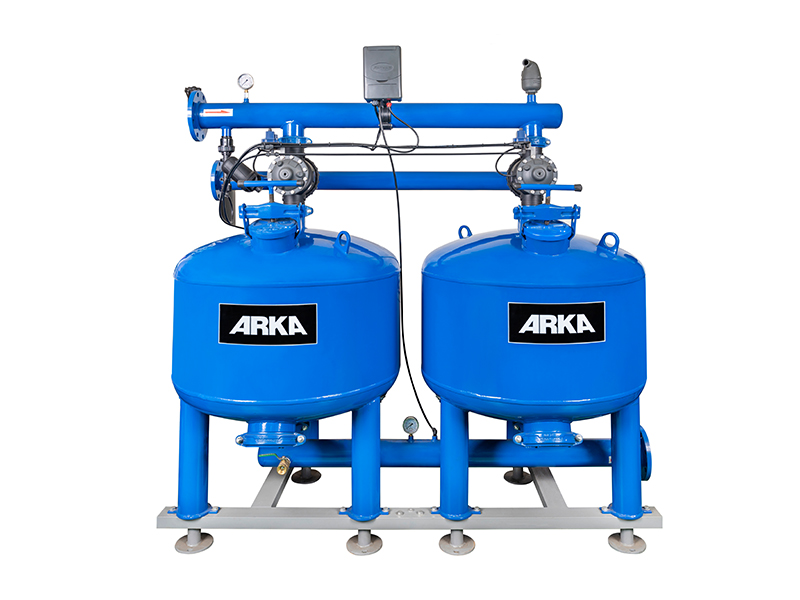
Take the ARKA F40-2-1000mm Automatic Self-Cleaning Sand Media Filter as a prime engineering example. This unit handles massive flow rates and relies on precise differential pressure sensors. When internal sensors detect a specific pressure drop, the system automatically triggers backwash cycles without human intervention. Because HTH sand is uniformly graded and free of natural impurities, it provides highly predictable pressure curves. This reliability is absolutely essential. Erratic pressure spikes caused by low-quality clumping sand can trigger false backwash cycles in automated systems, wasting perfectly balanced pool water.
Beyond the backyard swimming pool, #20 silica sand is a staple in large-scale aquatic management. Its high-density and chemically inert nature makes it highly suitable for use in a heavy-duty commercial water treatment filter. Facilities managing municipal fountains, agricultural irrigation, and zoo enclosures frequently rely on this specific grade to handle immense flow rates without degrading.
Looking at current market trends and search behaviors regarding pool maintenance, there is a clear industry shift. Facility managers and homeowners alike are prioritizing filtration efficiency while minimizing environmental impact.
In recent years, alternative media like crushed recycled glass have entered the market promising finer micron filtration. Yet, traditional #20 silica sand remains the dominant force in both residential and commercial sectors. Industry experts note that the enduring popularity of silica sand stems from its unmatched cost-to-performance ratio.
Furthermore, water conservation is now a critical global issue. The predictable backwash cycles of uniformly graded sand help facility managers precisely calculate wastewater output. When paired with smart, sensor-driven sand media filter systems, operators can drastically reduce their water footprint while maintaining flawless sanitation. This perfectly aligns traditional mechanical filtration with modern sustainability goals.
Even the highest quality silica is not immune to the laws of physics. Over years of constant hydraulic pressure and mechanical friction, the physical properties of the sand will inevitably degrade. Recognizing the symptoms of failing media prevents a total collapse of your water sanitation.
Two common structural failures within an aging sand bed are channeling and mudballs. If sand becomes heavily compacted by oils, pressurized water seeks the path of least resistance. It carves physical tunnels directly through the sand bed. Water bypasses the filtration media entirely. Additionally, as calcium carbonate accumulates, it cements sand grains together into hard clumps known as mudballs. These sink to the bottom, drastically reducing functional surface area.
The most obvious visual indicator of exhausted sand is a persistent inability to clear the pool water. Suppose your pool chemistry is perfectly balanced and your pump runs for the appropriate duration. The water should be sparkling. If water remains persistently cloudy and backwashing yields zero improvement, the sand has reached the end of its mechanical life. Over years of tumbling inside the tank, sharp edges are sanded down. Smooth grains lose their physical ability to snag 20-micron particles.
To avoid unexpected water quality disasters during peak summer, industry professionals recommend a proactive replacement schedule. Under normal residential usage, you should completely scoop out and replace the sand every 3 to 5 years. Pools subjected to exceptionally heavy bather loads or high surrounding vegetation may require fresh sand closer to the 3-year mark.
Because this specific product is essentially heavily washed and chemically inert crushed quartz, it has garnered a strong reputation outside the pool industry.
In the freshwater fish-keeping community, pool filter sand is highly sought after as a premium bottom substrate. Aquarists prefer this specific sand over standard pet store gravel for sound scientific reasons. Being pure silica, it is chemically inert and will never alter the pH of a carefully balanced aquarium. The grain size is heavy enough to settle quickly, preventing it from destroying motorized canister impellers.
In outdoor construction, precision-graded silica sand is frequently utilized as a high-end joint filler for patio pavers and retaining walls. The angular edges allow grains to lock tightly together when swept into narrow joints. Once compacted, it creates a highly stable, weed-resistant structural barrier.
Achieving and maintaining crystal-clear pool water does not have to be a constant struggle. By understanding the mechanical role of your equipment, you can take complete control of your backyard oasis. HTH pool care pool filter sand is a precisely engineered aggregate designed to trap microscopic debris through its jagged silica composition.
Pairing this high-quality sand with a consistent maintenance routine is the easiest way to guarantee optimal performance. Always monitor pressure gauges and execute proper backwash cycles. If you are upgrading your facility or troubleshooting a persistently cloudy system, investing in professional-grade equipment makes all the difference.
For those looking to eliminate the guesswork of manual maintenance, consider upgrading to an automated solution. Explore the advanced automatic self-cleaning systems at ARKA Irrigation to ensure your water remains pristine with maximum efficiency and minimal water waste.
Yes, it is standard #20 silica sand. This is the optimal size measuring 0.45 to 0.55 mm recommended by nearly all pool filter manufacturers. This specific grading ensures a perfect balance between maintaining high water flow rates and effectively trapping microscopic contaminants.
No. Play sand is naturally weathered, making it too fine and too smooth. It contains high levels of dust and organic impurities. If used in a filter, it will pass right through the laterals into your pool or clump together immediately, severely restricting water flow.
The required amount depends entirely on your specific filter volumetric size. A small above-ground filter may need only 50 lbs of sand. A large commercial in-ground filter may require 300 lbs or more. Always check your filter tank manufacturer label for the exact poundage.
No, this high-grade silica sand is completely chemically inert. It will not raise or lower your pH, total alkalinity, or free chlorine levels. Its sole purpose in the system is mechanical filtration.
You should initiate a backwash cycle when the pressure gauge on your tank reads 8 to 10 PSI higher than your clean starting pressure. For most standard residential pools during the swimming season, this translates to once every one to two weeks.
Sand returning to the pool usually points to a mechanical failure inside the tank. The most common culprit is a cracked lateral at the bottom of the filter. It can also happen if you recently replaced the sand and skipped the crucial rinse cycle, or if you added sand grains that are too small for your specific system.
While you can use enzymatic chemical cleaners to strip away oils and scale, you cannot restore the physical shape of the sand. Over 3 to 5 years, water friction wears down the jagged edges of the silica grains, making them smooth. Once they lose their angular shape, their filtration efficiency drops drastically, meaning replacement is the only viable option.


