
Views: 0 Author: Site Editor Publish Time: 2026-11-01 Origin: Site


Agricultural operators and commercial landscapers face a relentless challenge. Untreated surface water rapidly clogs drip emitters and wrecks sprinkler heads. Pumping water from lakes, ponds, or local rivers offers a highly economical alternative to municipal supplies. However, this practice pulls a complex mix of organic matter, algae, and abrasive silt directly into delicate irrigation networks. Without a physical barrier, these contaminants accumulate fast. The results are predictable. You get uneven water distribution, stressed crops, and premature equipment failure.
To mitigate these severe risks, implementing robust filtration acts as your primary line of defense. A properly engineered setup protects massive agricultural investments and ensures consistent yields. It also drastically slashes maintenance downtime. This guide breaks down the mechanics of screen filtration for surface water. We will examine everything from basic manual screens to advanced automated systems. By understanding these principles, system designers and farm managers gain the objective data required to optimize their hydraulic networks.
Understanding the specific environmental characteristics of your water source is the foundational step in designing an effective irrigation manifold. Unlike groundwater, which is naturally filtered by deep geological strata, surface water is entirely exposed to environmental inputs. Municipal water undergoes rigorous chemical treatment, but pond water is raw and unpredictable.
Looking at recent industry trends, the agricultural sector is undergoing a massive shift. Worsening groundwater depletion and increasingly strict municipal water regulations force cultivators to harvest surface water and utilize open reservoirs. Recent market analyses highlight a surging global demand for high-capacity, automated filtration. Modern precision agriculture relies heavily on micro-irrigation to conserve water. This drastically lowers the system tolerance for suspended solids. Consequently, farm operators are moving away from outdated sand separators. They are upgrading to precise, automated polymer screen filters. These modern units handle aggressive biological loads seamlessly without stopping critical fertigation cycles.
Surface water sources are dynamic, living ecosystems. When a pump draws water from a river, it ingests a wide spectrum of contaminants. These threat levels vary wildly by season, weather conditions, and local biological activity.
During warmer months, lakes frequently experience intense algae blooms. As a frontline engineer, I frequently see filamentous algae wrap entirely around intake screens. Meanwhile, microscopic planktonic algae easily pass through primary suction filters. This algae coagulates into a sticky biological sludge inside downstream pipes. Furthermore, heavy rainfall and spring runoff agitate riverbeds. This suspends fine sand, clay, and silt in the water column. These abrasive particles act exactly like liquid sandpaper on internal pump components and plastic valve diaphragms. Beyond just dirt, aquatic weeds and wind-blown trash present immediate threats to pump impellers if not intercepted early.
The financial impact of operating an irrigation system without adequate filtration is severe. The damage compounds rapidly over time. When debris bypasses the intake and enters the main lines, physical destruction begins at the most vulnerable points: the emitters.
Imagine walking rows of parched crops during peak summer heat, only to discover that microscopic sand grains have permanently blocked half of your drip tapes. Modern micro-sprinklers feature flow paths as narrow as 0.5 millimeters. When organic sludge lodges in these pathways, the emitter clogs. This causes localized drought stress and directly plummets crop yield. Specifically, as clogs multiply, overall system pressure spikes. This forces the primary irrigation pump to overexert itself. Sustained thermal stress leads to increased energy consumption and eventual premature mechanical failure. Ultimately, the labor costs associated with manually identifying and replacing plugged emitters far exceed the initial capital expenditure of a proper filtration setup.
At their core, these devices are highly engineered mechanical barriers. They operate on the straightforward principle of surface filtration. Fluid is forced under pressure through a precisely woven mesh material, leaving suspended solids trapped safely on the surface.
A standard filter housing contains a rigid cylindrical element. Water enters the body, typically flowing from the inside of the cylinder to the outside. As the water passes through the porous mesh, particles larger than the pore size are physically blocked. These meshes are usually constructed from marine-grade stainless steel or durable synthetic polymers.
Over time, these trapped particles form a dense filter cake. While a thin cake can paradoxically increase filtration efficiency by trapping even smaller particles, it eventually chokes the water flow. This restriction leads to a noticeable pressure drop across the unit. Once this differential reaches a critical threshold, the screen must be cleaned to restore optimal hydraulic dynamics.
Selecting the appropriate screen size dictates the success of your entire irrigation network. Screen precision is measured in two interchangeable units. Mesh denotes the number of openings per linear inch. Microns denote the absolute size of the opening in thousandths of a millimeter. A higher mesh number indicates a finer screen, whereas a higher micron number indicates a coarser screen.
| Mesh Size | Micron Equivalent | Primary Irrigation Application | Suitability for Surface Water |
|---|---|---|---|
| 40 Mesh | 400 Microns | Large impact sprinklers, pre-filtration | Excellent for removing large organic debris at the pump intake. |
| 80 Mesh | 200 Microns | Standard agricultural sprinklers | Good secondary filtration for moderately clean ponds. |
| 120 Mesh | 130 Microns | Drip irrigation, micro-sprinklers | Industry standard for drip tape; requires pre-filtration in dirty water. |
| 150 Mesh | 100 Microns | High-precision drip tape, foggers | Highly effective, but prone to rapid clogging if heavily laden with algae. |
The decision between manual and automated purification mechanisms hinges on a careful analysis of capital expenditure versus long-term operational costs. You must specifically evaluate your local labor availability and raw water quality.
Manual filters are the simplest and most economical option upfront. They consist of a static screen inside a rigid housing. They require no electrical connections or complex moving parts. This makes initial installation incredibly straightforward.
In contrast, the maintenance is highly labor-intensive. When the screen clogs, a worker must physically shut down the water supply and depressurize the manifold. They then open the housing, extract the cylinder, and scrub it clean with a stiff brush. If utilized with highly contaminated river water, manual units may require this tedious cleaning process multiple times a day. This renders them economically unviable for commercial-scale operations.
To eliminate the heavy burden of manual labor, forward-thinking growers integrate an automatic screen filter into their main lines. This technology utilizes pressure-sensing equipment to trigger self-cleaning cycles entirely without human intervention.
These systems are equipped with a differential pressure switch that continuously monitors the hydraulic pressure at both the inlet and outlet. As debris accumulates, the outlet pressure drops. Once the difference between the inlet and outlet reaches a pre-set threshold, the switch signals the electronic controller to initiate a flush cycle. This ensures the system operates at peak efficiency and protects downstream equipment from dangerous pressure fluctuations.
The internal mechanics of a self cleaning screen filter represent a massive leap in agricultural engineering. When the flush cycle triggers, an exhaust valve opens to the atmosphere. This creates a localized pressure drop inside the housing.
This differential activates a suction-scanning mechanism. A central dirt collector, equipped with specialized vacuum nozzles, begins to rotate and move linearly across the screen. These nozzles aggressively vacuum the algae and silt directly off the inner surface and expel it through the exhaust valve. The most profound economic advantage here is continuous operation. The cleaning cycle takes mere seconds and occurs without interrupting the main water flow to the field. You experience zero downtime for your critical irrigation schedules.
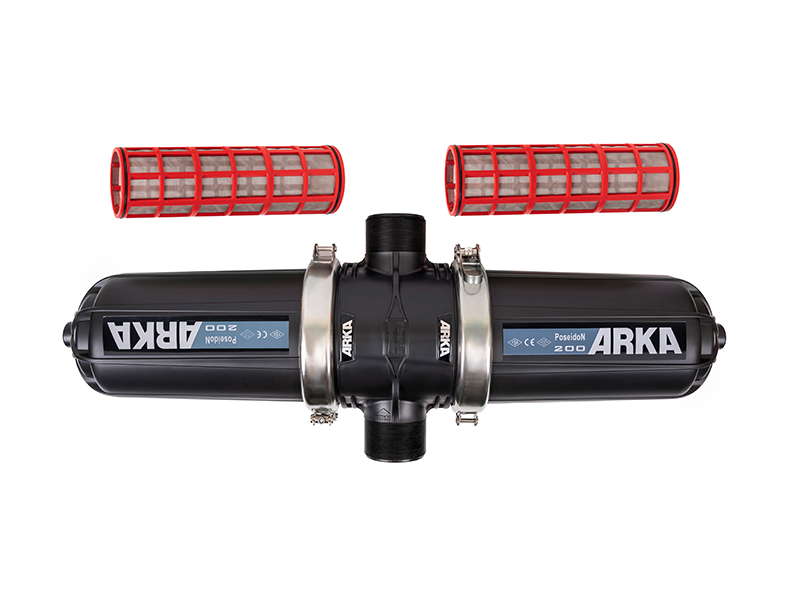
For large-scale agricultural enterprises drawing massive volumes of water, standard inline filters frequently present spatial and hydraulic bottlenecks. To address these industrial-scale demands, engineers developed highly optimized geometries to handle massive flow rates without sacrificing filtration precision.
The H-Type designation refers to the physical architecture of the filter housing. Unlike traditional linear designs where the inlet and outlet sit on a single axis, an H-type screen filter features parallel inlet and outlet manifolds connected by the main filtration chamber. This forms a distinct H shape.
This structural layout allows the unit to house a significantly larger screen cylinder within a surprisingly compact footprint. For instance, advanced 3-inch plastic models utilize a robust glass-reinforced polyamide housing. This specific material choice prevents corrosion from harsh fertilizers and acidic surface water. The fluid dynamics engineered into this shape are calibrated to process exceptionally high flow rates while maintaining a remarkably low initial pressure drop.
Integrating this specialized geometry into a surface water irrigation system provides several distinct operational advantages. First, the maximized filtration surface area means the unit traps significantly more debris before reaching the pressure differential threshold. This directly results in fewer flush cycles and less wastewater.
Furthermore, the parallel manifold design creates a smoother flow path. It reduces internal turbulence and minimizes hydraulic friction. From an installation standpoint, the H-shape is exceptionally versatile for complex pump stations. It allows engineers to stack or parallel-mount multiple units closely together. If farm acreage expands, additional units can be seamlessly integrated into the existing manifold with minimal repiping.
Purchasing a filtration system is a significant capital investment. Making an informed decision requires evaluating empirical data regarding your specific hydraulic infrastructure. You cannot afford to guess on specifications.
The most common cause of filtration failure is undersizing. You must size a unit based on the maximum flow rate of your irrigation pump, not merely the diameter of your main pipe. Check your pump peak output. If your system pushes 300 gallons per minute, do not just buy a standard 3-inch filter; verify the maximum flow capacity of the specific model. If a filter is undersized, the velocity of the water passing through the mesh becomes too high. This excessive velocity literally forces soft organic matter, like algae, straight through the pores. Always calculate your peak zone flow and select a capacity that exceeds your requirement by at least twenty percent.
When dealing with harsh surface water, material selection is non-negotiable. Insist on a 316L stainless steel weave for the screen element. Surface water contains abrasive silica and fluctuating pH levels from decaying organics. Standard nylon meshes will stretch, tear, or degrade under continuous pressure differentials.
For the housing itself, outdoor agricultural environments demand extreme durability. Glass-reinforced polyamide plastics offer excellent UV and corrosion resistance for modern setups. They easily handle high operating pressures while remaining immune to the rust issues that plague older carbon steel models.
Ensure the chosen technology aligns with your existing hydraulic parameters. Automated units require a minimum operating pressure to facilitate the flush cycle effectively, usually around 30 to 40 psi. If your surface water pump operates at a very low pressure, the suction scanners will fail to generate enough vacuum to clean the mesh. In such scenarios, a pressure-sustaining valve must be installed downstream. This guarantees adequate flushing pressure is maintained during the cleaning cycle.
Even the most advanced filtration technology will underperform if installed incorrectly. Proper integration into your existing layout is critical for long-term success and ease of maintenance.
Position the primary filtration unit as close to the water source as practically possible. It should sit immediately downstream from the main pump but strictly before any fertigation injectors or zone valves. Filtering the water before injecting fertilizers prevents chemical scaling on the stainless screen. It also ensures that undissolved fertilizer particulates are not accidentally flushed out during a cleaning cycle.
Never install a filter directly inline without a bypass manifold. By installing a series of three manual valves, you can isolate the filter for unexpected maintenance without shutting down the water supply to the entire farm. Additionally, installing highly accurate liquid-filled pressure gauges immediately before and after the housing is critical. Even with automated systems, these gauges provide a quick visual confirmation of the pressure differential. This allows operators to spot potential mechanical failures at a glance.
While automation drastically reduces daily labor, no agricultural equipment is entirely maintenance-free. A proactive approach extends the lifespan of your investment and prevents mid-season emergencies.
Conduct a brief visual and auditory inspection of automated units on a bi-weekly basis. Listen to the flush valve during a cleaning cycle. It should open sharply and close completely without dripping. Once a month, manually trigger a flush cycle via the controller to ensure the differential pressure switch communicates correctly. Every six months, safely depressurize the system, remove the screen, and inspect it for embedded scale or physical tears.
For farms in regions experiencing freezing temperatures, improper winterization will destroy a plastic filter housing. At the end of the irrigation season, completely drain the unit. Open the flush valve manually and remove the lowest drain plug on the housing. Extract the screen, wash it thoroughly with a mild acid solution to remove any calcium buildup, and store it indoors. Leaving a wet, dirty screen inside a housing over the winter invites severe corrosion and freeze-cracking.
Surface water drawn from ponds, lakes, and rivers remains a highly valuable resource for agricultural operations. However, the inherent biological and inorganic debris present in these open ecosystems dictates that this water absolutely requires robust filtration. Protecting your emitters is non-negotiable if you want to maintain high crop yields.
While basic manual screens may suffice for small garden plots, they quickly become an operational liability at scale. Investing in automated technology is the most financially sound decision for commercial farms. By eliminating the heavy labor costs of manual scrubbing and ensuring uninterrupted water flow, advanced systems transform unpredictable surface water into a reliable engine for growth. Assess your system flow rate, analyze your water quality, and upgrade your infrastructure today. Ready to safeguard your yields? Explore high-performance solutions like the H-type screen filter from ARKA to find the exact filtration system engineered for your specific agricultural demands.
For standard drip irrigation tapes and micro-sprinklers, a 120 to 150 mesh, equivalent to 130 to 100 microns, is highly recommended. This size perfectly balances the need to block microscopic silt that clogs emitters while allowing water to pass efficiently. However, if your pond experiences heavy seasonal algae blooms, it is best practice to install a coarser 40 or 80 mesh pre-filter at the pump intake to handle the bulk debris.
Yes, modern automated models are engineered to handle organic loads. However, because algae is soft and gelatinous, it can sometimes extrude through the mesh under high pressure. To combat this, advanced automated screens utilize aggressive suction scanners designed specifically to lift and expel sticky organic matter. For exceptionally severe algae problems, pairing the screen with a sand media pre-filter offers the ultimate protection.
The primary difference lies in the filtration method. Screen filters utilize two-dimensional surface filtration, making them incredibly efficient at blocking hard, inorganic materials like sand and silt. Disc filters rely on three-dimensional depth filtration, where water navigates a tortuous path through stacked plastic discs. Advanced H-type screen configurations bridge this gap by providing massive surface areas that handle organics exceptionally well without the complex maintenance associated with disc stacks.
Not at all. One of the primary engineering achievements of modern automated systems is their water efficiency. A typical flush cycle lasts only 10 to 15 seconds and utilizes less than one percent of the total water flow passing through the system. Because the cleaning is highly localized via suction nozzles, it requires very little volume to effectively expel the trapped debris.
To calculate the correct flow rate, you must determine the maximum output of your irrigation pump during peak operation, measured in gallons per minute. Do not base the size solely on your pipe diameter. Once you find your peak flow, select a filter capacity that exceeds this number by at least twenty percent. This safety margin accounts for pressure spikes and heavy contamination days without overwhelming the mesh.
High-quality plastic H-type filters, specifically those manufactured from glass-reinforced polyamide, are engineered to withstand rigorous agricultural environments. Most premium commercial models safely handle a maximum operating pressure of up to 120 to 140 psi. Always verify the specific pressure rating on the manufacturer data sheet to ensure compatibility with your main irrigation pump.


