
Views: 0 Author: Site Editor Publish Time: 2026-10-13 Origin: Site


Picture this. It is the peak of summer. You are ready for a refreshing dip, but you pull back the cover to find a murky, cloudy swamp. You might be constantly battling algae blooms despite dumping gallons of chemicals into the water. As a water treatment engineer, I see this daily in the field. Poor circulation almost always stems from mismatched equipment. In this comprehensive guide, you will learn exactly how to size an above ground pool pump and sand filter perfectly. This ensures you maintain crystal-clear water all season long without burning out your motor.
Selecting pool equipment is far more nuanced than simply purchasing the largest available unit on the shelf. For an above ground pool to maintain pristine clarity, the pump and the tank must operate in strict mechanical harmony. Understanding this symbiotic relationship forms the bedrock of effective, low-stress maintenance.
Acting as the heart of your swimming pool, the pump generates suction to pull water from the skimmer. It then forcefully pushes that fluid through the plumbing network. As the water enters the tank, it percolates through the internal bed. This effectively traps dirt, debris, and microscopic contaminants. Finally, the freshly purified water pushes back into the pool through the return jets. If these two critical components lack perfect alignment in flow capacity, the entire water circulation cycle collapses.
Many well-meaning owners make critical errors during installation. They either undersize their setup to save a few upfront dollars, or they oversize the motor under the false assumption that more horsepower equates to superior cleaning power.
Before even glancing at equipment specifications, you must determine the exact volume of your pool. Practically speaking, every single sizing calculation relies heavily on knowing exactly how many gallons of water your system needs to move daily.
To calculate the volume of a round pool, you will need to measure the diameter across the center and the average water depth. Always measure the actual water line rather than the wall height. The standard multiplier used by professionals for round pools is 5.9.
Formula: Diameter x Diameter x Average Depth x 5.9 = Total Gallons
Imagine you have a standard 24-foot round pool with an actual average water depth of 4 feet. First, multiply 24 by 24 to get 576. Next, multiply 576 by 4 to reach 2304. Finally, multiply 2304 by 5.9 to reveal a total of 13593 Gallons.
The math changes slightly for elongated shapes. You will need the length, width, and average depth. The multiplier is 5.9 for oval shapes and 7.5 for rectangular designs.
For a 15 by 30 foot oval pool with a 4-foot depth, multiply 15 by 30 to get 450. Multiply 450 by 4 to reach 1800. Multiply 1800 by 5.9 to find a total of 10620 Gallons.
Once you pin down your total gallon capacity, the next step involves translating that raw number into Gallons Per Minute. Manufacturers universally use this metric to rate their hardware.
The turnover rate refers to the amount of time it takes for a system to cycle every single drop of water through the tank one time. Industry standards established by fluid dynamics experts recommend an 8-hour turnover rate for above ground setups. Achieving this 8-hour benchmark ensures your water filters efficiently during standard daily operating hours. This prevents stagnation while keeping energy consumption in check.
We are currently witnessing a massive shift in residential water management trends. Driven by rising utility costs and stricter environmental regulations globally, the industry is moving aggressively away from oversized, energy-draining motors. Modern engineering favors pairing correctly sized, high-efficiency pumps with advanced filtration setups. This modern approach slashes electricity consumption. Specifically, it ensures a slower, more deliberate water flow that maximizes debris-trapping capabilities.
To find your target Gallons Per Minute, divide your total volume by 8 hours. Then divide that result by 60 minutes to break it down by the minute.
Using the 13593-gallon pool from our previous example, divide 13593 by 8 to get 1699 Gallons Per Hour. Divide 1699 by 60 to find exactly 28.3 Gallons Per Minute. To put this into perspective, your selected system must move at least 28.3 gallons every minute to maintain a healthy turnover rate.
With your target metric in hand, you are now equipped to evaluate hardware objectively. The ultimate goal is to select a unit that meets or slightly exceeds your minimum requirement without severely overpowering your future tank.
A widespread misconception in the residential sector dictates shopping based solely on horsepower. However, horsepower only measures the raw energy the motor consumes, not the actual water flow it produces. Due to differences in impeller design and motor efficiency, a one horsepower motor from Brand A might push 45 gallons per minute, while Brand B might only push 35. Beyond raw power, always look for the performance curve chart at a standard head pressure. Your chosen motor must deliver your calculated minimum flow rate at this specific operating pressure.
To make the best choice, let us compare the most common configurations available today.
| Pump Type | Initial Cost | Energy Efficiency | Best Application |
|---|---|---|---|
| Single-Speed | Low | Poor | Basic setups on a strict budget requiring short run times. |
| Variable-Speed | High | Excellent | Long-term energy savings and precise flow control. |
| Automated Systems | Premium | Maximum | Hands-free maintenance and commercial-grade clarity. |
This phase represents the most critical stage of the entire purchasing process. Now that you have selected a motor capable of meeting your volume needs, you must carefully pair it with a tank designed to safely handle that specific water velocity.
To guarantee system longevity and prevent the dreaded channeling effect mentioned earlier, your tank maximum flow rate must always exceed the pump output. If you purchase a motor that pushes 40 gallons per minute, your automatic sand filter must be rated to handle at least 40 gallons per minute. Ideally, you should build in a comfortable safety margin by selecting a unit rated for 45 to 50 gallons per minute. An oversized tank is actually highly beneficial. It provides a significantly larger surface area for dirt collection, naturally lowers the internal pressure of the plumbing system, and drastically reduces maintenance frequency.
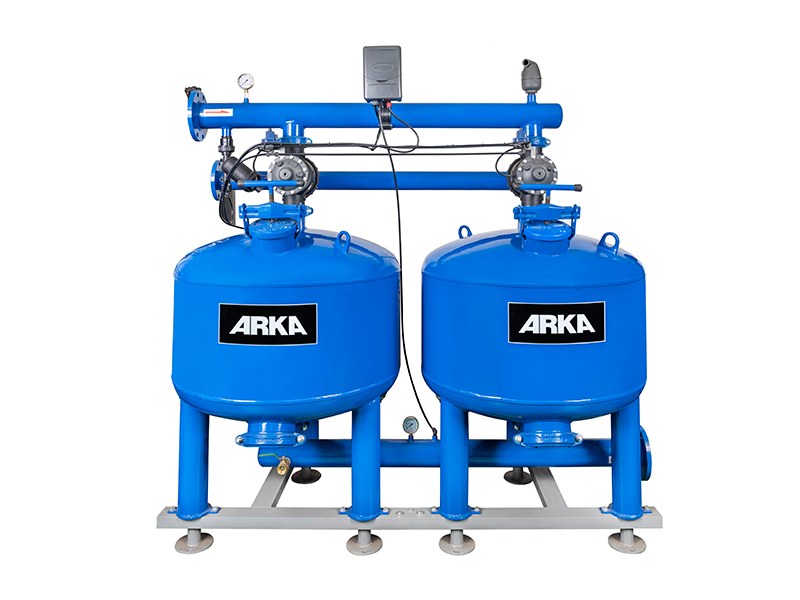
When evaluating industrial-grade or high-capacity residential options, looking at actual product specifications helps clarify the math. For example, high-performance units like the ARKA F40-2 1000mm automatic self-cleaning models are engineered to handle massive flow rates while maintaining structural integrity. For standard above ground applications, a 16-inch tank typically holds 100 pounds of media and handles 35 to 40 gallons per minute. A 19-inch model holds 150 pounds and manages 45 to 50 gallons per minute. For larger setups, a 22-inch tank holding roughly 250 pounds safely processes 60 to 65 gallons per minute.
The physical hardware sitting on your equipment pad is only part of the equation. What goes inside the tank, combined with how you manage maintenance cycles, will ultimately dictate your daily water clarity.
The material placed inside is entirely responsible for capturing microscopic debris. While standard number 20 silica sand remains the traditional choice, modern filtration media offers vastly superior alternatives. Recycled crushed glass can filter down to an impressive 5 microns and lasts significantly longer than traditional materials. Alternatively, specialized polymer balls are incredibly lightweight, reduce overall system pressure, and offer excellent micron-level cleaning. However, they require manual machine washing rather than standard flushing.
Most setups utilize a multiport valve mounted on the top or side of the tank to direct water flow. When checking your equipment, tap the pressure gauge lightly with your finger. If it reads 8 to 10 PSI above the clean starting pressure, it strongly indicates the bed is packed full of dirt. By switching the valve to the backwash filter setting, the system ingeniously reverses the water flow. This lifts the bed and flushes trapped debris out a designated waste line. A durable, well-sealed valve is absolutely essential to prevent internal leaks that cause dirty water to bypass the cleaning process entirely.
Even armed with the correct calculations, owners frequently encounter frustrating performance issues due to overlooked variables during installation. To ensure your equipment operates at peak efficiency, you must avoid these common bottom-of-funnel mistakes.
One of the most frequent errors involves pairing a high-output motor with severely undersized plumbing. The diameter of your hoses directly impacts head pressure. This is the physical resistance water faces as it moves through the system. Standard above ground pools typically use either 1.25-inch or 1.5-inch corrugated hoses. If you force 60 gallons per minute through a narrow 1.25-inch hose, the resulting friction significantly chokes the actual flow. Upgrading to smooth-wall 1.5-inch hoses allows water to flow with minimal resistance, ensuring your motor runs cool.
Furthermore, many pools are sold as convenient all-in-one packages at retail stores. While undeniably tempting for the price, these kits are notoriously bundled with undersized hardware to keep retail margins high. Manufacturers frequently include entry-level motors and tiny tanks that barely meet bare minimum requirements. Relying on an undersized stock setup often leads to cloudy water. If you struggle with a stock kit, upgrading to a dedicated water treatment filter system based on proper engineering math is the most cost-effective long-term solution.
Before finalizing your purchase, run your selected equipment through this technical checklist. This ensures the components will work together seamlessly.
Proper math ensures better water circulation. A clean above ground pool starts right here on the drawing board. Always take the time to double-check your gallon and flow calculations, as this simple step prevents costly hardware failures later on. By investing in a properly matched system, you save yourself countless hours of frustrating maintenance time. Ultimately, this allows you to enjoy crystal clear water all summer long.
If you are tired of battling murky water and replacing burned-out motors, it is time to upgrade to professional-grade equipment. Explore high-performance solutions designed for optimal fluid dynamics. Visit ARKA Irrigation to find the perfect automated systems and heavy-duty tanks tailored to your specific water treatment needs. Stop guessing and start enjoying crystal clear water today.
Yes, sizing up your tank while keeping a smaller motor is actually a highly beneficial strategy. A larger unit provides a substantially greater surface area for trapping debris. Because the motor pushes fluid through a wider area at a slower, more deliberate velocity, the cleaning process is far more thorough. Furthermore, a larger unit takes much longer to clog, meaning you will not have to flush the system as frequently.
You should initiate a cleaning cycle based on internal pressure rather than a set timeline. After installing clean materials, note the baseline pressure on your gauge, which is usually between 10 and 15 PSI. When the gauge reads 8 to 10 PSI above that clean starting pressure, the bed is restricted by trapped dirt, and it is time to flush the system.
Industry standards dictate that the hardware should run long enough to process all the water at least once per day. If your setup is properly sized, this takes exactly 8 hours. However, during peak summer heat, periods of heavy bather usage, or after heavy rainstorms, running the hardware for 10 to 12 hours is highly recommended to prevent algae growth.
Both systems are highly effective, but they serve different maintenance preferences. A sand setup is generally preferred for its durability and ease of maintenance. Cleaning it simply requires turning a multiport valve to flush the dirt out. Cartridge units require you to manually disassemble the housing and physically hose down pleated paper elements, which can be quite time-consuming.
If the motor output exceeds the tank maximum capacity, you will experience severe channeling. The high-pressure water literally blasts tunnels through the bed instead of filtering through it. This allows dirty water to bypass the cleaning stage completely. Additionally, the excessive pressure can easily crack the tank housing or shatter the plastic laterals located at the bottom of the unit.
Traditional silica materials typically last between 3 and 5 years. You will know it is time for a replacement if your water remains consistently cloudy despite proper chemical balance and regular flushing. Over time, the jagged edges of the granules become smooth and rounded from constant water friction, causing them to lose their ability to grab microscopic debris.


