
Views: 0 Author: Site Editor Publish Time: 2026-10-20 Origin: Site


Are clogged drip lines ruining your crop yields?
Pumping pond or river water saves money. However, it brings harmful silt, aggressive algae, and organic sludge straight into your delicate irrigation network. Guessing your filter size wastes water and ruins expensive equipment. Ultimately, it leaves your crops thirsty during critical growth stages.
In this guide, you will learn how to size a filtration system perfectly tailored to your agricultural needs.
Before diving into the calculations, we must acknowledge a major shift in modern agriculture. With tightening water scarcity regulations across major farming regions, operators are rapidly transitioning toward precision irrigation. Farm grids now rely heavily on IoT-connected manifolds and data logging. Efficient water management is no longer optional. It is a strict operational requirement.
Before calculating tank dimensions, it is necessary to understand how these systems function in a real-world agricultural setting. Farm water sources often contain heavy organic loads that quickly compromise micro-irrigation hardware. Implementing a properly sized irrigation sand filter provides a reliable, heavy-duty mechanical barrier against these contaminants.
These systems operate on the principle of depth filtration. Water enters the top of a pressurized steel or carbon tank. It then pushes downward through a thick bed of crushed silica sand. Unlike standard smooth beach sand, this specific silica features sharp, angular edges designed to catch debris.
As water weaves through the microscopic gaps between the sand particles, those sharp edges trap organic and inorganic debris in three dimensions. Dirt, algae, and silt become lodged deep within the sand bed. Only purified water exits through the bottom manifold and heads out to your fields.
Farms drawing water from rivers, lakes, or open canals face unique challenges. Screen or disc filters rely entirely on surface filtration, catching debris on a single flat plane. When exposed to heavy algae or summer slime, surface filters clog almost immediately. This rapid fouling causes severe pressure drops that halt watering.
In contrast, depth filtration holds massive amounts of debris throughout the entire sand bed before requiring a cleaning cycle. For surface water heavy in organic matter, this method remains the most reliable choice. It provides continuous operation without constant manual intervention, protecting delicate drip tape from permanent blockages.
The foundational metric for sizing any agricultural filtration equipment is the peak flow rate. Basing your system on average daily water use will result in severe operational failures during your most demanding watering times.
Determine your maximum system demand by evaluating the heaviest watering zone on your farm. Think about that massive block of row crops that runs during the peak afternoon heat. Your filtration manifold must process the exact volume of water demanded by that specific, simultaneous shift.
You can find this number by adding up the flow rates of all emitters, drip tapes, or sprinklers operating in that largest zone. This figure is typically measured in Gallons Per Minute. If your largest zone requires 600 Gallons Per Minute to operate efficiently, your entire manifold must be sized to handle that volume continuously.
Field experience proves that guessing your flow rate leads to two costly extremes. When the flow rate is too high for the filter size, water velocity increases dangerously. This high velocity forces water to channel directly through the sand bed. It pushes dirt and algae straight into your irrigation lines.
Conversely, if the flow rate is too low for an oversized system, there will be insufficient pressure and volume to perform a proper backwash. Without adequate upward flow, the sand bed cannot lift and expand. Trapped dirt will solidify inside the tank. Eventually, this turns the expensive media into a hardened, useless block.
With your flow rate established, the next critical variable is identifying what is actually floating in that water. Water quality directly changes the mathematical requirements for your equipment. A water treatment filter processing clean well water requires vastly different specifications than one processing stagnant, algae-filled pond water.
Agricultural water sources generally fall into three distinct categories based on their suspended solids and organic content:
Filtration velocity is defined as the flow rate of water passing through one square foot of sand surface area. The dirtier the water, the slower the water must move through the sand to effectively trap contaminants.
Dirty water requires a slower velocity. This means you need larger tanks to spread the water over a wider surface area. Cleaner water allows for a higher velocity, permitting the use of smaller, more cost-effective tanks.
| Water Quality Category | Typical Source | Recommended Filtration Velocity |
|---|---|---|
| Good | Deep Wells | 25 - 28 GPM / sq. ft. |
| Average | Moving Canals, Lakes | 20 - 24 GPM / sq. ft. |
| Poor | Stagnant Ponds, Runoff | 15 - 19 GPM / sq. ft. |
Selecting the correct tank size is only half the process. You must also connect the filter's internal media specifications to your actual irrigation hardware. The sand media filter dictates the precise micron rating of the purification process.
Agricultural filters do not use standard river sand. River sand packs too tightly and fails to trap microscopic debris. Instead, these systems require mined, crushed, and sifted silica to ensure sharp, angular edges.
The industry categorizes this silica by numbered grades. The most common grades used in agriculture are No. 16 and No. 20. A higher grade number indicates a finer sand particle, translating to a tighter, more restrictive filtration capability.
To prevent clogging, standard irrigation engineering follows the one-tenth rule. The filtration media must be capable of stopping particles that are one-tenth the size of the smallest emitter orifice on your farm.
If you use micro-drip tape, you need finer sand to block microscopic silt. For large impact sprinklers, a coarser sand grade is sufficient and allows for better flow rates with less friction loss.
| Silica Sand Grade | Equivalent Mesh Size | Equivalent Micron Rating | Best Suited For |
|---|---|---|---|
| No. 12 | 80 - 100 Mesh | 150 - 177 Microns | Large sprinklers, pivot systems |
| No. 16 | 120 - 150 Mesh | 100 - 125 Microns | Standard drip lines, micro-sprinklers |
| No. 20 | 200 - 250 Mesh | 60 - 75 Microns | Thin-wall drip tape, high-density emitters |
Armed with your peak flow rate and required filtration velocity, you can execute the core mathematical step of sizing your system. This calculation determines the physical footprint of your equipment.
To find the total required surface area for your filtration tanks, divide your total flow rate by your desired filtration velocity. For example, assume your farm has a peak flow rate of 600 Gallons Per Minute, pulling water from an average-quality canal. Based on standard engineering charts, you select a safe filtration velocity of 20 Gallons Per Minute per square foot. Dividing 600 by 20 gives you a requirement of 30 square feet of total surface area.
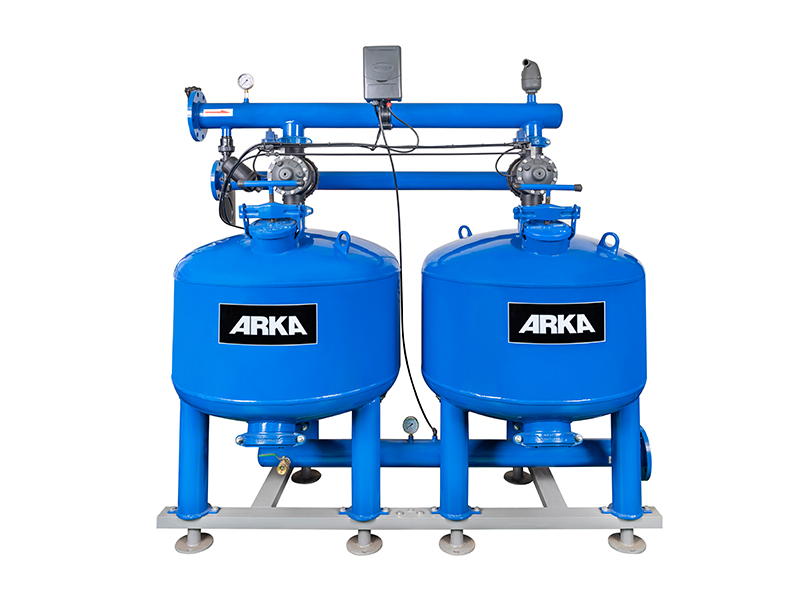
Next, you match this area to actual commercial equipment. Take the robust F40-2-1000mm Automatic Self-Cleaning system as a benchmark. A standard 40-inch diameter tank provides roughly 8.7 square feet of surface area. Dividing your required 30 square feet by 8.7 yields 3.4 tanks. Because you cannot install a fraction of a tank, you must round up. This specific farm would require a four-tank manifold utilizing 40-inch vessels to maintain optimal velocity and protect the drip lines.
A single-tank configuration is fundamentally flawed for agricultural use. Depth filtration systems cannot clean themselves without a secondary source of highly pressurized, purified water.
When a tank becomes dirty, the system reverses the water flow to flush the debris out. If you only have one tank, you would be flushing the sand with dirty source water, defeating the entire purpose. Therefore, systems are always built in pairs or larger manifolds. This configuration allows operational tanks to continue filtering clean water specifically to flush the dirty tank.
Sizing an irrigation setup is not solely about the volume of water moving toward your crops. A critical, yet frequently overlooked, component is ensuring the system can effectively clean itself. If a backwash sand filter cannot successfully purge trapped organic matter and silt, pressure will continuously drop until irrigation becomes impossible.
To maintain optimal efficiency, modern agricultural operations rely on an automatic sand filter to manage debris loads without constant human intervention. The self-cleaning process is triggered by a pressure differential switch.
As water flows top-down through the silica media, algae and dirt become trapped, creating resistance. The switch constantly monitors water pressure at the inlet manifold and compares it to the outlet manifold. When the system is clean, the pressure difference is minimal. However, as debris builds up, the inlet pressure rises while the outlet pressure drops.
Once the pressure differential reaches a predetermined threshold, the controller initiates the sequence. Hydraulic or pneumatic three-way valves shift, reversing the flow of water in one tank at a time. Clean water from the operational tanks is forced upward through the bottom underdrain of the dirty tank. This upward flow lifts and expands the sand bed, releasing trapped contaminants and flushing them out through a dedicated wastewater discharge line.
The flow rate required to properly lift and expand the sand bed is often significantly higher than the standard filtration flow rate per tank. Your main irrigation pump must have the capacity to meet this sudden demand.
If the pump is undersized, the water will lack the upward velocity needed to separate debris from the sand, leading to permanent media fouling known as mud-balling. Conversely, if the backwash flow is excessively high, valuable silica media will be blown out of the tank and lost through the flush line. When selecting your equipment, verify that your pump curve can deliver the required volume at the specific pressure needed to expand the sand bed by roughly 20 to 30 percent.
Even with accurate mathematical calculations, agricultural engineers and farm managers can make critical errors during the specification phase. Avoiding these common pitfalls ensures the longevity of your setup.
One of the most frequent mistakes is failing to account for friction loss, also known as head loss. As water navigates through complex pipe manifolds, three-way valves, and dense silica sand, it naturally loses kinetic energy.
A completely clean manifold typically induces a baseline pressure drop of 3 to 5 PSI. Furthermore, as the media captures biological contaminants throughout the irrigation shift, this resistance increases. By the time the system triggers a flush cycle, the pressure drop may reach 10 to 12 PSI.
If your irrigation pump is sized exactly to the pressure requirements of your drip tape, the addition of the filtration equipment will cause field pressure to drop significantly just before backwashing. This results in uneven water distribution and stressed crops at the end of the laterals. Always calculate your Total Dynamic Head by adding an extra 10 to 15 PSI to your pump requirements specifically to overcome this resistance.
Depth filtration is the ultimate solution for organic matter, algae, and lightweight suspended solids. However, if you are drawing water from a deep agricultural well that pumps heavy, inorganic sand and gravel, sending that water directly into a media tank is a costly mistake.
Heavy inorganic sand drives deep into the media, filling the voids and prematurely blinding the filter. Moreover, heavy well sand is incredibly difficult to lift and flush out during a standard backwash cycle because it is much denser than organic algae. In these scenarios, you must install a centrifugal sand separator upstream of the main tanks to spin out heavy particles first.
A properly sized filtration manifold does not operate in a vacuum. It must seamlessly integrate with the rest of your agricultural infrastructure. Finalizing your equipment specifications requires looking beyond the tanks themselves.
Standard professional practice requires the installation of a secondary filtration mechanism immediately downstream of the main media tanks. This is often referred to as a police filter. This is usually a screen or disc filter with a micron rating identical to the primary media's capability.
This backup system acts as a fail-safe insurance policy. If a lateral underdrain inside the media tank cracks due to a pressure hammer, silica sand could escape into the main lines. The downstream screen filter instantly captures this escaped media, preventing thousands of drip emitters from becoming permanently plugged.
When selecting your control unit, ensure it matches your farm's power availability. Advanced controllers log pressure differentials in real-time, ensuring backwash cycles only occur when absolutely necessary. This capability conserves thousands of gallons of source water annually. Specifically, if a system begins backwashing every 20 minutes, a smart controller can alert the farm manager to a potential algae bloom in the reservoir. This allows for immediate operational adjustments before crop damage occurs.
The size depends entirely on your maximum system flow rate and the quality of your water source. You must calculate the required surface area by dividing your peak flow rate by the recommended filtration velocity for your specific water type. Dirty surface water requires a slower velocity and larger tanks, while clean well water allows for smaller tanks.
Backwash flow rate is determined by the specific surface area of a single tank and the expansion requirements of the silica media. Typically, a standard agricultural tank requires a backwash velocity of 15 to 20 Gallons Per Minute per square foot to lift and clean the sand bed properly. You must check the manufacturer's specifications to ensure your main irrigation pump can meet this temporary surge in demand.
Typically, the media lasts between 3 to 5 years, depending heavily on the water quality and the frequency of the backwash cycles. Over time, continuous flushing causes the sharp edges of the crushed silica to wear down and become smooth. Once the media loses its angularity, its ability to trap fine dirt and microscopic organic matter diminishes, and it must be replaced.
No, a single-tank configuration is highly discouraged for agricultural applications. A proper self-cleaning system requires at least two tanks operating in parallel. The clean water produced by the operational tank is mathematically required to reverse flow and flush the dirty tank. Without a secondary clean water source, a single tank cannot effectively clean itself.
Screen filters utilize a physical, two-dimensional mesh to block particles. This surface filtration method clogs incredibly quickly when exposed to organic matter like algae. Media tanks rely on depth filtration. They use a thick, three-dimensional bed of crushed rock to trap massive amounts of organic matter, algae, and slime throughout the entire depth of the bed before requiring a cleaning cycle.
When the silica media is completely clean, the baseline pressure drop is typically between 3 to 5 PSI. As the system traps debris over the course of an irrigation shift, the resistance increases. Once the pressure drop reaches a differential of 10 to 12 PSI, the controller will detect the resistance and trigger a self-cleaning backwash cycle to restore normal pressure.
The frequency of the flush cycle is entirely dependent on the contaminant load of your water source. In relatively clean well water, the system may only backwash once every few days. In highly contaminated surface water, such as a stagnant pond with severe summer algae blooms, the system could backwash every few hours. This variability is exactly why sizing the total surface area based on specific water quality is so critical.
Do not let clogged emitters and poor water quality dictate your crop yields. Implementing a robust, properly sized filtration manifold is the most effective way to protect your irrigation investment. Whether you are pulling water from a deep well or a highly organic surface pond, selecting the right equipment is crucial. Explore the high-performance F40-2-1000mm Automatic Self-Cleaning Sand Media Filter and other advanced water treatment solutions at Arka Irrigation to ensure your fields receive clean, reliable water all season long.


