
Views: 0 Author: Site Editor Publish Time: 2026-10-20 Origin: Site


Imagine waking up to a sputtering shower head. You check your plumbing and discover a recent storm stirred up the aquifer. Thick mud has instantly blinded your home filtration system. Living with high sediment in well water is relentlessly frustrating. It silently ruins expensive water heaters. It clogs indoor fixtures. Worse, it forces homeowners into a never-ending cycle of buying replacement cartridges.
When standard surface filtration fails against extreme dirt and turbidity, upgrading to a heavy-duty solution is mandatory. A dedicated sand filter provides the ultimate defense against coarse sand, fine silt, and oxidized iron flakes. This guide shares field-tested engineering insights to help you evaluate your water profile and select the correct tank size, media type, and control valve for your specific residential or agricultural requirements.
Property owners dealing with heavy particulate matter often make a costly initial mistake. They rely on basic filtration methods. Understanding the mechanical limitations of these standard units is essential for establishing a reliable long-term water management strategy.
Melt-blown or pleated cartridge filters are engineered strictly for surface filtration. They force incoming water through a thin porous membrane to trap debris on the exterior layer. This mechanism works flawlessly for municipal city water or exceptionally light sediment. However, it transforms into a costly liability when attached to a well pumping heavy mud or coarse sand.
In high-turbidity environments, the limited surface area of a standard 10-inch or 20-inch cartridge blinds off entirely within days. Severe pressure drops then cripple the property plumbing network. Beyond the loss of water pressure, hidden costs accumulate rapidly. Constantly unthreading a heavy mud-caked housing to replace a fifty-dollar cartridge every weekend drains both your wallet and your free time.
To effectively process extreme particulate loads, a sand media filter serves as the industry-standard upgrade. Unlike surface-reliant cartridges, this robust equipment utilizes depth filtration. The system consists of a large pressurized vessel filled with carefully graded granular material.
As turbid water flows downward through the deep bed of media, debris is physically wedged and trapped throughout the entire depth of the tank. This three-dimensional capture zone holds massive quantities of dirt before any noticeable flow restriction occurs. The internal media can be washed and reused for years. Therefore, it stands as the most durable and cost-effective solution for high-sediment applications.
Before diving into the mechanics, we must address a growing reality in groundwater management. Shifting climate patterns and prolonged droughts are causing aquifer levels to fluctuate wildly. As water tables drop, well pumps draw from closer to the bottom of the casing, pulling in unprecedented levels of silt and fine sand.
Industry data shows a sharp increase in premature pump wear and residential plumbing failures due to these unpredictable sediment spikes. Consequently, water treatment professionals are rapidly moving away from passive cartridge systems. The modern standard demands active self-cleaning media systems capable of adapting to sudden changes in water turbidity without requiring constant human intervention.
The operational mechanics of these robust tanks rely on precise fluid dynamics. Rather than requiring physical disassembly, the system captures sediment and subsequently purges it through a three-phase self-cleaning cycle.
During normal daily operation, untreated well water enters through the control valve mounted at the top of the pressure vessel. A top distributor baffle disperses the incoming flow evenly across the surface of the media bed. As the water percolates downward, suspended solids including dirt, coarse gravel, and rusted iron particles become securely trapped between the jagged grains of sand. The purified water finally reaches the slotted lower distributor basket at the bottom, flowing up through a central riser tube to exit into your home plumbing.
The defining feature of this technology is its autonomous ability to clean itself. When the granular bed becomes saturated with trapped debris, a backwash sand filter initiates its purge sequence. The control valve mechanically reverses the internal fluid dynamics. Clean water is forced down the central riser tube and up through the bottom distributor.
This aggressive upward flow lifts and expands the heavy sand bed by approximately 30 to 40 percent. The turbulent agitation loosens the compacted mud. Because the trapped silt is significantly lighter than the dense filtration media, it is effortlessly carried upward and flushed out through a dedicated drain line. This action fully restores the tank filtration capacity.
Following the aggressive backwash phase, the valve seamlessly transitions into a brief rinse cycle. Water flows in the normal top-down direction but is directed straight to the drain rather than the property plumbing network. This crucial step compacts the disturbed sand bed back into its proper resting position. Furthermore, it purges any residual dirty water remaining in the tank to ensure only crystal-clear water enters your home.
Navigating modern filtration options requires matching the physical specifications of the filter to your specific well pump. Guessing these metrics often leads to catastrophic system failure.
The absolute most critical metric in selecting your equipment is your well pump maximum flow rate, measured in Gallons Per Minute. You can determine your GPM by performing a simple bucket test at your pressure tank or by consulting your pump technical documentation.
If you purchase a tank that is too small for a powerful pump, the high water velocity will blast sediment straight through the sand bed. This phenomenon is known as channeling. Conversely, installing a massive tank on a weak well pump means the system will lack the hydraulic force necessary to lift and agitate the heavy sand during the backwash cycle. Without proper bed expansion, the trapped mud will permanently solidify.
The specific granular material poured into the vessel dictates the system filtration precision. Standard silica sand remains highly effective for heavy coarse sediment, generally filtering down to the 20 to 40-micron range.
In addition, modern alternative media types offer superior performance. Highly porous materials like Filter-Ag provide massive surface area, catching finer silt down to the 10-micron range while weighing significantly less than sand. For the highest precision, crushed recycled glass media resists bacterial adhesion and filters down to 3 to 5 microns.
To simplify your decision-making process, review this direct comparison of common sediment management strategies used in the field today:
| Filtration Technology | Micron Rating | Maintenance Required | Best Application | Estimated Lifespan |
|---|---|---|---|---|
| Standard Cartridge Filter | 1 to 50 Microns | Weekly / Bi-weekly manual replacement | City water, extremely light sediment | Weeks to Months |
| Manual Sand Filter | 20 to 40 Microns | Manual valve operation every few days | Off-grid cabins, low-budget setups | 3 to 5 Years |
| Automatic Sand Media Filter | 5 to 40 Microns | Zero daily maintenance, fully automated | High-sediment well water, commercial agriculture | 5 to 10+ Years |
The control head mounted atop the pressure vessel dictates how the system initiates its vital cleaning cycles. Understanding how this impacts your daily routine is critical for long-term reliability.
A manual system utilizes a straightforward lever or rotary dial. To purge the accumulated dirt, the operator must physically walk to the tank, shift the valve to the backwash position, and monitor the drain line until the water runs clear.
These units boast a highly attractive upfront price point and require absolutely no electricity. They are the perfect solution for remote off-grid cabins. The primary drawback is human error. If a property owner forgets to actuate the valve for several weeks, the accumulated mud will compact into an impenetrable brick.
Upgrading to an automatic sand filter replaces the mechanical lever with a motorized programmable control head. Top-tier industrial models, such as the ARKA F40 Automatic Self-Cleaning series, utilize advanced volumetric water meters and pressure differential sensors to trigger the cleaning cycle without any human intervention.
Automation provides a true set-it-and-forget-it experience. You can program the high-flow cleaning sequence to occur at 2:00 AM, ensuring zero disruption to daytime household water pressure. For nearly all modern residential and commercial applications, this upgrade is strongly recommended to protect your investment from premature compaction.
While the core physics of trapping dirt remain identical, the scale and structural design of the equipment must adapt to the specific end-use application. Applying a residential tank to a commercial farm will result in immediate failure.
For residential properties, the primary objective is protecting delicate indoor infrastructure. Fine silt can effortlessly destroy washing machine impellers and build up at the base of expensive tankless water heaters. Residential setups typically utilize vertical fiberglass tanks designed to process flow rates between 7 and 15 GPM.
Farming operations face an entirely different engineering challenge. They must process massive volumes of surface or well water without restricting field flow rates. Heavy algae or coarse sand breaching the main line will rapidly clog micro-sprinklers and ruin thousands of feet of drip tape.
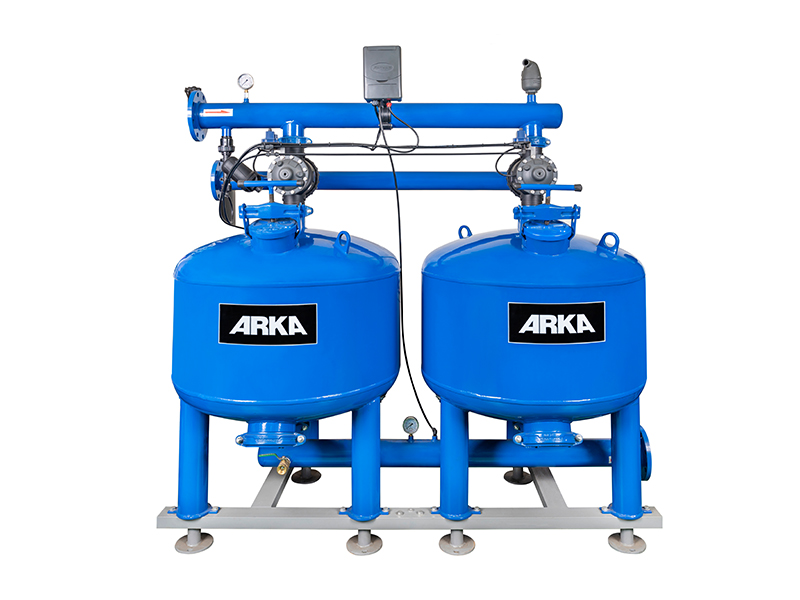
To manage these extreme demands, a purpose-built irrigation sand filter is required. These commercial-grade systems often utilize horizontal steel tanks or multi-tank manifolds operating in parallel. Specifically, equipment accommodating sizes from 2-inch up to massive 1000mm manifolds ensures absolute scalability for any agricultural layout. This intelligent array design allows one individual pod to backwash itself using clean water from the adjacent tanks, all while maintaining a continuous flow of water to the crops.
Complex well water profiles rarely present a single isolated issue. While granular media is exceptionally efficient at removing suspended solids, it operates most effectively when integrated into a broader multi-stage treatment strategy.
If your well pump is pulling up unusually large debris like small pebbles or heavy coarse sand, sending this directly into a media tank can quickly overwhelm the system. In these extreme scenarios, installing a spin-down centrifugal separator before the main tank acts as a heavy-duty shield. These simple devices use the centrifugal force of the incoming water to spin heavy boulders out of the water column.
It is vital to recognize that physical filtration media does not alter the chemical composition of your water. It will not remove dissolved calcium or dissolved clear-water iron.
However, removing the physical dirt is the mandatory first step before treating those chemical issues. Water softeners rely on highly sensitive ion-exchange resin beads. If heavy mud enters a water softener, it will coat and permanently destroy that expensive resin within weeks. By installing a robust sediment system first, you ensure only physically clear water reaches your secondary treatment equipment.
Even the highest-quality equipment requires adherence to strict plumbing guidelines. Proper physical installation is what separates a system that lasts fifteen years from one that fails in fifteen months.
A critical yet frequently botched aspect of installation is the drain line routing. When a water treatment filter cleans itself, it discharges water at a very high velocity. A single cycle can easily expel 50 to 150 gallons of water over a ten-minute period.
Routing this massive volume of water directly into a standard residential septic system is highly discouraged. The inorganic sand and heavy mud will settle at the bottom of the septic tank, disrupting the bacterial balance. The best practice is to route the rigid drain line outdoors to a dedicated dry well or a heavily wooded exterior drainage ditch.
Over years of constant agitation and hydraulic friction during the cleaning cycles, the jagged angular edges of the sand grains slowly wear down. Once the media becomes smooth and rounded, it loses its physical ability to grip fine micron particles.
Under typical conditions, the internal media should be extracted and replaced every three to five years. You will know it is time to perform a re-bedding service when you observe a permanent drop in household water pressure that does not improve after a cleaning cycle.
Dealing with high sediment does not have to be a daily nightmare when you invest in the right equipment. A properly sized sand filter provides a permanent heavy-duty solution that far outpaces the capabilities of standard surface cartridges. By accurately measuring your well pump flow rate, selecting the appropriate media, and opting for automated control valves, you can protect your plumbing infrastructure for decades. Do not let unpredictable well water ruin your home or crop yields. Evaluate your water profile today and explore professional-grade solutions at ARKA Irrigation to find the exact filtration manifold tailored to your specific flow requirements.
A: It will effectively remove oxidized rust-colored iron particles that have already formed into physical solids. However, it will not remove dissolved clear-water iron. If your water comes out of the tap clear but turns orange after sitting, you will need a dedicated iron filter installed after your sediment system.
A: The frequency depends entirely on your specific sediment levels and daily household water usage. It typically ranges from every three to seven days. Homes with exceptionally high sediment loads or large-scale agricultural applications may require cleaning every single day to maintain optimal flow rates.
A: If the pressure vessel is properly sized to match your well pump GPM output, the initial pressure drop is minimal. It usually hovers around 3 to 5 PSI when the media is clean. As the bed fills with trapped dirt throughout the week, the pressure will gradually decrease, serving as the mechanical cue that the system needs to initiate its self-cleaning cycle.
A: It is highly recommended to avoid standard pool sand. You should only use NSF-certified water treatment sand or specialized media designed specifically for potable drinking water. Pool sand is not strictly graded for home consumption safety and often lacks the precise angularity required to provide maximum filtration efficiency.
A: For a standard 10 GPM well pump, a 1.5 cubic foot media tank typically equipped with a 10-inch by 54-inch vessel is the ideal match. This size ensures the water velocity is slow enough to trap fine particles during normal operation while providing enough hydraulic lift to properly expand and clean the sand bed during the backwash cycle.
A: A standard residential backwash cycle lasts between 10 to 15 minutes and can discharge anywhere from 50 to 150 gallons of water depending on your pump flow rate. This high volume is exactly why routing the drain line away from delicate septic systems to a dedicated outdoor drainage area is critical for long-term property maintenance.


