
Views: 0 Author: Site Editor Publish Time: 2026-11-22 Origin: Site


Watching expensive filter media shoot out of a waste hose is a frustrating and costly scenario for many property owners. Incorrect maintenance procedures do more than just waste water. They cause severe media loss, damage internal lateral assemblies, and leave your water persistently cloudy. In this comprehensive technical guide, you will discover the exact engineering principles required to maintain your filtration system safely. By mastering fluid dynamics and equipment compatibility, you can keep your silica or glass media exactly where it belongs.
Filtration engineers use a specific term for the unintended ejection of sand, crushed glass, or zeolite from a vessel. When internal hydraulics become unbalanced during a cleaning cycle, Media Carry Over occurs. Instead of merely lifting trapped debris, the reversed water flow flushes the actual filtration media out through the waste port.
To truly grasp why sand escapes, you must visualize the fluid dynamics inside the heavy fiberglass or carbon steel tank. Reversing the water flow pushes a massive volume of water upward from the bottom laterals. This upward surge lifts and separates the compacted sand grains. This physical reaction is known as Bed Expansion. The empty space at the top of the tank is called the freeboard. It is meticulously engineered to accommodate this lift safely. If the upward velocity exceeds the tank's design limits, the expanded bed breaches the upper baffles and escapes.
Recent developments in water treatment and agricultural irrigation highlight a massive shift away from manual multiport valves. Relying on human operators to monitor pressure gauges often leads to delayed maintenance or over-washing. Consequently, the industry is rapidly adopting automated self-cleaning systems. Modern setups utilize differential pressure sensors that constantly monitor the resistance across the sand bed. Once the pressure drop reaches a critical threshold, automated hydraulic valves instantly reverse the flow. This eliminates human error, ensures the bed is never over-expanded, and drastically reduces water waste.
A widespread misconception in aquatic and irrigation maintenance is that filters require weekly flushing. In reality, a sterile sand bed is highly inefficient. You should rely entirely on hard data provided by your pressure gauge. Note the baseline PSI right after commissioning new media. As organic matter, silt, and microscopic dirt accumulate, water faces greater resistance. This drives the internal tank pressure up. Initiate a cleaning cycle only when the needle climbs exactly 10 to 15 PSI above that initial clean baseline.
Furthermore, secondary visual cues can confirm what your instrumentation indicates. If you place your hand in front of the return jets and feel a noticeably weak stream, the system is choking. Persistent water cloudiness, sudden algae blooms despite balanced chemistry, or a sluggish automatic vacuum are all practical indicators. They signal that water is struggling to penetrate a heavily compacted debris layer.
The single most destructive mistake an operator can make is failing to cut the power before adjusting the control valve. While running, a high-performance pump generates immense hydraulic pressure. This forces the rubber spider gasket into a watertight seal. Attempting to wrench the handle under this intense load will inevitably tear or unseat the gasket. Always flip the breaker or switch the pump off before applying any downward pressure to the diverter handle.
Specifically, before reversing the flow, secure your external drainage routing. Unroll the discharge hose completely, smoothing out any sharp twists. A blocked hose creates massive backpressure. This force can literally split vinyl tubing or shatter internal tank laterals. Ensure any manual isolation valves on the discharge line are fully open. Verify that your chosen drainage area can absorb hundreds of gallons of water rapidly without causing property damage.
With the equipment powered down and the drainage path clear, approach the control valve. Grip the handle firmly and press down to compress the heavy internal spring. Rotate it steadily until the pointer aligns perfectly with the backwash notch. Release the handle so it locks securely into place.
Restore power to the pump. Water will immediately surge backward through the system. For anyone learning How to Backwash Sand Filter mechanics, the clear plastic sight glass on the side of the valve is your primary diagnostic tool. Initially, the water swirling inside this glass will look like dark mud. Stand by the equipment and watch this glass intently. Depending on the debris load, this flushing phase takes roughly two to three minutes.
The exact second the water in the sight glass runs crystal clear, shut off the pump. Allowing the motor to run longer than necessary wastes hundreds of gallons of treated water. Prolonged agitation also unnecessarily grinds the sand grains together. This friction wears down their sharp edges and reduces their future filtering efficiency.
Perhaps the most detrimental omission in DIY maintenance is jumping straight from washing back to standard filtering. During the reverse flow, the sand bed is violently churned and left suspended. If you immediately resume standard operation, the sudden downward surge of water forces that unsettled sand straight through the lower laterals. The Rinse Cycle is specifically engineered to counteract this disaster. By directing water downward through the sand but routing the exit out the waste port, it physically compacts the media back into a tight, flat resting state.
Executing this protective measure requires strict adherence to the power-down rule. First, turn the pump off. Depress the valve handle and shift it to the rinse position. Turn the power back on and let it run for just 30 to 60 seconds. You might notice a brief burst of cloudy water in the sight glass before it clears. Turn the pump off one last time, rotate the valve back to the standard filter setting, and restore power.
Filtration systems are meticulously engineered for specific hydraulic loads. A catastrophic but common error is pairing a high-horsepower pump with a small-capacity tank. When the pump's output drastically exceeds the filter's design limits, the resulting Flow Rate violently disrupts the internal mechanics. The immense water velocity easily lifts the sand past the upper baffles, guaranteeing continuous media loss.
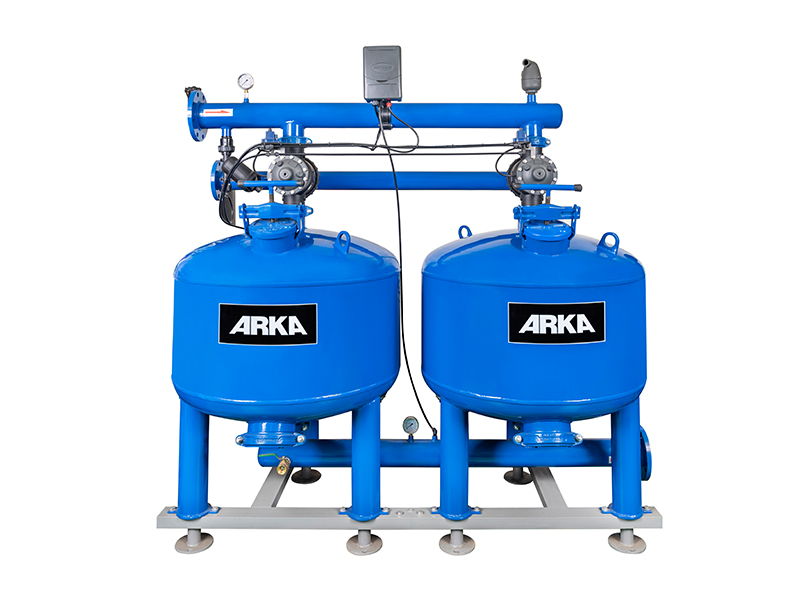
To combat these hydraulic mismatches, facility managers and agricultural operators are upgrading to commercial-grade vessels. For instance, systems like the Arka F40-2-1000mm Automatic Self-Cleaning Sand Media Filter are engineered specifically for heavy-duty water treatment and irrigation. Featuring a massive 1000mm tank diameter, these units are designed to handle aggressive flow rates while maintaining a perfect freeboard ratio. The integrated automated backwash valves ensure that upward velocity is perfectly calibrated. This prevents media blowout even under extreme commercial demands.
If you have verified your pump speed, stopped over-washing, and religiously flush the bed afterward, yet sand still accumulates in your clean water lines, mechanical failure is the culprit. At the very bottom of the tank sits a lateral assembly. This hub features slotted plastic tubes radiating outward. Over years of chemical exposure, these microscopic slots become brittle and crack. Once a lateral fractures, sand pours freely into the return lines. The only remedy is a complete tank excavation to replace the broken components.
Manufacturers calculate a highly specific media capacity for every model. They generally leave the top third of the vessel entirely empty. If a technician overfills the tank assuming more media equals better filtration, the bed has absolutely zero room to expand safely. Consequently, the system will aggressively eject the excess pounds of sand out of the waste port during the first few cleaning cycles until it naturally reaches its engineered freeboard level.
Mastering the art of maintaining your filtration equipment demands respect for the system's internal fluid dynamics. By always killing the power before shifting gears, strictly managing your water velocity, and never skipping that final compacting flush, you preserve both your equipment and your media. Following these robust operating procedures extends the lifespan of your internal components and guarantees a crystal-clear water supply. If you are designing a new water treatment or irrigation system and want to eliminate manual maintenance errors entirely, explore the advanced automatic self-cleaning sand media filters available at Arka Irrigation to secure a highly efficient, loss-free filtration setup.
The reverse flow process typically takes between 2 to 3 minutes. However, time is secondary to visual confirmation. You should continue the cycle until the water passing through the clear sight glass transitions from dark and murky to completely clear.
While a tiny amount of fine silica dust is normal during a media change, significant sand loss indicates a severe hydraulic imbalance. This is usually caused by a pump that pushes too much volume for the tank size, overfilling the vessel beyond the manufacturer's fill line, or upward velocity that is too aggressive for the specific media type.
Bypassing the rinse step leaves the sand bed violently disrupted and loose. The moment you switch back to standard filtration, the downward surge of water will push unsettled dirt and loose sand grains directly through the return jets, leaving a gritty mess in your clean water supply.
Absolutely. These systems actually perform better when slightly dirty. The initial layer of trapped oils and debris forms a matrix that helps catch even smaller microscopic particles. Cleaning the tank too frequently destroys this beneficial layer, leading to persistently cloudy water.
Yes, crushed glass is an excellent alternative that often provides finer filtration and resists bacterial channeling. However, glass is lighter than silica sand. You must carefully calibrate your pump speed during cleaning cycles to ensure the lighter glass media is not blown out of the waste line.
Normal operating pressure varies based on your specific pump and plumbing configuration, typically resting between 10 and 20 PSI when the media is brand new. The critical metric is not the starting number, but the differential: you should only initiate a cleaning cycle when the pressure rises 10 to 15 PSI above your specific clean baseline.


