
Views: 0 Author: Site Editor Publish Time: 2026-10-13 Origin: Site


Tired of constantly battling cloudy, lackluster pool water? The secret to achieving that resort-quality, crystal-clear shimmer usually hides deep inside your filter tank. Even premium sand eventually loses its sharp edges. Over time, it transforms from a powerful debris-catcher into smooth, ineffective pebbles.
In this comprehensive guide, we uncover exactly how long your silica media lasts under normal operating conditions. Furthermore, you will learn the microscopic science behind its degradation. We will also share actionable, professional maintenance secrets to maximize your equipment investment.
Before diving into the technical nuances of media degradation, here is a quick overview of what you need to know about your system's lifespan and maintenance requirements.
| Feature | Specification / Recommendation |
|---|---|
| Average Lifespan | 3 to 5 years under normal residential use |
| Core Material | 100% natural silica sand graded as #20 |
| Filtration Capacity | Traps debris as small as 20 to 40 microns |
| Primary Signs of Wear | Channeling, calcification, persistently cloudy water |
| Maintenance Secret | Routine backwashing and strict water chemistry balance |
To truly grasp how long your investment will last, you must first understand its composition and mechanical function on a microscopic level. Not all sand is created equal. Specific grading standards strictly dictate operational efficiency.
Effective pool water clarity starts with the raw material itself. This particular product is composed of pure natural silica. The industry explicitly grades this material as #20 silica sand. This classification means the grains are precisely sifted to a microscopic diameter spanning 0.45 to 0.55 millimeters.
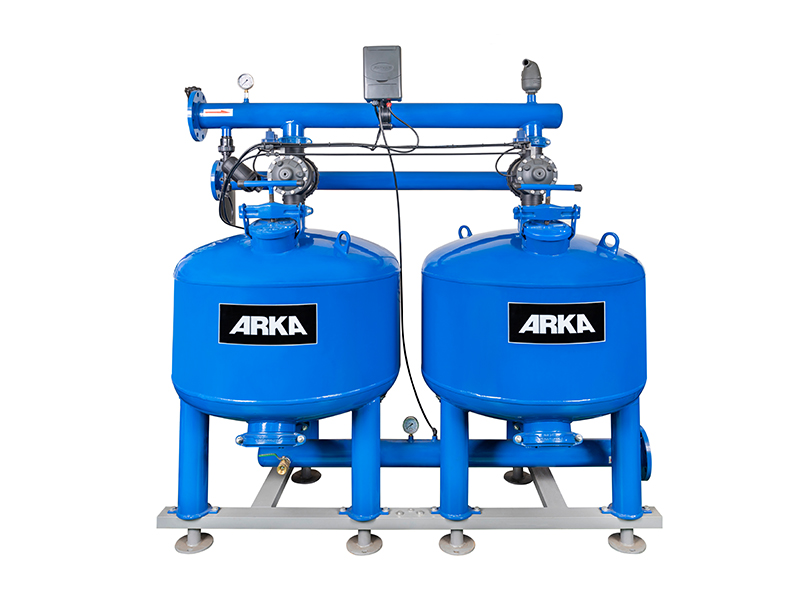
This specific diameter is far from arbitrary. It represents the mathematical sweet spot for any reliable water treatment filter. If the grains were any smaller, they would slip through the internal laterals and blow back into your swimming area. Conversely, if they were any larger, the gaps between the grains would be too expansive. Microscopic dirt and algae would pass through entirely unhindered. Industrial-grade systems, such as the ARKA F40-2 1000mm units, rely heavily on this exact specification to achieve optimal flow rates and hydraulic balance.
Picture opening a fresh bag of this product. The individual grains are incredibly rough. Under a microscope, they resemble jagged little rocks with sharp, irregular edges. As pressurized water is forced through the bed, these jagged edges act as microscopic hooks.
They effectively snag and hold particulate matter, organic waste, and debris as small as 20 microns. To put that into perspective, a single human hair is roughly 70 microns thick. These sharp edges are the primary reason the system works so beautifully. However, they are also the exact feature that weathers down over time, ultimately dictating the lifespan of the product.
When budgeting for seasonal maintenance, understanding the lifecycle of your materials is crucial. Fortunately, the longevity of this silica media is highly predictable when operated under standard environmental conditions.
Industry standards and decades of empirical data indicate that under normal residential use, this specific silica media will last between 3 to 5 years. During this period, the constant friction of water rushing over the bed slowly erodes those microscopic jagged edges. The abrasive action of routine cleaning accelerates this process. By year four or five, the grains become smooth and rounded, much like polished river rocks. Once this smoothing occurs, the bed can no longer trap fine particles. Your water clarity will inevitably suffer.
The 3 to 5-year benchmark relies heavily on the definition of normal use. In a standard residential setting, this implies running the pump for 8 to 12 hours a day during a typical summer swimming season. It also assumes an average family bather load and proper chemical balance.
Recent water treatment industry analyses highlight a distinct shift in media longevity. Global climate patterns now drive longer, hotter swimming seasons across many regions. Consequently, pumps are running longer. Bathers are introducing heavier loads of modern, water-resistant sunscreens and body oils. Field engineers note that these compounded factors push the average residential replacement cycle closer to the 3-year mark. Today, proactive maintenance is no longer optional; it is a mechanical necessity to keep your sand media filter operating safely.
While the physical erosion of silica is inevitable, several external variables can prematurely ruin your setup. These factors can force a labor-intensive replacement long before the expected 5-year mark.
Every time someone enters the water, they introduce a slew of organic contaminants. Sweat, cosmetics, hair products, and heavy layers of sunscreen are pulled into the skimmer and sent directly into the tank. Unlike regular dirt, which sits loosely between grains, oils act as a stubborn adhesive. Over time, these heavy organic loads cause the filtration media to clump together into greasy, solid masses. This drastically reduces its active surface area.
Water chemistry does not just protect your vinyl liner or plaster. It actively protects the delicate components inside your tank. Consistently high pH levels and elevated calcium hardness often lead to a severe, irreversible issue known as calcification. When water becomes over-saturated, calcium precipitates out and deposits directly onto the grains. Eventually, this turns the entire bed into a solid, rock-like block of limestone. Once calcification occurs, the material is permanently ruined and must be physically chiseled out.
You cannot physically observe degradation inside a sealed, pressurized steel or fiberglass tank. Therefore, field diagnosis relies entirely on operational symptoms. Here are objective indicators that your media has reached the end of its functional life.
The most obvious sign of exhaustion is water that simply will not clear up, despite absolute perfection in your chemical balance. If your chlorine, pH, and alkalinity are all locked into ideal ranges, yet the water remains milky or hazy, the internal media is almost certainly the culprit. The smoothed-out grains are allowing microscopic dirt to pass straight through the laterals and return to the pool.
Water is inherently lazy and will always seek the path of least resistance. When the bed becomes clumped by oils or hardened by calcium scale, pressurized water forces its way through narrow gaps. This creates deep tunnels known as channels. When channeling occurs, the water bypasses the majority of the bed entirely. You are effectively running the pump without filtering the water at all.
Under optimal conditions, a clean system should operate for several weeks before requiring maintenance. If you find yourself needing to utilize the backwash filter function every few days just to maintain normal water return flow, your setup is heavily compromised. This indicates the bed is so packed with permanent debris or grease that it can no longer sustain standard hydraulic pressure.
Your pressure gauge is an invaluable diagnostic tool. After adding fresh material, you should note the clean baseline pressure, usually between 10 and 15 PSI. Normally, you clean the system when the pressure rises 8 to 10 PSI above that baseline. If you perform a thorough cleaning cycle and the gauge immediately returns to a high reading upon restarting, the bed is permanently compacted.
Replacing the contents of a heavy tank is a labor-intensive chore. To ensure you get the absolute maximum lifespan out of your investment, strictly implement these professional maintenance protocols.
Proper cleaning mechanics are critical. Reversing the flow of water lifts the bed and flushes trapped dirt out of the waste line. However, over-cleaning is a surprisingly common mistake. Frequent flushing prevents the system from reaching its peak efficiency, as a slightly dirty bed actually traps smaller particles than a perfectly clean one.
For those looking to eliminate human error entirely, upgrading to an automatic sand filter can be a game-changer. Advanced systems, like the ARKA F40 series, initiate cleaning cycles based on precise, real-time pressure sensor readings rather than guesswork. This ensures the media is only disturbed when absolutely necessary.
Standard hydraulic flushing only removes loose dirt. It does absolutely nothing to remove baked-on body oils, sunscreen, or mineral scale. As a best practice, use a specialized chemical degreaser once a year, typically at the end of the swimming season. These industrial solutions are poured into the tank and left to soak for 24 hours. They strip away organic buildup and rejuvenate the silica.
When the time finally comes to swap out the exhausted material, approaching the task with a systematic engineering methodology ensures the safety of your delicate internal equipment.
Before initiating any maintenance on a pressurized system, safety must be the primary focus. Begin by completely disconnecting the power to your pump at the main electrical breaker. Next, locate the air relief valve on top of the tank and open it to depressurize the system. Finally, remove the drain plug located at the bottom. Allowing the water to drain completely is crucial. Wet silica is exceptionally heavy and difficult to maneuver.
Extracting the old media requires patience and the right tools. A heavy-duty wet vacuum is your best friend here. Attempting to scoop it out with a metal shovel introduces a severe risk of cracking the internal plastics. Vacuum it out in layers. If you encounter hard clumps due to calcification, gently break them apart with your hands or a blunt wooden stirrer.
Proper installation dictates how well your system will perform over the next half-decade. First, cover the open top of the central standpipe with heavy-duty duct tape so nothing accidentally falls inside. Crucially, fill the empty tank halfway with water before pouring anything in. This water acts as a vital shock absorber. Pouring fifty pounds of dry weight directly onto unprotected plastic laterals will almost certainly crack them.
| Filter Tank Diameter | Approximate Media Required | Number of 50 lb Bags Needed |
|---|---|---|
| 16 inches | 100 lbs | 2 bags |
| 19 inches | 150 lbs | 3 bags |
| 22 inches | 250 lbs | 5 bags |
| 24 inches | 300 lbs | 6 bags |
| 30 inches | 600 lbs | 12 bags |
Note that these figures represent industry averages. Always verify the exact weight requirement printed on the manufacturer data plate of your specific tank.
When evaluating options for residential and commercial setups, owners typically choose between three distinct technologies: sand, cartridge, and diatomaceous earth. While cartridge and diatomaceous earth offer finer micron capabilities, traditional silica remains the undisputed industry standard for excellent reasons.
The primary advantage is its exceptional cost-to-lifespan ratio. Diatomaceous earth systems require the addition of new powder every single time the system is cleaned, creating a continuous expense. Cartridge systems avoid this but require expensive replacement pleated paper elements every one to two years. In stark contrast, silica media is highly affordable upfront and provides years of continuous service with zero recurring material costs.
No, you cannot wash and reuse old media to extend its lifespan indefinitely. The fundamental mechanism relies on the microscopic, jagged edges of the grains to physically snag and trap dirt. Over three to five years of continuous water flow, this weathering process slowly erodes the sharp edges, turning them into smooth spheres. While reversing the flow successfully flushes out trapped dirt, it cannot restore the eroded physical structure. Once smooth, it must be entirely replaced.
The exact amount required is dictated entirely by the diameter and manufacturer specifications of your specific tank. As a general guideline, a small 16-inch tank requires about 100 pounds, while a standard 24-inch tank typically requires 300 pounds. It is imperative that you do not guess this amount. Check the data plate affixed to the side of the tank. Adding too much will cause the system to over-pressurize and forcefully eject the excess directly into your pool.
Yes, advanced automated systems are engineered to handle routine cleaning without human intervention. These systems utilize electronic pressure transducers that constantly monitor internal differential pressure. Once the pressure reaches a pre-programmed threshold, the system controller activates a motorized multi-port valve to flush the debris, rinse the bed, and return to standard mode. This ensures cleaning happens at the precise moment it is needed.
Yes, #20 grade silica is universally compatible with virtually all standard residential and commercial brands. It is manufactured from pure natural silica and is strictly graded to span 0.45 to 0.55 millimeters. This precise sizing ensures it is large enough not to fall through internal laterals, yet small enough to create a tightly packed bed capable of trapping fine particulate matter safely and effectively.
The most definitive sign of a broken lateral is a constant stream of sand returning into the swimming pool through the return jets. If you vacuum the floor and notice a fresh pile of silica accumulating directly beneath the return jets a few hours later, one or more plastic laterals at the bottom of the tank have cracked and must be replaced immediately.
Absolutely not. Play sand and construction sand are completely different materials. They are not sifted to uniform sizes and contain massive amounts of fine dust and impurities. Using construction sand will instantly clog your laterals, destroy your water clarity, and potentially burn out your pump motor due to extreme hydraulic resistance.
Silica media offers incredibly durable, predictable performance, keeping your backyard oasis or commercial facility crystal clear for years. While it is a robust material, understanding that its lifespan is finite empowers you to stay ahead of water clarity issues before they trigger costly downtime.
Ultimately, proper engineering and maintenance are the true secrets to long-lasting equipment. By mastering your cleaning cycles, maintaining flawless chemical balance, and monitoring your pressure gauges, you ensure that your system operates at peak efficiency. If you are battling persistently cloudy water, or if you are ready to upgrade to a maintenance-free setup, it is time to take action. Explore high-performance, professional solutions like the ARKA F40-2 1000mm Automatic Self-Cleaning systems at ARKA Irrigation. Investing in reliable automation ensures a clean, safe, and beautiful water environment with minimal manual labor.


