
Views: 0 Author: Site Editor Publish Time: 2026-10-14 Origin: Site


Imagine walking your field in mid-July only to find an entire row of premium crops wilting under the summer sun. Your pump is running perfectly. The mainline is fully pressurized. Yet, the plants are bone dry. Discovering that your crops are dying because of clogged drip lines is the ultimate frustration for farmers and landscapers. Drip irrigation systems rely on microscopic passageways to deliver water efficiently. This precise engineering makes them highly susceptible to blockages from high-sediment water, algae, and organic debris.
The strongest line of defense against this hidden threat is a high-quality disc filter. Basic mesh screens merely catch large particles on a flat surface. This advanced technology utilizes depth filtration to trap significantly more debris. By capturing contaminants at multiple layers, it extends the life of your entire irrigation infrastructure. This comprehensive guide breaks down exactly how these specialized units work. We will compare the different configurations available and help you select the perfect setup for your agricultural or landscaping needs.
Key Takeaways
To truly understand the necessity of a reliable drip irrigation filter, we must first examine the delicate mechanics of the delivery system itself. Drip irrigation is celebrated for its incredible water efficiency. However, that exact precision creates inherent vulnerabilities to waterborne contaminants.
Modern emitters deliver water directly to the root zone at a highly calculated rate. To achieve this ultra-low flow, water forces its way through a complex internal labyrinth. This winding pathway creates turbulent flow. It bleeds off water pressure and regulates the output to a steady drip. The physical passageways within these emitters are microscopic. They often measure less than a single millimeter in diameter. Because these orifices are frequently smaller than a grain of fine sand, any particulate matter slipping into the mainline has a high probability of lodging squarely inside the labyrinth. Once a single particle gets stuck, it acts as a microscopic dam. It captures smaller particles behind it until the emitter is entirely choked off.
Agricultural water is rarely pristine. Depending on whether you draw from an aquifer or a surface reservoir, different contaminants threaten your infrastructure. Sand, silt, and grit are notorious in well water and boreholes. These inorganic, rigid particles easily wedge into emitter labyrinths, causing immediate and stubborn physical blockages. Ponds, rivers, and open canals introduce biological matter. These are breeding grounds for algae, moss, and decaying plant material. This organic debris is soft, slimy, and incredibly problematic. It easily squeezes through standard mesh screens under pressure. Furthermore, groundwater often contains dissolved calcium, iron, and manganese. Chemical precipitates can bind with trapped sediment to cement clogs permanently in place.
Operating a micro-irrigation system without adequate protection leads to cascading economic consequences. When emitters clog, field water distribution becomes severely uneven. Certain zones become waterlogged. Meanwhile, other areas suffer devastating drought stress. This directly reduces crop yields and compromises plant health. Clogged drip tape is notoriously difficult to clean. Farmers are frequently forced to rip out and replace entire sections of their irrigation lines mid-season. This incurs heavy material costs and demands intensive manual labor.
To combat the severe vulnerabilities of drip emitters, agricultural engineers developed specialized filtration technology. This system represents a massive leap forward from traditional mesh screens. It provides robust protection against both hard grit and sticky organic contaminants.
The core component of this technology is a dense stack of synthetic, heavy-duty plastic rings. Each individual ring is injection-molded with microscopic, diagonal grooves on both sides. When hundreds of these rings are stacked tightly together on a central spine and compressed, the intersecting grooves create a complex, three-dimensional network of tiny passageways. The physical size of these grooves determines the precise filtration grade. Because the plastic is rigid, the grooves do not stretch or distort under high water pressure. For example, a standard 2-inch industrial unit typically handles maximum operating pressures up to 10 bar. This ensures absolute filtration accuracy at all times without structural deformation.
Understanding why this irrigation disc filter technology dominates the agricultural sector requires distinguishing between surface and depth filtration. Standard screen filters operate on a two-dimensional plane. Water hits a flat mesh, and debris larger than the holes is stopped on the surface. While adequate for hard particles like sand, soft organic matter like algae will simply smear across the mesh. It deforms and extrudes right through the holes under the force of the water pump.
In contrast, stacked grooved rings operate in three dimensions. As water is forced through the tightly compressed stack, it must navigate a tortuous maze of intersecting grooves. Debris is not just trapped on the outer edge. It is caught at various depths deep within the matrix. This thickness allows the unit to effectively capture and hold stringy algae and organic sludge. It prevents the slime from slipping through to the delicate emitters.
The operational flow is elegantly simple yet highly effective. Unfiltered water enters the main housing. It is directed to flow from the outside of the compressed stack toward the hollow center. As the water navigates the grooved pathways, sediment and algae become trapped within the labyrinth of plastic rings. Finally, the perfectly clean water reaches the central hollow spine and exits the housing, traveling safely downstream to nourish the crops.
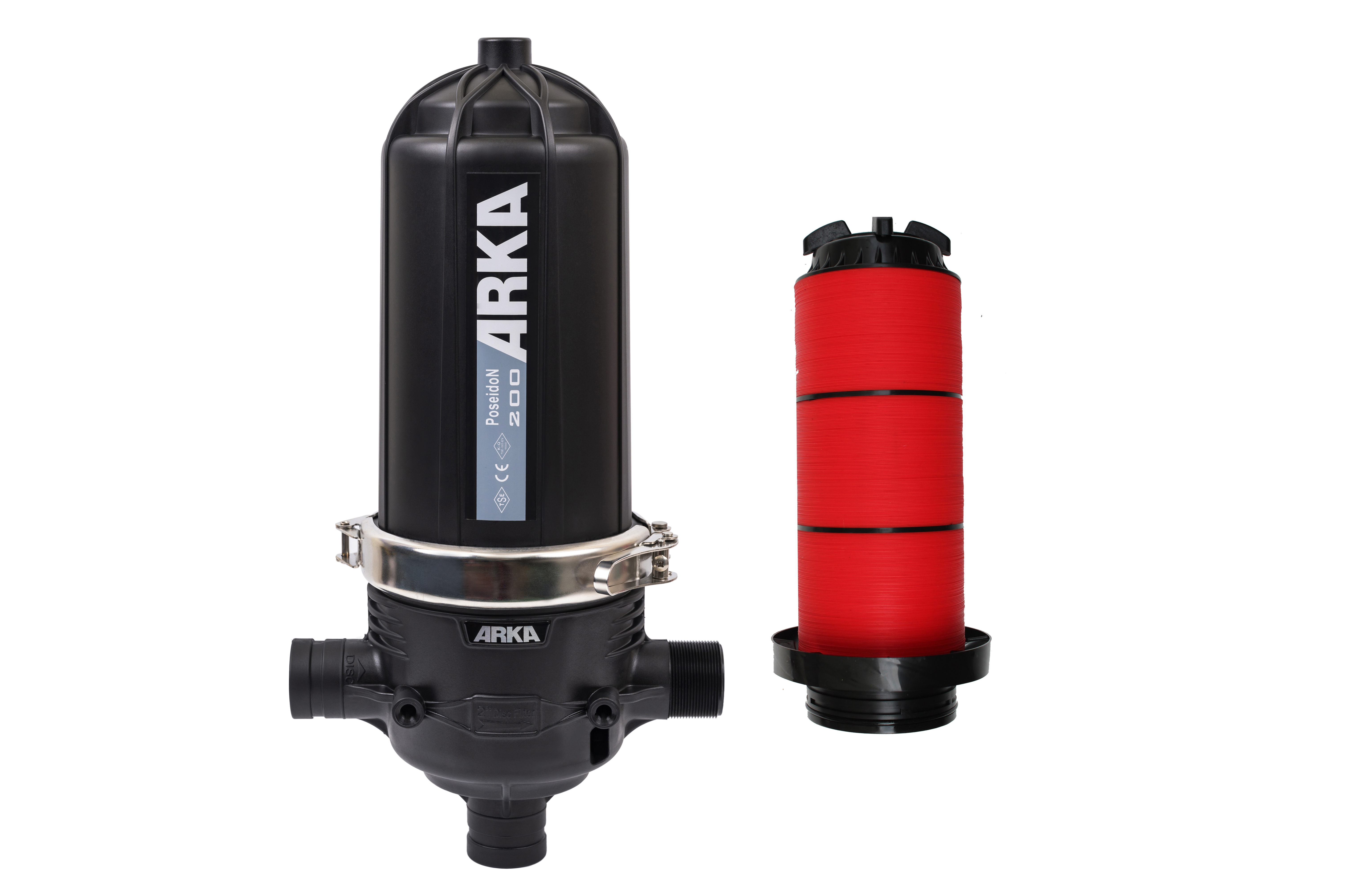
Filtration requirements vary wildly depending on the scale of the farm, the quality of the water, and the available labor force. Consequently, manufacturers have developed several distinct configurations to meet these diverse operational demands.
Manual units are the standard, cost-effective choice for residential landscaping, commercial greenhouses, and small-to-medium agricultural plots. In these systems, the internal stack remains permanently compressed during operation. When the unit reaches its maximum dirt-holding capacity, an operator must physically intervene. This involves shutting down the pump, depressurizing the line, unscrewing the housing, and removing the central spine. The operator then loosens the rings and thoroughly washes the debris away with a hose. While highly effective at protecting crops, they require dedicated physical maintenance.
For large-scale commercial agriculture or systems drawing from highly contaminated surface water, manual cleaning quickly becomes an unsustainable labor burden. Here, self-cleaning technology is the industry standard. These sophisticated systems monitor the pressure differential between the inlet and outlet. When the internal matrix becomes loaded with debris, the outlet pressure drops. A controller detects this head loss and instantly triggers a backwash cycle. The system temporarily reverses the water flow and mechanically decompresses the stack. It spins the rings rapidly using specialized high-pressure nozzles. The combination of centrifugal force and reverse water flow violently flushes the trapped debris out through a dedicated waste valve in a matter of seconds. Normal irrigation then resumes automatically.
The physical geometry of the housing dictates how the unit integrates into your existing plumbing. A Y type disc filter features a housing that branches off the main pipeline at a distinct angle, resembling the letter Y. This configuration is incredibly popular for manual applications. It can be seamlessly installed in a straight run of pipe. More importantly, the internal cartridge can be easily extracted for cleaning without having to dismantle the surrounding PVC or poly tubing.
Alternatively, T-Type or angle designs force the water to enter at a right angle to the filter element. A commercial 2-Inch T-Type disc filter is engineered for heavy industrial and agricultural setups. These units comfortably manage flow rates around 25 to 30 cubic meters per hour. They are frequently utilized in larger, multi-filter manifolds and automated setups where space optimization and highly specific hydraulic flow patterns are required.
When engineering an irrigation layout, operators typically weigh three main filtration technologies. Understanding how stacked ring technology compares against the alternatives is crucial for making an informed, long-lasting investment.
| Feature | Disc Filter | Screen Filter | Sand Media Filter |
|---|---|---|---|
| Filtration Method | 3D Depth Filtration | 2D Surface Filtration | 3D Depth Filtration |
| Organic Matter Handling | Excellent. Traps algae deep in grooves. | Poor. Algae smears and pushes through. | Excellent. Very high holding capacity. |
| Footprint & Space | Compact and modular. | Very compact. | Massive. Requires heavy steel tanks. |
| Backwash Water Usage | Very Low. Fast spin cycle. | Low. | Very High. Needs sustained high pressure. |
Screen filters utilize a stainless steel or nylon mesh to catch debris. They are generally inexpensive and perform adequately for clean municipal water containing only occasional hard grit. However, screens are easily blinded by biological loads. The depth filtration of grooved rings traps algae within its multi-layered grooves. This maintains consistent water flow much longer and prevents soft organics from breaching the defenses.
Sand media systems use massive steel or fiberglass tanks filled with crushed silica or basalt to filter water. Historically, they offered the highest level of organic filtration for extremely dirty surface water. However, they require massive amounts of water and high pressure to execute a backwash cycle. Modern automated ring systems clean themselves using a fraction of the water and energy.
Global agricultural practices are undergoing a massive transformation driven by severe water scarcity. Farms are rapidly abandoning traditional flood irrigation in favor of precision micro-irrigation. This shift demands vastly superior water quality. Consequently, agricultural engineers are observing a distinct industry trend. Large-scale operations are transitioning away from bulky, water-heavy sand media tanks.
Instead, the market is aggressively adopting compact depth-filtration technologies. Labor shortages make manual filter cleaning and sand replacement economically unviable. Modern automated stacked-ring modules offer near-equivalent organic depth filtration but in a modular, lightweight, and highly cost-effective footprint. They preserve precious water resources during backwash cycles while ensuring absolute micron precision for delicate emitter labyrinths.
Selecting the correct equipment is not a matter of guesswork. It requires a calculated assessment of your specific hydraulic parameters. An improperly sized unit will either fail to protect your emitters or cause excessive pressure drops that starve your crops of water.
Filtration precision is measured in microns or mesh. To simplify the selection process, the irrigation industry universally utilizes a color-coded system for the grooved rings. This visual standard allows operators to quickly identify the filtration grade. For standard drip irrigation, emitter manufacturers generally recommend filtering water to 120 or 150 mesh to prevent clogging. Common industry color codes include Blue for 400 Micron coarse pre-filtration, Yellow for 200 Micron landscape spray heads, Red for 130 Micron standard drip tape, and Black for 100 Micron ultra-low flow emitters. Always consult the technical specifications provided by your drip tape manufacturer before making a selection.
A common operational error is sizing the housing based merely on the diameter of the existing pipeline. Instead, sizing must be dictated by the maximum flow rate the system will experience, measured in gallons per minute or liters per hour. If you push 100 gallons per minute through a unit rated for only 50, the water velocity increases drastically. This high velocity forces debris deep into the grooves under immense pressure. It makes the unit nearly impossible to clean while causing a severe pressure drop. Determine the total flow rate of your largest irrigation zone and select a model that accommodates that volume comfortably.
The origin of your irrigation water dictates the physical design and automation level required. For clean sources like deep aquifers that primarily carry trace amounts of sand, a manual unit is economically prudent. However, drawing from a pond or open canal means the biological load is exponentially higher. Relying on manual cleaning becomes a massive labor burden. Upgrading to an automatic disc filter is a practical necessity for surface water. It ensures continuous flow to your crops without requiring a farmhand to disassemble plumbing multiple times a day.
Even the most precisely engineered hardware requires systematic maintenance to retain its depth filtration capabilities. Implementing a strict maintenance protocol protects your crop yields by ensuring uniform water distribution. It also extends the lifespan of the equipment itself.
Attempting to clean the unit improperly can damage the delicate plastic grooves or compromise the housing seals. Never attempt to open a housing while the pump is active. Turn off the water source and open a downstream flush valve to bleed all residual pressure. Carefully unscrew the outer housing cover. Remove the central spine that holds the stacked rings. Loosen the tension nut at the top of the spine to allow the rings to separate and spin freely. Do not remove them completely from the spine. Using a standard hose with a high-pressure nozzle, direct a strong stream of clean water at an angle against the loosened rings. Spin them manually while spraying to flush out trapped algae and sediment. Tighten the tension nut, apply a thin layer of silicone-based lubricant to the O-ring to ensure a watertight seal, and reassemble the housing.
Relying on a fixed calendar schedule is an inefficient way to manage maintenance. Water quality fluctuates based on weather and seasonal algae blooms. The only scientifically accurate method to determine when cleaning is required is by monitoring the pressure drop. Install liquid-filled pressure gauges on both the inlet and outlet sides. When clean, the pressure reading should be nearly identical. As debris accumulates, the inlet pressure rises while the outlet pressure drops. Industry best practices dictate that manual units should be cleaned when the pressure differential reaches between 5 and 10 PSI.
For operations located in regions that experience freezing temperatures, winterization is a non-negotiable end-of-season procedure. The heavy-duty plastics used in agricultural filtration cannot withstand the expansive force of freezing water. If water is left inside during a hard freeze, the housing will shatter. Shut down the main supply and open the bottom drainage port to allow all standing water to escape. Remove the internal cartridge entirely. Clean the rings thoroughly so organic matter does not cement itself into the grooves over the winter. Store the dry cartridge indoors in a climate-controlled environment.
Protecting your delicate drip emitters is arguably the most critical step in ensuring a successful, water-efficient irrigation system. Traditional screen filters have their place in basic applications. However, they simply cannot handle the rigors of organic matter and heavy sediment loads. By utilizing advanced depth filtration, you create an impenetrable barrier that stops both hard grit and slimy algae dead in their tracks.
Whether you manage a small commercial greenhouse or hundreds of acres of row crops, evaluating your water source carefully today will save you from the devastating costs of clogged lines tomorrow. Browse the professional selection of manual and automated filtration solutions at Arka Irrigation to safeguard your crops this season. Invest in the right equipment for lasting agricultural success and unmatched water efficiency.
Generally, 120 to 150 mesh, which translates to 130 to 100 microns, is recommended by most drip tape and emitter manufacturers. This specific filtration grade is fine enough to capture microscopic particles that cause emitter blockages. Yet, it remains coarse enough to prevent the system from experiencing rapid pressure drops and requiring constant maintenance. Always verify the specific micron requirements printed on your drip line specifications.
Yes. Because of their three-dimensional depth filtration design, these units are highly effective at trapping algae and organic matter. Traditional screen filters rely on surface filtration. This often allows soft, stringy organic matter like algae to deform and squeeze right through the mesh under pressure. The intersecting grooves of stacked rings trap this organic matter at multiple depths, preventing it from reaching your fields.
It depends entirely on your water quality and the biological load of your source. It could be once a week for clean well water, or once a day for surface water during a summer algae bloom. Installing pressure gauges before and after the unit is the most accurate way to know. You should initiate a cleaning cycle when the pressure drops by 5 to 10 PSI between the inlet and outlet gauges.
If you are drawing water from a highly contaminated source like a river, canal, or pond, or running a large-scale agricultural operation, the investment is highly justified. The labor costs saved by eliminating daily manual cleaning are substantial. Combined with the protection of crop yields through consistent, uninterrupted water delivery, an automatic backflushing system typically pays for itself within the first few growing seasons.
The most reliable indicator is a noticeable drop in water pressure and flow rate at your drip emitters. If certain zones are taking longer to water or plants are showing drought stress despite the pump running, a clog is likely. Mechanically, checking the pressure gauges on either side of the filter housing will confirm this. A pressure differential greater than 10 PSI indicates a severe clog requiring immediate cleaning.
It is generally not recommended unless you have significant elevation drop. These filters require a minimum operating pressure to force water through the tightly compressed grooved rings effectively. Gravity-fed systems often lack the necessary pressure, resulting in restricted flow. For very low-pressure gravity setups, a coarse screen filter or a specialized low-pressure filtration unit is usually a better hydraulic match.


