
Views: 0 Author: Site Editor Publish Time: 2026-10-18 Origin: Site


Is your pond water destroying your irrigation system? Utilizing a surface water source for your garden or farm is an excellent strategy to conserve municipal water. It also slashes utility costs significantly. However, this dynamic ecosystem is notoriously challenging to manage. Untreated surface water quickly clogs tiny emitters with algae, silt, and biological waste.
Without the right pond water filtration, the microscopic labyrinths in your drip lines will succumb to blockages almost instantly. In this comprehensive guide, we will explore the specific engineering challenges of using surface water. We will also evaluate various filtration technologies. Finally, we will explain why investing in a robust, automated setup is the ultimate secret to a highly efficient, clog-free irrigation network.
Implementing a surface water source presents a distinct set of engineering challenges. Ponds offer an abundant, nutrient-rich water supply. Yet, their raw water quality is fundamentally incompatible with the precision engineering of micro-irrigation components. Establishing a reliable system requires a foundational understanding of why treating this water is a strict mechanical necessity.
To fully grasp the necessity of robust filtration, one must first examine the mechanics of a drip emitter. Modern emitters are highly engineered devices designed to deliver water at precise, low flow rates. These rates typically range from 0.5 to 2.0 gallons per hour. To achieve this slow drip, water is forced through a microscopic, turbulent flow path often referred to as a labyrinth.
The orifices within these labyrinths generally measure between 0.5mm and 1.2mm in diameter. Because the flow path is intentionally turbulent to regulate pressure, any particulate matter that enters is highly likely to become lodged in the sharp turns. Once a single particle anchors itself, subsequent debris rapidly accumulates. This chain reaction results in a complete and irreversible blockage.
In practical terms, the financial and operational implications of clogged drip lines extend far beyond the cost of replacement hardware. Imagine walking your agricultural rows mid-summer, only to find half your crop wilting despite the pump running at full capacity. When emitters become blocked, the system Coefficient of Uniformity plummets. This means plants receive highly variable amounts of water and fertigation nutrients.
Uneven watering translates directly to inconsistent crop yields, localized drought stress, and potential plant mortality. Furthermore, the labor hours required to manually walk the fields, diagnose blocked emitters, flush lines, and splice in replacement drip tape can quickly negate the utility savings gained by using pond water in the first place.
Beyond the physical hardware in the field, an irrigation system is a significant capital expenditure. It encompasses pumps, mainlines, solenoid valves, and pressure regulators. Effective filtration acts as a comprehensive insurance policy for this entire infrastructure. By removing abrasive inorganic materials and sticky organic matter at the source, you prevent premature wear on pump impellers. You also stop automated valves from sticking open and guarantee that the terminal drip emitters function for their full engineered lifespan.
Unlike municipal water or deep aquifers, a pond is a dynamic, living ecosystem. The water quality fluctuates dramatically based on temperature, agricultural runoff, aquatic life, and weather patterns. Identifying the specific types of particulate matter suspended in your surface water is the critical first step in selecting the appropriate filtration mechanism.
Biological matter is universally recognized as the most difficult contaminant to filter in micro-irrigation systems. Farm ponds and retention basins are breeding grounds for various forms of algae, suspended organic sludge, decaying plant matter, and fish waste.
The primary challenge with organic matter lies in its physical structure. Algae is soft, gelatinous, and highly compressible. When drawn into a standard mesh screen under pump pressure, it does not simply bounce off. Instead, it extrudes and smushes through the microscopic holes of the mesh. What remains on the surface forms a dense, impermeable biofilm that rapidly blinds the filter, causing severe pressure drops within minutes of operation.
In contrast to biological threats, inorganic contaminants consist of non-living, mineral-based particles. Sand, silt, and clay are frequently suspended in the water column. This is especially true after heavy rainfall, high winds, or when the intake suction is placed too close to the pond bottom.
While inorganic matter does not form sticky biofilms, its abrasive nature causes severe mechanical damage. High-velocity sand particles act like liquid sandpaper, eroding pump impellers and scoring the internal seals of automated valves. Silt and clay, being exceptionally fine, can also settle in the lowest points of the drip lines during off-cycles. Over time, these sediments solidify into concrete-like blockages.
Filtration demands are rarely static. They vary significantly throughout the calendar year, requiring a system capable of handling peak contaminant loads.
| Season | Primary Contaminant Risk | Impact on Irrigation System |
|---|---|---|
| Spring | Pollen, early algae growth, suspended silt from spring rains | Moderate risk; requires frequent monitoring of pressure differentials. |
| Summer | Severe algae blooms, high biological activity, insect larvae | Maximum risk; rapid filter blinding; high demand for automatic backwashing. |
| Autumn | Falling leaves, decaying aquatic vegetation, organic sludge | High risk of intake blockages; increased large particulate load. |
| Winter | Minimal biological activity, settling of suspended solids | Low risk; focus shifts to winterization and preventing freeze damage. |
As global agriculture faces unprecedented water scarcity, field engineers are witnessing a massive shift in how growers approach irrigation. Reliance on municipal and deep-well water is decreasing rapidly. Meanwhile, the utilization of surface water from retention ponds and reclaimed wastewater is sharply rising. This transition has sparked a revolution in filtration technology.
Recent market trend analysis indicates that commercial operations are aggressively abandoning manual filtration methods. Instead, they are pivoting toward fully automated, pressure-differential-driven systems. The primary driving force behind this trend is labor optimization. Growers have realized that the recurring labor costs associated with manually scrubbing screen filters far outweigh the initial capital expenditure of automated deep-bed media systems. Furthermore, modern precision agriculture demands absolute pressure stability to deliver liquid fertilizers uniformly. This is a crucial metric that only self-cleaning filtration arrays can consistently guarantee.
The agricultural market offers several distinct drip irrigation filters. However, evaluating them objectively for surface water applications reveals significant disparities in performance, maintenance requirements, and overall efficacy.
Screen filters utilize a stainless steel or heavy-duty plastic mesh to physically block particles larger than the mesh openings. They operate on the principle of surface filtration, meaning all debris is trapped on a single, two-dimensional plane.
While they are highly cost-effective and excellent for clean well water, they are exceptionally vulnerable to organic matter. If you have ever pulled a screen filter from a pond system mid-July, you know it quickly resembles a green, slimy cylinder. Because they rely on a single surface area, algae smears across the screen, typically requiring manual scrubbing on a daily basis.
Disc filters consist of hundreds of tightly stacked, color-coded plastic rings featuring microscopic diagonal grooves. When compressed together, these grooves intersect to create a three-dimensional matrix. This provides depth filtration, as water must navigate a complex path to pass through, trapping debris at various depths within the disc stack.
They offer a significantly higher dirt-holding capacity than screens and are more effective at trapping compressible organic matter. Nevertheless, heavy algae blooms can still bind the discs tightly together. If manual cleaning is required, separating and scrubbing the individual discs is a tedious, time-consuming process.
A hydrocyclone is not a true filter, as it contains no physical barrier. Instead, it utilizes centrifugal force. Water enters a conical chamber at an angle, creating a vortex. Heavier inorganic particles are thrown to the outer walls and drop into a collection chamber, while clean water exits through the top.
They are exceptionally efficient at removing heavy sand with zero pressure drop buildup. However, they are completely ineffective against organic matter. Algae shares a similar specific gravity to water and will pass straight through the vortex. Consequently, hydrocyclones should only be used as a pre-filter in ponds with extreme sand issues.
When empirical data and field performance are analyzed, sand media filtration emerges as the undisputed gold standard for treating surface water. Originally adapted from municipal water treatment protocols, these heavy-duty systems are engineered to handle massive organic loads without succumbing to the rapid pressure losses that plague basic mesh barriers.
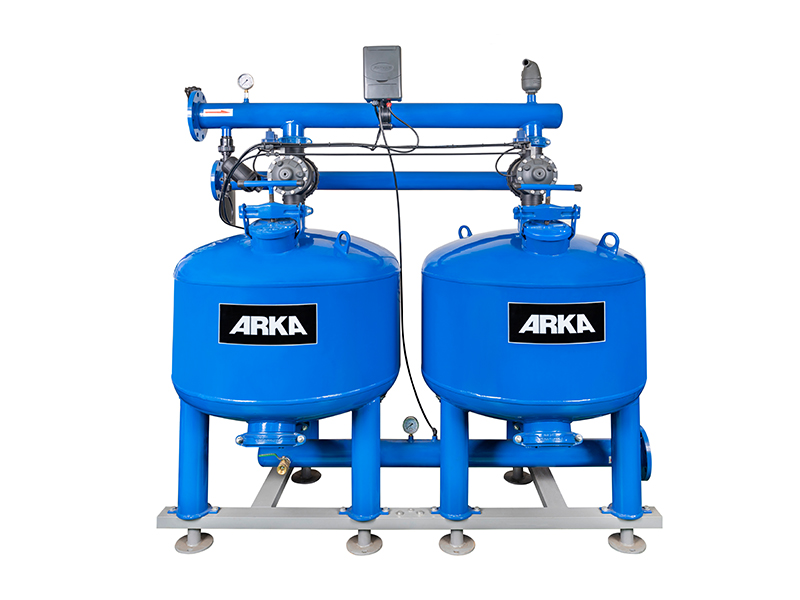
Unlike devices that trap debris on a single surface, a sand media filter consists of a large, pressurized tank filled with a deep bed of crushed silica sand or basalt. For instance, commercial-grade units like the F40 1000mm systems utilize a massive tank diameter to slow down water velocity. As raw pond water enters the top of the tank, it percolates slowly downward.
The jagged edges of the crushed silica create millions of microscopic voids. Particulate matter is trapped throughout the entire depth of the sand bed, which is often 12 to 18 inches deep. Clean water is then collected by specialized underdrain laterals at the bottom of the tank and directed safely into the irrigation mainline.
The primary advantage of this technology is its unparalleled dirt-holding capacity. Because debris is distributed throughout the entire volume of the sand bed, the system can absorb a massive amount of algae, silt, and fish waste before water flow is restricted.
This characteristic makes it uniquely capable of processing pond water during peak summer algae blooms. Where a standard mesh filter might blind and fail within 30 minutes under heavy biological loading, a properly sized media tank can operate for hours or even days before requiring a cleaning cycle.
To achieve a truly hands-off setup, these filters are deployed in pairs or larger arrays equipped with automated backwash manifolds. Modern systems utilize a differential pressure switch that continuously monitors water pressure at the inlet and outlet.
As the sand bed gradually fills with pond debris, the outlet pressure drops. Once the pressure differential reaches a predetermined threshold, the system controller automatically initiates a backwash cycle. Automated valves reverse the flow, fluidizing the sand bed. This violently scrubs the silica particles against one another, lifting trapped algae and silt out of the filter to be discharged through a waste line. This completely eliminates manual labor and ensures your crops never experience a drop in water pressure.
A filtration system is only as effective as its engineering. Oversizing results in unnecessary capital expenditure, while undersizing leads to excessive backwashing, high pressure loss, and rapid media degradation. Proper sizing requires a mathematical approach based on your specific hydraulic parameters.
The most critical metric is the flow rate of your irrigation pump, measured in gallons per minute or cubic meters per hour. Sand media filters are rated by their surface area. Industry standards dictate a flow velocity of approximately 15 to 20 gallons per minute per square foot of media. For large agricultural setups, a 1000mm tank provides the necessary surface area to process high volumes of water without forcing debris through the sand bed.
If water is forced through the sand bed too rapidly, the pressure will push compressible algae straight through the microscopic voids and into your drip lines. Conversely, if the flow rate is too low during a backwash cycle, the sand bed will not fluidize properly, leaving biological waste trapped in the tank.
Drip tape manufacturers specify a minimum filtration requirement to validate their warranties, usually expressed in mesh or microns. Most standard agricultural drip tapes require water filtered to at least 120 mesh or approximately 125 microns.
In a media tank, the equivalent mesh rating is determined by the size of the crushed media used. Number 16 crushed silica sand yields an equivalent filtration of roughly 150 to 200 mesh, making it ideal for standard drip tape. Number 20 crushed silica sand yields an equivalent filtration of roughly 200 to 250 mesh, which is used for ultra-low-flow emitters or highly sensitive micro-sprinklers.
Every component added to a mainline creates friction, resulting in a loss of pressure. A clean sand filter typically introduces a baseline pressure drop of 2 to 5 PSI. However, as it collects debris, this drop will increase.
You must ensure that your primary irrigation pump generates sufficient total dynamic head to overcome the maximum dirty pressure drop of the filter, usually around 10 PSI, while still delivering the required operating pressure to the furthest drip emitter in the field. Failure to calculate this correctly will result in the emitters at the end of your lines failing to emit water.
The physical layout and placement of your intake hardware play a massive role in overall efficiency. A well-designed intake can reduce the initial contaminant load by up to fifty percent, saving water and energy by drastically reducing backwash frequencies.
The location of the pump intake pipe within the pond is critical. Placing the intake directly on the pond floor will vacuum up heavy anaerobic sludge and abrasive silt. Conversely, placing it directly on the surface will draw in floating algae mats and duckweed.
The objective best practice is to utilize a floating intake extractor. These devices suspend the suction screen approximately 12 to 18 inches below the surface. This specific stratum generally contains the cleanest, most highly oxygenated water, minimizing the initial debris load drawn into the pump.
Before water even reaches the pump, it should pass through a pre-filtration stage, typically a coarse suction strainer or a foot valve. The goal here is not to protect the delicate drip emitters, but to protect the pump impeller from catastrophic mechanical damage caused by large debris such as sticks, whole leaves, and aquatic life.
Your primary filtration array must be installed on the discharge side of the pump. A standard professional layout follows a specific sequence to ensure maximum protection and efficiency:
| Stage | Equipment | Primary Function |
|---|---|---|
| 1. Intake | Floating Suction Strainer | Prevents large debris from entering the pump volute. |
| 2. Pumping | Centrifugal or Submersible Pump | Pressurizes the raw water for the system. |
| 3. Primary Filter | Sand Media Filter Array | Removes algae, silt, and fine organic matter down to the required micron. |
| 4. Secondary Filter | Screen or Disc Filter | Acts as a backup police filter in case a sand underdrain breaks. |
| 5. Regulation | Pressure Regulating Valve | Lowers the high mainline pressure to safe operating levels for drip tape. |
Even highly automated systems require periodic human oversight. Establishing a routine maintenance schedule ensures your equipment operates at peak hydraulic efficiency and prevents mid-season crop stress. Integrating an automatic self-cleaning sand media filter handles the daily heavy lifting, but seasonal checks are still mandatory.
While automatic backwashing keeps the sand bed clean daily, the silica sand itself will degrade over time. The sharp edges of crushed silica that trap debris eventually become rounded and smooth due to constant water friction. When this happens, the sand loses its filtration efficiency, and microscopic algae may begin slipping through. Standard operating procedures dictate inspecting the media bed annually and replacing the sand entirely every three to five years, depending on your pond water quality.
For farms and gardens located in regions that experience freezing temperatures, winterizing your hardware is mandatory. Water expands when it freezes, which can easily crack expensive carbon steel or fiberglass filter tanks, rupture PVC manifolds, and destroy pressure gauges.
At the end of the growing season, turn off the pump and open all drain valves at the bottom of the filter tanks. Remove the pressure gauges and store them indoors. Leave the drain valves open throughout the winter to ensure any condensation or melting snow can escape.
Filtration is a highly effective mitigation strategy, but it is not an impenetrable barrier. Over a six-month growing season, dissolved minerals and microscopic biological matter will inevitably pass through the filter and settle at the very end of your drip tapes, forming a slimy biofilm. To prevent this buildup from permanently clogging the final emitters, manually open the ends of your drip lines and flush them with pressurized water for five to ten minutes at least three times per season.
Using a pond for irrigation is an incredibly smart way to save valuable municipal resources and tap into nutrient-rich water. However, untreated surface water will inevitably ruin delicate drip emitters, turning a cost-saving measure into an expensive operational nightmare.
To succeed, you must bridge the gap between raw natural water and precision agriculture by installing a robust, properly sized filtration system. Automated sand media filters effectively trap algae and heavy sediment before clogs can even form, ensuring your irrigation lines remain completely clear. By protecting your agricultural investment with the right equipment, you guarantee peace of mind, drastically reduce manual labor, and foster a thriving, perfectly watered crop.
Ready to upgrade your farm infrastructure and eliminate clogged emitters for good? Explore commercial-grade solutions like the F40 1000mm Automatic Self-Cleaning Sand Media Filter at Arka Irrigation, and design a system engineered for absolute reliability.
While you theoretically can, it is highly discouraged by irrigation professionals. Screen filters only offer surface filtration. Algae and organic matter from pond water will quickly smear across the screen, blinding it in a matter of hours. This results in severe pressure loss and requires constant, frustrating manual scrubbing to maintain water flow.
The most effective choice for managing algae is a deep-bed sand media system. The three-dimensional bed of crushed sand traps organic matter efficiently without clogging instantly. When paired with an automatic backwash valve, it manages heavy summer algae blooms with zero manual effort, ensuring uninterrupted water flow to your crops.
This depends entirely on your water quality and the type of hardware you install. Manual disc or screen filters drawing from a pond might require cleaning daily or even multiple times a day. Conversely, automatic self-cleaning systems monitor their own internal pressure and clean themselves automatically, requiring only seasonal visual check-ups and periodic media replacement.
Yes, it is highly recommended to use a coarse intake screen or a floating suction strainer directly in the pond. This prevents large debris, aquatic life, and heavy weeds from entering your pump. A pre-filter protects the pump impeller from mechanical damage and prevents your primary filter from being overwhelmed by unnecessarily large waste.
Most standard drip irrigation tapes and micro-emitters require water to be filtered to at least 120 mesh to 150 mesh. Using water that is not filtered to this specification will lead to rapid emitter blockage. Always check your specific drip tape manufacturer technical recommendations for exact micron requirements to keep your warranty valid.
While you cannot completely stop algae in a natural pond, you can mitigate its impact by using a floating intake. Algae mats typically float on the very surface, while heavy sludge sinks to the bottom. A floating intake suspends the suction screen about a foot below the surface, drawing from the cleanest layer of the water column.
No, sand media filters are designed to remove suspended particulate matter, not dissolved solids or chemicals. If you inject liquid fertilizer into your mainline downstream of the filter, it will pass through the sand bed without any issues, allowing for highly efficient fertigation.


