
Views: 0 Author: Site Editor Publish Time: 2026-11-22 Origin: Site


Turning on the tap for a refreshing glass of water, only to be met with a cloudy, gritty mess, is a deeply frustrating experience for any homeowner or farm manager. Sediment and sand originating from an aging, shifting, or newly drilled well can silently wreak havoc on your daily operations. Simple tasks like washing dishes, running irrigation lines, or doing laundry quickly transform into an anxiety-inducing chore. Finding particulate matter in your water supply is a relatively common issue for rural properties. However, ignoring it is never a viable long-term strategy.
Untreated sediment inevitably leads to severely clogged pipes, ruined household appliances, and drastically degraded water quality. The most reliable, permanent solution to this abrasive problem is the installation of a dedicated depth-filtration setup. This comprehensive guide will walk you through the essential steps to filter sand from well water effectively. We will explore crucial selection criteria, break down complex technical specifications, and outline the maintenance routines necessary to restore your water pristine clarity. By following these engineering principles, you will protect your home plumbing infrastructure or agricultural drip lines for decades.
Abrasive grit acts exactly like liquid sandpaper as it travels through your plumbing infrastructure at high velocity. These microscopic, jagged particles continuously scour and erode the inner lining of copper and PEX pipes. I have seen standard plumbing systems completely fail within a few years due to unchecked grit. Beyond the pipes themselves, sediment accumulation is notorious for scoring the delicate ceramic discs inside expensive kitchen faucets. It degrades rubber seals and buries the lower heating elements of water heaters in a thick layer of insulating sludge. Intercepting these abrasives before they enter the house drastically extends the lifespan of your washing machines, dishwashers, and plumbing fixtures.
Aside from the mechanical destruction happening behind your walls, suspended solids severely impact the daily usability and aesthetics of your water. High concentrations of silt cause the water to appear murky, yellowed, or completely opaque. To complicate matters, this physical debris often traps organic matter or trace minerals. These trapped elements negatively alter the taste and smell of your drinking water. Creating a physical barrier to trap these particulates ensures that the water you use for cooking, drinking, and bathing remains visually appealing and odor-free.
Many modern homes and agricultural setups utilize advanced multi-stage water purification technologies. These include whole-house water softeners, Ultraviolet light purifiers, or under-sink Reverse Osmosis systems. These highly sensitive units are strictly designed to target microscopic contaminants, dissolved minerals, and bacteria. They are not built to handle heavy physical debris. If large particles pass through, they will quickly tear delicate RO membranes, scratch the quartz sleeves of UV lights, and prematurely overwhelm carbon blocks. A primary sediment barrier acts as a bodyguard. It protects your finer, significantly more expensive filtration investments from catastrophic failure.
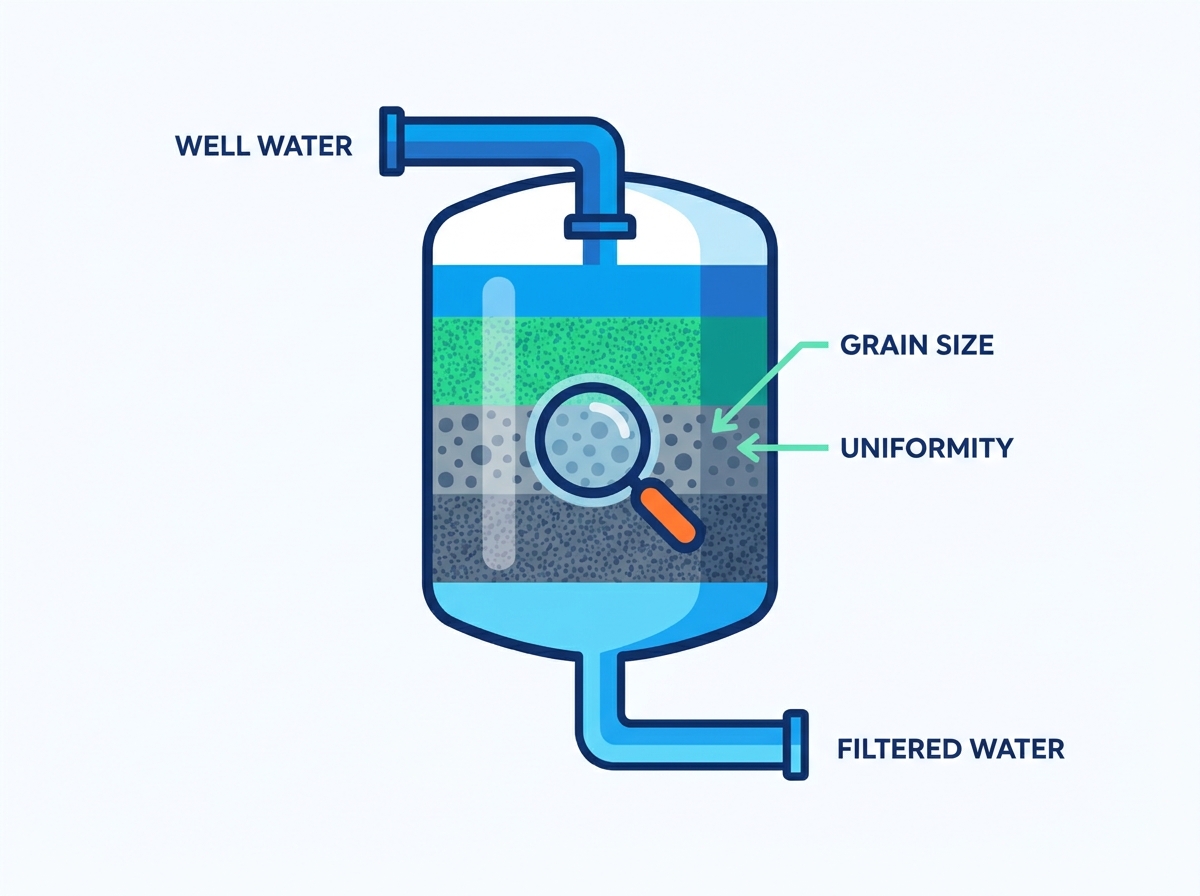
Basic surface-level cartridge filters merely trap dirt on a pleated paper screen. They often clog within days. In contrast, a dedicated tank setup utilizes the robust mechanics of depth filtration. Raw, untreated well water is forced into the top of the pressure tank. It travels downward through a thick, dense column of specialized media. The irregular, jagged shapes of the individual grains create a complex maze of microscopic pathways. Suspended solids and silt become wedged within these deep void spaces. As a result, only crystal-clear water exits the bottom of the tank.
Beneath the primary filtration media lies a seemingly simple but structurally vital component known as the support bed. Composed of carefully graded, washed quartz gravel, this base layer serves two critical engineering purposes. Primarily, it supports the much finer media above it. This prevents those tiny grains from slipping through the bottom distributor screen and contaminating your plumbing. Secondly, during the cleaning cycle, the gravel ensures that incoming water is dispersed evenly across the entire diameter of the tank. This prevents localized pressure spikes that could easily shatter the internal basket.
Selecting equipment engineered to withstand the highly abrasive nature of well sediment is fundamental to achieving long-term operational stability. Property owners should prioritize tanks constructed from reinforced carbon steel with anti-corrosion epoxy coatings or heavy-duty fiberglass. For instance, professional-grade systems often feature maximum working pressures of 8 to 10 bar. They also utilize standard connection sizes ranging from 2-inch to 4-inch to ensure minimal flow restriction. Evaluating commercial-grade or high-capacity options is highly recommended. These robust units provide the structural integrity required to handle heavy, continuous sediment loads without succumbing to mechanical degradation over time.
The physical dimensions of your chosen filtration media directly dictate the micron size of the particles your system can successfully intercept. Choosing the correct grain size is the foundation of your entire setup. This metric is typically measured in millimeters. For standard residential and agricultural well water applications, industry guidelines strongly recommend a size between 0.5mm and 1.2mm. If you select a size that is too large, fine silt will slip straight through the voids. Conversely, if the grains are too fine, they will pack together like concrete. This severely restricts water flow and causes unacceptable pressure drops across your piping network.
Beyond the average physical dimension of the media, the consistency of those dimensions within a single batch is equally critical. This metric is defined by the uniformity coefficient. It is a mathematical ratio comparing the different sized particles. In water treatment engineering, a lower coefficient hovering around 1.5 is vastly superior. High uniformity guarantees that the grains are nearly identical in size. This prevents smaller particles from migrating into the empty spaces between larger ones. Maintaining this consistency preserves a porous filter bed, prevents the media from solidifying, and maximizes the system overall dirt-holding capacity.
Filtration efficiency is inextricably tied to contact time. This is the exact duration the water spends navigating through the media. Therefore, managing the vertical thickness of your filter bed is critical. Industry standards dictate a specific bed depth for optimal performance. Generally, systems require 24 to 36 inches of active material to ensure the water spends enough time in the tank to leave all debris behind. However, installers must never fill the tank completely to the top. Proper calculation demands leaving approximately 30 to 40 percent of the tank volume empty. This void, known as freeboard, is mandatory. It allows the media bed to lift and expand upward during the backwash cycle without flushing your expensive sand down the drain.
To help you visualize the best approach for your specific well conditions, we have compiled a core comparison of the most prevalent filtration media used in modern systems. Matching the media to your water profile is the secret to a maintenance-free setup.
| Media Type | Micron Rating | Weight / Density | Best Application Scenario |
|---|---|---|---|
| Standard Silica Sand | 20 - 40 Microns | Heavy | General sediment removal, high-yield well pumps, agricultural irrigation pre-filtration. |
| Zeolite | 3 - 5 Microns | Lightweight | Ultra-fine silt, clay removal, older wells with low-flow pumps. |
| Filter-Ag | 20 - 40 Microns | Very Lightweight | Homes experiencing severe pressure drops, maximizing backwash efficiency. |
Recent market analyses regarding residential and agricultural water treatment reveal a distinct shift in how property owners approach sediment issues. Search trends indicate a massive surge in demand for automated depth-filtration tanks. Consumers are rapidly migrating away from disposable, surface-level cartridge filters. This shift is largely driven by an increase in extreme weather events and fluctuating water tables. These environmental factors cause wells to shift and produce much heavier sediment loads than in previous decades.
Furthermore, eco-conscious consumers and commercial farm operators are prioritizing smart-valve control heads. These advanced controllers trigger backwash cycles based strictly on measured volumetric water consumption rather than rigid time clocks. This precision engineering drastically reduces wastewater, conserves energy, and extends the lifespan of the well pump. The industry is clearly moving toward high-efficiency, set-and-forget systems that require minimal human intervention.
The most common point of mechanical failure in well water treatment is a mismatch between the well pump output capacity and the filter tank backwash requirements. To successfully purge trapped dirt, the system must force water upward at a specific Gallons Per Minute rate. This high-velocity flow is required to lift the heavy media. If your pump only produces 6 GPM, but your newly installed tank requires 10 GPM to backwash, the media will never get clean. Over a few short months, the trapped debris will harden into a solid, impenetrable block. Always verify your pump true output with a simple bucket test before finalizing your tank size.
Selecting the appropriate tank dimensions should be dictated by your property peak water demand. Think about scenarios where you are running the shower, dishwasher, and washing machine simultaneously. A tank that is too small will bottleneck your plumbing. This causes severe flow restrictions when multiple fixtures are open. Conversely, a massive commercial tank installed on a standard residential well may never backwash properly due to insufficient pump flow. A standard 10x54-inch tank is generally ideal for a typical family of four. It perfectly balances excellent filtration capacity with manageable backwash requirements.
When configuring the control head of your setup, you face a choice between automated convenience and manual simplicity. Manual lever valves are highly cost-effective. They contain zero electronic components that could fail during a power outage. However, they require the homeowner to physically remember to initiate the cleaning cycle every few days. Automatic control heads require a higher initial investment but offer a true hands-off experience. By programming the system to backwash automatically at 2:00 AM based on exact water usage, you eliminate human error. This guarantees the media remains pristine and functional year-round.
Backwashing is the essential mechanical process of reversing the flow of water through the pressure tank. Instead of flowing top-down, water is aggressively forced bottom-up. This high-velocity action lifts the filter bed, separates the tightly packed grains, and flushes the accumulated sludge out through a dedicated drain line. Depending on the severity of your water sediment load, this cycle should occur every 3 to 7 days. Systems equipped with pressure gauges provide an even better metric. You should initiate a backwash whenever you observe a 10 PSI pressure differential between the inlet and outlet pipes. This specific reading clearly indicates the bed is choked with debris.
Even with meticulous backwashing schedules, filter media has a finite lifespan. Over years of enduring constant water friction and the aggressive tumbling of the backwash cycle, the sharp, jagged edges of the sand grains inevitably wear down. They become smooth and rounded like river rocks. When this degradation occurs, the media loses its physical ability to snag and hold sediment. This leads to channeling, a phenomenon where water simply carves a direct, unfiltered path through the bed. To prevent this complete loss of function, media replacement is generally required every 3 to 5 years, strictly contingent upon your daily water consumption.
Executing a media swap requires careful attention to detail. Rushing this process often damages internal tank components. First, isolate the system by turning off the main water supply. Depressurize the tank by opening a nearby faucet. Carefully unscrew the top control valve, ensuring you do not accidentally pull up the central distributor tube. Using a wet and dry shop vacuum, extract the exhausted, sludgy sand and gravel. Inspect the bottom screen for hairline cracks. Sanitize the empty tank with a mild bleach solution. Finally, tape off the top of the central tube, pour in the new gravel base, and add your fresh primary media. Be absolutely certain to leave the necessary 30 to 40 percent empty freeboard space at the top before reattaching the valve.
If you have spent the money to install a filtration system but still find annoying grit pooling in the bottom of your sinks, a mechanical failure has occurred. The most frequent culprit is a cracked lateral or a shattered bottom distributor screen inside the tank. This structural breach actively allows the filter media itself to bleed into your plumbing. Another distinct possibility is incorrect media sizing. If your well pumps ultra-fine silt but you filled the tank with coarse silica, the microscopic particles will effortlessly bypass the barrier. Lastly, chronic channeling caused by a lack of regular backwashing will allow raw well water to slip through entirely untreated.
A sudden or gradual loss of water pressure throughout the property almost always points to a severely clogged filter bed. If manually triggering a backwash cycle does not restore normal pressure, the media may be heavily fouled with sticky organic matter or iron bacteria. This scenario requires aggressive chemical cleaning or immediate replacement. Poor installation practices can also be to blame. If the tank was overfilled with sand, leaving no freeboard space, the bed has no room to expand during backwashing. This results in a permanently compacted block of media. Always verify your well pump is still functioning at its rated capacity before tearing the filter tank apart.
Successfully removing abrasive sediment from your water supply requires more than just buying the first tank you see on a shelf. It demands a thoughtful, engineering-based approach to equipment selection. By paying careful attention to the specific physical dimensions of your media, ensuring a low uniformity coefficient, and calculating the correct vertical depth of the bed, you create an impenetrable barrier against grit. Coupled with this, a strict commitment to regular backwashing and timely media swaps will keep the system operating flawlessly. We highly recommend testing your well water today to identify your exact sediment profile. If you are looking for industrial-grade reliability, explore the robust carbon steel sand filter systems from Arka Irrigation to secure clean, safe, and crystal-clear water for your entire property or agricultural operation.
The most effective method depends entirely on the volume and physical size of the particles present in your specific water supply. For extremely heavy, large particles, a spin-down sediment separator acts as an excellent, easily cleanable first line of defense. However, for thorough, whole-house purification and the removal of finer sediment, a dedicated, automatic backwashing depth-filter system remains the gold standard in the industry. It provides the most reliable long-term results.
The total investment varies widely based on the size of the system, the construction material of the tank, and the type of control valve used. Basic residential fiberglass tanks with manual valves can start around $500 to $800. High-capacity, automated carbon steel systems designed for heavy agricultural or commercial use typically range from $1,200 to over $3,000. Keep in mind that investing in a quality automatic backwash valve upfront will save you countless hours of manual labor and prevent premature media failure.
A standard sand filter is strictly designed to capture physical particulate matter, not dissolved minerals. If your well water contains high levels of clear-water iron, it will pass right through the standard silica sand. However, if the iron is oxidized, meaning it has already turned into physical rust particles, a sand filter will catch it. To effectively treat heavy dissolved iron, you must use specialized media like Birm or Manganese Greensand, often paired with an oxidation method like air injection or chlorine dosing.
Your media choice should always be dictated by a comprehensive, professional water test. For standard residential applications dealing with typical well grit, 0.5mm to 1.2mm silica sand is highly effective and economical. However, if your test reveals that your well produces ultra-fine silt or clay rather than coarse sand, you will need to upgrade to specialized, highly porous media like Zeolite to capture those microscopic contaminants.
To achieve optimal contact time and thorough purification, standard engineering practices require 24 to 36 inches of active filtration media. This primary layer must be supported by a solid, graded gravel base. Crucially, you must leave enough empty freeboard space at the top of the tank. This is usually 30 to 40 percent of the total tank volume. This empty space allows the bed to lift, expand, and clean itself properly during the high-velocity backwash cycle.


