
Views: 0 Author: Site Editor Publish Time: 2026-10-26 Origin: Site


Engineers, landscapers, and facility managers face a brutal operational bottleneck on a daily basis. They critically need high-efficiency water purification in environments with virtually zero available square footage. Retrofitting a cramped utility closet, optimizing a high-yield commercial greenhouse, or upgrading a municipal pump station quickly highlights this unforgiving constraint. Wrestling a massive fiberglass sand tank through a standard 36-inch mechanical doorway is not just difficult. It is often physically impossible.
Traditional sand media filters and bulky screen filtration systems demand massive floor space. They also require significant vertical clearance for routine maintenance. Furthermore, these older technologies demand excessive manual labor and consume prohibitively high water volumes during backwash cycles. The automated compact disc design has emerged as a highly efficient, space-saving remedy to this exact engineering dilemma. By leveraging three-dimensional depth filtration within a miniaturized housing unit, these systems deliver industrial-grade water treatment without devouring the mechanical room.
This comprehensive field guide examines the operational mechanics of these advanced systems from an engineering perspective. We will explore precise sizing parameters, practical applications across various industries, and provide empirical criteria to help you select the optimal filtration infrastructure for your site.
To truly grasp the value of these systems, you must first understand their core fluid dynamics. Unlike traditional single-layer screens that capture debris on a flat, two-dimensional surface, disc filtration utilizes hundreds of color-coded, diagonally grooved synthetic rings. These rugged polymer discs are stacked tightly together on a central telescopic spine. This configuration creates a dense, three-dimensional filtration cylinder. As raw water flows from the exterior of the cylinder toward the inner core, suspended solids, silt, and biological matter become trapped within the intersecting microscopic grooves.
The defining compact advantage lies in an optimized surface-area-to-volume ratio. Fluid dynamics engineers have designed the housing to contain a massive filtration surface area within a highly restricted physical shell. Consequently, facilities can achieve high-velocity flow rates and precise micron filtration without dedicating an entire room to water treatment equipment.
The self-cleaning mechanism is what elevates these compact units above manual alternatives. The entire process relies on a pressure differential switch communicating with a master controller. As debris inevitably accumulates on the outer edges and within the grooves of the discs, water pressure drops on the downstream side of the filter manifold. Once this pressure differential reaches a pre-calibrated threshold, the controller instantly triggers a backwash sequence.
During this brief cycle, the flow of water is reversed. The central spine decompresses, allowing the stack of discs to separate slightly. High-velocity jets of clean water are then sprayed outward through the discs, causing them to spin rapidly in a cyclonic motion. This aggressive centrifugal action dislodges trapped organic and inorganic matter, flushing it out through a dedicated drainage manifold. Because this automated purge takes only 15 to 20 seconds and utilizes a highly concentrated flow, it completely eliminates the need for the large, redundant backup tanks that older filtration methods require.
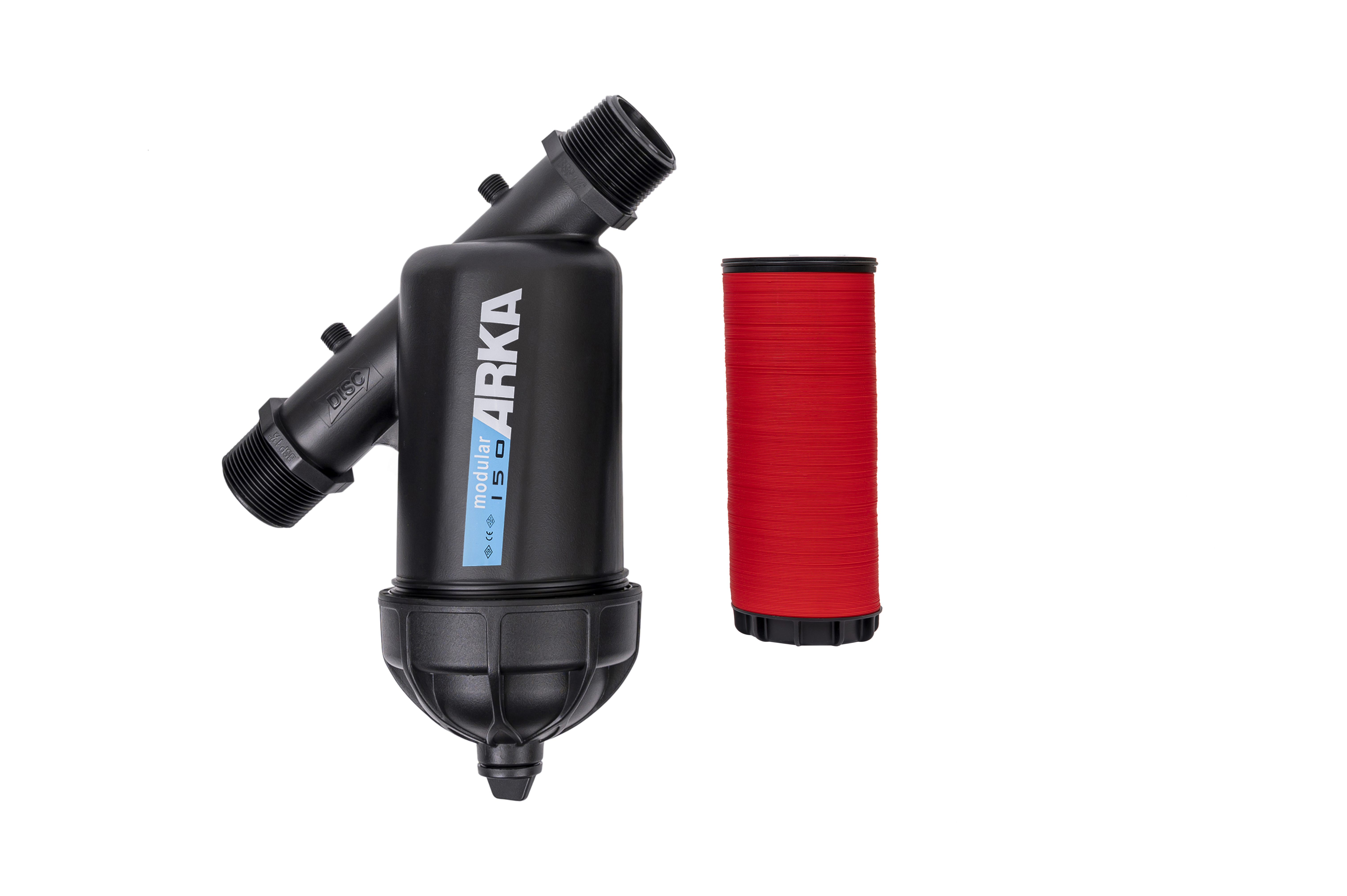
When evaluating infrastructure upgrades at the bottom of the purchasing funnel, decision-makers must weigh spatial constraints directly against water treatment efficiency. In almost every restrictive scenario, a compact disc filter consistently outperforms traditional sand media and screen filters. To illustrate this, let us look at the hard data comparing the three dominant technologies.
| Feature | Compact Disc Filter | Sand Media Filter | Screen Filter |
|---|---|---|---|
| Physical Footprint | Minimal. Wall-mountable or skid-integrated. | Massive. Requires dedicated floor space. | Moderate to Large. |
| Organic Matter Handling | Excellent. 3D grooves prevent algae extrusion. | Excellent. Deep sand bed traps organics. | Poor. Algae easily extrudes through mesh. |
| Backwash Water Waste | Very Low. 15 to 20 seconds per cycle. | Very High. Requires thousands of gallons. | Low to Moderate. |
| Maintenance Labor | Automated. Annual inspection only. | High. Requires periodic sand replacement. | Moderate. Screens require manual scrubbing. |
Real-world installations rarely offer the luxury of open space. Retrofitting an aging agricultural irrigation shed, squeezing a filtration manifold into a cramped commercial basement, or integrating water treatment beneath the dosing benches of a small greenhouse leaves zero margin for error. Compact disc systems are inherently modular. Installers can mount them vertically, horizontally, or even suspended from the ceiling. This architectural flexibility allows engineers to route plumbing tightly against walls to reclaim critical floor space.
Looking at current industry trends reveals why these systems are dominating the market. Urban real estate costs are skyrocketing, forcing commercial developers to shrink mechanical utility rooms by up to forty percent. Simultaneously, the rise of Controlled Environment Agriculture and vertical farming in dense urban centers means every square foot dedicated to utility equipment is a square foot lost to revenue-generating crop canopy. Decentralized, skid-mounted filtration is rapidly replacing centralized plant systems. Modern compact filters now frequently feature smart controllers that allow facility managers to monitor pressure differentials and trigger backwashes remotely via smartphone apps, making hidden filtration skids more viable than ever before.
Procuring the correct filtration unit requires a meticulous analysis of site-specific data. Moving beyond abstract concepts, buyers must evaluate peak flow rates, necessary micron ratings, thread types, and the available dynamic operating pressure.
For localized residential setups, precision micro-irrigation zones, or specialized laboratory dosing equipment, massive industrial manifolds are a waste of capital. This is precisely where a 1/2 inch disc filter provides absolute protection without over-engineering the plumbing.
Designed for environments where space is at an absolute premium, this sizing is ideal for low flow rates typically ranging from 2 to 5 cubic meters per hour. Despite its miniature connection size, it utilizes the exact same 120-mesh grooved disc technology as municipal-grade units. Featuring standard BSP or NPT male threads and a robust polymer body capable of withstanding up to 8 bar of pressure, this unit ensures that highly sensitive downstream equipment remains completely shielded from particulate clogging.
A common apprehension among field technicians is whether automated backwash systems can function adequately if the site suffers from chronically low water pressure. Historically, self-cleaning filters demanded a high baseline pressure to spin the internal mechanisms effectively during the cleaning cycle.
Specifically, modern compact designs have evolved to overcome this hydraulic hurdle. By utilizing specialized low-pressure solenoids and highly efficient hydraulic spines, these units achieve a violent, thorough backwash cycle even when incoming pressure drops as low as 30 PSI. This makes an automated small flow filter incredibly adaptable for gravity-fed agricultural setups or municipal lines plagued by fluctuating pressure variables.
The modular flexibility of the compact design allows it to be seamlessly deployed across a wide spectrum of demanding industries.
In high-end residential and commercial landscaping, protecting subterranean drip lines and pop-up sprinkler heads is paramount. Particulate buildup inevitably leads to uneven water distribution, unsightly dry spots, and the costly excavation of ruined irrigation components. Utilizing a compact unit as a lawn irrigation filter ensures that water drawn from municipal lines, shallow wells, or reclaimed ponds is rigorously purified before reaching delicate emitters. Because the system can be hidden entirely within a standard underground valve box, it preserves the pristine aesthetic of the landscape design.
Agricultural operations, particularly hydroponics and greenhouse growing, often rely on raw water sources that carry heavy biological loads. Space inside climate-controlled greenhouses is incredibly expensive to heat and cool. Compact disc systems mount directly onto existing structural supports or tuck neatly beneath fertilizer injection stations. They provide essential depth filtration without sacrificing a single square foot of crop canopy space.
Industrial mechanical rooms and HVAC cooling tower enclosures are notoriously claustrophobic. They are packed tightly with chillers, heat exchangers, and electrical panels. Cooling tower water acts as a massive air scrubber, pulling airborne dust, pollen, and smog directly into the water loop. Compact disc filters efficiently strip this suspended solid load from the water. This prevents devastating scale buildup and biological fouling in heat exchangers, all while fitting seamlessly into the tight confines of existing pipe runs.
Proper installation is the linchpin of system efficiency. While these units are engineered to save space, sloppy plumbing practices can easily negate their physical advantages.
To fully leverage the compact design, installers must think vertically. Modular manifold setups allow multiple small filter pods to be stacked or aligned closely against a wall. Utilizing high-density polyethylene or reinforced flexible hoses for inlet and outlet connections helps navigate the awkward angles found in cramped basements. Additionally, always install isolation butterfly or ball valves immediately upstream and downstream of the filter. This allows technicians to depressurize the unit for maintenance without shutting down the entire facility water supply.
The hands-off magic of an automatic system relies entirely on the precise calibration of its controller. First, connect the high-pressure and low-pressure sensing tubes to the designated ports on the manifold. Set the pressure differential switch to trigger a backwash when the pressure drops by approximately 7 to 10 PSI.
Furthermore, it is highly recommended to program a time-based override. Even if the water remains relatively clean and the pressure threshold is not met, forcing a backwash every 24 to 48 hours prevents biological matter from drying and calcifying onto the discs.
Although automated systems drastically reduce manual labor, they are not install-and-forget devices. Empirical field data consistently shows that routine preventative maintenance extends the lifecycle of filtration equipment by years.
Routine physical inspections should be conducted bi-annually. If the unit is utilized outdoors, proper winterization is absolutely mandatory in freezing climates. This involves completely draining the housing and control tubes to prevent expanding ice from shattering the polymer body.
Troubleshooting typically centers around monitoring backwash frequency. If you hear the sharp hiss of the pneumatic valve opening too often, it may indicate a severe spike in incoming water turbidity. Alternatively, the pressure differential switch may simply require recalibration. Conversely, if downstream pressure remains low after a backwash, isolate the filter, remove the spine, and manually fan the discs. Soaking them in a mild acid solution will dissolve any entrenched mineral scale, restoring them to factory condition.
An automatic disc filter compact system represents the ultimate intersection of high-tech water purification and spatial efficiency. By moving away from oversized, outdated filtration tanks, facilities can reclaim valuable square footage while genuinely improving their water quality. Whether you require a miniature inline unit to protect a backyard landscape or a multi-pod manifold to safeguard an industrial cooling tower, this technology pays for itself rapidly. By drastically reducing manual labor, minimizing wastewater, and shielding sensitive downstream equipment from catastrophic clogs, compact disc filtration is a remarkably sound investment for any space-constrained operation.
A screen filter utilizes a single, flat layer of metal or plastic mesh to catch debris. Under high pressure, pliable organic matter like algae can easily extrude right through this mesh. A disc filter uses hundreds of stacked, grooved discs to create three-dimensional depth filtration. This allows it to hold significantly more debris within the same footprint, completely preventing extrusion and ensuring much cleaner downstream water.
The suitability depends entirely on the specific zone size and the required volumetric flow rate. A 1/2 inch model is highly effective for specific low-flow drip zones, raised garden beds, or small residential lawns operating under 5 cubic meters per hour. However, for larger commercial turf applications, a 1-inch or 2-inch compact manifold will likely be required to handle the increased water volume without causing an unacceptable pressure drop.
While older traditional self-cleaning systems required high baseline pressure to spin the discs effectively, modern compact designs are engineered differently. They utilize optimized hydraulic spines and specialized low-pressure valves to operate efficiently even in low-pressure applications. This makes them highly versatile for gravity-fed tanks or fluctuating municipal environments.
Because the system relies on an automated, pressure-triggered backwash cycle to clean itself daily, manual scrubbing is rarely required. Standard operating protocol suggests a manual inspection and chemical soak only once a year as part of routine preventative maintenance. Constructed from highly durable synthetic plastics, the discs resist chemical degradation and can last for many years without needing replacement.
For standard agricultural and landscape drip emitters, a 130-micron rating is generally the industry standard. This precise filtration level effectively blocks fine sand, silt, and organic particulates that cause emitter clogging, while still allowing dissolved liquid fertilizers to pass through the system unimpeded.
Compared to traditional sand media filters that can consume hundreds or even thousands of gallons during a prolonged backwash, a compact disc filter is incredibly efficient. A standard automated backwash cycle lasts only 15 to 20 seconds, utilizing a highly concentrated burst of water. This typically uses less than ten gallons per pod, resulting in up to a ninety percent reduction in wastewater discharge.
Ready to upgrade your water infrastructure without sacrificing valuable space? Evaluate your site's flow requirements and discover the perfect space-saving filtration solution by exploring the advanced product lineup at Arka Irrigation today.


