
Views: 0 Author: Site Editor Publish Time: 2026-11-26 Origin: Site


Imagine turning on your kitchen faucet. Instead of clean water, a sputtering stream of cloudy, grit-filled liquid pours out. This is an infuriating reality for many private well owners. Sediment, sand, and abrasive particles silently destroy expensive plumbing fixtures. They wreck water-using appliances. Simply buying a random purification unit off the shelf is a massive gamble. I have seen countless homeowners suffer severe plumbing bottlenecks and ruined well pumps because of blind purchases. To truly protect your infrastructure, sizing your filtration equipment based on specific hydrological metrics is critical.
What exactly does this equipment do? A robust Sand Filter for Water Well acts as your home's first line of mechanical defense. It extracts suspended solids, grit, and coarse sediment right at the source. Standard carbon filters merely remove odors. In contrast, heavy-duty centrifugal or disc systems physically separate abrasive particles from the water column. They stop debris before it infiltrates your plumbing network.
Filtration mechanisms generally fall into specific categories. Spin-down separators and disc filters utilize centrifugal force and precise grooved pathways. Raw well water enters the engineered housing. It is immediately forced into a rapid swirling vortex. Consequently, heavier particles are thrown to the outer edges of the chamber. They drop into a collection basin. Clean water exits through the center element.
How do you know it is time to upgrade? Look at your faucet aerator. If it is packed with tiny pebbles, you need immediate action. Persistently turbid water straight from the tap is another massive red flag. You might also hear unusual grinding noises from the well pump. Abrasive sand is likely wearing down the impellers right now.
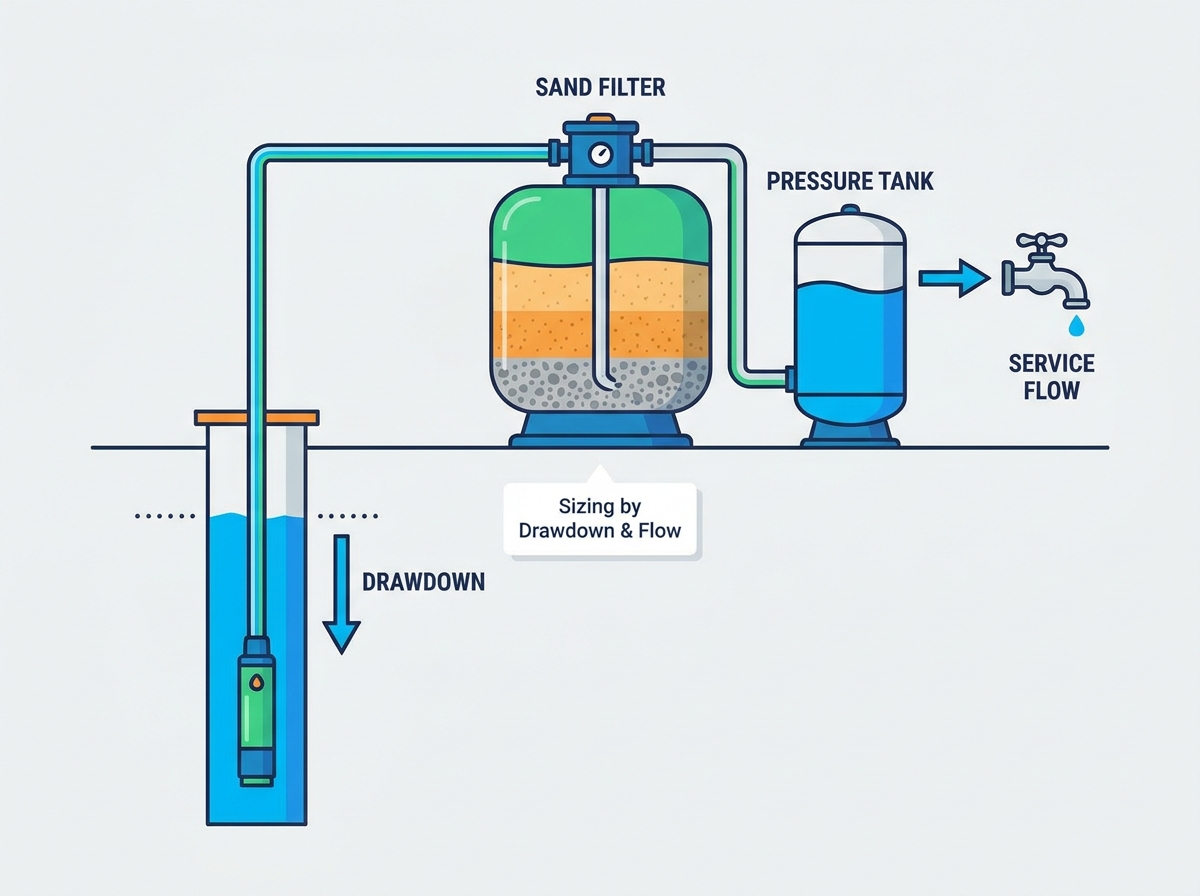
In hydrological engineering, Drawdown is the most critical metric defining your aquifer's behavior under active pumping conditions. It is the direct mathematical link between your groundwater yield and your equipment's operational limits.
To grasp this concept, identify two distinct water levels inside your casing. The static water level is the natural resting depth when the pump is off. The dynamic water level is the depth to which the water plummets while the submersible pump actively extracts water. The difference between these two points equals your drawdown.
Severe drawdown drastically impacts the actual volume your pump delivers to the surface. As the dynamic level drops deeper, the pump works exponentially harder. Head pressure increases. This physical strain reduces the effective output. If you install a massive filtration unit requiring high flow to self-clean, but severe drawdown restricts your pump's output, the system fails. The media fouls. Flow to your home chokes completely.
Bolting on a filtration unit without calculating flow dynamics is an expensive rookie mistake. The primary risk here is a catastrophic mechanical failure. We call this short cycling in the trade.
Specifically, Pump Cycling happens when a well pump turns on and off far too rapidly during a single water demand event. Instead of running continuously to smoothly fill the system, the pump engages, shudders to a halt, and immediately fires back up. This chaotic rhythm destroys well equipment.
When a separator is too small for the pump output, it acts as a severe bottleneck. The pump forces water into an undersized housing. This generates massive friction and a high pressure drop. Artificial backpressure tricks the pressure switch into falsely registering maximum pressure. The switch turns the pump off. Pressure immediately plummets. The switch kicks the pump on again. This rapid sequence generates extreme thermal heat in the motor windings. Submersible pumps melt down fast under these conditions.
To prevent these mechanical nightmares, establish your baseline metrics. You need to know the actual, usable water flow rate available to your plumbing.
Determining your Service Flow is a straightforward process. Grab a standard 5-gallon bucket and a stopwatch. Ensure absolutely no water is running inside the house. Open the boiler drain valve near the pressure tank. Let the water run until you hear the distinct click of the pump turning on. Close the valve immediately. Wait patiently for the pump to fill the tank and click off. Next, open the valve fully and catch the water in the bucket. Measure exactly how many gallons you collect before the pump clicks back on. Record the time it takes for the pump to refill the tank. Divide the collected volume by the cycle time, then multiply by 60. You now have your true gallons per minute.
Armed with your accurate flow rate, ensure the filter's maximum continuous rating meets or slightly exceeds this number. Installing a unit rated for 8 gallons per minute on a 12-gallon pump guarantees restriction. Always size up to accommodate maximum potential flow.
Filtration does not operate in a vacuum. It is part of a delicate, interconnected ecosystem. The pressure tank works in tandem with your purification unit to maintain systemic stability.
The pressure tank utilizes a compressed air bladder to store pressurized water. It acts as a hydraulic shock absorber between the aggressive power of the well pump and your delicate home fixtures. Proper Tank Sizing ensures the pump runs long enough to cool its motor efficiently. It also provides a steady, smooth flow through the filtration media. Undersized tanks cause water to rush through the filter too aggressively. Violent pressure spikes can crack polycarbonate housings or force fine sediment right through protective screens.
Installation sequence dictates system longevity. Spin-down separators are almost exclusively installed prior to the pressure tank. Their primary job is catching large, jagged grit before it enters the pressure switch mechanism. Conversely, backwashing media filters are typically installed after the pressure tank. They require a steady, regulated flow of pressurized water to perform backwash cycles effectively.
Looking at recent hydrological data and industry news, groundwater management is undergoing a massive shift. Climate variations are causing unpredictable aquifer fluctuations. Consequently, water tables are dropping in many regions. This dramatically alters well drawdown profiles.
Furthermore, professionals are moving away from static, one-size-fits-all filtration mentalities. The industry trend heavily favors precision-engineered equipment. We are seeing a surge in demand for high-efficiency disc and screen filters made from reinforced polymers. These modern systems adapt better to fluctuating dynamic water levels. They offer precise micron ratings without demanding the massive backwash flow rates that traditional sand media tanks require. Relying on outdated well logs is no longer sufficient. Modern setups demand real-time flow adaptation.
Making an objective, data-driven purchasing decision requires a methodical approach. Stop guessing and start measuring. Follow these criteria to ensure absolute precision.
Consult your original well driller log. It details the static level, dynamic level, and tested yield. If this document is missing, hire a licensed contractor to perform a formal flow test. Accurate baseline data is your foundation.
Your chosen filter must handle the highest potential water usage at any given moment. Assess the number of bathrooms and water-drawing appliances. A standard family home typically requires a peak demand flow of 8 to 12 gallons per minute. This allows simultaneous showers and appliance operation without frustrating pressure loss.
The physical size of your sediment dictates the mesh screen or disc grade you require. Micron ratings measure the microscopic pore size. Selecting a screen too fine for coarse beach sand results in immediate clogging. A tiered approach works best.
| Filter Architecture | Ideal Sediment Type | Drawdown Sensitivity | Maintenance Profile |
|---|---|---|---|
| Spin-Down Screen Filter | Coarse sand, gravel, large grit (100+ microns) | Low. Does not require high flow to clean. | Manual flush valve. Quick and easy. |
| Engineered Disc Filter | Fine sand, organic matter, silt (120 mesh / 130 micron) | Low to Medium. Highly adaptable to flow changes. | Manual spine removal and rinse. Highly durable. |
| Rapid Sand Media Tank | Very fine silt, heavy sediment loads | High. Requires sustained high GPM for backwashing. | Automated backwash cycle. Risk of media fouling. |
With empirical data in hand, evaluate the market for reliable filtration systems matching your specific drawdown. As engineers, we look for specific material and performance parameters.
Modern irrigation and well water technology often utilizes T-type or Y-type disc and screen filters. Brands like Arka Irrigation engineer these units from durable PA+GF plastics. They handle maximum pressures up to 8 or 10 bar. These units are incredibly efficient at removing heavy particulate sand. Because they do not rely on a complex, high-volume backwash cycle, they remain largely unaffected by severe well drawdown. This makes them perfect for low-yield wells.
In contrast, massive backwashing sand media tanks are heavily dependent on your dynamic water level. They demand a specific, sustained flow to lift and flush the media bed. Failing to achieve this flow fouls the filter bed.
Prioritize industrial-grade materials. Look for 120 mesh or 130-micron filtration grades for standard well sand. Ensure the inlet and outlet port sizes match your plumbing exactly. Forcing a 2-inch main line through a 1-inch filter creates a severe choke point. High-quality disc filters offer flow rates ranging from 15 to 100 cubic meters per hour, ensuring zero restriction on your main lines.
Even precisely engineered systems require maintenance. Neglecting these protocols leads to mechanical failures.
A drop in household water pressure is the primary symptom of a fouled filter. As the mesh screen or disc stack packs with sand, water struggles to pass. To diagnose this objectively, install two pressure gauges. Place one before the filter inlet and one after the outlet. A differential exceeding 10 to 15 PSI means the filter is severely restricted. You must clean it immediately to prevent pump cycling.
For spin-down or manual disc filters, maintenance is rapid. Open the bottom purge valve while the well pump runs. The water forcefully ejects trapped sand in seconds. For disc filters, periodically unscrew the housing, remove the disc spine, and rinse the grooved rings under clean water. This removes stubborn mineral scaling and restores full flow capacity.
Choosing the right sediment filtration system requires careful planning and precise calculation. Measure your well drawdown accurately. Establish your true service flow. Proper sizing prevents catastrophic damage to your well pump while keeping indoor water pressure steady. Always match the filter capacity to your pump output. Remember that correct pressure tank sizing is equally important for long-term success. If you are dealing with aggressive sand and fluctuating water tables, upgrade to professional-grade equipment. Explore high-efficiency disc and screen filters tailored to your specific hydrological metrics. Protect your plumbing infrastructure and enjoy crystal-clear water for decades to come. Ready to upgrade your well system? Explore the robust, precision-engineered filtration solutions at Arka Irrigation today to safeguard your water supply.
Yes, a sand filter will reduce your water pressure if it is improperly sized or poorly maintained. Every filtration device introduces friction loss into the plumbing system. Installing a unit with a maximum flow rating lower than your well pump output creates an artificial bottleneck. This restricts usable flow and drops pressure at your showerheads. Sizing the filter correctly based on your pump output prevents this issue entirely.
Optimal placement depends strictly on the filter architecture. A centrifugal spin-down separator or disc filter is typically installed before the pressure tank. This catches heavy sand before it enters the tank and clogs the pressure switch. Conversely, large backwashing media tanks are usually installed after the pressure tank. They require a strong, consistent flow of pressurized water to perform backwash cycles effectively.
Severe drawdown means the pump struggles to pull enough water to maintain steady flow. If this low-flow scenario combines with a clogged or incorrectly sized filter, the system experiences extreme pressure fluctuations. The pressure switch detects these rapid spikes and drops. It triggers the pump to turn on and off in rapid succession. This phenomenon generates excessive heat in the pump motor and destroys the equipment.
The ideal micron size is dictated by the physical characteristics of your particulate matter. For heavy, coarse beach sand, a 100-micron to 250-micron screen is highly effective. If your well produces finer silt or very fine sand, a 130-micron disc filter or a 50-micron screen is required. Many professionals utilize a two-stage approach. They install a coarse spin-down separator followed by a finer cartridge filter.
Upgrading your pressure tank is not strictly mandatory, but you must verify its capacity. The pressure tank acts as a hydraulic buffer. If you install a large backwashing media filter, it requires a specific volume of water to clean itself. If your current pressure tank is too small, it cannot sustain the required flow. This causes the pump to short-cycle during backwashing. Upgrading undersized tanks is highly recommended.
The lifespan depends heavily on the material quality and maintenance frequency. High-quality polymer disc filters and stainless steel screens can last 5 to 10 years with regular manual flushing. However, the internal media of a rapid sand tank typically needs replacement every 3 to 5 years. Heavy sediment loads will shorten this lifespan significantly if pre-filtration is not utilized.
A spin-down filter uses a single stainless steel mesh screen and centrifugal force to trap large particles on the outside of the screen. It is best for coarse grit. A disc filter utilizes a stack of color-coded, grooved plastic rings tightly compressed together. Water passes through the microscopic intersections of these grooves. Disc filters provide depth filtration, capturing much finer silt and organic matter than a standard screen.


