
Views: 0 Author: Site Editor Publish Time: 2026-10-29 Origin: Site


Did you know dirty water can ruin an expensive irrigation network in mere days? Imagine walking your fields in mid-July. You expect lush growth, but instead, you discover half your tomato crop suffers from severe drought stress. Microscopic algae silently choked your drip tape. The wrong equipment choice costs significant time, labor, and money. Conversely, the right hardware acts as an impenetrable insurance policy for your yields. In this comprehensive guide, we break down exactly how to analyze your water source, match micron sizes to your emitters, and engineer the perfect mechanical setup for your specific agricultural site.
Investing in high-quality irrigation filtration is not merely an optional upgrade. It is a fundamental engineering requirement for the longevity and hydraulic efficiency of any water delivery network. Without adequate protection, the physical and chemical properties of untreated water will inevitably compromise your entire setup.
Micro-irrigation systems feature extremely small orifices. These are often less than 1.0 millimeter in diameter. Microscopic debris like fine silt, clay particles, and biological slime easily accumulate inside these narrow labyrinth passages. When emitters clog, water distribution becomes severely uneven. This leads to localized drought stress for certain plants while waterlogging others. The ultimate result is devastated crop yields.
Furthermore, untreated water often carries abrasive inorganic materials. Sand and heavy grit act like liquid sandpaper within the internal mechanisms of a pipe network. Over time, these abrasive particles wear down the impellers of expensive water pumps. They score the internal rubber seals of solenoid valves and permanently damage pressure regulators. Proper interception of these destructive materials before they enter the mainlines prevents premature, costly equipment failure.
For operations utilizing fertigation, baseline water clarity is paramount. Organic debris and suspended solids can react chemically with certain synthetic fertilizers. This causes nutrients to precipitate or bind to floating particles rather than remaining in a plant-available solution. Removing these contaminants ensures that vital nutrients are distributed uniformly and absorbed efficiently by the root zone.
As global climate patterns shift, the agricultural sector faces unprecedented water scarcity. Prolonged droughts are rapidly transforming industry standards for water management. Growers are increasingly forced to pivot away from pristine municipal or deep-aquifer sources. Instead, they must turn to reclaimed wastewater, brackish groundwater, and highly variable surface water runoff.
Specifically, the utilization of recycled water introduces complex engineering challenges. Reclaimed water typically carries higher loads of suspended solids, biological contaminants, and dissolved minerals. To combat this, modern agricultural engineering leans heavily into advanced, multi-stage filtration technologies. We are seeing a massive industry shift toward automated smart systems equipped with IoT sensors. These modern units monitor pressure differentials in real-time. They alert farm managers via smartphone apps and autonomously initiate self-cleaning cycles only when necessary. This precision conserves water during the backflush process. As precision agriculture dominates the market, ultra-reliable water purification is no longer just a maintenance tool. It is the foundational pillar of modern food production.
The single most critical factor in your decision-making process is understanding the specific characteristics of your water source. Different water bodies carry entirely different particulate loads. They require distinct mechanical solutions.
Groundwater drawn from deep wells is typically free of organic matter. It remains unexposed to sunlight, naturally preventing algae blooms. However, well water frequently contains heavy inorganic particulate matter. Depending on the local aquifer and the structural integrity of your well casing, you may encounter significant amounts of coarse sand, fine silt, and mineral scale like iron precipitates. Because these particles are hard and dense, they require rigid barriers designed to handle heavy, non-sticky debris.
In contrast, surface water is constantly exposed to the elements and sunlight. If you pump from a farm pond, natural lake, or open irrigation canal, your water will inevitably contain algae, moss, fallen leaves, and biological slime. Organic matter is inherently soft, sticky, and highly compressible. Standard flat mesh barriers often fail miserably here. Organic slime quickly smears across the surface, blocking water flow entirely in a matter of minutes. Therefore, surface water almost always demands three-dimensional depth filtration.
Municipal or city water has already been treated at a facility, but it is not entirely risk-free. As water travels through miles of aging underground infrastructure, it easily picks up pipe rust and calcium scale. Occasional sediment dislodges during pressure spikes. Although municipal water requires the least aggressive treatment, a baseline physical barrier remains strictly necessary to protect sensitive micro-emitters.
Actionable Advice: Before purchasing any hardware, conduct a comprehensive agricultural water test. Measure your Total Suspended Solids and obtain a particle size distribution analysis. This empirical data removes all guesswork and allows you to engineer a precise solution.
Once you understand your exact water profile, you must match it to the correct mechanical technology. There are four primary designs utilized in modern agriculture, each engineered for specific environmental conditions.
A screen filter operates on a simple, straightforward physical barrier principle. Pressurized water is forced through a cylindrical mesh. Any particles larger than the microscopic holes are trapped on the inside surface of the cylinder, while purified water passes through to the field lines.
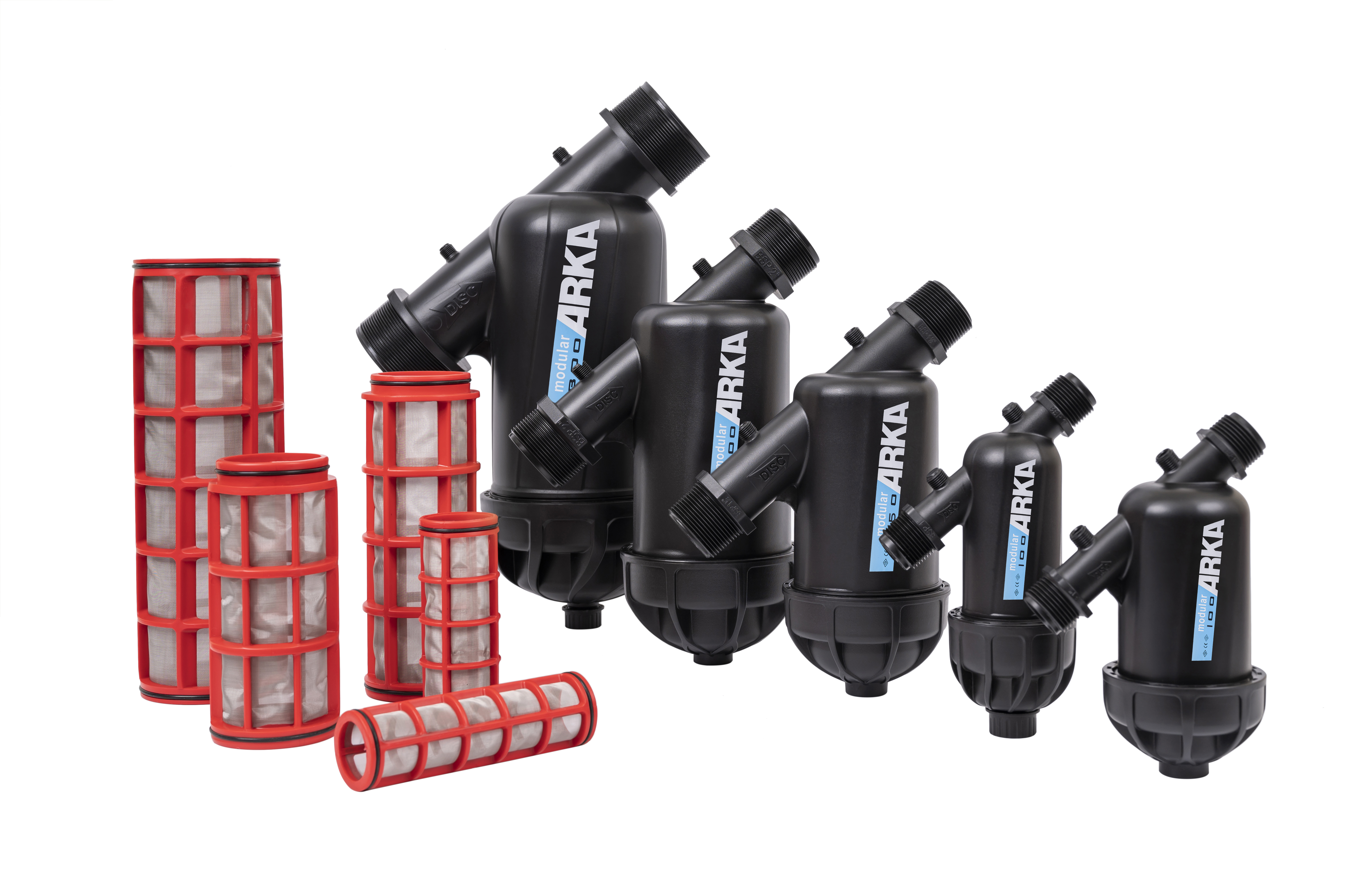
For example, modern ARKA Y-type large flow designs feature durable reinforced plastic bodies capable of handling high volumetric flow rates while maintaining structural integrity. Standard configurations offer 120-mesh stainless steel elements, providing a perfect balance between flow capacity and fine particle retention. They are best for well water or municipal lines where contaminants are hard and inorganic. However, they remain highly vulnerable to organic matter. If algae enters the cylinder, water pressure flattens the soft material against the mesh, instantly blinding the unit.
These units utilize a highly effective depth filtration method. The core consists of hundreds of tightly stacked, color-coded plastic rings. Each ring features microscopic diagonal grooves. When stacked and compressed under hydraulic pressure, these grooves intersect to create a complex, multi-layered maze of microscopic pathways.
Because a disc filter has physical depth, it traps massive volumes of soft, sticky organic matter throughout the entire stack before restricting flow. When it is time for maintenance, the rings decompress. Trapped algae easily flushes away. This represents a massive advantage over flat mesh, which often requires aggressive scrubbing with a brush.
Also known as media tanks, these represent the absolute highest capacity purification method available on the market. Water is introduced at the top of a large steel or fiberglass vessel and forced downward through a deep, thick bed of crushed silica sand or specialized crushed glass. The sharp edges of the media trap microscopic debris as the water slowly percolates to the bottom collector.
A sand filter can hold an incredible volume of contaminants before requiring maintenance. They are cleaned via an automated backwash process. Water flow is temporarily reversed, lifting the media bed and violently flushing the trapped sludge out through a waste valve. They are best for extremely heavy organic loads and large-scale commercial farming.
Technically, this is not a true filter, but rather a centrifugal separator. Raw water is pumped into the top of a conical chamber at a specific angle, creating a high-speed internal vortex. The intense centrifugal force throws heavy particles toward the outer walls, where they slide down into a collection chamber at the base. The lighter, clean water is drawn up through the center of the vortex.
A hydrocyclone is essential for extremely sandy wells that pump heavy grit. Crucially, this unit only removes dense, heavy particles. It will not catch lightweight organic matter, fine silt, or clay. Therefore, it is strictly a pre-filtration device and must always be installed upstream of a primary fine-mesh barrier.
| Technology Type | Best Application | Target Contaminants | Maintenance Level |
|---|---|---|---|
| Screen | Well / Municipal Lines | Hard, Inorganic Debris, Sand, Scale | Low to Medium |
| Disc | Surface Water / Ponds | Mixed Debris, Soft Organic Algae | Medium |
| Sand Media | Heavy Surface Water | High Organic Loads, Slime | Low (Usually Automated) |
| Hydrocyclone | Sandy Wells | Heavy Grit Only | Very Low |
Selecting the correct physical size of the barrier is a highly technical aspect of system design. If the barrier is too coarse, large particles bypass the element and permanently plug your emitters. Conversely, if it is too fine, the system experiences rapid pressure drops and requires constant, labor-intensive cleaning even when the water is relatively clear.
To make an informed decision, you must first understand the two primary measurement metrics used globally. Mesh refers to the number of openings per linear inch of a screen. A higher mesh number indicates a finer barrier because more holes per inch means smaller holes. Micron refers to the actual physical diameter of the hole. A lower micron number indicates a finer barrier.
When matching hardware, the golden engineering rule is simple. You must filter out particles that are at least one-tenth the size of the smallest orifice in your field layout.
For example, drip tape utilizes highly engineered emitters with microscopic labyrinth pathways designed to regulate flow drop by drop. Because these pathways are incredibly narrow, they are highly susceptible to blockages. The industry standard for drip setups is typically 120 to 150 mesh or 130 to 100 microns. Micro-sprinklers used in orchards or nurseries require medium-fine protection, usually ranging from 80 to 120 mesh.
In stark contrast, large impact sprinklers and agricultural water guns feature massive nozzles. These can easily pass small stones without issue. For broad-acre applications, lower degrees are perfectly acceptable, typically requiring only 40 to 80 mesh. Using an ultra-fine 150-mesh element on a pasture rotor system merely results in unnecessary, maddening maintenance.
A frequent and highly destructive error in landscape design is sizing equipment based solely on the physical diameter of the PVC pipe. Purchasing a 2-inch unit simply because you have a 2-inch mainline is a recipe for disaster. Proper hardware must always be sized according to the system volumetric flow rate and the allowable pressure drop.
Your chosen unit must be capable of handling the absolute maximum output of your pump without causing a hydraulic bottleneck. Flow rate is typically measured in Gallons Per Minute or Cubic Meters per Hour. If you force 100 Gallons Per Minute through a unit rated for a maximum of 50, the water velocity increases drastically. This high velocity forces soft organic debris directly through the barrier, completely defeating its purpose. Always select a unit where your maximum flow rate falls comfortably at around 70 to 80 percent of the manufacturer maximum capacity, allowing a safe buffer for debris accumulation.
Additionally, every component you add to a mainline creates friction. This loss of kinetic energy is known as pressure drop or Delta P. When an element is brand new, it has a baseline pressure drop of roughly 2 to 5 PSI. However, as it traps dirt, the available open area for water to pass through shrinks, causing the pressure drop to spike. If you undersize your equipment, this spike happens incredibly fast. By the time the water reaches your furthest zones, the residual pressure may be too low to operate the emitters, leading to uneven watering.
The final operational consideration dictates how your setup will be maintained. This decision ultimately comes down to a careful calculation of initial capital expenditure versus ongoing operational labor costs.
Manual systems are the most common choice for home landscapes, small market gardens, and operations utilizing exceptionally clean municipal water. The operator must physically shut off the main valve, unscrew the heavy housing, remove the internal cartridge, and wash it by hand using a hose or brush. While they are highly cost-effective upfront and feature foolproof designs with no moving parts, they demand strict maintenance discipline. If an operator forgets to clean the unit during a busy harvest week, the pressure drop will starve the crops of water.
Semi-automatic systems bridge the gap between basic manual units and fully automated tech. They typically feature an external manual crank handle. When the operator notices a pressure drop on the gauges, they simply open a flush valve and turn the crank. This action rotates internal suction scanners or stiff brushes that scrub the element while the system remains fully pressurized. This reduces cleaning time from fifteen minutes of muddy labor to just fifteen seconds of dry work.
Automatic self-cleaning systems are the gold standard for large commercial agriculture and smart greenhouses. These rely on a pressure differential switch. Electronic sensors constantly monitor water pressure at both the inlet and the outlet. When debris builds up and the outlet pressure drops by a predetermined threshold, the controller autonomously initiates a backflush cycle. While they require a higher initial investment and a minimum operating pressure to function, they drastically reduce labor costs and protect the crops around the clock without requiring a human presence.
Even with a solid understanding of flow rates and micron sizes, buyers frequently make installation errors that compromise their entire investment. Avoid these critical engineering pitfalls.
Ponds, lakes, and canals are rich in biological matter. If you use a standard single-layer mesh for this application, the soft, sticky algae will quickly smear across the surface, blinding the flow. Once blinded, it is incredibly difficult to scrub clean. Surface water absolutely dictates depth filtration, such as a media tank or grooved rings.
It sounds elementary, but it is one of the most common reasons for catastrophic structural failure. These units are strictly engineered for directional flow. The external housing always features a molded arrow indicating the direction the water must travel. If installed backward, hydraulic pressure pushes against the weakest structural points of the internal element. It will eventually crush the plastic skeleton or tear the stainless steel mesh entirely.
Operating a pressurized water line without gauges is like driving a truck without a speedometer. You are operating entirely on blind guesswork. You must install one pressure gauge on the inlet side and one on the outlet side. The mathematical difference between these two readings is your pressure differential. This empirical data is the only objective way to know exactly when maintenance is required, preventing both unnecessary labor and dangerous flow restrictions.
If you pump from an aging well that produces a high volume of sand, a standard mesh or depth unit becomes overwhelmed within minutes. In these specific scenarios, failing to install a pre-treatment separator is a massive error. By ignoring this crucial step, you subject your primary fine-mesh barrier to severe abrasive wear and guarantee endless, frustrating maintenance cycles.
Selecting the perfect hardware for your agricultural or landscape setup does not have to be overwhelming. Success ultimately relies on three foundational pillars. First, accurately analyze your water source. Second, calculate your exact volumetric flow rate. Finally, match the micron size to the physical requirements of your emitters.
Remember that investing in robust, properly sized water purification is not just about keeping pipes clean. It is a vital insurance policy that protects your expensive pumps, extends the life of your drip tape, and guarantees uniform crop yields season after season. By taking the time to design your setup correctly from day one, you save countless hours of frustrating labor and ensure your fields remain lush and profitable.
Ready to upgrade your water management system and protect your yields? Explore the comprehensive range of professional-grade equipment at ARKA Irrigation. From high-capacity Y-type models to advanced disc technologies, matching the right product to your exact field specifications ensures your operations run flawlessly. Visit ARKA Irrigation today to find the perfect filtration solution for your specific needs.
A 120 to 150-mesh disc or mesh unit is generally required, depending entirely on whether your water source contains organic or inorganic debris. Drip tape utilizes microscopic labyrinth pathways that are highly susceptible to clogging from fine silt and algae. Therefore, extremely fine, reliable protection is mandatory to ensure uniform water distribution and prevent premature failure of the lines.
No, a centrifugal sand separator cannot function as a standalone purification solution. It is explicitly engineered to remove heavy, dense particles like sand and large mineral scale. Because it relies on specific gravity, it will not catch lightweight organic matter, floating algae, or very fine silt. It must always be utilized as a pre-treatment, followed immediately by a primary fine-mesh or depth unit to catch the remaining suspended solids.
The cleaning frequency is dictated strictly by your specific water quality, seasonal changes, and flow rate. You should manually inspect the internal element after the first few hours of initial operation to gauge the rate of debris buildup. Moving forward, the most accurate method is to monitor your installed pressure gauges. Ideally, you should initiate a manual cleaning cycle whenever the pressure differential between the inlet and outlet gauges reaches 5 to 7 PSI.
A screen unit utilizes a single, flat layer of woven stainless steel or plastic to physically block hard, inorganic debris like sand or pipe rust. In contrast, a disc unit utilizes tightly stacked, diagonally grooved plastic rings pressed together to create a deep, three-dimensional filtration matrix. This unique depth allows it to effectively trap soft, sticky biological debris, like algae and bacterial slime, without instantly blinding the flow of water.
Yes, baseline protection is still highly recommended even with chemically treated municipal water. While city water is generally clean and free of biological contaminants, the aging municipal underground infrastructure often contains pipe scale, rust flakes, and occasional sediment that breaks loose during municipal pressure fluctuations. These rogue particles can easily travel into your property lines and permanently clog micro-emitters if a basic physical barrier is not in place.
Calculating pressure drop, or Delta P, requires installing two pressure gauges on your system. Place one gauge directly on the inlet pipe before the housing, and one on the outlet pipe immediately after it. Subtract the outlet pressure reading from the inlet pressure reading. For example, if the inlet reads 45 PSI and the outlet reads 40 PSI, your pressure drop is 5 PSI. Monitoring this metric tells you exactly when the internal element is clogged and requires cleaning.
Using a standard flat mesh element for pond water is highly discouraged. Pond water contains high levels of organic matter, algae, and biological slime. When pressurized, this soft, sticky debris instantly flattens against the rigid mesh, blinding the holes and completely stopping water flow. For pond or surface water, you must use depth filtration technology, such as grooved plastic rings or a sand media tank, which can trap large volumes of soft debris without immediately clogging.


