
Views: 0 Author: Site Editor Publish Time: 2026-10-26 Origin: Site


There is a hidden truth in the food service industry that often catches facility managers by surprise. Nearly 70 percent of all commercial ice machine failures link directly to poor water quality. Hard water, relentless scale buildup, and high chlorine levels do more than just ruin the taste of premium beverages. Over time, these impurities destroy internal mechanical components. They lead to expensive breakdowns and unexpected downtime in high-end equipment.
As water treatment engineers, we see this constantly in mechanical rooms across the hospitality sector. Manufacturers developed specialized purification solutions to combat this costly issue head-on. A robust filtration setup addresses water quality right at the source, ensuring your machine operates at peak efficiency.
This comprehensive technical guide breaks down exactly how to optimize your commercial ice equipment. From technical specifications and hands-on installation tips to routine maintenance and troubleshooting, you will learn how to guarantee food-safe, crystal-clear ice for years to come.
At the heart of a reliable ice-making operation is the single-filter manifold. This vital component serves as the durable mounting head and primary structural support for the entire process. Built from heavy-duty materials, the manifold is engineered to withstand the constant pressure fluctuations inherent in busy commercial kitchens.
Unlike basic residential purifiers that merely improve drinking water taste, this assembly functions as a heavy-duty water treatment filter specifically tailored for rigorous food service environments. It easily manages high flow rates while maintaining strict structural integrity during continuous daily operation.
Key technical specifications dictate its performance. The manifold operates safely between 10 and 125 psi. The operating temperature handles cold water lines ranging from 35 to 100 degrees Fahrenheit. Furthermore, it consistently delivers up to 2.0 Gallons Per Minute. This precise flow rate ensures the ice machine reservoir fills rapidly without ever starving the internal water pump.
While the manifold provides the structural foundation, the replacement cartridge acts as the true engine of the system. This advanced cylinder houses a sophisticated three-stage purification process designed to tackle the most common municipal water issues simultaneously.
First, the outer mechanical layer acts as a microscopic net. It traps dirt, rust, and particulates as small as half a micron. This prevents physical debris from immediately clogging the internal float valves. Next, as water passes deeper into the core, high-grade activated carbon removes up to 99.9 percent of chlorine. This critical step eliminates the foul chemical odors that easily transfer from tap water into ice cubes.
Finally, the last stage introduces a food-grade polyphosphate compound. This scale inhibitor coats hard minerals like calcium and magnesium. By doing so, it prevents them from clinging to the freezing evaporator plates and forming stubborn, destructive scale.
From a practical standpoint, the 21,000-gallon capacity is massive. Depending on your specific machine yield, this volume translates to roughly 175,000 pounds of ice before the media is fully exhausted. This makes it highly efficient for busy restaurants and cafes.
Operating a commercial ice machine on unfiltered tap water is a gamble that inevitably leads to financial losses. Scale buildup acts as a thick insulator on the evaporator plates. It forces the compressor to run longer and harder just to freeze the water. Consequently, this increased energy consumption drives up utility bills, triggers frequent service calls, and often voids the manufacturer warranty.
Beyond the mechanical risks, ice clarity and taste are paramount for customer satisfaction. Impurities and trapped gases cause ice to become cloudy, soft, and quick to melt. When organic compounds are present, they impart a bitter taste that ruins expensive cocktails and soft drinks. A dedicated system prevents these issues by stripping out offending contaminants before they ever reach the freeze cycle.
Looking closely at recent shifts in the hospitality sector, modern food service operations now demand absolute water purity. The industry is moving rapidly toward predictive maintenance and ultra-fine sub-micron ratings. Facility managers no longer wait for a breakdown to act. They utilize systems with integrated pressure gauges as early warning indicators. Additionally, eco-friendly scale inhibitors have become the new operational standard, replacing the harsh chemical treatments of the past to align with broader sustainability goals.
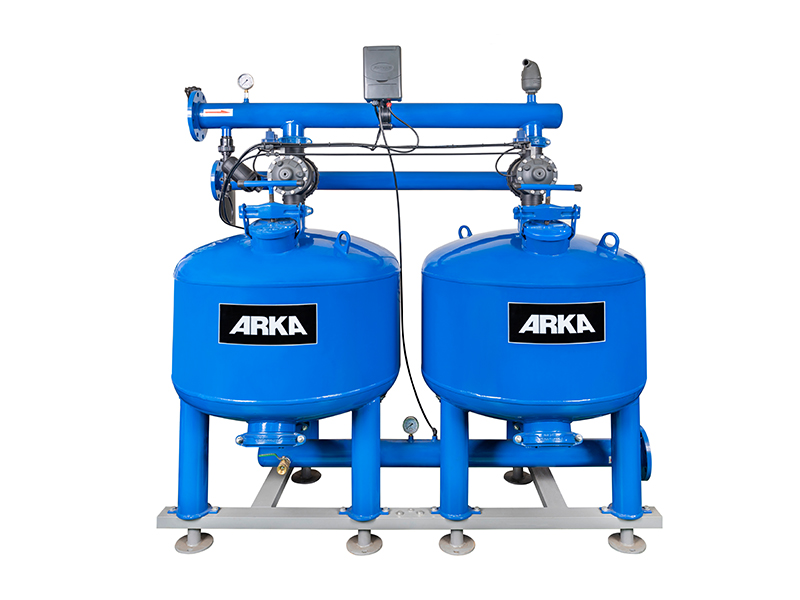
Understanding the difference between filtration technologies ensures you deploy the exact right tool for your facility. Facility managers sometimes rely on whole-building systems, assuming they offer sufficient protection. However, a large-scale sand media filter is designed primarily to remove large debris and heavy sediment at the municipal intake level.
If your building draws from a highly turbid municipal line, a multi-stage approach is absolutely mandatory. For example, utilizing an industrial-grade automatic filter like the F40-2-1000mm series provides massive bulk pre-filtration. With a 1000mm tank diameter and automated backwash capabilities, it protects the entire plumbing infrastructure from heavy silt.
In contrast, bulk pre-filtration lacks the activated carbon core and precise polyphosphate dosing required by delicate ice evaporators. The point-of-use manifold serves as the vital final polishing stage right behind the ice maker.
| Feature Matrix | Facility-Wide Pre-Filtration | Point-of-Use Ice Filtration |
|---|---|---|
| Primary Function | Removes heavy silt, sand, and large particulates | Removes chlorine, odors, and prevents scale |
| Micron Rating | Typically 50 to 100+ microns | Ultra-fine 0.5 microns |
| Maintenance Style | Automated backwashing | Manual cartridge replacement every 6 months |
| Ideal Application | Main building water inlet protection | Direct connection to commercial ice machines |
Specifically, if your primary issue is a massive sediment load, start with a high-capacity self cleaning filter at the building inlet. Then, polish the water at the actual equipment with a half-micron cartridge.
Installing the manifold properly sets the foundation for years of trouble-free operation. Before beginning, ensure you have the necessary tools on hand. You will need an adjustable wrench, Teflon pipe tape, a tubing cutter, and a large bucket. Always prioritize safety by completely shutting off the main water supply to the equipment area.
Select a location on the wall that is easily accessible for future cartridge changes. The spot should be shielded from direct heat sources, such as heavy-duty ovens or dishwashers. Secure the bracket firmly to the wall studs to prevent any movement when twisting the heavy cartridges in and out.
Using standard plumbing practices, connect the inlet and outlet water lines. Apply Teflon tape to the threaded fittings to ensure a watertight seal. Be extremely careful not to overtighten the connections and crack the plastic housing.
Align the locking tabs on the cartridge with the slots in the manifold head. Push up firmly and give it a quarter-turn twist to lock it securely into place. Before connecting the outlet line to the ice maker, direct the flow into a bucket. Turn on the water and flush the system for at least five minutes. This critical step purges trapped air and washes away loose carbon fines that could otherwise clog the machine float valve.
Consistent maintenance is the absolute secret to extending the life of your expensive equipment. We mandate a strict six-month replacement schedule for the cartridge, regardless of the volume of water processed. Over time, the activated carbon loses its chemical efficacy. The stagnant, moist environment inside the filter can become a breeding ground for bacteria if left unchanged. Furthermore, the polyphosphate scale inhibitors deplete over time and must be replenished to remain active.
Watch closely for telltale signs that it is time for a change. A noticeable drop in ice production speed, the sudden appearance of cloudy ice cubes, or the manifold water pressure gauge dipping below 10 psi all indicate a severely clogged filter.
To perform a quick replacement, turn the built-in shut-off valve on the manifold to stop the water flow. Place a towel under the manifold to catch any minor drips. Grasp the old cartridge, twist it a quarter-turn to the left, and pull down to remove it. Insert the new cartridge, pushing up and twisting right until it locks firmly. Finally, turn the water back on, flush the new media via the flush valve for five minutes, and resume normal operation.
Even with top-tier equipment, occasional issues may arise in a busy kitchen. If you experience low water pressure or a slow flow rate, check the manifold gauge first. If the pressure is low, the media might be prematurely clogged due to a recent local water main break that flushed excess sediment into your lines.
If you notice leaking from the manifold head, inspect the O-rings on the cartridge to ensure they are not pinched, dry, or damaged. Verify that the cartridge is fully locked into position and double-check the tightness of the water line fittings.
Should your ice still look cloudy after a fresh installation, investigate secondary factors. The incoming water temperature might be too high. Alternatively, your local municipal water might be exceptionally hard, necessitating the bulk pre-filtration strategy discussed earlier before the water ever reaches the point-of-use system.
You should replace the cartridge every six months, when the maximum capacity of 21,000 gallons is reached, or if the water pressure drops below acceptable operating levels under 10 psi. Whichever scenario occurs first dictates the replacement time.
It is highly discouraged. Generic filters may not fit securely within the specific manifold head. They often lack the specific polyphosphate scale inhibitors required to protect delicate evaporators, and using them can instantly void your ice machine manufacturer warranty.
No, the system operates entirely on your facility existing water line pressure. It relies solely on mechanical flow and does not require a power source or electrical outlet to function.
Yes, in the vast majority of cases. Cloudy ice is usually caused by trapped air, excess scale, or high sediment levels. The half-micron mechanical filtration and dedicated scale inhibitors are specifically engineered to directly address and eliminate these exact issues.
If scale persists despite a new cartridge, your incoming water hardness likely exceeds the chemical capacity of standard polyphosphate inhibitors. In these extreme cases, the water requires a dedicated softening system before it reaches the ice maker manifold.
A rating of 0.5 microns is considered the gold standard for commercial ice production. This ultra-fine level captures microscopic cysts, fine dirt, and rust, ensuring the resulting ice is both visually perfectly clear and entirely food-safe.
Investing in dedicated point-of-use purification is a direct investment in the longevity and reliability of your kitchen equipment. By prioritizing routine maintenance and adhering to timely replacements, you guarantee high-quality ice, satisfied customers, and significantly lower maintenance costs over the long term. If your facility struggles with severe municipal water quality, a single cartridge is rarely enough. We highly recommend evaluating your entire incoming water supply. Guide your facility toward complete protection by exploring heavy-duty pre-filtration solutions tailored to your specific flow requirements. Discover the right industrial-grade systems and technical specifications at https://www.arka-irrigation.com to safeguard your entire operation today.


