
Views: 0 Author: Site Editor Publish Time: 2026-11-02 Origin: Site


Clogged irrigation emitters ruin crops, damage downstream machinery, and inflate operational costs. In many fluid management scenarios, fine sediment, sticky algae, and suspended solids easily bypass basic screen filtration systems, leading to catastrophic system failures and frequent, frustrating downtime.
To combat these challenging water conditions, engineers developed the Disc Filter. This highly efficient, scientifically designed solution is specifically engineered to tackle high-turbidity environments where traditional methods fall short. In this guide, we will break down exactly how this technology operates, exploring the mechanics of its internal structure, the science of capturing microscopic particles, and how automated self-cleaning features allow for continuous, low-maintenance operation.
At its core, a disc filtration system is a mechanical water treatment device designed to remove suspended solids, biological growth, and fine inorganic materials from a water source. Unlike traditional media tanks that use bulky sand, or flat screen filters that rely on a single layer of wire mesh, this technology utilizes hundreds of tightly stacked, grooved plastic rings. When compressed, these rings form a robust, three-dimensional cylinder that effectively strains particulate matter from the water flowing through it.
To fully grasp how the system operates, one must look closely at its core structural components. The engineering relies on precise tension and fluid dynamics, ensuring that dirty water has no bypass route.
While both technologies aim to clarify water, their physical mechanisms differ significantly. Screen filters operate on the principle of surface filtration, acting much like a standard kitchen sieve. They catch particles larger than the holes in the mesh. While effective for hard, large debris, screens are highly susceptible to blinding. Imagine a farmer walking a parched crop row because soft organic matter like algae has flattened against the screen under water pressure, rapidly blocking the flow and starving the irrigation lines.
In contrast, disc systems excel in these challenging conditions due to their three-dimensional structure. Because the water must navigate a deep, winding path through the compressed rings, soft organics are trapped within the inner layers without immediately blocking the outer surface. Consequently, the system holds a significantly larger volume of dirt before requiring a cleaning cycle. This shift toward advanced filtration is becoming a global standard, as industries increasingly prioritize water recovery and efficiency in high-turbidity conditions.
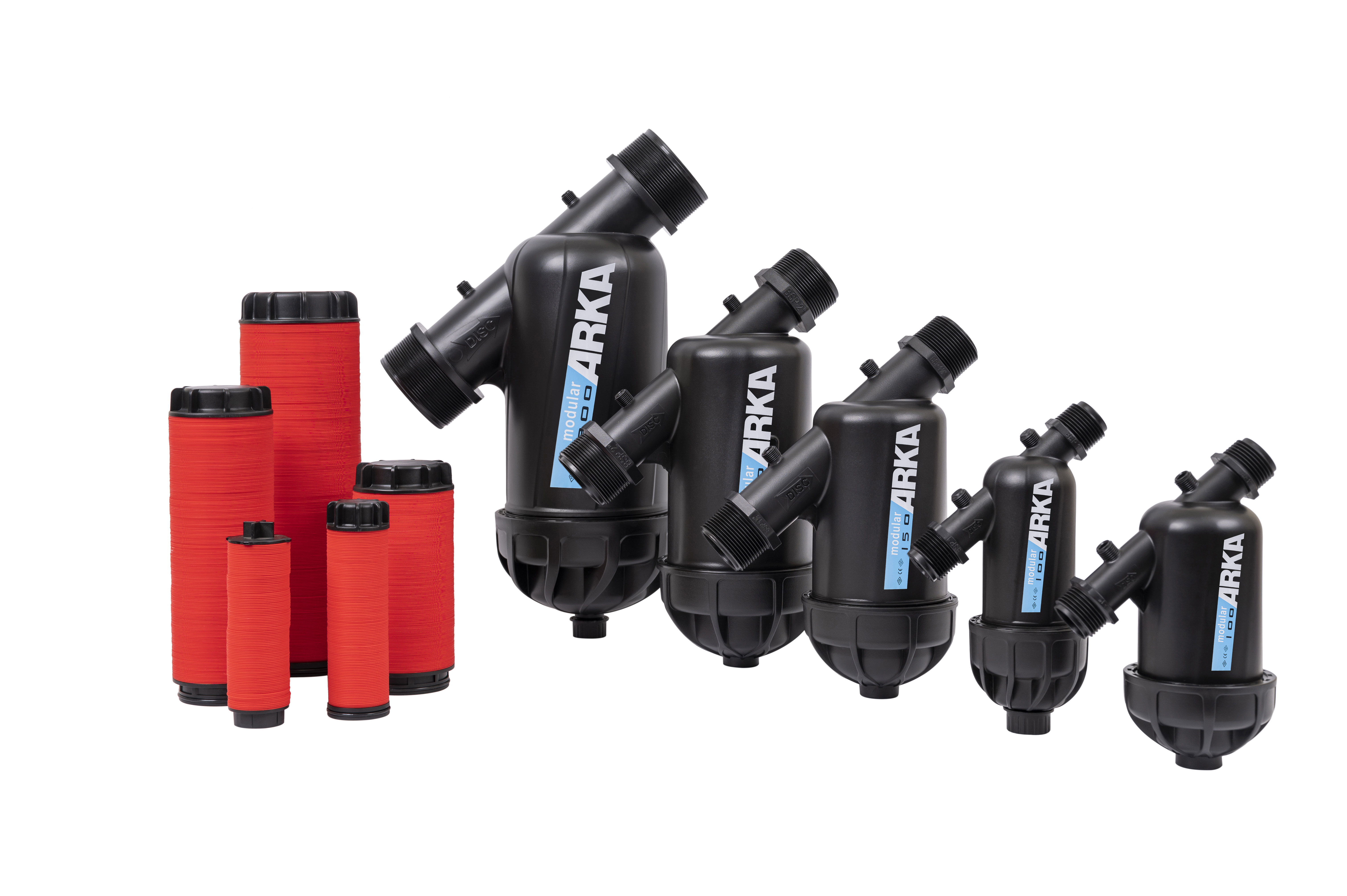
The true efficiency of this filtration method lies in the physical design of the discs themselves. The Groove Stack serves as the heart of the system, transforming simple plastic rings into a highly precise separation matrix.
Each individual disc is manufactured with diagonal grooves cut into both sides. Engineers design these cuts at specific angles, widths, and depths. Ultimately, the geometry of these grooves dictates the micron rating, defining the exact size of the smallest particle it can reliably trap.
To simplify maintenance in the field, manufacturers universally color-code these discs. This allows operators to easily identify the filtration grade without needing microscopic measurement tools. Blue typically represents 400 microns for coarse pre-filtration, yellow denotes 200 microns for medium sand, red signifies 130 microns for standard irrigation, and green is used for 20 to 50 microns, targeting fine silt and industrial process water.
When the system enters filtration mode, a hydraulic mechanism or heavy spring compresses the stacked discs tightly together. Because the grooves on the top of one disc intersect with the grooves on the bottom of the adjacent disc at opposing angles, they create a highly complex, tortuous path.
Water cannot simply flow straight through. Instead, it is forced to change direction multiple times as it moves from the outside of the stack toward the hollow center. This intense compression creates thousands of microscopic intersections. As the pathways become progressively narrower toward the center, fine particles become wedged in these intersections, guaranteeing exceptional water clarity.
To evaluate water treatment solutions objectively, engineers rely on specific fluid dynamic classifications. The primary reason these synthetic ring systems perform so well in high-turbidity environments is their utilization of advanced physical separation techniques.
Specifically, Depth Filtration refers to a process where particles are captured not just on the surface of the medium, but throughout its entire thickness. In a compressed ring stack, the "depth" is the physical distance from the outer edge of the plastic ring to the inner edge. As dirty water travels through this depth, particles are trapped at various levels based on their size.
From an industry perspective, escalating global water scarcity is forcing agricultural and industrial operators to utilize lower-quality, highly turbid surface waters. Market trends show a distinct shift away from bulky sand media filters and basic screens toward compact, automated systems. This transition is driven by the need to handle massive organic loads without consuming excessive amounts of backwash water, a critical metric in modern sustainability mandates.
Academic research and industrial field tests consistently demonstrate that utilizing the entire volume of the ring stack allows the filter to hold a massive amount of suspended solids before flow is restricted. Furthermore, the multi-layered path prevents soft, amorphous particles like biological floc from extruding through to the clean water side under high pressure.
Understanding the journey of a single drop of dirty water through the housing clarifies why this technology is highly valued in modern infrastructure.
Dirty water enters the outer housing under high pressure. Many high-efficiency models feature a specialized directional baffle or helix at the inlet. This component forces the incoming water into a rapid spinning motion. Acting as a preliminary separator, this centrifugal action throws heavier, inorganic debris like coarse sand outward against the walls of the housing and down into a collection bowl. By keeping heavy gravel away from the discs, the system significantly reduces the immediate particulate load on the internal matrix.
Once the heavier particles drop out of suspension, the water is forced radially through the compressed discs. It moves from the high-pressure outer zone to the lower-pressure inner core. As the fluid navigates the intersecting grooves, the actual Sediment Capture occurs. Particles larger than the micron rating of the specific color-coded disc physically wedge into the matrix. The tortuous path ensures that even if a tiny speck of clay slips past the first intersection, it will inevitably be caught by the second, third, or fourth layer.
After successfully passing through the entire depth of the compressed rings, the purified water reaches the hollow central spine. From here, it flows upward or downward, depending on the orientation of the manifold, and exits the system. At this stage, the water is free of fine sediment and safe to enter delicate downstream applications, such as micro-irrigation emitters or sensitive heat exchangers.
One of the most significant operational challenges in any fluid management network is maintaining continuous flow while managing accumulated debris. Traditional setups often require manual intervention, but modern automated units utilize a sophisticated purging sequence.
The automated cleaning process relies on continuous monitoring of the system's hydraulic conditions. As particles accumulate within the microscopic pathways, the resistance to water flow increases. This resistance creates a measurable pressure drop between the inlet and the outlet.
A specialized sensor, known as a pressure differential (DP) switch, constantly monitors this variance. When the pressure differential reaches a predetermined threshold, usually between 0.5 and 0.7 bar, the controller initiates the cleaning cycle. Operators can also program the controller to trigger a flush based on a set time interval, ensuring the system remains functional even if pressure variations fluctuate.
Once the cycle triggers, the mechanical configuration undergoes a rapid transformation. To clean the internal surfaces, the compression holding the rigid cylinder must be removed. A three-way hydraulic valve shifts its position, reversing the flow and releasing the pressure applied to the tensioning cylinder. The central spring decompresses, allowing the individual rings to separate slightly. This breaks the rigid matrix and exposes the trapped particulate matter.
With the discs loosened, high-pressure clean water is forced in the opposite direction—from the central spine outward. The spine is equipped with nozzles that direct the water at specific tangential angles. As high-velocity jets strike the plastic rings, they cause the entire stack to spin. This centrifugal action, combined with the outward flow, creates a violent, scrubbing effect. This Backwash Release physically dislodges and ejects the trapped organic and inorganic matter. This energetic process typically lasts only 10 to 20 seconds, ensuring minimal disruption to the overall fluid network.
Selecting the appropriate filtration equipment is not a one-size-fits-all process. Empirical data regarding your water source must dictate the engineering choices for your system. Factors such as particle size, organic load, and overall volume play a critical role.
Before specifying a system, operators must evaluate the Total Suspended Solids (TSS) and turbidity of the source water. If a water source, such as a turbulent river or industrial effluent, exhibits high TSS, a standard manual filter will clog almost immediately. In these scenarios, engineering guidelines recommend designing a multi-pod, automated system. By increasing the total filtration surface area, the velocity of water passing through the system decreases, allowing it to handle higher solid loads without constant flushing.
The objective of this technology is precise physical separation. The geometry of the discs must be matched to the size of the contaminants. For instance, well water typically contains hard, inorganic particles like sand, which are easy to trap with a 130-micron red disc. Conversely, surface water from reservoirs often contains soft organic matter like algae. Because algae can deform and squeeze through basic screens, the tortuous path of a 100-micron or 50-micron setup is required to capture these biological contaminants effectively.
The integration of this technology provides measurable improvements in system reliability and resource conservation. By providing a robust physical barrier, these systems protect sensitive infrastructure globally.
Modern agriculture relies on drip irrigation to deliver moisture directly to the root zone. However, the emitters feature microscopic flow paths, often measuring less than a millimeter. If fine silt or biological growth enters the lines, these emitters clog. A clogged emitter means a dead plant and yield losses. Installing a disc-based system acts as an insurance policy for farmers, trapping both the abrasive sand that wears down orifices and the sticky algae that binds them shut.
Beyond agriculture, industrial and municipal facilities rely on precise physical separation. In industrial settings, cooling towers continuously scrub airborne dust. If this debris is not filtered, it leads to scale buildup and accelerated corrosion of heat exchangers. Furthermore, in tertiary wastewater treatment, water must often be purified for environmental discharge using delicate reverse osmosis membranes. Implementing a disc-based pre-filtration stage removes the bulk of fine sediment, reducing the chemical cleaning frequency for these expensive membranes.
While the design of these systems is robust, adhering to proper maintenance protocols is essential for preserving efficiency and ensuring a financial return. Proactive maintenance significantly reduces long-term operational costs.
For systems operating without automation, manual intervention is required when the pressure differential indicates a clogged state. Operators must isolate the filter pod, depressurize the housing, and remove the internal spine. After loosening the compression mechanism, the rings can be thoroughly rinsed with a high-pressure hose. In areas with hard water, calcium carbonate scale can calcify on the rings. Soaking the dismantled discs in a mild acidic solution dissolves the mineral buildup, while a diluted bleach solution effectively oxidizes stubborn bacterial slime.
When evaluating financial viability, stakeholders must weigh the initial capital expenditure against ongoing operational costs. Automated, self-cleaning systems require a higher upfront investment compared to manual versions. However, the ROI is typically realized within the first few years. They reduce the labor hours required for manual cleaning, eliminate the costs of disposable filter cartridges, and prevent catastrophic downtime. By preventing production halts, self-cleaning mechanisms offer a sustainable and economically sound approach to fluid management.
The unique architecture of the grooved rings creates a highly effective depth filtration matrix. This three-dimensional pathway leads to unparalleled particle capture, handling organic and inorganic loads that would easily overwhelm traditional screens. Whether utilized in agricultural drip lines or industrial wastewater plants, a properly sized system provides a reliable, self-sustaining barrier against microscopic debris. To protect your infrastructure and reduce overhead, assess your current water quality and consult with a filtration expert to select the precise specifications needed for your environment.
Screen filters utilize a two-dimensional mesh that captures debris primarily on its surface, making them suitable only for large, hard particles. In contrast, disc filters employ a three-dimensional matrix of compressed, grooved rings. This structural difference allows water to travel through a deeper, winding path, making them significantly more effective at capturing soft organic matter and holding a larger volume of fine sediment before needing cleaning.
Filtration precision is determined by the size and angle of the grooves etched into the synthetic rings. Standard systems offer micron ratings ranging from 400 microns down to 20 microns. A 20-micron rating is fine enough to capture very fine silt, suspended organic matter, and most types of biological floc, providing purified water for sensitive equipment.
The frequency is dependent on the quality of the source water and the volume of suspended solids present. In clean well water, a system may only purge once a day, while highly turbid surface water may trigger a cycle every few hours based on the pressure differential. Regardless of frequency, the actual cleaning process is highly efficient, lasting only 10 to 20 seconds per pod without shutting down the main system flow.
No. These systems are designed strictly for the physical separation of suspended solids and particulate matter. They cannot alter the chemical composition of the water. To remove dissolved minerals, heavy metals, or salts, operators must employ advanced chemical treatments or membrane-based technologies, such as Reverse Osmosis or nanofiltration.
Yes, a slight pressure drop is a normal and necessary characteristic of any effective filtration system. As water is forced through the microscopic grooves, natural hydraulic resistance occurs. Monitoring this specific pressure drop, known as the pressure differential, is exactly how automated systems determine when the matrix is full of debris and requires a cleaning cycle.


